

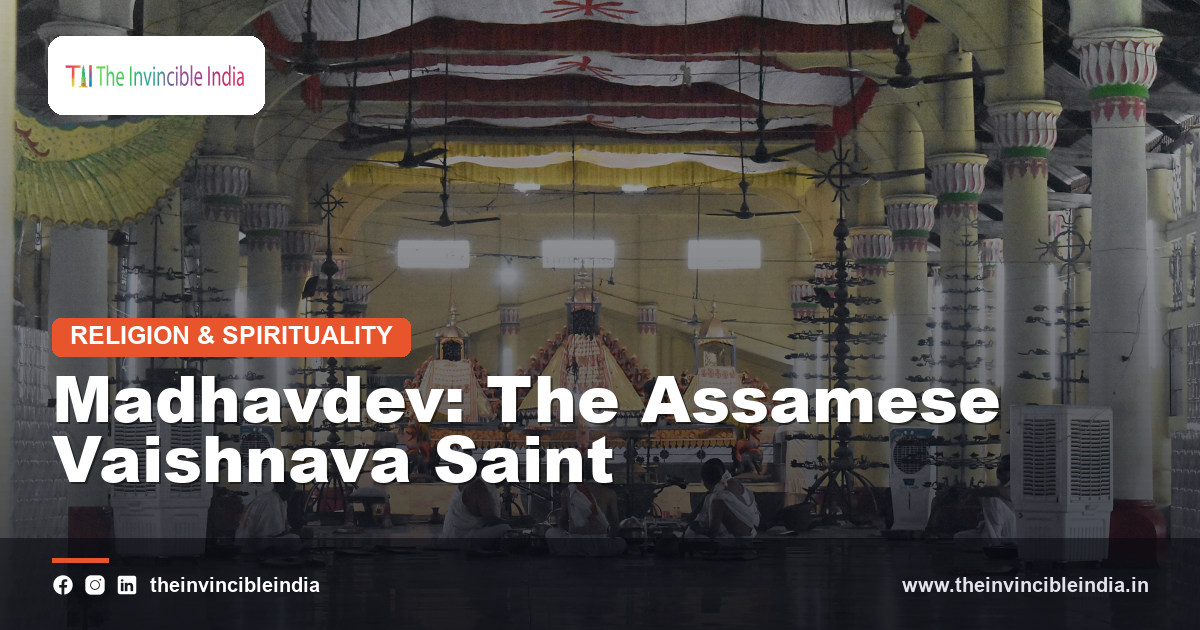
Madhavdev, also spelled Madhabdev, was a sixteenth-century Assamese Vaishnava saint, the foremost disciple and chosen successor of Srimanta Sankardev in the devotional movement known as the Ekasarana Dharma, the Assamese neo-Vaishnavism that teaches surrender to the one God. He is honoured as a poet of deep devotion and as the composer of the Naam Ghosa and the Bhakti Ratnavali, cherished scriptures of the tradition, and his memory is closely bound to the Barpeta Satra, a great monastic centre of the faith. His life and work belong to the wider world of the Bhakti movement, the great tide of devotion that swept across India, and though some details of his life come through tradition, his standing as the chief disciple and heir of Sankardev is firmly held.
Quick answer: Madhavdev, also spelled Madhabdev, was a sixteenth-century Assamese Vaishnava saint, the foremost disciple and successor of Srimanta Sankardev in the Ekasarana Dharma, the Assamese neo-Vaishnava tradition of devotion to one God. He is honoured above all as the composer of the Naam Ghosa and the Bhakti Ratnavali, and his memory is closely associated with the Barpeta Satra in Assam. He carried forward and consolidated the devotional movement that Sankardev had founded.
Key Takeaways
- Madhavdev was a sixteenth-century Assamese Vaishnava saint, the foremost disciple of Srimanta Sankardev.
- His name is also spelled Madhabdev.
- He was the chosen successor of Sankardev in the Ekasarana Dharma, the Assamese neo-Vaishnava tradition.
- He composed the Naam Ghosa and the Bhakti Ratnavali, cherished scriptures of the tradition.
- His memory is closely associated with the Barpeta Satra, a great monastic centre in Assam.
- He taught devotion to one God, Krishna as a form of Vishnu, through the chanting of the divine name.
The sections below explain his life as told by tradition, his bond with Sankardev, the Ekasarana Dharma, his works, his link with the Barpeta Satra and his continuing place in Assamese devotion.
Quick Facts
| Detail | Information |
|---|---|
| Also spelled | Madhabdev |
| Tradition | Ekasarana Dharma, Assamese neo-Vaishnavism |
| Era | Sixteenth century, traditionally dated |
| Region | Assam, in the Brahmaputra valley |
| Language of works | Assamese (and Brajavali) |
| Principal works | Naam Ghosa and Bhakti Ratnavali |
| Deity | Krishna, a form of Vishnu |
| Principal centre | Barpeta Satra, Assam |
| Standing | Foremost disciple and successor of Sankardev |
Who Was Madhavdev?
Madhavdev was an Assamese Vaishnava saint of the sixteenth century who is honoured as the foremost disciple and chosen successor of Srimanta Sankardev, the founder of the Ekasarana Dharma, the Assamese neo-Vaishnava movement of devotion. He is remembered as a poet and teacher of deep devotion whose life was given to the service of God and of his master.
Also spelled Madhabdev, he is cherished above all as the composer of the Naam Ghosa, a collection of devotional verses that holds a central place in the worship of the tradition. Tradition pictures him as a saint of great learning, humility and devotion, wholly devoted to Sankardev and to the one God. Although some episodes of his life come through devotional tradition rather than documented record, his standing as the chief disciple and heir of Sankardev, and his gift of enduring scripture, are firmly remembered.
What Does the Name Madhabdev Mean and How Is It Spelled?
The saint is known as Madhavdev, a name also commonly spelled Madhabdev, and keeping both spellings in mind helps readers recognise the same figure across different texts and traditions. The variation reflects the sounds of the Assamese language in which his memory is cherished.
The suffix dev, meaning a revered or divine one, is an honorific attached to the names of saints and teachers in the tradition, as it is also in the name of his master Sankardev. The name expresses the reverence in which the disciple is held within the Ekasarana Dharma. In the hymnody and tradition of Assamese Vaishnavism he appears under this honoured name, and recognising its forms helps a reader follow his story and understand his place as the foremost disciple and successor of the founder of the movement.
When and Where Did Madhavdev Live?
Madhavdev is traditionally dated to the sixteenth century, and because some of the sources are devotional it is wise to describe his era in general terms while holding to the broadly accepted period. He lived in Assam, in the valley of the great Brahmaputra river in the north-east of India.
His life unfolded in the land of Assam, where the devotional movement of Sankardev was taking shape, and his memory is bound to several places of the region, above all the Barpeta Satra. This part of the Brahmaputra valley became the heartland of the Ekasarana Dharma. Because parts of his biography are handed down through tradition, careful writers describe his region and general period with confidence while leaving finer details open, in keeping with the respectful caution that the devotional sources invite.
How Did Madhavdev Become the Disciple of Sankardev?
Madhavdev became the foremost disciple of Sankardev, as tradition relates, after an encounter that turned him from other forms of worship to the path of devotion to one God that his master taught. This meeting is cherished in the tradition as the turning point of his life.
The devotional accounts tell that Madhavdev, once devoted to the worship of the Goddess, was led through dialogue and the grace of his master to embrace the Ekasarana path of surrender to the one God, Krishna as a form of Vishnu. From that turning he became the closest and most devoted of Sankardev’s disciples. The story of this meeting is treasured by the tradition as an image of the power of the master to awaken devotion, and it is understood as a devotional account that conveys the depth of the bond between the two saints.
What Is the Ekasarana Dharma?
The Ekasarana Dharma is the Assamese neo-Vaishnava tradition founded by Sankardev, whose name means the religion of surrender to one refuge, teaching devotion to a single God, Krishna understood as a form of Vishnu, through the chanting of the divine name. Madhavdev carried this tradition forward as the successor of its founder.
The movement set aside elaborate ritual in favour of a simple and heartfelt devotion open to all, centred on the hearing and chanting of the name and the deeds of God. It gave Assam a rich religious and cultural life, expressed through song, scripture, drama and the communal prayer hall. Madhavdev deepened and consolidated this tradition through his own devotion and his composition of its central scriptures. Understanding the Ekasarana Dharma helps a reader see why Madhavdev is so deeply honoured as its great disciple and heir.
What Is the Naam Ghosa?
The Naam Ghosa is the most celebrated work of Madhavdev, a collection of devotional verses in Assamese in praise of God and in exaltation of the chanting of the divine name, which holds a central place in the worship of the Ekasarana tradition. Its name may be understood as the proclamation of the name of God.
The work gathers hundreds of verses that express devotion, praise the greatness and grace of God, and teach the path of surrender and the chanting of the name. It is recited and sung in the prayer halls of the tradition and is cherished as sacred scripture. Through the Naam Ghosa, Madhavdev gave the devotion of the Ekasarana Dharma a lasting voice, and the work remains at the heart of the religious life of Assamese Vaishnavism, loved by devotees as one of their holiest texts.
What Is the Bhakti Ratnavali?
The Bhakti Ratnavali is another important work associated with Madhavdev, a composition in the Assamese tradition concerned with devotion, whose title may be understood as a necklace of gems of devotion. It stands among the cherished writings through which the saint expressed and taught the path of bhakti.
The work is remembered for conveying the teachings of devotion that lie at the heart of the Ekasarana Dharma, gathering and presenting the essence of the devotional life for the followers of the tradition. It reflects Madhavdev’s concern to hand on the devotion and learning he had received in a form that could guide and inspire. Because the work belongs to the living tradition and is studied within it, careful accounts describe it in general terms of its devotional purpose, and it is counted among the treasured compositions of the saint.
What Other Works Did Madhavdev Compose?
Besides the Naam Ghosa and the Bhakti Ratnavali, Madhavdev is remembered as the author of a rich body of devotional songs, poems and dramatic compositions that enriched the religious and cultural life of the Ekasarana tradition. His writings form a treasured part of the Assamese literary and devotional heritage.
Tradition honours him for devotional songs known in the tradition as borgeet, for short devotional plays, and for other poems that express the devotion and teachings of the movement. These compositions were made to be sung, recited and performed in worship, so that devotion might be shared and remembered. Because these works belong to the living tradition and are studied within it, careful writers describe them in general terms rather than claiming detailed knowledge of every text. Together they reflect his standing as a poet and teacher of great gifts.
How Did Madhavdev Succeed Sankardev?
Madhavdev succeeded Sankardev as the leader of the Ekasarana Dharma after his master’s lifetime, carrying forward and consolidating the devotional movement that Sankardev had founded. Tradition remembers this succession as the fulfilment of the deep bond and trust between the two saints.
As the chosen successor, Madhavdev took up the guidance of the community of devotees, the composition of scripture and song, and the strengthening of the institutions of the faith. He is remembered for his faithfulness in preserving and spreading the teaching he had received, so that the movement endured and grew after its founder. His leadership gave the tradition stability and continuity at a crucial time. The succession of Madhavdev to Sankardev is cherished in the tradition as a model of the devoted disciple who becomes a worthy heir, carrying the master’s work into the future.
How Is Madhavdev Linked to the Barpeta Satra?
Madhavdev is linked above all to the Barpeta Satra, a great monastic and devotional centre in Assam with which his memory is most closely bound. The satra is remembered as a place he established or greatly developed, and it became a leading seat of the Ekasarana tradition.
A satra is a monastery and centre of worship, teaching and culture in Assamese Vaishnavism, gathered around a prayer hall and a community of devotees. The Barpeta Satra grew into one of the most important of these centres, carrying forward the devotion, song and learning of the tradition. The association of Madhavdev with Barpeta gives his memory a firm and sacred setting. For devotees the link keeps alive the story of the great disciple and the devotional life of the satra that he is remembered for founding or shaping.
What Is a Satra in the Assamese Tradition?
A satra is a monastery and devotional institution of the Ekasarana Dharma, a centre of worship, teaching, music, drama and community life that forms the backbone of Assamese Vaishnavism. Madhavdev is remembered as a great builder and guide of these institutions.
At the heart of each satra stands the namghar, the prayer hall where devotees gather to hear and chant the name and deeds of God. Around it the satra preserves the scriptures, songs and arts of the tradition and gathers a community of devotees and monks. The satras spread the devotion of the Ekasarana movement across Assam and became custodians of its rich culture. Madhavdev’s work in establishing and strengthening satras, above all at Barpeta, helped to give the tradition its lasting form, and the satra remains a living expression of the faith he served.
How Did Madhavdev Shape Assamese Culture?
Madhavdev helped to shape the religious and cultural life of Assam through his devotional poetry, song and drama, which enriched the worship of the Ekasarana tradition and became treasures of the Assamese heritage. His gifts reached beyond religion into the wider culture of the region.
The devotional songs, plays and verses of the tradition, to which Madhavdev contributed greatly, were performed in the prayer halls and gatherings of the community, uniting worship with music, poetry and performance. Through these the devotion of the movement was carried to the people in forms they could share and love. The satras became custodians of this culture, preserving its songs, dances and dramas. Madhavdev’s contribution to this flowering of devotional art is one of the reasons his memory is cherished not only as a saint but as a shaper of Assamese cultural life.
Why Is Madhavdev So Deeply Honoured?
Madhavdev is deeply honoured in the Ekasarana tradition as the foremost disciple and successor of Sankardev and as the composer of the Naam Ghosa, which lies at the heart of the worship of Assamese Vaishnavism. His memory is cherished with reverence and gratitude by the whole community of the faith.
Devotees honour him for his devotion, his faithfulness to his master, his gift of enduring scripture and his leadership of the movement after its founder. His name is invoked alongside that of Sankardev in the remembrance of the great teachers of the tradition. His works are recited and sung in the prayer halls, keeping his devotion present in daily worship. The honour given to Madhavdev reflects the tradition’s sense of debt to the great disciple who preserved, deepened and carried forward the faith that Sankardev had founded.
How Is Madhavdev Remembered in Tradition and Art?
Madhavdev is remembered in Assamese Vaishnava tradition and art as a revered saint, a poet and teacher of devotion honoured beside his master Sankardev. His memory is cherished in the satras and in the devotional life of the community wherever his songs and verses are sung.
The tradition honours him through the recitation of his works, through the remembrance of his life and through the devotional culture of the satras he helped to shape. The art and song of the tradition express his character as a singer of the praise of God rather than any worldly rank. Representations and remembrances of Madhavdev help devotees recall the great disciple as a living model of devotion and surrender. The care given to his memory keeps his contribution present in the worship and culture of Assamese Vaishnavism.
Why Does Madhavdev Still Matter Today?
Madhavdev still matters today because the Naam Ghosa he composed remains central to the worship of the Ekasarana tradition, and because he stands as the great disciple and heir who carried the devotional movement of Sankardev into the future. His legacy lives in the daily prayer of the satras and in the culture of Assam.
For devotees he is a beloved saint, the composer of their holiest hymns and the faithful successor of their founder. Scholars value his role in consolidating and spreading the Ekasarana Dharma and in enriching Assamese literature and devotional art. Careful readers honour the context of his tradition and treat the devotional accounts of his life as belief, while recognising his enduring importance as the saint whose works and leadership gave Assamese Vaishnavism much of its lasting form.
Madhavdev Today
Madhavdev today is remembered as the foremost disciple and successor of Sankardev, the composer of the Naam Ghosa and the Bhakti Ratnavali, and a saint whose memory is bound to the Barpeta Satra and the satras of Assam. His works and devotion remain a living presence in Assamese Vaishnavism.
Through his scriptures and songs he gave the Ekasarana Dharma a lasting voice, and through his leadership he carried the tradition forward after its founder. Some details of his life come through tradition, yet the living recitation of the Naam Ghosa in the prayer halls gives a clear and constant witness to his work. His legacy endures as a reminder that a devoted disciple may become a worthy heir, preserving and deepening the faith he received and handing it on to the generations that follow.
Sources & Further Reading
- Ministry of Culture, Government of India (indiaculture.gov.in).
- Sahitya Akademi general references on Assamese devotional literature.
Frequently Asked Questions
Who was Madhavdev?
Madhavdev, also spelled Madhabdev, was a sixteenth-century Assamese Vaishnava saint, the foremost disciple and successor of Srimanta Sankardev in the Ekasarana Dharma. He is honoured above all as the composer of the Naam Ghosa and the Bhakti Ratnavali, and his memory is bound to the Barpeta Satra in Assam.
What is the Naam Ghosa?
The Naam Ghosa is the most celebrated work of Madhavdev, a collection of Assamese devotional verses in praise of God and the chanting of the divine name. It holds a central place in the worship of the Ekasarana tradition and is recited and sung in the prayer halls of Assamese Vaishnavism.
What is the Ekasarana Dharma?
The Ekasarana Dharma is the Assamese neo-Vaishnava tradition founded by Sankardev, teaching devotion to one God, Krishna as a form of Vishnu, through the chanting of the divine name. Madhavdev carried this tradition forward as the chosen successor of its founder.
How was Madhavdev related to Sankardev?
Madhavdev was the foremost disciple and chosen successor of Sankardev, the founder of the Ekasarana Dharma. Tradition relates that he was turned from other forms of worship to the path of devotion to one God through an encounter with his master, becoming his closest follower and heir.
Where is Madhavdev associated?
Madhavdev is associated above all with the Barpeta Satra in Assam, a great monastic centre of the Ekasarana tradition that he is remembered for founding or greatly developing. His life unfolded in the valley of the Brahmaputra river, the heartland of Assamese Vaishnavism.
What is a satra?
A satra is a monastery and devotional centre of the Ekasarana Dharma, gathered around a prayer hall and a community of devotees, where the worship, song, drama and learning of the tradition are preserved. Madhavdev is remembered as a great builder and guide of these institutions.


