

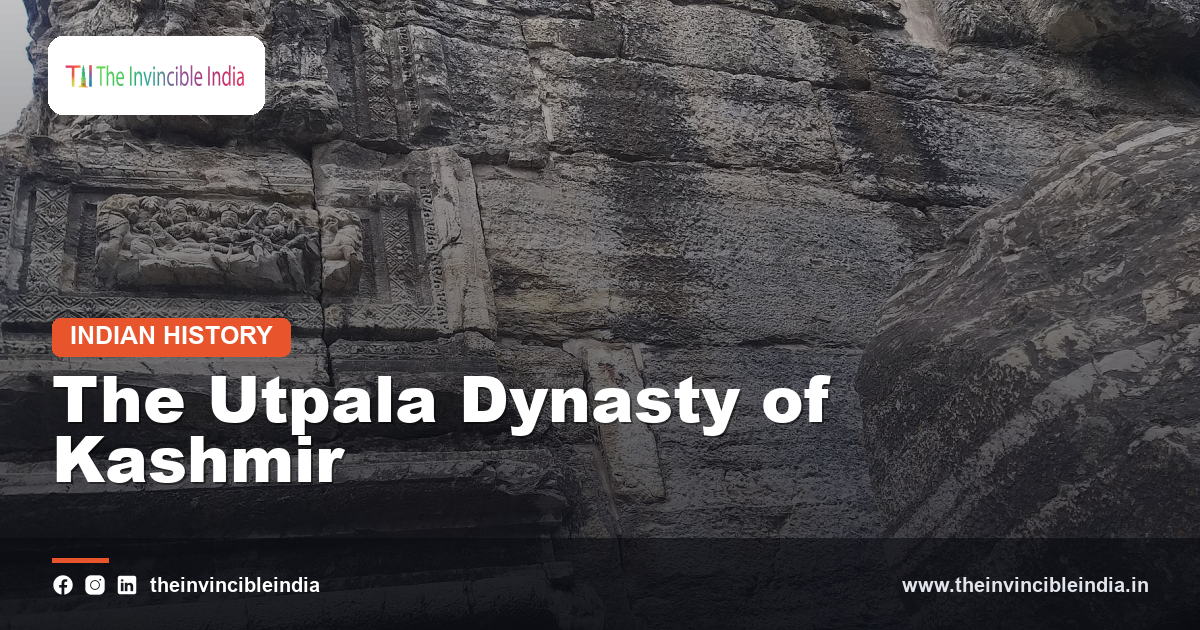
The Utpala dynasty, also called the Utpalas of Kashmir, was a line of rulers who governed the Kashmir Valley during the early medieval period, generally dated to roughly the ninth and tenth centuries, following the decline of the earlier Karkota dynasty. Founded by Avantivarman, the dynasty is remembered for a remarkable age of peace and prosperity, for the great works of flood control and irrigation on the river Vitasta, or Jhelum, carried out by the celebrated engineer Suyya, and for the temples built at the new capital of Avantipura. Later rulers such as Shankaravarman continued the line before its eventual decline. As with the Karkotas before them, almost everything known of the Utpalas comes from Kalhana’s Sanskrit chronicle, the Rajatarangini. Their achievements belong to the long history of the northern subcontinent, in the same broad medieval world as the dynasties treated in our guide to the Rajputs, and this account keeps to general terms where particular details are uncertain.
Quick answer: The Utpala dynasty was a line of rulers who governed the Kashmir Valley during the early medieval period, generally dated to roughly the ninth and tenth centuries, after the Karkotas. Founded by Avantivarman, it is remembered for a prosperous age, for the great flood-control and irrigation works carried out on the river Jhelum by the engineer Suyya, and for the temples at the new capital of Avantipura. Later rulers included Shankaravarman, and almost all that is known of the dynasty comes from Kalhana’s chronicle, the Rajatarangini.
Key Takeaways
- The Utpalas were an early-medieval dynasty of Kashmir, generally dated to roughly the ninth and tenth centuries.
- The dynasty followed the Karkotas and was founded by Avantivarman.
- Avantivarman’s reign is remembered as an age of peace, prosperity and cultural patronage.
- The engineer Suyya carried out major flood-control and irrigation works on the river Vitasta, or Jhelum.
- Avantivarman founded the capital of Avantipura, where the Avantiswami and Avantishvara temples were built.
- Most of what is known of the Utpalas comes from Kalhana’s chronicle, the Rajatarangini.
Read on for the history, culture, and legacy in detail.
Quick Facts
| Detail | Information |
|---|---|
| Dynasty | Utpala dynasty (Utpalas of Kashmir) |
| Period | Roughly ninth to tenth centuries, dates debated |
| Region | Kashmir Valley and adjoining regions of the north |
| Capital | Avantipura, founded by Avantivarman |
| Founder | Avantivarman |
| Notable Figure | Suyya, the engineer of the Jhelum works |
| Later Ruler | Shankaravarman |
| Patronage | Temple building; irrigation and public works |
| Chief Source | Kalhana’s Rajatarangini (twelfth century) |
Who Were the Utpalas?
The Utpalas were an early-medieval dynasty that ruled the Kashmir Valley, generally dated to roughly the ninth and tenth centuries, rising to power after the decline of the earlier Karkota dynasty. They are remembered above all for an age of peace, prosperity and able governance, associated especially with their founder Avantivarman. Under the Utpalas, Kashmir enjoyed a period of recovery and flourishing, marked by notable works of public benefit and by the building of temples and cities. The dynasty took its name, Utpala, from the family of its founder, and its history is preserved in the Rajatarangini, the great chronicle of Kashmir’s kings. The Utpalas presided over a distinctive chapter in the valley’s history, remembered for achievements in irrigation, architecture and culture rather than for conquest alone. As the dynasty that followed the Karkotas, the Utpalas occupy an important place in the continuous historical record of early-medieval Kashmir.
Where Did the Utpala Dynasty Rule?
The Utpala dynasty ruled from the Kashmir Valley, the fertile and secluded land of mountains, lakes and rivers in the far north of the subcontinent that had long been the heart of the region’s kingdoms. The valley, watered by the river known as the Vitasta, or Jhelum, was a prosperous realm whose agriculture and culture supported a wealthy and well-ordered state. From this heartland the Utpalas governed Kashmir and its adjoining regions, maintaining the distinct identity and prosperity of the valley. The Utpala age is especially associated with the management of the valley’s waters, a matter of great importance in a land shaped by its rivers and prone to flooding. The valley’s natural defences and fertility gave the dynasty a secure and prosperous base. Within this homeland the Utpalas built their new capital and their temples. The Kashmir Valley was thus both the homeland and the centre of Utpala rule, as it had been for the dynasties before them.
Who Was Avantivarman?
Avantivarman was the founder of the Utpala dynasty and is remembered as one of the most admired rulers in the history of Kashmir, associated with an age of peace, prosperity and wise governance. According to the Rajatarangini, he restored order and stability to the valley after a troubled period and presided over a flourishing of agriculture, culture and building. He is especially remembered for his support of the great engineering works carried out by Suyya and for founding the capital city of Avantipura, which he adorned with notable temples. His reign is portrayed as a model of benevolent and effective rule. Avantivarman therefore holds the honoured place of founder and greatest ruler in the memory of the Utpalas. The details of his reign are drawn from Kalhana’s chronicle and are treated with scholarly care. Avantivarman stands as the central figure of the dynasty, embodying the achievements for which the Utpala age is remembered.
Who Was Suyya the Engineer?
Suyya was a celebrated engineer of the Utpala period, remembered in the Rajatarangini for carrying out major works of flood control and irrigation on the river Vitasta, or Jhelum, during the reign of Avantivarman. According to the chronicle, Suyya undertook the regulation of the river’s course and the drainage and reclamation of flooded lands, works that greatly improved the agriculture and prosperity of the valley. He is portrayed as a figure of remarkable skill and determination whose achievements transformed the productivity of Kashmir. The story of Suyya, including his humble origins and his rise to royal favour, is one of the most famous episodes in the Rajatarangini, blending history with tradition. Historians treat the colourful details cautiously while recognising the genuine importance of water management in the valley. Suyya remains one of the most renowned engineers of early India. His works stand among the most celebrated achievements of the Utpala age.
What Were the Irrigation Works on the Jhelum?
The irrigation and flood-control works on the river Vitasta, or Jhelum, carried out under Avantivarman by the engineer Suyya, are among the most celebrated achievements of the Utpala dynasty. According to the Rajatarangini, these works involved regulating the course of the river, clearing obstructions, and draining and reclaiming lands that had been subject to flooding, thereby greatly improving the agriculture of the valley. In a land whose prosperity depended on the management of its waters, such works were of immense practical value and brought lasting benefit to the people. The achievements of Suyya are remembered as a model of beneficial public works undertaken by a wise and well-governed state. The scale and detail of these projects are described in Kalhana’s chronicle and are treated by historians in general terms. These engineering works illustrate the practical wisdom of the Utpala age. They remain a cherished part of the dynasty’s reputation for prosperity and good governance.
What Was Avantipura?
Avantipura was the capital city founded by Avantivarman, named after himself, and it became the centre of Utpala power and one of the notable royal cities of early-medieval Kashmir. The king adorned his new capital with important temples, above all the shrines dedicated to Vishnu and Shiva known as the Avantiswami and Avantishvara temples. The ruins of these temples, with their carved stone and distinctive Kashmiri architecture, survive near the site and are among the most significant ancient monuments of the valley. Avantipura thus stands as a lasting symbol of Avantivarman’s reign and of the devotional and architectural energy of the Utpala age. The founding of a new capital adorned with temples followed the practice of early-medieval rulers who expressed their power and piety through grand building. The precise history of the city is reconstructed from tradition and archaeology and is treated with care. Avantipura remains the architectural emblem of the Utpala dynasty.
What Are the Avantipura Temples?
The Avantipura temples, the Avantiswami and Avantishvara, were built at the capital founded by Avantivarman and are among the most celebrated monuments associated with the Utpala dynasty. Dedicated respectively to Vishnu and Shiva, these temples were constructed in the distinctive stone architecture of early-medieval Kashmir, with carved detail, colonnaded courtyards and bold forms characteristic of the regional style. Even in ruin, their remains are admired for their craftsmanship and scale, reflecting the wealth and devotion of the Utpala age. The temples express the religious patronage of Avantivarman and the flourishing of temple building under his rule. Their weathered remains near the site of Avantipura are counted among the important ancient monuments of the valley. As with other temples of the period, their precise history is studied through tradition and archaeology. The Avantipura temples stand as enduring witnesses to the artistic and devotional achievements of the Utpala dynasty.
How Did the Utpalas Patronise Religion?
The Utpalas were active patrons of religion, supporting the Hindu traditions that flourished in Kashmir, especially the worship of Vishnu and Shiva, while the valley also remained an important centre of Buddhist and Shaiva learning. Avantivarman and his successors are associated with the building of temples, above all the great shrines at Avantipura, reflecting the devotional energy of the age. Kashmir in this period was a notable centre of religious and philosophical thought, including the Shaiva traditions for which the valley became famous. Royal patronage of temples and religious institutions reinforced the legitimacy and prestige of the dynasty and tied its rule to the sacred landscape. The temples and monuments of the Utpala age express this devotion in enduring stone. Through such patronage the Utpalas contributed to the rich religious and intellectual heritage of Kashmir. Their support for temple building remains one of the most visible legacies of the dynasty.
Who Was Shankaravarman?
Shankaravarman was a later ruler of the Utpala dynasty, remembered in the Rajatarangini as a king who followed in the line established by Avantivarman and who pursued his own ambitions and building projects. According to the chronicle, his reign was marked by military activity and by the founding of a city associated with his name, continuing the dynasty’s tradition of royal building. His period is also remembered for the pressures of administration and taxation that accompanied his ambitions, matters discussed in Kalhana’s account. As with other rulers of the age, the details of his reign are drawn from the Rajatarangini and are treated cautiously by historians. Shankaravarman represents the continuation of the Utpala line after its founder, through a period of changing fortunes. His reign illustrates both the achievements and the strains that marked the later history of the dynasty. Shankaravarman is thus a notable figure in the chronicle of the Utpalas.
What Was Utpala Art and Architecture Like?
Utpala art and architecture belonged to the distinctive tradition of early-medieval Kashmir, best seen in the stone temples built at Avantipura and other sites during the dynasty’s rule. The temples of the age, such as the Avantiswami and Avantishvara shrines, display the characteristic Kashmiri style, with massive stone construction, colonnaded courtyards, trefoil arches and finely carved decoration. The sculpture of the period, including images of deities, continued the refined artistic traditions of the valley. This art reflects the prosperity of Kashmir under the Utpalas and the religious devotion of its rulers, as well as the valley’s position at a crossroads of cultural exchange. Much of this heritage survives in the ruins of the temples and in images preserved in collections. The architectural achievements of the Utpala age form an important chapter in the artistic heritage of Kashmir. They stand as enduring evidence of the dynasty’s wealth, piety and cultural ambition.
How Was the Utpala Kingdom Governed?
The Utpala kingdom was governed from the Kashmir Valley through the authority of the king, supported by ministers, officials and administrators who managed the realm, its revenue and its public works. At the head stood the Utpala ruler, whose power rested on the fertile wealth of the valley and the stability brought by able governance. The administration is especially remembered for its concern with the management of the valley’s waters, as shown in the great irrigation works of Suyya, which improved agriculture and prosperity. Revenue drawn from the rich lands of the valley supported the dynasty’s building and religious patronage. As in other early-medieval states, officers and local authorities held responsibilities within the structure of government. The Utpala age is remembered as a period of generally sound and beneficial administration, especially under Avantivarman. This system of governance underpinned the prosperity and achievements for which the dynasty is celebrated in the Rajatarangini.
What Role Did the Rajatarangini Play?
The Rajatarangini, Kalhana’s twelfth-century Sanskrit chronicle of the kings of Kashmir, is the principal source for the history of the Utpala dynasty, as it is for the Karkotas before them. This remarkable work, rare among Indian texts for its sustained narrative of political history, preserves the deeds, achievements and traditions of the Utpala rulers, including the celebrated story of the engineer Suyya and the works of Avantivarman. For the Utpalas, the chronicle is the main window onto their age of prosperity and building. Because Kalhana wrote long after the events, drawing on earlier sources and traditions, historians read his account with care, separating firm history from legend and elaboration. The vivid episodes of the Utpala age, such as the rise of Suyya, show both the value and the complexity of the source. The Rajatarangini remains indispensable to the study of the Utpalas, shaping almost everything that is known of the dynasty.
How Did the Utpala Dynasty Decline?
The Utpala dynasty declined after the age of its greatest rulers, as later kings faced the internal troubles, factional struggles and administrative strains that commonly beset ruling houses over time. According to the traditions preserved in the Rajatarangini, the later Utpala period saw weaker rule and growing instability, which gradually eroded the strength and unity the dynasty had enjoyed under Avantivarman. As central authority weakened, the way was opened for new powers and ruling houses to rise in Kashmir. The precise course of the decline is drawn from Kalhana’s chronicle and is described cautiously by historians. Rather than a single dramatic fall, the end of the Utpalas appears as a gradual weakening following their age of prosperity. Their passing marked the close of another chapter in the long and continuous history of Kashmir’s dynasties. The decline of the Utpalas illustrates the familiar rhythms of rise and fall recorded in the Rajatarangini.
Why Are the Utpalas Significant?
The Utpalas are significant as the dynasty that followed the Karkotas and gave Kashmir an admired age of peace, prosperity and beneficial public works, remembered above all for the reign of Avantivarman and the engineering achievements of Suyya. Their management of the valley’s waters, their founding of the capital Avantipura, and their building of celebrated temples illustrate a reign devoted to the welfare and culture of the realm rather than to conquest alone. Their history, preserved in the Rajatarangini, adds to the rich narrative record of Kashmir’s kings. The Utpalas exemplify the ideals of wise governance and public benefit in early-medieval India. Their monuments, even in ruin, remain among the important ancient heritage of the valley. For students of Indian history, the Utpalas offer a vivid picture of a prosperous northern kingdom and its achievements. Their significance rests on this blend of good governance, engineering and cultural patronage.
The Utpala Dynasty Today
The Utpala dynasty is remembered today chiefly through the ruins of the temples at Avantipura and through the vivid narrative of the Rajatarangini, especially the celebrated story of the engineer Suyya and the reign of Avantivarman. The weathered remains of the Avantiswami and Avantishvara temples draw visitors, historians and admirers of ancient architecture, standing as enduring symbols of the dynasty’s devotion and prosperity. The memory of Suyya’s great works on the Jhelum remains a cherished part of the historical imagination of Kashmir, honoured as an example of beneficial public enterprise. Scholars continue to study the Rajatarangini and the archaeological remains to refine the understanding of the Utpala age. For readers of Indian history, the Utpalas offer a striking example of a wise and prosperous early-medieval kingdom of the far north. Their legacy endures in the stone temples of the valley and in the pages of Kalhana’s chronicle.
Sources & Further Reading
- Archaeological Survey of India (asi.nic.in).
- Ministry of Culture, Government of India (indiaculture.gov.in).
- Department of Tourism, Government of Jammu and Kashmir (jktourism.jk.gov.in).
Frequently Asked Questions
Who were the Utpalas of Kashmir?
The Utpalas were an early-medieval dynasty that ruled the Kashmir Valley, generally dated to roughly the ninth and tenth centuries, following the Karkotas. They are best remembered for the reign of Avantivarman, the irrigation works of the engineer Suyya, and the temples of Avantipura.
Who founded the Utpala dynasty?
The Utpala dynasty was founded by Avantivarman, remembered as one of the most admired rulers in the history of Kashmir for restoring order and presiding over an age of prosperity. He founded the capital of Avantipura and supported the great works of the engineer Suyya.
Who was Suyya?
Suyya was a celebrated engineer of the Utpala period who, according to the Rajatarangini, carried out major flood-control and irrigation works on the river Jhelum during the reign of Avantivarman. His works greatly improved the agriculture and prosperity of the valley.
What are the Avantipura temples?
The Avantipura temples, the Avantiswami and Avantishvara, were built at the capital founded by Avantivarman and are dedicated to Vishnu and Shiva. Their ruins, with distinctive Kashmiri stone architecture, are among the important ancient monuments of the valley.
How do we know about the Utpalas?
Almost all that is known of the Utpalas comes from Kalhana’s twelfth-century chronicle, the Rajatarangini, which narrates the kings of Kashmir. Because it was written long after the Utpala age, historians read its more colourful episodes with caution.
Who came before and after the Utpalas?
The Utpalas rose to power after the decline of the earlier Karkota dynasty of Kashmir, and their founder Avantivarman restored order to the valley. Later rulers such as Shankaravarman continued the line before the dynasty itself declined and gave way to new powers.


