

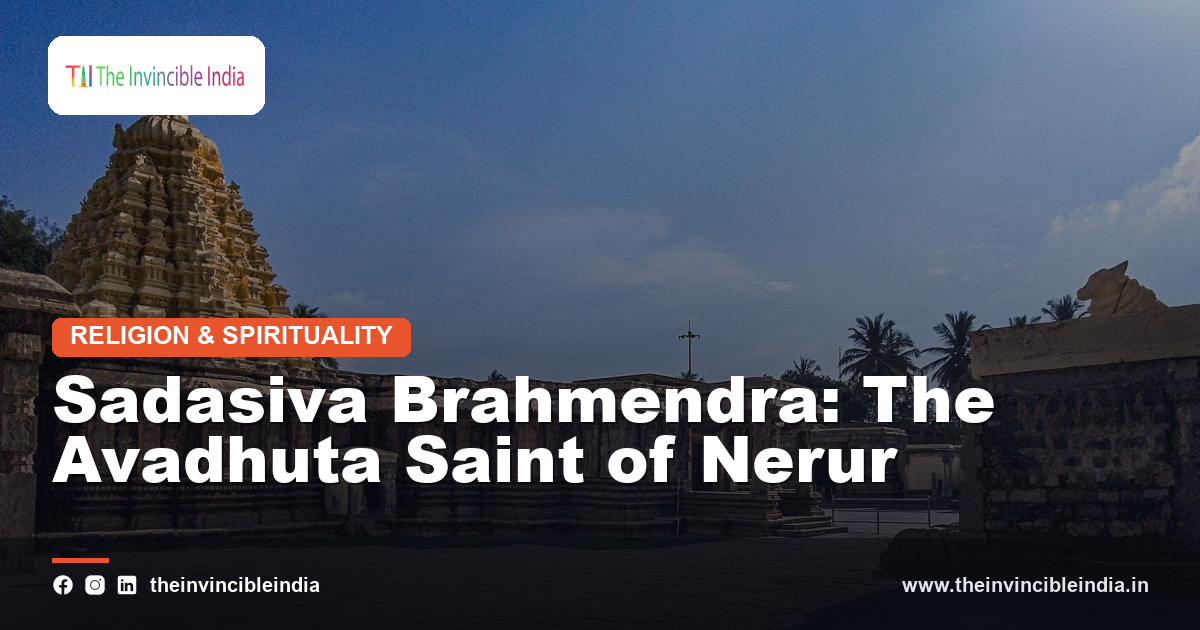
Sadasiva Brahmendra, also honoured as Sadasivendra, was an eighteenth-century Advaita sannyasi and avadhuta, a renunciant absorbed in the realisation of the one reality, and a renowned composer of Sanskrit kritis in the Carnatic music tradition, among them the beloved song often rendered as Manasa Sancharare. He is remembered as a saint of the non-dual path of Advaita Vedanta, linked with the teacher Paramasivendra Saraswati and the Kanchi tradition, and his samadhi, his place of final rest, is at Nerur near Karur in Tamil Nadu. His life and work belong to the wider world of Shaivism and the broader Hindu tradition of renunciation, and though his many miracle stories are cherished as devotional tradition, his standing as a great saint and composer is firmly held.
Quick answer: Sadasiva Brahmendra, also called Sadasivendra, was an eighteenth-century Advaita sannyasi and avadhuta, a renunciant absorbed in the non-dual reality, and a celebrated composer of Sanskrit kritis in the Carnatic tradition, such as Manasa Sancharare. Linked with Paramasivendra Saraswati and the Kanchi tradition, he is remembered as a saint who wandered in silence and absorption. His samadhi is at Nerur near Karur in Tamil Nadu, and his miracle stories are cherished as devotional tradition.
Key Takeaways
- Sadasiva Brahmendra was an eighteenth-century Advaita sannyasi and avadhuta.
- He is also honoured as Sadasivendra.
- He was a renowned composer of Sanskrit kritis in the Carnatic music tradition, such as Manasa Sancharare.
- He is linked with the teacher Paramasivendra Saraswati and the Kanchi tradition.
- His samadhi, his place of final rest, is at Nerur near Karur in Tamil Nadu.
- His many miracle stories are cherished in the tradition as devotional belief.
The sections below explain his life as told by tradition, the path of the avadhuta, his Advaita teaching, his Carnatic compositions, his samadhi at Nerur and his continuing place in devotion.
Quick Facts
| Detail | Information |
|---|---|
| Also known as | Sadasivendra |
| Tradition | Advaita Vedanta; avadhuta renunciant |
| Era | Eighteenth century, traditionally dated |
| Region | Tamil Nadu, the Kaveri country |
| Language of works | Sanskrit |
| Principal works | Carnatic kritis such as Manasa Sancharare |
| Linked teacher | Paramasivendra Saraswati; Kanchi tradition |
| Principal shrine | Samadhi at Nerur, near Karur |
| Standing | Celebrated saint-composer of the Advaita path |
Who Was Sadasiva Brahmendra?
Sadasiva Brahmendra was an eighteenth-century saint of the Advaita Vedanta tradition, a sannyasi and avadhuta who renounced the world wholly and lived absorbed in the realisation of the one reality, and who is also renowned as a composer of Sanskrit devotional songs in the Carnatic music tradition. He is remembered as a figure of rare spiritual absorption and artistic gift.
Also honoured as Sadasivendra, he is remembered as a wandering renunciant who kept silence and dwelt in deep meditation, and whose kritis, such as the beloved Manasa Sancharare, remain treasured in the Carnatic repertoire. Tradition surrounds his life with many stories of his detachment and of wonders attributed to him. Although these miracle stories are cherished as devotional tradition rather than documented history, his standing as a great saint of the non-dual path and a celebrated composer is firmly remembered.
What Does Avadhuta Mean?
An avadhuta is a renunciant who has cast off all attachments and conventions and lives wholly absorbed in the realisation of the one supreme reality, beyond the usual bounds of worldly conduct. Sadasiva Brahmendra is remembered as a great example of this rare and exalted state.
The word avadhuta suggests one who has shaken off the bonds of the world and the mind, living in freedom and absorption in the divine. Such a saint may appear indifferent to the ordinary concerns of life, dwelling in silence and meditation. In the Hindu tradition the avadhuta is honoured as one who has gone beyond the stages and rules that guide others, having realised the truth they point towards. Sadasiva Brahmendra is cherished as an avadhuta whose life embodied this supreme detachment, and the stories told of him express the tradition’s reverence for this state.
When and Where Did Sadasiva Brahmendra Live?
Sadasiva Brahmendra is traditionally dated to the eighteenth century, and because the sources are largely devotional it is wise to describe his era in general terms while holding to the broadly accepted period. He lived and wandered in the Tamil country, especially in the region watered by the Kaveri river.
His life is associated with the Kaveri country of Tamil Nadu and with the area around Karur, near which his samadhi lies at Nerur. As a wandering avadhuta he is remembered for moving through this region in silence and absorption rather than dwelling in one fixed place. This part of the Tamil land was a centre of learning, devotion and music. Because the accounts of his life come largely through tradition, careful writers describe his region and general period with confidence while leaving finer details open, in keeping with respectful caution.
What Is the Advaita Vedanta Tradition?
Advaita Vedanta is the non-dual tradition of Hindu philosophy which teaches that the ultimate reality is one, and that the true self of each being is not separate from that one supreme reality. Sadasiva Brahmendra was a saint of this tradition, and his life and songs express its spirit.
The word advaita means non-dual, pointing to the teaching that there is one reality, often named Brahman, beneath the appearance of the many. The tradition teaches a path of knowledge, renunciation and realisation by which the seeker comes to know the oneness of the self with the supreme. Sadasiva Brahmendra is remembered as one who had realised this truth and who lived and sang from that realisation. His compositions often call the restless mind to turn inward and rest in the one reality, giving voice to the heart of the Advaita teaching.
How Is Sadasiva Brahmendra Linked to Paramasivendra Saraswati?
Sadasiva Brahmendra is linked in tradition with Paramasivendra Saraswati, a teacher of the Advaita path, and through him with the Kanchi tradition, one of the honoured lineages of Advaita renunciants. This link places the saint within a recognised line of teaching and spiritual descent.
Tradition holds that Sadasiva Brahmendra received instruction in the Advaita path from Paramasivendra Saraswati, and his association with the Kanchi tradition reflects his place within the world of the non-dual renunciants of the south. Such links of teacher and disciple are cherished in the tradition as the means by which spiritual wisdom is handed down. The connection with Paramasivendra Saraswati and the Kanchi tradition roots the memory of Sadasiva Brahmendra in the established lineage of Advaita teaching, even as his own life as an avadhuta carried him beyond all ordinary bounds.
What Are the Carnatic Compositions of Sadasiva Brahmendra?
Sadasiva Brahmendra is celebrated as a composer of Sanskrit kritis, devotional songs of the Carnatic music tradition of southern India, which unite musical beauty with the teaching of the non-dual path. His compositions hold a treasured place in the Carnatic repertoire to this day.
His songs, composed in Sanskrit, express the themes of devotion, detachment and the realisation of the one reality, often calling the mind to turn from its restlessness towards the divine. Among the best known is the song often rendered as Manasa Sancharare, which addresses the mind and bids it dwell on the supreme. These kritis are sung by Carnatic musicians and loved by devotees for their blend of music and spiritual teaching. Through them the saint’s realisation reaches listeners in the form of song, and his name is kept alive in the living tradition of South Indian music.
What Is the Song Manasa Sancharare?
The song often rendered as Manasa Sancharare is among the best known of the Sanskrit kritis of Sadasiva Brahmendra, a composition that addresses the mind and calls it to dwell on the supreme reality. It is cherished in the Carnatic tradition both for its music and for its spiritual message.
The song, in keeping with the saint’s Advaita realisation, turns to the restless mind and bids it rest in the divine rather than wander among the fleeting things of the world. This theme of calming and directing the mind towards the one reality runs through many of his compositions. Sung by Carnatic musicians and loved by audiences, the song carries the saint’s teaching in a form of great beauty. It stands as an example of how Sadasiva Brahmendra united the art of music with the wisdom of the non-dual path.
Why Are the Miracle Stories of Sadasiva Brahmendra Told as Tradition?
The many miracle stories told of Sadasiva Brahmendra are cherished in the tradition as devotional belief, expressions of the reverence in which the saint is held, rather than as documented history. They should be understood in that spirit, as accounts that convey his holiness and the wonder he inspired.
Tradition tells of his extraordinary detachment, his absorption in meditation and of wonders said to have surrounded his wandering life. Such stories gather around great saints as a way of expressing the awe and love of devotees and the sense of a presence beyond the ordinary. Careful writers present these episodes explicitly as devotional tradition, honouring their meaning for the faithful while not treating them as historical record. In this way the wonder of the stories is respected, and the saint’s standing as an avadhuta of rare absorption is conveyed with proper caution.
Where Is the Samadhi of Sadasiva Brahmendra?
The samadhi of Sadasiva Brahmendra, his place of final rest and veneration, is at Nerur near Karur in Tamil Nadu, in the Kaveri country where he spent much of his wandering life. The samadhi is honoured as a sacred place by devotees of the saint.
In the tradition the samadhi of a great renunciant becomes a shrine where devotees gather to honour his memory and seek his blessing. The samadhi at Nerur is the chief centre of the veneration of Sadasiva Brahmendra, a place of pilgrimage for those who cherish his memory and his songs. Its location in the Tamil country links the saint firmly to this region. For devotees the samadhi keeps alive the presence of the avadhuta who wandered in silence and absorption, and it stands as the enduring focus of his remembrance.
What Is a Samadhi Shrine in the Tradition?
A samadhi shrine is the place of final rest of a great saint or renunciant, honoured in the Hindu tradition as a sacred site where the memory and blessing of the holy one are sought. The samadhi of Sadasiva Brahmendra at Nerur is such a shrine.
In the case of a realised renunciant, the body is traditionally interred rather than cremated, and the place becomes a shrine of veneration where devotees offer worship and remembrance. Such shrines often grow into centres of pilgrimage and devotion, keeping alive the presence of the saint for later generations. The samadhi at Nerur serves this purpose for the devotees of Sadasiva Brahmendra, drawing those who honour his life and sing his compositions. Understanding the place of the samadhi shrine helps a reader appreciate how the memory of the avadhuta is cherished and kept living in the tradition.
How Does Sadasiva Brahmendra Embody Detachment?
Sadasiva Brahmendra embodies the ideal of detachment in the Hindu tradition, remembered as an avadhuta who had cast off all attachment to the world and lived wholly absorbed in the realisation of the one reality. His life is held up as an image of supreme renunciation.
Tradition pictures him as indifferent to comfort, reputation and the ordinary concerns of life, keeping silence and dwelling in meditation as he wandered. This detachment is understood not as coldness but as the fruit of realisation, the freedom of one who has found the supreme and no longer clings to the fleeting. His songs, too, call the mind away from its restless attachments towards the peace of the divine. For devotees and seekers, the detachment of Sadasiva Brahmendra is an inspiration and a reminder of the goal of the spiritual path as the tradition understands it.
How Is Sadasiva Brahmendra Honoured in Tradition?
Sadasiva Brahmendra is honoured in the Advaita and devotional traditions of southern India as a great avadhuta and saint-composer, remembered with reverence at his samadhi at Nerur and wherever his songs are sung. His memory unites the worlds of renunciation and of music.
Devotees honour him for his supreme detachment, his realisation of the non-dual truth and his gift of devotional song. His kritis are performed in the Carnatic tradition and loved by audiences and devotees alike, keeping his name alive. Pilgrims visit his samadhi to seek his blessing and to remember his holy life. The honour given to Sadasiva Brahmendra reflects the tradition’s reverence for the realised renunciant and its love of the songs through which his wisdom still speaks, and it keeps his memory present in the devotional and musical life of the south.
How Do His Songs Carry His Teaching Today?
The songs of Sadasiva Brahmendra carry his teaching today through their place in the living Carnatic music tradition, in which his Sanskrit kritis are performed, studied and loved, so that his message of detachment and realisation reaches new listeners. Music has preserved his wisdom in a living form.
His compositions, which call the mind to rest in the one reality, continue to be sung in concerts and devotional gatherings across southern India and beyond. Musicians value them for their beauty and their depth, and devotees treasure them as expressions of the non-dual path. Through this continuing life in music, the saint’s realisation is not confined to books but is carried on the breath of singers. The survival of his songs gives a clear witness to his gift, even where the details of his life rest on devotional tradition.
Why Does Sadasiva Brahmendra Still Matter Today?
Sadasiva Brahmendra still matters today because his Carnatic compositions remain a treasured part of South Indian music, and because he stands as a revered example of the avadhuta, the realised renunciant of the Advaita path. His legacy unites spiritual realisation with the art of song.
For devotees and seekers he is an image of supreme detachment and of the realisation of the one reality that the Advaita tradition teaches. For musicians and lovers of music his kritis are living treasures, sung and studied to this day. Careful readers honour the context of his tradition and treat his many miracle stories explicitly as devotional belief, while recognising his enduring importance as a saint whose life embodied renunciation and whose songs continue to carry the wisdom of the non-dual path to new generations.
Sadasiva Brahmendra Today
Sadasiva Brahmendra today is remembered as a great avadhuta and Advaita saint and as a celebrated composer of Carnatic kritis, honoured at his samadhi at Nerur near Karur in Tamil Nadu and wherever his songs are sung. His memory joins the paths of renunciation and of devotional music.
Through his life of silence and absorption he embodied the ideal of the realised renunciant, and through his Sanskrit songs he gave that realisation a voice of great beauty. His many miracle stories are cherished as devotional tradition, expressions of the reverence he inspired. The living performance of his kritis gives a clear witness to his gift, and his samadhi draws those who honour his memory. His legacy endures as a reminder that the wisdom of the non-dual path and the beauty of song can meet in a single saintly life.
Sources & Further Reading
- Ministry of Culture, Government of India (indiaculture.gov.in).
- Sangeet Natak Akademi general references on Carnatic music (sangeetnatak.gov.in).
Frequently Asked Questions
Who was Sadasiva Brahmendra?
Sadasiva Brahmendra, also called Sadasivendra, was an eighteenth-century Advaita sannyasi and avadhuta and a celebrated composer of Sanskrit kritis in the Carnatic tradition, such as Manasa Sancharare. Linked with Paramasivendra Saraswati and the Kanchi tradition, he is remembered as a saint of rare detachment whose samadhi is at Nerur in Tamil Nadu.
What is an avadhuta?
An avadhuta is a renunciant who has cast off all attachments and conventions and lives wholly absorbed in the realisation of the one supreme reality, beyond the usual bounds of worldly conduct. Sadasiva Brahmendra is remembered as a great example of this rare and exalted state.
What songs did Sadasiva Brahmendra compose?
Sadasiva Brahmendra composed Sanskrit kritis in the Carnatic music tradition, among them the beloved song often rendered as Manasa Sancharare. His songs express detachment and the realisation of the one reality, calling the mind to rest in the divine, and remain treasured in the Carnatic repertoire.
Where is the samadhi of Sadasiva Brahmendra?
The samadhi of Sadasiva Brahmendra, his place of final rest and veneration, is at Nerur near Karur in Tamil Nadu, in the Kaveri country where he spent much of his wandering life. It is honoured as a sacred shrine and a place of pilgrimage by devotees of the saint.
Are the miracle stories of Sadasiva Brahmendra historical?
The many miracle stories told of Sadasiva Brahmendra are cherished in the tradition as devotional belief rather than documented history. They express the reverence in which the saint is held and are best understood as devotional tradition that conveys his holiness and detachment.
What is Advaita Vedanta?
Advaita Vedanta is the non-dual tradition of Hindu philosophy which teaches that the ultimate reality is one and that the true self is not separate from that supreme reality. Sadasiva Brahmendra was a saint of this tradition, and his life and songs express its spirit of realisation and renunciation.


