

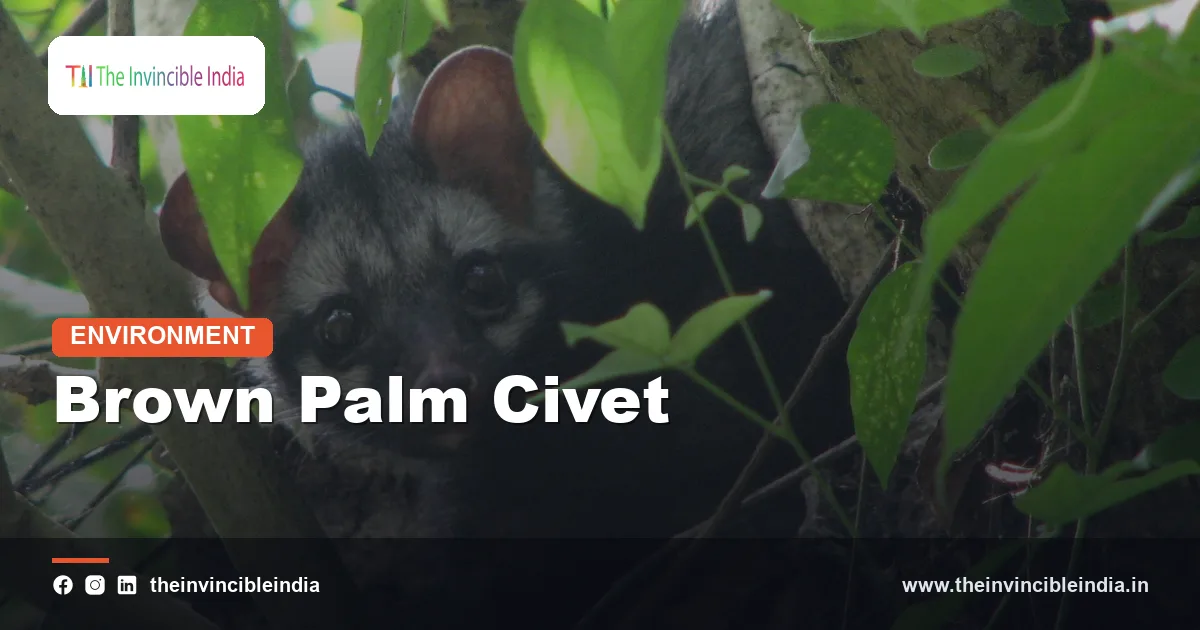
Brown palm civet conservation is the effort to protect the brown palm civet (Paradoxurus jerdoni), a nocturnal, tree-dwelling mammal found only in the Western Ghats of southern India, where it disperses the seeds of many rainforest trees. The brown palm civet, also called Jerdon’s palm civet, lives in evergreen forests and nearby plantations, and its main threats are forest fragmentation, loss of fruiting trees and hunting, which is why it is protected under Indian wildlife law and monitored by researchers.
Because it is endemic, meaning it occurs naturally nowhere else in the world, the species is an important part of the Western Ghats biodiversity hotspot. This explainer describes what the brown palm civet is, where it lives, what it eats, why it matters for forests and coffee-growing landscapes, what threatens it and how it is protected. Figures are approximate and legal schedule placements are described with caution. Last updated: 21 October 2026.
| Attribute | Detail |
|---|---|
| Common names | Brown palm civet, Jerdon’s palm civet |
| Scientific name | Paradoxurus jerdoni |
| Family | Viverridae (civets and genets) |
| Distribution | Endemic to the Western Ghats of southwestern India |
| Habitat | Evergreen and moist forests, plus shaded plantations near forest |
| Activity | Nocturnal and mostly arboreal |
| Diet | Mainly fruit, with some insects and small animals |
| IUCN status | Assessed as Least Concern at the last assessments, with a decreasing trend noted |
| Legal protection | Wildlife (Protection) Act, 1972 (protected schedule placement to be verified against the current Act) |
Key Takeaways
- The brown palm civet (Paradoxurus jerdoni) is endemic to the Western Ghats, which means it is found naturally nowhere else on Earth.
- The brown palm civet is nocturnal and spends most of its time in trees, feeding mainly on wild fruits.
- By eating fruits and passing the seeds, the brown palm civet helps regenerate rainforest trees across the Western Ghats.
- The species survives in shaded coffee and cardamom plantations adjoining forest, but it depends on remaining large trees and nearby forest.
- Forest fragmentation and loss of fruiting trees are the main threats to the brown palm civet, along with hunting and snares.
- The brown palm civet is protected under the Wildlife (Protection) Act, 1972, and occurs in several protected areas of Karnataka, Kerala and Tamil Nadu.
What is the brown palm civet?
The brown palm civet is a medium-sized, nocturnal carnivoran mammal in the civet family, scientifically named Paradoxurus jerdoni, and it lives only in the rainforests and hills of the Western Ghats. Despite the name “civet”, it is not a cat; civets belong to a separate family, Viverridae, which also includes genets and linsangs.
The species is named after Thomas C. Jerdon, a nineteenth-century British naturalist who documented many Indian animals, and it was described scientifically in the nineteenth century. It belongs to the same genus as the common palm civet (Paradoxurus hermaphroditus), sometimes known as the toddy cat, from which it is distinguished mainly by its plain coat and restricted range.
The brown palm civet is much less familiar than the common palm civet, which is widespread, lives in towns and is known in connection with civet coffee. The brown palm civet, by contrast, is a forest specialist with a limited range, and it is rarely seen by the public.
What does the brown palm civet look like?
The brown palm civet has a uniform dark brown to chestnut coat without conspicuous spots, a lighter underside and a long, bushy tail, and this plain appearance is the easiest way to separate it from the common palm civet. Adults weigh roughly three to five kilograms and measure about half a metre in head-and-body length, with a tail of similar length.
The face is somewhat paler, with a small white or buff patch under the eyes in some individuals, a long muzzle and rounded ears. The legs are short and the feet have strong curved claws that can be partly retracted, which helps the animal climb. The tail is not fully prehensile but helps balance on branches.
The common palm civet, by comparison, often shows faint stripes or spots on its body and a darker facial mask. Identification in the field can still be tricky, particularly at night, so researchers rely on camera traps with good images or on genetic data.
Where does the brown palm civet live?
The brown palm civet lives in the Western Ghats of southern India, mainly in the forested hills of Karnataka, Kerala and Tamil Nadu, and probably extends in smaller numbers into the northern parts of the range. It is considered a mid-elevation to high-elevation specialist, found in wet evergreen and semi-evergreen forests as well as moist deciduous forests and plantations that retain tree cover.
Protected areas with records
The species has been reported from forest landscapes such as the Nilgiri Biosphere Reserve, Anamalai, Periyar, Silent Valley, Kodagu (Coorg) and Brahmagiri, although the list changes as surveys add records. Large contiguous forests such as the Nilgiris and Anamalai are thought to be strongholds.
Plantations and forest edges
The brown palm civet is also found in shaded coffee, cardamom and tea estates, especially where native shade trees remain and forest is close by. This makes plantation managers important partners in its conservation.
The ecological range is narrow, so even small changes in forest cover can alter the available habitat. This is typical of Western Ghats endemics, many of which are confined to a thin strip along the western side of peninsular India.
What does the brown palm civet eat?
The brown palm civet eats mainly fruit, including wild figs and the fleshy fruits of many rainforest trees and shrubs, supplemented by insects, small vertebrates and occasionally nectar. This mostly fruit-based diet makes it a frugivore within an order that is largely carnivorous.
It feeds at night in the canopy and mid-storey, moving along branches and sometimes descending to the ground to pick up fallen fruit. Because it swallows fruits whole, seeds usually pass through the gut and are deposited far from the parent tree, often in a small pile of droppings that include nutrients.
The species is believed to eat the fruits of the coffee plant in plantations as well as the fruits of shade trees, although detailed quantitative studies are limited. Most evidence on diet comes from scat analysis and observations by field researchers, and findings may differ across sites.
Why is the brown palm civet important for forests?
The brown palm civet is important for forests because it disperses the seeds of many native trees, helping them to regenerate and colonise new ground. Seed dispersal by animals is one of the key processes that maintains tropical forest diversity, since many large-seeded trees cannot spread without animal help.
By moving seeds away from the parent tree, the civet reduces competition between seedlings and parent plants and lowers the chance that seedlings are eaten by pests concentrated near the parent. Seeds that pass through the gut may also germinate more readily in some species, though this varies.
In the Western Ghats, the loss of frugivores can have long-term effects on forest composition, because some trees rely on a handful of animals to spread their seeds. This is why researchers regard the brown palm civet, along with hornbills, bats and primates, as a functional contributor to forest health.
| Role | How the brown palm civet contributes |
|---|---|
| Seed dispersal | Swallows fruits and deposits viable seeds away from parent trees |
| Forest regeneration | Helps native trees recruit in gaps and edges |
| Plantation ecosystems | May spread seeds of shade trees in coffee and cardamom landscapes |
| Food web | Eats insects and small animals; is itself prey for large carnivores |
| Indicator of health | Its presence suggests intact canopy and fruiting trees |
How does the brown palm civet link to coffee-shade landscapes?
The brown palm civet is linked to coffee-shade landscapes because shaded coffee estates in the Western Ghats provide fruiting trees and corridors that the species can use, and in return the civet may help spread shade-tree seeds. Many coffee farms in Karnataka, Kerala and Tamil Nadu retain native or planted shade trees, which keep some forest functions alive.
Shade-grown coffee supports more wildlife than open sun-grown plantations. When estates keep a variety of tall trees, birds, bats, squirrels and civets can move through them, connecting forest patches that would otherwise be isolated. Conservationists therefore promote biodiversity-friendly coffee practices, such as retaining native shade trees, limiting chemical use and avoiding snares.
A word of caution is needed about civet coffee. The brown palm civet is not the animal normally associated with the commercial “civet coffee” trade, which mostly involves the common palm civet, and many forms of that trade are linked to caged animals and animal welfare concerns. Travellers should avoid products made by keeping wild civets in captivity.
What are the main threats to the brown palm civet?
The main threats to the brown palm civet are habitat fragmentation, loss of fruiting trees, hunting and snaring, road mortality and disturbance from expanding plantations and infrastructure. Because the species is confined to the Western Ghats, it has no other range to retreat to if its habitat shrinks.
- Fragmentation: Roads, dams, plantations, mining and settlements divide forest into isolated patches, which reduces movement and genetic exchange.
- Loss of large trees: Removal of fruit-bearing and hollow-bearing trees takes away both food and resting sites.
- Hunting and snares: Wire snares set for other animals can catch civets, and some local hunting for meat or skins has been reported.
- Roadkill: Nocturnal movement across highways through forests leads to deaths.
- Agricultural change: Conversion of shaded plantations into open monocultures removes habitat on forest edges.
- Climate change: Warming may push upland species higher, where area is limited.
Researchers consider the species vulnerable to long-term declines even though it is not listed as threatened globally, because its range is small and the Western Ghats are under strong development pressure.
How is the brown palm civet protected?
The brown palm civet is protected in India under the Wildlife (Protection) Act, 1972, which prohibits hunting and trade, and it occurs in national parks, tiger reserves and sanctuaries across the Western Ghats. Its placement within the Act’s schedules has been reported as being in the most protected category, but the schedules have been revised, notably by the 2022 Amendment, so readers should check the current text.
The IUCN Red List has assessed the species as Least Concern at its latest assessments, with a note that the population is decreasing, while the international trade regime under CITES treats related civets in different ways. The Western Ghats are also a UNESCO World Heritage Site, with several clusters of protected forest recognised for their biodiversity.
In practice, conservation of the brown palm civet is mostly indirect. Protecting large forest blocks and corridors for elephants, tigers and hornbills automatically shelters the civet as well. Camera trap surveys, plantation biodiversity programmes and community monitoring add data.
What can be done to conserve the brown palm civet?
Conserving the brown palm civet requires protecting forest corridors, keeping shade trees in plantations, removing snares and monitoring populations with camera traps and genetic surveys. These measures are practical, and they benefit many other Western Ghats species at the same time.
- Maintain and restore corridors between forest fragments, including through plantations.
- Promote biodiversity-friendly coffee and cardamom certification that rewards shade-tree retention.
- Clear snares and wire traps in and around protected areas.
- Add wildlife crossings or speed controls on roads that bisect forests.
- Fund long-term surveys that identify the species correctly and map its range.
- Work with local communities, planters and forest departments on shared monitoring.
Bottom Line
Brown palm civet conservation matters because the species exists only in the Western Ghats and acts as a seed disperser for rainforest and shade-tree landscapes. The animal is not globally listed as threatened, but its narrow range and the pressure on its habitat make forest connectivity, plantation stewardship and enforcement of wildlife law important.
Frequently Asked Questions
What is the brown palm civet?
The brown palm civet (Paradoxurus jerdoni) is a nocturnal, tree-dwelling civet that lives only in the Western Ghats of southern India. It has a plain brown coat and a long tail, and it feeds mainly on fruit. It is also called Jerdon’s palm civet.
Where is the brown palm civet found?
The brown palm civet is found only in the Western Ghats, mainly in forests and nearby plantations of Karnataka, Kerala and Tamil Nadu. It is known from areas such as the Nilgiris, Anamalai, Periyar and Kodagu. Its range is small compared with that of the common palm civet.
Is the brown palm civet endangered?
The brown palm civet is not classified as endangered; the IUCN has assessed it as Least Concern, though with a decreasing population trend. Its small range makes it sensitive to habitat loss. It is protected under India’s Wildlife (Protection) Act, 1972.
How does the brown palm civet help the forest?
The brown palm civet helps the forest by eating fruits and spreading the seeds in its droppings. This allows native trees to regenerate and colonise new areas. It also helps shade trees spread in plantations next to forest.
What is the difference between the brown palm civet and the common palm civet?
The brown palm civet has a plain dark brown coat and lives only in the Western Ghats, whereas the common palm civet often has faint stripes or spots and lives across much of Asia, including towns. The common palm civet is the species usually linked to civet coffee. The two are in the same genus but differ in range and habitat.
How can people help protect the brown palm civet?
People can help protect the brown palm civet by supporting forest conservation, choosing shade-grown coffee from responsible estates and avoiding civet coffee made from caged animals. Reporting snares and drive-over road deaths to forest officials also helps. Citizen sightings uploaded to biodiversity platforms add useful data.
{“@context”:”https://schema.org”,”@graph”:[{“@type”:”FAQPage”,”mainEntity”:[{“@type”:”Question”,”name”:”What is the brown palm civet?”,”acceptedAnswer”:{“@type”:”Answer”,”text”:”The brown palm civet (Paradoxurus jerdoni) is a nocturnal, tree-dwelling civet that lives only in the Western Ghats of southern India. It has a plain brown coat and a long tail, and it feeds mainly on fruit. It is also called Jerdon’s palm civet.”}},{“@type”:”Question”,”name”:”Where is the brown palm civet found?”,”acceptedAnswer”:{“@type”:”Answer”,”text”:”The brown palm civet is found only in the Western Ghats, mainly in forests and nearby plantations of Karnataka, Kerala and Tamil Nadu. It is known from areas such as the Nilgiris, Anamalai, Periyar and Kodagu. Its range is small compared with that of the common palm civet.”}},{“@type”:”Question”,”name”:”Is the brown palm civet endangered?”,”acceptedAnswer”:{“@type”:”Answer”,”text”:”The brown palm civet is not classified as endangered; the IUCN has assessed it as Least Concern, though with a decreasing population trend. Its small range makes it sensitive to habitat loss. It is protected under India’s Wildlife (Protection) Act, 1972.”}},{“@type”:”Question”,”name”:”How does the brown palm civet help the forest?”,”acceptedAnswer”:{“@type”:”Answer”,”text”:”The brown palm civet helps the forest by eating fruits and spreading the seeds in its droppings. This allows native trees to regenerate and colonise new areas. It also helps shade trees spread in plantations next to forest.”}},{“@type”:”Question”,”name”:”What is the difference between the brown palm civet and the common palm civet?”,”acceptedAnswer”:{“@type”:”Answer”,”text”:”The brown palm civet has a plain dark brown coat and lives only in the Western Ghats, whereas the common palm civet often has faint stripes or spots and lives across much of Asia, including towns. The common palm civet is the species usually linked to civet coffee. The two are in the same genus but differ in range and habitat.”}},{“@type”:”Question”,”name”:”How can people help protect the brown palm civet?”,”acceptedAnswer”:{“@type”:”Answer”,”text”:”People can help protect the brown palm civet by supporting forest conservation, choosing shade-grown coffee from responsible estates and avoiding civet coffee made from caged animals. Reporting snares and drive-over road deaths to forest officials also helps. Citizen sightings uploaded to biodiversity platforms add useful data.”}}]}]}


