

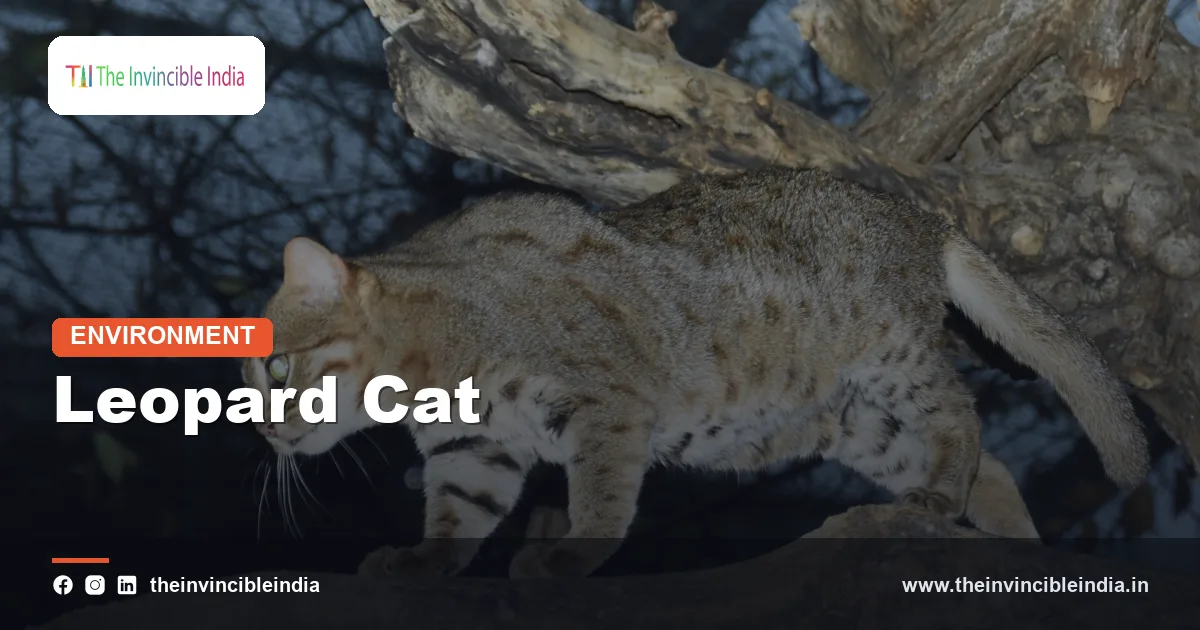
Leopard cat conservation in India is the effort to protect the leopard cat (Prionailurus bengalensis), a small spotted wild cat about the size of a domestic cat that lives across the Himalayan foothills, the Northeast, the Western Ghats and the eastern forests of the country. The leopard cat is one of India’s most widespread small cats and is not currently considered globally threatened, but it faces local pressures from habitat loss, hunting for skins, road deaths and illegal trade, and it is protected under Indian wildlife law.
Because the leopard cat is small, secretive and active at night, it receives far less attention than tigers or leopards, and many people never see one in the wild. This explainer describes how to recognise the leopard cat, where it lives, what it eats, what threatens it and how it is protected. Figures are approximate and legal schedule placements are described with caution. Last updated: 21 October 2026.
| Attribute | Detail |
|---|---|
| Common name | Leopard cat (also called Asian leopard cat) |
| Scientific name | Prionailurus bengalensis |
| Family | Felidae (cats) |
| Typical weight | Roughly 1 to 5 kg, with most adults at the lower to middle part of that range |
| Habitat in India | Forests, scrub, plantations and grasslands from the foothills to montane forests |
| Range in India | Himalayas and foothills, Northeast, Western Ghats, eastern forests and parts of central India |
| IUCN status (global) | Least Concern, with a declining or uncertain trend in places |
| Legal protection | Wildlife (Protection) Act, 1972 (listed in a protected schedule); CITES listing |
| Main threats | Habitat loss, skin trade, roadkill, retaliatory killing and pet trade |
Key Takeaways
- The leopard cat (Prionailurus bengalensis) is a small, spotted wild cat that is among the most widespread small cats in India.
- Adult leopard cats weigh only about one to five kilograms, which is comparable to a domestic cat, though they are longer-legged and more slender.
- The leopard cat is listed as Least Concern globally by the IUCN, but habitat loss and hunting cause local declines.
- Leopard cats are adaptable and are recorded in forests, tea and coffee plantations, farmland edges and even near villages.
- In India, the leopard cat is protected under the Wildlife (Protection) Act, 1972, and hunting or trading in its skin is illegal.
- Leopard cats control rodent populations, which makes them quietly valuable to forests and farms.
What is the leopard cat?
The leopard cat is a small wild cat species, scientifically named Prionailurus bengalensis, that is found across South, Southeast and East Asia and is named for its coat of dark spots, which resembles a miniature leopard’s pattern. In India, it is one of around fifteen wild cat species, a group that also includes the tiger, lion, leopard, snow leopard, clouded leopard, fishing cat, rusty-spotted cat, jungle cat, caracal, Asiatic golden cat, marbled cat, Pallas’s cat, Eurasian lynx and leopard cat itself.
The leopard cat belongs to the genus Prionailurus, which also includes the fishing cat and the rusty-spotted cat. Taxonomists have debated how many species and subspecies exist within the leopard cat group. Some authorities now treat the Sunda leopard cat of the Sunda Islands and the Amur leopard cat of northeast Asia as separate forms, so the Indian population is generally the mainland Asian form, but the classification may be revised.
The animal should not be confused with the leopard (Panthera pardus), a large cat that weighs many times more. The two are unrelated at the genus level and are only superficially similar in colouring.
What does a leopard cat look like?
A leopard cat looks like a slim, long-legged domestic cat with a yellowish or tawny-brown coat marked by dark spots and stripes, a white underside and a ringed tail. Most adults have a head-and-body length of roughly 45 to 65 centimetres, with a tail about half to two-thirds of that length.
The face has two dark stripes running from the eyes and white patches on the sides of the muzzle and above the eyes. The back of each ear is black with a white central spot, a feature that can help distinguish the leopard cat from similar small cats. Coat colour and spot pattern vary with region and elevation, and animals in colder Himalayan areas can be paler with thicker fur.
Leopard cats have long legs, partial webbing between the toes in some individuals and strong claws, features suited to climbing and moving across wet ground. They are good swimmers and tolerate water better than many cats.
Where does the leopard cat live in India?
The leopard cat lives across a wide belt of Indian habitats, including the Himalayan foothills, the forests of the Northeast, the Western Ghats and parts of the eastern and central forests, and it has been recorded at elevations reaching well above two thousand metres in the mountains. Its adaptability to different vegetation types explains the broad range.
Himalayas and foothills
Records come from states and territories such as Uttarakhand, Himachal Pradesh, Sikkim, West Bengal, and Arunachal Pradesh, where the cat occupies broadleaf, mixed and subtropical forests. Protected areas such as Jim Corbett National Park and Kanchenjunga National Park are among those where camera traps have documented the species, though the list of sites changes as surveys continue.
Northeast India
The Northeast is a stronghold because of its extensive forest cover and diverse habitat. The leopard cat has been photographed in forests of Assam, Meghalaya, Nagaland, Mizoram and Arunachal Pradesh, including in community-managed forests.
Western Ghats and southern India
In the Western Ghats, the leopard cat occurs in evergreen and moist deciduous forests and has been recorded in plantations adjacent to protected areas, where rodents are abundant. Its presence in coffee, tea and cardamom landscapes shows that it can use modified habitats when cover remains.
Eastern and central India
Records from the Eastern Ghats, Odisha, Chhattisgarh and parts of central India show that the species extends into drier forests, though it is usually less common there. Coastal mangroves such as the Sundarbans are also reported as habitat.
What does the leopard cat eat?
The leopard cat eats mainly small rodents such as rats and mice, supplemented by birds, lizards, frogs, insects and occasionally fish or small mammals. As an opportunistic carnivore, it adjusts its diet to what is locally abundant.
It hunts mostly at night and around dusk and dawn, moving along streams, forest edges and plantation rows. It can climb trees to catch birds or to rest, but it typically hunts on the ground by stalking and pouncing.
Because rodents are a staple prey, leopard cats can reduce populations of crop pests. Studies in several countries have noted that small cats may help limit rats in plantations, although the scale of this benefit is not well measured in India. Leopard cats are known to take poultry in a few places, which is a source of conflict with villagers.
How does the leopard cat breed and behave?
The leopard cat is mostly solitary, nocturnal and territorial, with females giving birth to litters of usually two to four kittens after a gestation of about two months. Details of breeding in the wild in India are not well documented, and much information comes from captive studies and surveys in other countries.
Kittens are born in dens in tree hollows, rock crevices or dense vegetation, and they open their eyes within about a week or so. The mother raises them alone, and they become independent after several months. Leopard cats can live for more than a decade in captivity, but wild lifespans are shorter.
The species marks territory with scent and scratches, and home ranges can overlap. Males typically hold larger ranges than females. Camera trap studies show activity peaks during the night with some daytime movement in undisturbed forests.
What is the conservation status of the leopard cat?
The leopard cat is classified as Least Concern on the IUCN Red List at the global level, but this reflects its wide range rather than a lack of pressure, and populations are reported to be declining in several areas. In India, the species is considered widespread, though reliable population estimates are not available because small cats are hard to count.
The classification has some caveats. The Red List assessment covers the species as a whole, and subpopulations may be in worse shape locally, especially where forest has been fragmented or where trapping is common. Researchers have also emphasised that the status could change if taxonomic revisions split the species into several, as each would then need its own assessment.
Under the Convention on International Trade in Endangered Species (CITES), the species is listed so that international trade is controlled, with some national populations, including those of India, receiving the strictest level of protection. Readers should consult the current CITES appendices for exact listings.
What are the main threats to leopard cats in India?
The main threats to leopard cats in India are habitat loss and fragmentation, hunting and trade in skins, roadkill, retaliatory killing over poultry and the pet trade. These pressures often act together and are stronger outside protected areas.
- Habitat loss: Conversion of forest to agriculture, plantations, mining and infrastructure reduces cover and prey.
- Skin and fur trade: Leopard cat skins have been seized in wildlife-trade cases, and the species is sometimes sold as a substitute for larger spotted cats.
- Roadkill: Roads that cut through forests lead to deaths of small carnivores, which are often unreported.
- Snares and traps: Traps set for other animals can capture leopard cats accidentally.
- Retaliation: Cats that enter poultry sheds may be killed by villagers.
- Pet trade: Kittens are sometimes captured for sale or kept illegally.
Disease transmitted from domestic cats and dogs and the risks of hybridisation or competition near human settlements are additional concerns that scientists continue to study.
How is the leopard cat protected in India?
The leopard cat is protected in India under the Wildlife (Protection) Act, 1972, which prohibits hunting, capturing, keeping or trading in the species, with penalties that include imprisonment and fines. It has been listed in one of the protected schedules of the Act, and the schedule placement has been revised in amendments, including the 2022 Amendment, so the current schedule should be checked against the Act.
Protection operates through several layers. National parks and wildlife sanctuaries safeguard habitat, the Wildlife Crime Control Bureau (WCCB) coordinates action on trade, and state forest departments handle enforcement. Courts have heard many seizure cases that involve skins of small cats.
Because the leopard cat is not a flagship species, conservation tends to occur indirectly through habitat management for larger animals. Camera trap surveys for tigers frequently photograph leopard cats, giving data for monitoring without dedicated funding.
| Protection layer | What it does |
|---|---|
| Wildlife (Protection) Act, 1972 | Bans hunting, possession and trade; provides penalties |
| Protected areas | Preserve forest habitat and prey base |
| CITES | Regulates international trade in the species and its parts |
| WCCB and state forest departments | Investigate and prosecute trade and poaching cases |
| Community conservation | Local forest committees and sacred groves protect habitat outside parks |
What is the link between leopard cats and the Bengal cat?
The Bengal cat is a domestic cat breed developed by crossing domestic cats with leopard cats, and the connection explains why the wild species is sometimes sought as a pet. The breed was developed in the United States in the twentieth century, and later generations are bred only from domestic Bengal cats.
The breed’s wild-like spotted coat has made it popular, but wild leopard cats do not make suitable pets. They are nocturnal, territorial and difficult to keep, and removing them from the wild is illegal in India. Anyone considering a Bengal cat should buy from a registered breeder of later-generation cats rather than from any trade involving wild-caught animals.
What can people do to help leopard cats?
People can help leopard cats by supporting forest protection, driving carefully in wildlife areas, securing poultry at night, reporting illegal trade and avoiding any purchase of wild-animal products. Everyday choices matter for a species that mostly lives outside the reach of dedicated conservation programmes.
Citizen science is another option. Photographs and sightings uploaded to biodiversity platforms contribute to range maps. Researchers also use camera traps to study leopard cats alongside tigers and other species, and they welcome local knowledge from forest communities.
Bottom Line
Leopard cat conservation in India relies on the species’ adaptability, legal protection and the survival of forest and plantation landscapes across the country. The leopard cat is currently secure at the species level, but steady habitat loss, trade and road deaths mean that it still needs monitoring and enforcement.
Frequently Asked Questions
What is a leopard cat?
A leopard cat is a small spotted wild cat, Prionailurus bengalensis, found across South, Southeast and East Asia. It is roughly the size of a domestic cat and has a tawny coat with dark spots. In India, it lives in forests from the Himalayan foothills to the Western Ghats and Northeast.
Is the leopard cat endangered in India?
The leopard cat is not classified as endangered; the IUCN lists it as Least Concern globally. It is, however, protected under Indian wildlife law, and local populations face pressure from habitat loss and hunting. Reliable population estimates for India are limited.
Where can leopard cats be seen in India?
Leopard cats have been recorded in protected areas and forests across the Himalayan foothills, the Northeast, the Western Ghats and some eastern and central forests. Sightings are rare because the animal is nocturnal and shy. Camera traps in places such as Jim Corbett and in Northeast forests have captured the species.
What does a leopard cat eat?
A leopard cat eats mainly rats, mice and other small rodents, along with birds, lizards, frogs and insects. It hunts at night on the ground and sometimes in trees. Its diet changes according to what is available locally.
Is it legal to keep a leopard cat as a pet in India?
It is not legal to keep a wild leopard cat as a pet in India, because the species is protected under the Wildlife (Protection) Act, 1972. Capturing, possessing or selling one can lead to imprisonment and fines. Domestic Bengal cats are a separate, legally bred domestic breed.
How is the leopard cat different from a leopard?
The leopard cat is a small cat weighing about one to five kilograms, whereas the leopard (Panthera pardus) is a large cat weighing many times more. They belong to different genera and differ in size, behaviour and prey. Only the spotted coat gives them a resemblance.
{“@context”:”https://schema.org”,”@graph”:[{“@type”:”FAQPage”,”mainEntity”:[{“@type”:”Question”,”name”:”What is a leopard cat?”,”acceptedAnswer”:{“@type”:”Answer”,”text”:”A leopard cat is a small spotted wild cat, Prionailurus bengalensis, found across South, Southeast and East Asia. It is roughly the size of a domestic cat and has a tawny coat with dark spots. In India, it lives in forests from the Himalayan foothills to the Western Ghats and Northeast.”}},{“@type”:”Question”,”name”:”Is the leopard cat endangered in India?”,”acceptedAnswer”:{“@type”:”Answer”,”text”:”The leopard cat is not classified as endangered; the IUCN lists it as Least Concern globally. It is, however, protected under Indian wildlife law, and local populations face pressure from habitat loss and hunting. Reliable population estimates for India are limited.”}},{“@type”:”Question”,”name”:”Where can leopard cats be seen in India?”,”acceptedAnswer”:{“@type”:”Answer”,”text”:”Leopard cats have been recorded in protected areas and forests across the Himalayan foothills, the Northeast, the Western Ghats and some eastern and central forests. Sightings are rare because the animal is nocturnal and shy. Camera traps in places such as Jim Corbett and in Northeast forests have captured the species.”}},{“@type”:”Question”,”name”:”What does a leopard cat eat?”,”acceptedAnswer”:{“@type”:”Answer”,”text”:”A leopard cat eats mainly rats, mice and other small rodents, along with birds, lizards, frogs and insects. It hunts at night on the ground and sometimes in trees. Its diet changes according to what is available locally.”}},{“@type”:”Question”,”name”:”Is it legal to keep a leopard cat as a pet in India?”,”acceptedAnswer”:{“@type”:”Answer”,”text”:”It is not legal to keep a wild leopard cat as a pet in India, because the species is protected under the Wildlife (Protection) Act, 1972. Capturing, possessing or selling one can lead to imprisonment and fines. Domestic Bengal cats are a separate, legally bred domestic breed.”}},{“@type”:”Question”,”name”:”How is the leopard cat different from a leopard?”,”acceptedAnswer”:{“@type”:”Answer”,”text”:”The leopard cat is a small cat weighing about one to five kilograms, whereas the leopard (Panthera pardus) is a large cat weighing many times more. They belong to different genera and differ in size, behaviour and prey. Only the spotted coat gives them a resemblance.”}}]}]}


