

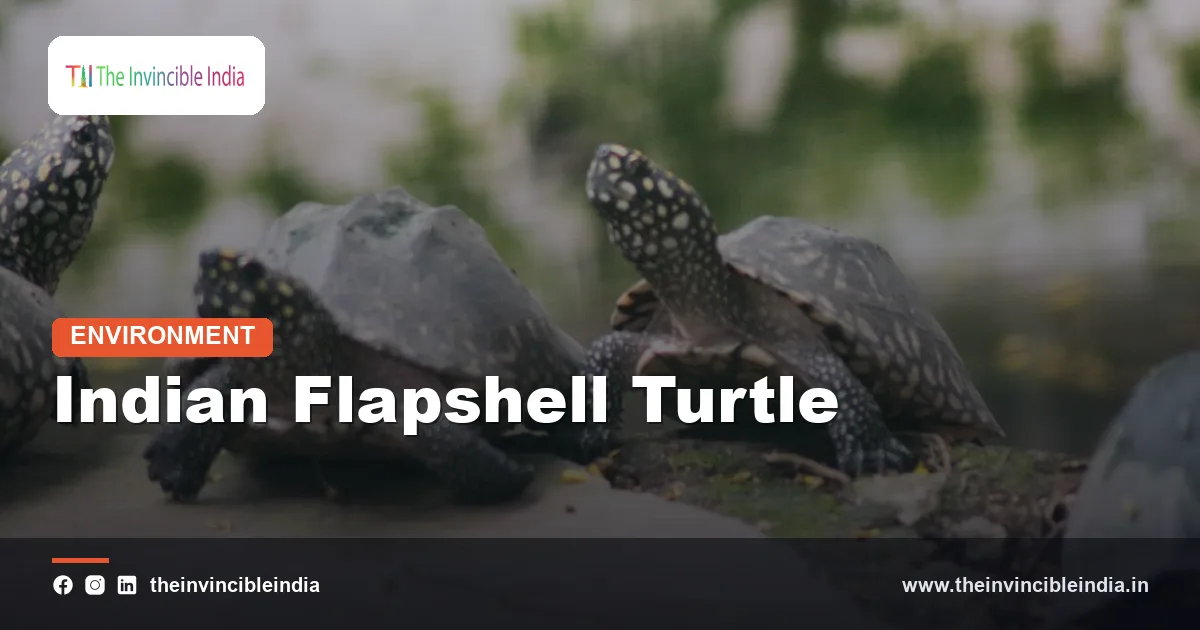
The Indian flapshell turtle (Lissemys punctata) is a small, olive-coloured freshwater softshell turtle that lives in ponds, tanks, lakes, rivers and wetlands across much of the Indian subcontinent, and it is named for the hinged flaps on its underside that fold over its hind limbs. It is one of the most widespread freshwater turtles in India, and it is often seen basking at the edge of village ponds.
Because it is common, the Indian flapshell turtle is easily overlooked in conservation discussions, yet it is one of the freshwater turtles most frequently seized from illegal wildlife traffickers in India. The animal is protected under the Wildlife (Protection) Act, 1972, and it is regulated in international trade, but live capture for meat, pets and traditional uses continues to put pressure on wild populations.
| Attribute | Detail |
|---|---|
| Common name | Indian flapshell turtle (also Indian flap-shelled turtle) |
| Scientific name | Lissemys punctata |
| Family | Trionychidae (softshell turtles), flapshell group |
| Range | India, Pakistan, Nepal, Bangladesh, Sri Lanka and Myanmar |
| Habitat | Ponds, village tanks, lakes, slow rivers, canals, marshes and flooded fields |
| Diet | Omnivorous: snails, insects, fish, frogs, carrion and water plants |
| Distinctive feature | Hinged femoral flaps on the plastron that cover the limbs when it withdraws |
| Typical shell length | Commonly around 20 to 25 cm, with large individuals growing bigger |
| Main threat | Illegal capture for the meat and pet trades, plus wetland loss and pollution |
Key Takeaways
- The Indian flapshell turtle (Lissemys punctata) is a freshwater softshell turtle that is widespread across India, Pakistan, Nepal, Bangladesh, Sri Lanka and Myanmar.
- The Indian flapshell turtle gets its name from hinged flaps on the underside of its shell, which close over its hind limbs for protection.
- The Indian flapshell turtle can survive drought by burying itself in mud and becoming inactive, a process called aestivation.
- The Indian flapshell turtle is an omnivore that helps clean wetlands by eating snails, insects, carrion and plant matter.
- Large numbers of Indian flapshell turtles are captured illegally in India for the meat and live-animal trades, and they are among the freshwater turtles most often found in wildlife seizures.
- Capturing, keeping or trading the Indian flapshell turtle is an offence under India’s Wildlife (Protection) Act, 1972, and international trade is regulated under CITES.
What is the Indian flapshell turtle?
The Indian flapshell turtle is a medium-small freshwater turtle of the softshell family Trionychidae, with a rounded, flattened shell covered partly in leathery skin and a long, snorkel-like snout. It is the best-known member of the flapshell turtles, a small group of softshells with hinged flaps on their undersides that are found only in South Asia and parts of Africa.
Unlike the hard-shelled pond turtles of India, the Indian flapshell turtle has a central bony shell plate surrounded by a softer, flexible margin, which gives it a somewhat pancake-like shape. The word “punctata” in the scientific name means “spotted” and refers to the yellowish spots that are most noticeable on young animals.
Two subspecies are commonly recognised in the literature, the nominate Indian flapshell turtle and a northern form often called Anderson’s flapshell turtle (Lissemys punctata andersoni), although the exact boundaries and the validity of such subspecies have been revisited by taxonomists. Reptile classification changes as genetic studies improve, so names found in older field guides may differ slightly.
Where does the Indian flapshell turtle live?
The Indian flapshell turtle lives throughout most of peninsular and northern India and in the neighbouring countries of Pakistan, Nepal, Bangladesh, Sri Lanka and Myanmar, in almost any permanent or seasonal body of still or slow-moving water. It is found from the plains to moderate elevations and is rare or absent in cold, high mountain waters.
Its habitats include village ponds, temple tanks, irrigation canals, reservoirs, oxbow lakes, marshes, rice paddies and the quiet backwaters of rivers. Compared with many other turtles, it is tolerant of muddy and moderately polluted water, which is one reason it is often the last turtle to disappear from degraded wetlands. Even so, tolerance has limits, and heavily contaminated or drained water bodies cannot support it for long.
The turtle moves between water bodies, particularly after monsoon rains, and can cross land to find new ponds. This movement helps maintain gene flow among populations, but it also exposes it to road traffic and hunters.
What does the Indian flapshell turtle look like?
The Indian flapshell turtle has an olive-green to brownish, dome-shaped but low carapace, a cream or yellowish underside, and a neck and head marked with yellow or pale blotches, with a long snout that ends in a fleshy tip. Young turtles are conspicuously spotted, and these markings fade as the animal ages.
Adults commonly measure about 20 to 25 cm in shell length, and some individuals grow larger, with females generally being the bigger sex. The legs are paddle-like, with webbed feet and three claws on each foot, and the tail is short. Measurements differ between sources and regions, so these are indicative values.
What are the flaps on the Indian flapshell turtle?
The flaps on the Indian flapshell turtle are hinged, shield-like plates on the rear part of the plastron, or belly shell, that swing up and close over the hind limbs when the turtle pulls its legs in. Together with the withdrawn head, the closed flaps give the animal a good deal of protection from predators such as dogs, otters, large birds and larger fish.
These flaps are the feature that gives the flapshell turtles their common name. They are unusual among softshell turtles, most of which lack any such closing mechanism and are therefore more exposed. The flaps do not make the turtle completely sealed, but they reduce injury to the vulnerable limbs.
What does the Indian flapshell turtle eat?
The Indian flapshell turtle is an omnivore that eats aquatic snails, insects and their larvae, crustaceans, small fish, tadpoles, frogs, carrion and water plants. Its diet shifts with age, as young turtles take more animal prey and adults eat a wider mix of plants and dead material.
Feeding takes place mostly in shallow water. The turtle may forage by probing mud with its snout, ambushing prey that comes close or scavenging dead animals that have sunk to the bottom. Its strong jaws crush snail shells and other hard food.
By eating snails, insect larvae and carrion, the Indian flapshell turtle plays a cleaning and balancing role in small wetlands. Some researchers have noted that scavenging turtles can reduce organic waste in ponds, though the size of the effect varies and is hard to measure.
How does the Indian flapshell turtle survive dry seasons?
The Indian flapshell turtle survives dry seasons by aestivating, which means it buries itself in mud or soft soil and enters a state of reduced activity until water returns. This habit lets it endure the heat and drying of ponds that occur in many parts of India before the monsoon.
During aestivation, the turtle’s metabolism slows, and it relies on stored energy and its ability to tolerate low oxygen and water loss. The animal is not truly asleep and can react to disturbance. Many individuals in northern India also reduce their activity during the cold season.
Like other softshell turtles, the Indian flapshell turtle can take up some oxygen through the skin of its throat and other body surfaces, in addition to breathing air through its lungs. This ability is part of what allows softshells to remain under water for long periods, although the exact contribution of each route varies and is still studied.
How does the Indian flapshell turtle breed?
The Indian flapshell turtle breeds by laying hard-shelled, roughly spherical eggs in nests that the female digs in sandy or loose soil near water, and it usually nests in the drier months before the monsoon. A female may lay more than one clutch in a season, with a clutch size that ranges from a few to more than a dozen eggs depending on the female and region.
The eggs take a couple of months to hatch, with timing influenced by temperature, and the hatchlings emerge with the first rains and head for the nearest water. As with many turtles, nests and hatchlings are exposed to predators such as monitor lizards, crows, jackals, dogs and humans, and only a small fraction survive to adulthood.
Late maturity and high early mortality mean that adult turtles are especially valuable to a population. Removing adults, as hunters and traffickers do, removes breeding capacity that is slow to replace.
Why is the Indian flapshell turtle traded and hunted?
The Indian flapshell turtle is hunted and traded because there is demand for its meat, for live animals in the pet and aquarium trade, and for uses in some traditional remedies, and because it is easy to catch in the shallow waters where it lives. Cheap, abundant and widespread, it has become one of the main freshwater turtle species moved by wildlife traffickers.
Enforcement agencies in India have repeatedly reported seizures of large numbers of live Indian flapshell turtles packed in sacks, particularly in the Gangetic plains and eastern India, with the animals often destined for markets across the border in neighbouring countries and onwards to East and Southeast Asia. Turtles are captured by fishermen and local collectors, passed to middlemen and transported over long distances, and many die from stress, dehydration and injury on the way.
The Wildlife Crime Control Bureau (WCCB) has run special operations against tortoise and freshwater turtle trafficking, one of which was called Operation Save Kurma, and has issued alerts about turtles being sold online and in local markets. Such operations have led to arrests and rescues, but the trade is persistent because profits are high compared with the risks.
Common trade and use patterns
- Food: turtle meat is eaten locally in some communities and is in demand in some consumer markets abroad.
- Pet trade: small and young turtles are sold as pets or for aquariums, often in violation of wildlife law.
- Traditional medicine: shells and body parts are used in remedies in some countries, without scientific proof of benefit.
- Religious release and ponds: some turtles are kept in temple ponds, which can be a conservation resource when well managed.
What other threats does the Indian flapshell turtle face?
Besides capture, the Indian flapshell turtle is threatened by the loss and pollution of wetlands, accidental death in fishing gear, road kills during overland movements, and nest destruction. These pressures affect the turtle even where hunting is limited.
- Wetland loss: filling, draining and building over ponds and tanks eliminates habitat, especially around expanding towns.
- Pollution: sewage, industrial waste and agricultural chemicals degrade water quality and prey availability.
- Fishing gear: turtles are caught in nets and on baited hooks, and some are killed as unwanted bycatch.
- Nest disturbance: sand mining, construction and farming near ponds can destroy nesting sites.
- Invasive species: introduced fish and predators in ponds can reduce food and increase hatchling losses.
- Roads: turtles crossing roads after rain are frequently struck by vehicles.
Population numbers for the Indian flapshell turtle are not well documented, and the species’ reputation as “common” can hide local disappearance. Wildlife biologists warn that the combination of heavy capture and habitat loss can cause a widespread species to decline quickly.
Is the Indian flapshell turtle protected by law?
Yes, the Indian flapshell turtle is a protected species in India under the Wildlife (Protection) Act, 1972, and its capture, possession, sale and export without legal authority are offences punishable by imprisonment and fines. Enforcement reports have commonly placed the species in the Act’s higher-protection schedules, but the Act was amended in 2022 and its Schedules were reorganised, so exact placement should be checked in the current official text.
The species is also covered internationally. The Convention on International Trade in Endangered Species of Wild Fauna and Flora (CITES) regulates the cross-border trade in many Asian freshwater turtles, and the Indian flapshell turtle has been listed on one of its appendices, which requires permits for legal international movement. The conservation category of the species on the IUCN Red List has been revisited in recent years to reflect trade pressure, so the current category should be confirmed on the Red List itself.
Protection on paper depends on practical enforcement and public awareness. Many people in rural areas are unaware that ordinary pond turtles are legally protected, and some collectors treat them as ordinary fish.
How does the Indian flapshell turtle differ from other Indian turtles?
The Indian flapshell turtle differs from other Indian freshwater turtles mainly in its hinged plastral flaps, its smaller size and its adaptability to ponds. India has a rich turtle fauna, including both softshell and hard-shelled species, and identification matters because laws and trade patterns differ among them.
| Turtle | Scientific name | Shell type | Quick identification |
|---|---|---|---|
| Indian flapshell turtle | Lissemys punctata | Softshell with bony centre | Hinged flaps on the belly; olive shell with pale spots in young |
| Ganges softshell turtle | Nilssonia gangetica | Softshell | Much larger, river-living, without the flaps |
| Indian peacock softshell turtle | Nilssonia hurum | Softshell | Peacock-eye-like markings on the carapace of young |
| Indian roofed turtle | Pangshura tecta | Hard shell | Ridged, roof-like shell with a keel |
| Indian black turtle | Melanochelys trijuga | Hard shell | Dark, smooth domed shell; hard-shelled pond turtle |
Accurate identification is important in law enforcement because traders sometimes mix several species in the same consignment. Trained wildlife officers and reptile biologists use features of the shell, the head and the plastron to confirm species.
How can the Indian flapshell turtle be conserved?
Conserving the Indian flapshell turtle requires protecting village ponds and wetlands, enforcing laws against capture and trade, reducing pollution and involving local communities in guarding turtles. Because the species lives close to people, community attitudes are as important as formal protected areas.
- Protect and restore wetlands: keep village ponds, tanks and marshes from being filled or polluted.
- Strengthen enforcement: monitor trade routes, markets and online sales, and ensure that seized turtles are rescued, not resold.
- Rescue and release: return healthy seized turtles to suitable local waters following expert advice, as moving turtles long distances can spread disease and disturb local populations.
- Reduce bycatch: encourage fishers to release turtles caught accidentally and avoid harmful gear.
- Protect nest sites: keep stretches of sandy bank near ponds free from sand mining and disturbance.
- Educate communities: explain that these turtles are protected, harmless and useful in ponds.
Temple ponds, school-led pond projects and community conservation groups have shown that traditional respect for turtles can be turned into protection. Citizen sightings recorded on public biodiversity platforms also help researchers track where the species still occurs.
Bottom Line
The Indian flapshell turtle is a hardy, widespread pond turtle whose flaps, mud-burying habit and varied diet make it well adapted to South Asian wetlands. Its commonness is no guarantee of safety, because illegal capture and shrinking wetlands are steadily eroding numbers, so enforcement of the Wildlife (Protection) Act, 1972 and protection of village ponds are both essential.
Frequently Asked Questions
Why is it called the Indian flapshell turtle?
It is called the Indian flapshell turtle because it has hinged flaps on the rear of its belly shell that fold over its hind limbs. The flaps help protect the legs when the turtle withdraws into its shell. The word “Indian” refers to its occurrence in the Indian subcontinent.
Is the Indian flapshell turtle a protected species in India?
Yes, the Indian flapshell turtle is protected under India’s Wildlife (Protection) Act, 1972, and capturing, keeping or trading it is illegal. Penalties include imprisonment and fines. Its international trade is also regulated under CITES.
Can the Indian flapshell turtle be kept as a pet?
No, the Indian flapshell turtle cannot legally be kept as a pet in India without proper authorisation, because it is a protected wild species. Buying or selling it, even as a small aquarium turtle, can lead to prosecution. People who find one should contact the state forest department or a wildlife rescue group.
What does the Indian flapshell turtle eat?
The Indian flapshell turtle eats snails, insects, small fish, frogs, carrion and water plants. It is an omnivore, and its diet changes with age and season. By eating dead animals and snails, it helps keep ponds cleaner.
How does the Indian flapshell turtle survive when ponds dry up?
The Indian flapshell turtle survives dry ponds by burying itself in mud and becoming inactive, a state known as aestivation. It can stay in this condition until rain refills the water body. It may also walk overland to find new water.
Why is the Indian flapshell turtle trafficked?
The Indian flapshell turtle is trafficked because it is easy to catch and there is demand for its meat, for live pets and for traditional uses. Live turtles are often packed into sacks and moved over long distances, and many die on the way. Wildlife agencies have seized large consignments in several parts of India.
{“@context”:”https://schema.org”,”@graph”:[{“@type”:”FAQPage”,”mainEntity”:[{“@type”:”Question”,”name”:”Why is it called the Indian flapshell turtle?”,”acceptedAnswer”:{“@type”:”Answer”,”text”:”It is called the Indian flapshell turtle because it has hinged flaps on the rear of its belly shell that fold over its hind limbs. The flaps help protect the legs when the turtle withdraws into its shell. The word “Indian” refers to its occurrence in the Indian subcontinent.”}},{“@type”:”Question”,”name”:”Is the Indian flapshell turtle a protected species in India?”,”acceptedAnswer”:{“@type”:”Answer”,”text”:”Yes, the Indian flapshell turtle is protected under India’s Wildlife (Protection) Act, 1972, and capturing, keeping or trading it is illegal. Penalties include imprisonment and fines. Its international trade is also regulated under CITES.”}},{“@type”:”Question”,”name”:”Can the Indian flapshell turtle be kept as a pet?”,”acceptedAnswer”:{“@type”:”Answer”,”text”:”No, the Indian flapshell turtle cannot legally be kept as a pet in India without proper authorisation, because it is a protected wild species. Buying or selling it, even as a small aquarium turtle, can lead to prosecution. People who find one should contact the state forest department or a wildlife rescue group.”}},{“@type”:”Question”,”name”:”What does the Indian flapshell turtle eat?”,”acceptedAnswer”:{“@type”:”Answer”,”text”:”The Indian flapshell turtle eats snails, insects, small fish, frogs, carrion and water plants. It is an omnivore, and its diet changes with age and season. By eating dead animals and snails, it helps keep ponds cleaner.”}},{“@type”:”Question”,”name”:”How does the Indian flapshell turtle survive when ponds dry up?”,”acceptedAnswer”:{“@type”:”Answer”,”text”:”The Indian flapshell turtle survives dry ponds by burying itself in mud and becoming inactive, a state known as aestivation. It can stay in this condition until rain refills the water body. It may also walk overland to find new water.”}},{“@type”:”Question”,”name”:”Why is the Indian flapshell turtle trafficked?”,”acceptedAnswer”:{“@type”:”Answer”,”text”:”The Indian flapshell turtle is trafficked because it is easy to catch and there is demand for its meat, for live pets and for traditional uses. Live turtles are often packed into sacks and moved over long distances, and many die on the way. Wildlife agencies have seized large consignments in several parts of India.”}}]}]}


