

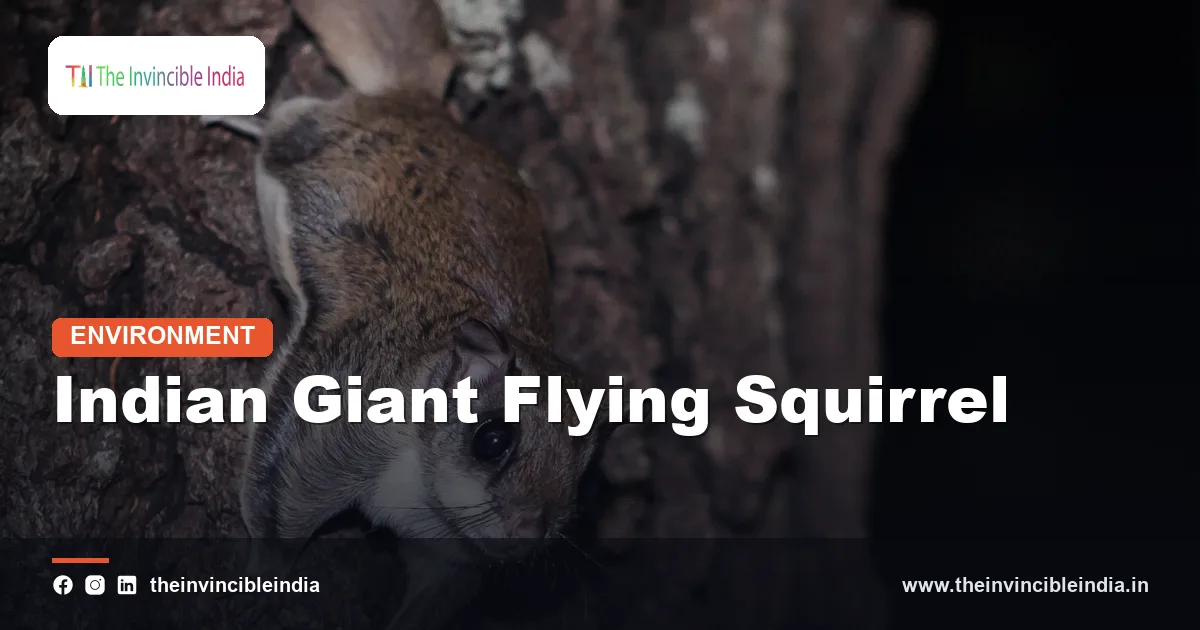
The Indian giant flying squirrel (Petaurista philippensis) is a large, nocturnal, tree-dwelling rodent of Indian forests that glides between trees using a furry skin membrane stretched between its front and hind limbs. Reddish-brown above and paler below, with a long bushy tail, the Indian giant flying squirrel can glide well over a hundred metres from a high branch to a lower tree, though it cannot truly fly.
The animal is also called the large brown flying squirrel, and it lives in tall forests, wooded hills and some plantations, where it nests in tree hollows and feeds on fruit, seeds, leaves and bark. It is shy and rarely seen in daylight, so most people know it only from its calls or a fleeting shape against the night sky, yet it depends on healthy, connected forest canopy and is affected when old trees are cut.
| Attribute | Detail |
|---|---|
| Common name | Indian giant flying squirrel (also large brown flying squirrel) |
| Scientific name | Petaurista philippensis |
| Family and order | Sciuridae (squirrel family), order Rodentia |
| Gliding structure | Patagium, a furred membrane between the fore and hind limbs |
| Approximate size | Head and body around 40 to 50 cm, with a tail as long as or longer than the body; weight roughly 1.5 to 2 kg |
| Habitat | Tall evergreen, deciduous and mixed forest, wooded hills and some orchards and plantations |
| Activity | Nocturnal and arboreal (tree-living) |
| Diet | Fruit, seeds, nuts, flowers, leaves and bark |
| IUCN status | Least Concern (global assessment), though local declines are possible |
Key Takeaways
- The Indian giant flying squirrel (Petaurista philippensis) is a large nocturnal rodent that glides, not flies, using a membrane called the patagium.
- The Indian giant flying squirrel can glide for more than a hundred metres between trees, using its bushy tail as a rudder to steer.
- The Indian giant flying squirrel lives mainly in tall forest and nests in tree hollows, so it depends on old trees and an unbroken canopy.
- The Indian giant flying squirrel eats fruit, seeds, nuts, flowers, leaves and bark, and helps to spread seeds through the forest.
- The IUCN assesses the Indian giant flying squirrel as Least Concern globally, but deforestation, loss of hollow trees and hunting can reduce local populations.
- The Indian giant flying squirrel is distinct from the Indian giant squirrel (Ratufa indica), a daytime climbing squirrel that cannot glide.
What is the Indian giant flying squirrel?
The Indian giant flying squirrel is a large member of the squirrel family Sciuridae that is adapted for gliding from tree to tree at night. It belongs to a group of squirrels known as the flying squirrels (tribe Pteromyini), which includes roughly fifty species worldwide, most of them in Asia.
Despite the name, no flying squirrel flies like a bird or bat. It cannot flap or gain height in the air, and instead launches itself from a high perch, spreads its limbs to open the membrane and glides downwards in a controlled arc. For this reason, biologists refer to flying squirrels as gliding mammals.
The genus Petaurista contains the “giant” flying squirrels of Asia, which are far larger than the small flying squirrels found elsewhere. Taxonomy within the genus is still under study, and different authors treat some populations as separate species, which is why the exact range assigned to the Indian giant flying squirrel can differ between references.
Where does the Indian giant flying squirrel live?
The Indian giant flying squirrel lives in the forests of peninsular India, including the Western Ghats and Eastern Ghats and parts of central India, and it also occurs in Sri Lanka, with related populations extending into Southeast Asia and southern China depending on how taxonomists define the species. It is recorded across a wide band of forested hills rather than in a single small area.
In India, it is typically found in mature evergreen, semi-evergreen and moist deciduous forest, in wooded valleys and in some shaded plantations and orchards that retain tall trees. It is associated with large trees that have hollows suitable for dens and a continuous canopy that allows it to glide safely from one tree to another.
It is important to separate this species from other flying squirrels of India. The red giant flying squirrel and other giant forms live in the Himalayan foothills and the north-east, while the small Travancore flying squirrel lives in the Western Ghats. Overlaps and similar appearance can make field identification tricky without good views or photographs.
How does the Indian giant flying squirrel glide?
The Indian giant flying squirrel glides by stretching out a furred skin membrane called the patagium, which runs along each side of the body from the wrist of the front leg to the ankle of the hind leg, turning its body into a broad, flat, wing-like surface. The animal launches from a high branch, spreads its limbs, and glides downwards towards a target trunk.
A slim rod of cartilage at each wrist extends the membrane outwards and acts like a wingtip, helping the animal to increase surface area and adjust its flight path. The squirrel steers by changing the tension of the membrane with its limbs, and the long, bushy tail works as a rudder and stabiliser. Just before landing, the squirrel pitches its body upwards to brake, then lands on a trunk with all four feet and often scurries upwards to a new launch point.
Glides of well over a hundred metres have been reported for giant flying squirrels, although the distance depends on the height of the launch point and the species. A glide is not powered by wing flapping, so the animal always loses some height, which is why tall trees are essential. Gliding allows it to cross gaps in the forest without descending to the ground, where predators are a greater danger.
Why did gliding evolve in squirrels?
Gliding probably evolved in squirrels because it is an efficient way to travel between widely spaced trees in tall forests. Moving by glide uses less energy than climbing down, running over the ground and climbing up again, and it reduces exposure to ground predators.
Gliding mammals have evolved independently in several groups, including sugar gliders in Australia and colugos in Southeast Asia, and these are examples of convergent evolution. Flying squirrels are the only gliders among the rodents and are not closely related to the others.
What does the Indian giant flying squirrel look like?
The Indian giant flying squirrel is a heavily built squirrel with thick, soft, reddish-brown to dark brown fur on its back, a paler grey or buff underside, large dark eyes, rounded ears and a long, very bushy tail that often has a darker tip. The patagium at the sides appears as a loose skin flap when the animal is at rest, giving it a shaggy, rounded look.
Sizes vary among individuals and regions. Typical adults have a head-and-body length of around 40 to 50 cm and a tail of comparable length or longer, with a weight of roughly 1.5 to 2 kg. The large eyes help it see in low light, and the strong claws let it cling to bark.
The shape on the wing is distinctive: when airborne, the animal looks like a rectangular or kite-shaped silhouette with the tail trailing behind. Observers using torches at night often see the reflected eyeshine in the treetops before they see the animal itself.
What does the Indian giant flying squirrel eat?
The Indian giant flying squirrel eats mostly plant material, including fruit, seeds, nuts, flower buds, young leaves and tree bark, and may occasionally take insects. In forests, figs and other wild fruits are an important food, and in plantations, some individuals feed on cultivated fruits.
The squirrel feeds in the canopy at night, often in the same fruiting trees for several nights in a row. It holds food in its forepaws, gnaws through hard shells and drops fragments as it feeds. Because it moves between trees and drops seeds or defecates intact seeds, the Indian giant flying squirrel helps to disperse some tree species, which links its survival to forest regeneration.
- Fruit: wild figs and other soft fruits in the canopy.
- Seeds and nuts: gnawed open using strong front teeth.
- Leaves and buds: young shoots, especially when fruit is scarce.
- Bark and flowers: eaten in smaller amounts.
How does the Indian giant flying squirrel live and breed?
The Indian giant flying squirrel is a solitary or paired, nocturnal animal that spends the day in a den, usually a hollow in a large tree, and becomes active soon after sunset. It is territorial to some degree, and a pair or an individual may use several dens within a home range of forest.
The species is noisy in its own way. Giant flying squirrels give loud, harsh or trilling calls at dusk and during the night that are often the best clue that they are present. The calls help individuals keep contact and signal territory, and many forest dwellers recognise them even if they have never seen the animal.
Breeding records are limited, but females generally give birth in a tree hollow to a small litter, often one or two young, which are cared for in the den until they can move and glide on their own. Because litters are small, population recovery after losses is not fast. Natural predators include large owls, forest eagles, leopards, civets and large snakes, and a squirrel on the ground is far more vulnerable than one in the canopy.
What threatens the Indian giant flying squirrel?
The main threats to the Indian giant flying squirrel are deforestation and the loss of the large old trees it uses for dens, followed by forest fragmentation, hunting in some regions and accidents with wires or roads. Because it relies on tall trees and canopy connections, even selective logging can reduce its habitat quality.
- Loss of hollow trees: old trees are felled for timber, firewood and land clearance, removing den sites.
- Canopy gaps: roads, power-line corridors, mines and clearings can create gaps that are too wide to glide across.
- Hunting: in parts of its wider range, flying squirrels are hunted for meat and fur or captured as pets, though the extent in India is poorly documented.
- Plantation conversion: replacing mixed forest with monoculture crops can remove food trees and den sites.
- Accidents: collisions with wires, vehicles and fences may kill individual animals.
Since the animal is nocturnal and canopy-living, its numbers are difficult to survey, and few robust population estimates exist. The IUCN Least Concern classification reflects its wide global range, but experts caution that regional populations in fragmented landscapes may be declining without being noticed.
Is the Indian giant flying squirrel protected in India?
Yes, the Indian giant flying squirrel is a protected wild animal in India under the Wildlife (Protection) Act, 1972, which restricts hunting, capture and trade in listed species. Flying squirrels have been placed in the higher protection schedules of the Act, but because the Schedules were reorganised by the Wildlife (Protection) Amendment Act, 2022, the exact current placement should be confirmed in the official text.
Many populations live inside national parks, wildlife sanctuaries and tiger reserves, where forest protection benefits them. The species also occurs in managed forests and private plantations outside protected areas, where protection is weaker, and where the protection of mature hollow-bearing trees depends on forest management decisions.
Internationally, the global assessment by the IUCN is Least Concern. That label applies to the whole species, not to each local population, and it does not remove the need for habitat protection in India.
How does the Indian giant flying squirrel differ from other squirrels of India?
The Indian giant flying squirrel differs from other Indian squirrels because it can glide, is nocturnal and has a membrane between the limbs, while most Indian squirrels are daytime climbers without any gliding membrane. It is frequently confused with the Indian giant squirrel, or Malabar giant squirrel (Ratufa indica), a large, colourful squirrel that lives in the same forests but is active by day and cannot glide.
| Animal | Scientific name | Where in India | Key feature |
|---|---|---|---|
| Indian giant flying squirrel | Petaurista philippensis | Peninsular India and some other forested regions | Large nocturnal glider with a patagium |
| Red giant flying squirrel | Petaurista petaurista | Himalayan foothills and the north-east | Large glider with rich reddish colouring |
| Namdapha flying squirrel | Biswamoyopterus biswasi | Namdapha in Arunachal Pradesh | Rare glider known from very few records |
| Travancore flying squirrel | Petinomys fuscocapillus | Western Ghats | Small, rarely seen glider |
| Indian giant squirrel | Ratufa indica | Western Ghats and peninsular forests | Large, colourful, diurnal climber that cannot glide |
| Indian palm squirrel | Funambulus palmaris | Most of India, including towns | Small, striped, daytime squirrel |
Several of the rarer flying squirrels of India’s north-east are among the least studied mammals in the country, and some were described only in recent decades. The Namdapha flying squirrel, for example, is known from very few records and is treated as a species of serious conservation concern.
How can the Indian giant flying squirrel be protected?
The Indian giant flying squirrel can be protected by conserving old-growth and hollow-bearing trees, keeping the forest canopy connected, limiting hunting and improving surveys so that its true status is known. These steps are inexpensive compared with large-scale projects and also help many other forest species.
- Retain old trees: leave large hollow-bearing trees standing during logging, plantation work and road construction.
- Keep canopy links: build canopy bridges or leave tall “stepping-stone” trees across roads and power-line corridors.
- Protect corridors: maintain forest connections between reserves so that local populations do not become isolated.
- Control hunting: discourage hunting and pet capture through awareness and enforcement.
- Survey and monitor: use spotlighting, call surveys and camera traps in the canopy to estimate where the species lives and how it is faring.
- Engage local communities: involve forest-edge villages, who know the animal’s calls and dens, in monitoring and protection.
Plantation managers can also help by keeping mixed shade trees and leaving some mature trees with hollows. Small changes in how plantations and orchards are managed can make the difference between a species passing through and a species staying.
Bottom Line
The Indian giant flying squirrel is a large, night-active glider that depends on tall forest with old hollow trees and a connected canopy. It is not currently listed as globally threatened, but India’s forests are fragmenting, so conserving mature trees, canopy corridors and protected habitats is the best way to keep this remarkable animal gliding through them.
Frequently Asked Questions
Can the Indian giant flying squirrel actually fly?
No, the Indian giant flying squirrel cannot truly fly; it glides. It stretches a skin membrane between its front and hind limbs and descends in a controlled arc from a high tree to a lower one. It cannot flap or gain height in the air.
How far can the Indian giant flying squirrel glide?
The Indian giant flying squirrel can glide for well over a hundred metres under good conditions. The distance depends on the height from which it launches. It uses its tail as a rudder to steer and brakes before landing on a trunk.
Is the Indian giant flying squirrel nocturnal?
Yes, the Indian giant flying squirrel is nocturnal. It rests in a tree hollow during the day and becomes active after sunset to feed in the canopy. This is why it is seldom seen by day.
What does the Indian giant flying squirrel eat?
The Indian giant flying squirrel eats mainly fruit, seeds, nuts, flowers, leaves and bark. It occasionally takes insects. By feeding on fruit and moving between trees, it helps to disperse seeds.
Is the Indian giant flying squirrel endangered?
No, the Indian giant flying squirrel is not classed as endangered; the IUCN lists it as Least Concern globally. However, it depends on large forest trees, and local populations can fall when forests are cut or fragmented. It is also protected under India’s Wildlife (Protection) Act, 1972.
What is the difference between a flying squirrel and the Indian giant squirrel?
A flying squirrel glides at night using a limb-to-limb membrane, while the Indian giant squirrel (Ratufa indica) is a daytime climber that cannot glide. The Indian giant squirrel is large and brightly coloured, with a maroon and buff coat. The two can share forests but are different species.
{“@context”:”https://schema.org”,”@graph”:[{“@type”:”FAQPage”,”mainEntity”:[{“@type”:”Question”,”name”:”Can the Indian giant flying squirrel actually fly?”,”acceptedAnswer”:{“@type”:”Answer”,”text”:”No, the Indian giant flying squirrel cannot truly fly; it glides. It stretches a skin membrane between its front and hind limbs and descends in a controlled arc from a high tree to a lower one. It cannot flap or gain height in the air.”}},{“@type”:”Question”,”name”:”How far can the Indian giant flying squirrel glide?”,”acceptedAnswer”:{“@type”:”Answer”,”text”:”The Indian giant flying squirrel can glide for well over a hundred metres under good conditions. The distance depends on the height from which it launches. It uses its tail as a rudder to steer and brakes before landing on a trunk.”}},{“@type”:”Question”,”name”:”Is the Indian giant flying squirrel nocturnal?”,”acceptedAnswer”:{“@type”:”Answer”,”text”:”Yes, the Indian giant flying squirrel is nocturnal. It rests in a tree hollow during the day and becomes active after sunset to feed in the canopy. This is why it is seldom seen by day.”}},{“@type”:”Question”,”name”:”What does the Indian giant flying squirrel eat?”,”acceptedAnswer”:{“@type”:”Answer”,”text”:”The Indian giant flying squirrel eats mainly fruit, seeds, nuts, flowers, leaves and bark. It occasionally takes insects. By feeding on fruit and moving between trees, it helps to disperse seeds.”}},{“@type”:”Question”,”name”:”Is the Indian giant flying squirrel endangered?”,”acceptedAnswer”:{“@type”:”Answer”,”text”:”No, the Indian giant flying squirrel is not classed as endangered; the IUCN lists it as Least Concern globally. However, it depends on large forest trees, and local populations can fall when forests are cut or fragmented. It is also protected under India’s Wildlife (Protection) Act, 1972.”}},{“@type”:”Question”,”name”:”What is the difference between a flying squirrel and the Indian giant squirrel?”,”acceptedAnswer”:{“@type”:”Answer”,”text”:”A flying squirrel glides at night using a limb-to-limb membrane, while the Indian giant squirrel (Ratufa indica) is a daytime climber that cannot glide. The Indian giant squirrel is large and brightly coloured, with a maroon and buff coat. The two can share forests but are different species.”}}]}]}


