

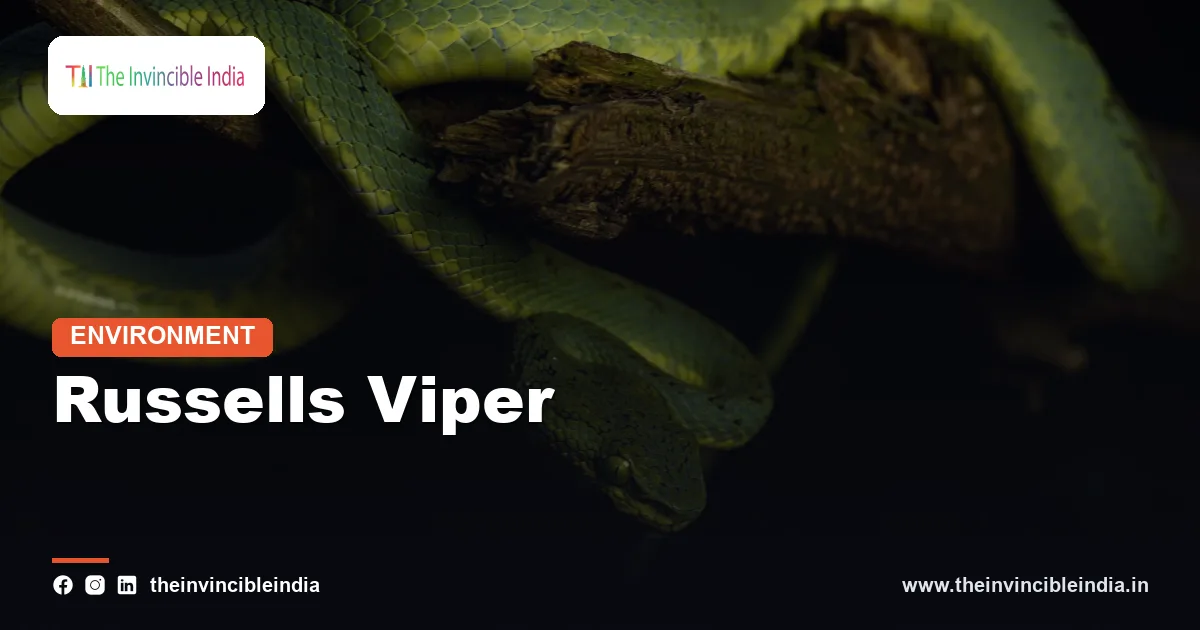
Russell’s viper is Daboia russelii, a stout, heavy-bodied venomous snake of the Indian subcontinent that is identified by the chain of dark, white-rimmed ovals along its back, and it is one of the “Big Four” snakes responsible for a large share of snakebite injuries and deaths in India. Its venom is haemotoxic, meaning it disrupts blood clotting and can cause severe bleeding and kidney failure.
This explainer covers how to identify Russell’s viper, where it lives, why it causes so many bites in farmland, what its venom does to the body, which first-aid steps are recommended and how hospitals treat envenoming. It also explains the snake’s role in rodent control and its legal protection in India. Information was last reviewed on 22 October 2026.
Quick Facts
| Common name | Russell’s viper, chain viper, daboia (Marathi: ghonas) |
|---|---|
| Scientific name | Daboia russelii (Shaw and Nodder, 1797) |
| Family | Viperidae (vipers) |
| Named after | Patrick Russell, a Scottish naturalist who studied the snakes of India in the 1700s |
| Typical adult length | Around 1 to 1.5 metres; thick and heavy-bodied |
| Distinctive pattern | Three rows of dark, white- or cream-edged oval spots along a tan to brown body |
| Venom type | Mainly haemotoxic; can disturb blood clotting and damage the kidneys |
| Reproduction | Gives birth to live young (ovoviviparous), often in large litters |
| Range | Across the Indian subcontinent, including India, Pakistan, Nepal, Bangladesh and Sri Lanka |
Key Takeaways
- Russell’s viper (Daboia russelii) is one of India’s “Big Four” medically important snakes and is widely reported to be responsible for a large share of serious snakebite cases in farming regions.
- The Russell’s viper is recognised by a chain of three rows of dark, white-rimmed oval spots along its back and by an exceptionally loud, prolonged hiss.
- Russell’s viper venom is mainly haemotoxic and can stop blood from clotting properly, cause severe bleeding and lead to acute kidney injury.
- Anyone bitten by a suspected Russell’s viper should be kept still and taken to a hospital with antivenom and dialysis facilities as soon as possible, without using folk remedies.
- Russell’s viper commonly lives in open farmland, grassland and scrub, and bites mostly occur on the feet, ankles and hands of agricultural workers.
- Russell’s viper gives birth to live young and feeds mainly on rats and mice, which makes it ecologically useful in agricultural landscapes.
What is Russell’s viper?
Russell’s viper is a large, venomous snake belonging to the viper family (Viperidae), native to South Asia and known for its thick body, triangular head and potent blood-affecting venom. It was named in honour of Patrick Russell, a Scottish physician and naturalist who documented Indian snakes in the late 18th century.
Vipers differ from cobras and kraits in the structure of their fangs. A viper has long, hinged fangs that fold back against the roof of the mouth when not in use and swing forward during a bite, allowing deep penetration. This helps explain why viper bites can inject venom deep into tissue.
Scientists have separated the Russell’s viper of South Asia (Daboia russelii) from the closely related eastern Russell’s viper (Daboia siamensis) found in parts of Southeast Asia and Taiwan, which has somewhat different venom. In India the snake is often called daboia or chain viper, and it has many local names, including ghonas in Marathi.
How can you identify a Russell’s viper?
A Russell’s viper can be identified by its stout body, flat triangular head distinct from the neck, vertical slit-like pupils and a pattern of large dark ovals outlined in white or cream running in three rows down the back. The general colour is tan, yellowish brown or dark brown, and the underside is pale.
The ovals in the middle row typically form a chain-like series, with smaller spots along the flanks. The head usually shows a pair of dark streaks behind the eyes and a pale V-shaped mark. Adults commonly reach about a metre and a half in length, though most individuals seen are smaller, and the body looks very thick compared with its length.
Why is the hiss so well known?
The hiss of Russell’s viper is one of the loudest produced by any snake. When disturbed, the snake coils into a tight S-shape, inflates its body and exhales in long, deep hisses that can be heard from a distance, a warning display that often precedes a strike. The snake can strike quickly and with surprising range for its size, so people should step back and give the snake room. Hearing this sound in grass or crops is a strong signal to keep still and move away carefully.
Where does Russell’s viper live?
Russell’s viper lives across most of the Indian subcontinent, favouring open grassland, scrub, farmland, paddy fields and plantations where rodents are plentiful. It usually avoids dense forest, very high mountains and true desert, although it can be found in a wide variety of settings.
The snake shelters in rat burrows, thick vegetation, crop fields, stacks of cut stalks and bundles of fodder, and may rest in the open on cool mornings and evenings. It is mainly active at night but may also be seen at dusk and dawn. After harvest, when workers walk through dense crops, or during the monsoon, when burrows flood and snakes move, encounters become more likely.
Because the species is so closely tied to farmland, Russell’s viper is a significant cause of occupational snakebite in rural India, especially in parts of the south, the Deccan, the plains of the north and western regions. Exact regional proportions vary between studies and over time, so figures should be treated with caution.
What does Russell’s viper eat and how does it breed?
Russell’s viper mainly eats rodents such as rats and mice, but it also eats lizards, frogs, scorpions, crabs and other small animals. In farmland it acts as a natural check on rodent populations that damage stored grain and crops.
The snake is an ambush hunter that waits for prey to pass, strikes, releases the animal and then follows the scent trail to find it after the venom has worked. Young snakes may feed on insects and small lizards.
Unlike cobras and kraits, which lay eggs, Russell’s viper gives birth to live young. A female can produce a large litter, with numbers recorded in the dozens, in the early part of the monsoon season. The newborn snakes are fully venomous and independent, and they scatter into surrounding vegetation within days. This reproductive pattern means that the number of snakes in a field can rise during the rainy season, when people are also busy with farm work.
How does Russell’s viper venom affect the body?
Russell’s viper venom mainly affects the blood and blood vessels, causing disordered clotting, bleeding, low blood pressure and damage to the kidneys. It contains enzymes that activate clotting factors, which uses them up and leaves the blood unable to clot properly.
Effects reported in clinical studies of Russell’s viper bites include:
- Intense local pain, swelling and bruising that may spread up the limb and form blisters
- Bleeding from the gums, nose, or the bite site, and blood in urine or stool
- Blood that does not clot at all (incoagulable blood), which doctors check with a simple bedside test
- Falling blood pressure and shock in severe cases
- Reduced urine output and acute kidney injury that may require dialysis
In some populations, especially in parts of southern India and Sri Lanka, Russell’s viper venom also causes neurotoxic features such as drooping eyelids and weakness. Survivors can also experience longer-term complications, including chronic kidney problems and, in some cases, failure of the pituitary gland, which may appear weeks or months later and need follow-up care. How much venom is injected, the site of the bite and the speed of treatment strongly influence severity.
What should you do after a Russell’s viper bite?
After a suspected Russell’s viper bite, the person should be kept calm and still, the bitten limb should be immobilised, and the patient should be taken to a hospital that has antivenom and facilities to manage kidney failure as quickly as possible. The first hours are critical because the clotting problem and organ damage progress with time.
Recommended first-aid steps
- Move away from the snake and ask the person to lie or sit down and move as little as possible.
- Immobilise the bitten limb, as with a broken bone, and remove rings, bangles, anklets and tight footwear before swelling develops.
- Arrange the fastest safe transport to a hospital with antivenom, calling an ambulance such as 108 in many states.
- Note the time of the bite and any symptoms such as bleeding or swelling, and take a photograph of the snake only if it is safe to do so.
- Avoid giving aspirin or similar painkillers unless a doctor advises it, because they can worsen bleeding.
What should be avoided?
People should not cut the bite, suck the venom, tie tight bands or tourniquets, apply ice, or use herbs, oils, stones or other traditional remedies. Such measures can damage the limb, introduce infection, and waste the time needed to reach medical care. Treatment by traditional healers before reaching a hospital is repeatedly cited in studies as a cause of delay and avoidable deaths. Only antivenom and hospital care have been shown to work.
How is a Russell’s viper bite treated?
A Russell’s viper bite is treated in hospital with intravenous polyvalent antivenom, close monitoring of blood clotting and kidney function, and supportive care such as fluids, blood products and dialysis if needed. Treatment decisions are guided by the patient’s symptoms and test results.
In India, doctors commonly use the 20-minute whole blood clotting test, a simple bedside check in which a small sample of blood is left in a clean glass tube to see whether it clots. If the blood fails to clot, it is a sign of venom-induced clotting disorder, and antivenom is given. Doctors also look for signs of kidney injury, bleeding and low blood pressure.
The polyvalent antivenom made in India is raised against the Big Four, including Russell’s viper. Its effectiveness can differ in some regions because venom composition varies across the species’ wide range, an issue under research. Patients with kidney failure may need dialysis for days or weeks. Doctors also give tetanus prevention and treat any local tissue damage. After discharge, patients with kidney or hormonal complications need follow-up.
Why does Russell’s viper cause so many bites?
Russell’s viper causes so many bites because it lives in the same open farmland where millions of people work barefoot or in sandals, and because it tends to stay still and rely on camouflage rather than flee. The snake’s pattern blends with dry leaves and soil, so workers can step on it without seeing it.
The snake’s habits explain much of the pattern. It frequently rests curled in grass or beside crop rows during the day, and many bites occur during harvest, ploughing, weeding or while walking at dusk. Most bites are on the lower limbs, followed by the hands and arms.
India is widely reported to have the largest number of snakebite deaths of any country. A national mortality study published in 2020 estimated an average of roughly 58,000 snakebite deaths a year over the period 2000 to 2019, though estimates differ and the true figure is hard to establish because many cases in remote areas go unrecorded. Snakebite envenoming is recognised by the World Health Organization as a neglected tropical disease. Studies of hospital admissions in many regions point to Russell’s viper as a leading cause of the most severe cases, but proportions vary by place and by year.
How does Russell’s viper compare with the other Big Four?
Russell’s viper differs from the other three of the Big Four mainly in its venom, which is chiefly haemotoxic, whereas the cobra and krait venoms are chiefly neurotoxic. The table below summarises the key points.
| Snake | Group | Main venom effect | Typical habitat |
|---|---|---|---|
| Spectacled cobra (Naja naja) | Elapid | Neurotoxic paralysis with local tissue damage | Farmland, villages, forest edges |
| Common krait (Bungarus caeruleus) | Elapid | Neurotoxic paralysis, often with painless bites at night | Houses, farmland, scrub |
| Russell’s viper (Daboia russelii) | Viper | Bleeding, clotting failure and kidney injury | Open grassland, crops, scrub |
| Saw-scaled viper (Echis carinatus) | Viper | Bleeding and clotting disorders | Dry, sandy and rocky scrub |
The same polyvalent antivenom is designed to cover all four species, which is why a quick transfer to a hospital is more important than identifying the exact snake.
Is Russell’s viper protected in India?
Russell’s viper is a wild animal protected under the Wildlife (Protection) Act, 1972, which restricts hunting, capture and trade in snakes in India. The schedule listing has changed with amendments to the law, so it is best to check the current text of the Act.
Across its range, the species is not considered globally threatened, but it is often killed on sight, and farmland changes affect local populations. Trained snake rescuers can relocate snakes found in homes or fields. The safest approach for the public is to leave the snake alone and call a rescuer or the forest department, because most bites happen when people try to kill or handle the animal.
How can farmers reduce the risk of bites?
Farmers and field workers can reduce the risk of Russell’s viper bites by wearing sturdy boots and long trousers, using a torch at dusk and after dark, and being careful where they put their hands and feet in dense crops and straw. Most bites in agricultural settings are preventable.
- Wear closed boots or gum boots when working in fields, and use gloves when handling straw, firewood and bundles.
- Carry a stick to move vegetation and a torch when walking in the evening or at night.
- Keep fields, bunds and yards tidy and manage rats and grain storage to limit prey.
- Do not reach into holes, piles of crop residue or dark crevices without looking.
- Learn the location of the nearest hospital that stocks antivenom and plan transport in advance.
Bottom Line
Russell’s viper is a camouflaged, loud-hissing and ecologically useful snake whose haemotoxic venom makes every bite an emergency. Immobilise the limb, avoid folk remedies, and reach a hospital with antivenom and dialysis support quickly.
Frequently Asked Questions
What is Russell’s viper?
Russell’s viper is Daboia russelii, a heavy-bodied venomous snake of South Asia with a chain of white-rimmed oval spots along its back. It is one of the “Big Four” snakes of India. Its venom mainly affects the blood and kidneys.
How dangerous is a Russell’s viper bite?
A Russell’s viper bite is a medical emergency because its venom can stop the blood from clotting, cause heavy bleeding and damage the kidneys. The seriousness depends on how much venom is injected and how quickly treatment starts. Prompt antivenom and hospital care greatly improve the outlook.
What are the symptoms of a Russell’s viper bite?
Typical symptoms include severe pain and swelling at the bite site, bruising, bleeding from the gums or nose, blood in the urine and reduced urine output. Blood pressure can fall, and the kidneys may be injured. Some patients, particularly in parts of southern India, also develop drooping eyelids or weakness.
What should I do if a Russell’s viper bites someone?
Keep the person calm and still, immobilise the bitten limb, remove tight items and take them to a hospital with antivenom immediately. Do not cut the wound, suck out venom, tie a tight tourniquet or try herbal or folk remedies. Avoid aspirin and similar painkillers unless a doctor advises them.
Where is Russell’s viper found in India?
Russell’s viper is found across most of India in open grassland, scrub, plantations and farmland, particularly in paddy and crop-growing regions. It generally avoids dense forest, high mountains and true desert. Bites are most common in rural areas during harvest and the monsoon.
Why does Russell’s viper hiss so loudly?
Russell’s viper hisses loudly as a warning to deter predators and large animals before it strikes. It coils into an S-shape and exhales forcefully, producing a long, deep hiss that is among the loudest of any snake. Hearing it is a signal to step back slowly and move away.
{“@context”:”https://schema.org”,”@graph”:[{“@type”:”FAQPage”,”mainEntity”:[{“@type”:”Question”,”name”:”What is Russell’s viper?”,”acceptedAnswer”:{“@type”:”Answer”,”text”:”Russell’s viper is Daboia russelii, a heavy-bodied venomous snake of South Asia with a chain of white-rimmed oval spots along its back. It is one of the “Big Four” snakes of India. Its venom mainly affects the blood and kidneys.”}},{“@type”:”Question”,”name”:”How dangerous is a Russell’s viper bite?”,”acceptedAnswer”:{“@type”:”Answer”,”text”:”A Russell’s viper bite is a medical emergency because its venom can stop the blood from clotting, cause heavy bleeding and damage the kidneys. The seriousness depends on how much venom is injected and how quickly treatment starts. Prompt antivenom and hospital care greatly improve the outlook.”}},{“@type”:”Question”,”name”:”What are the symptoms of a Russell’s viper bite?”,”acceptedAnswer”:{“@type”:”Answer”,”text”:”Typical symptoms include severe pain and swelling at the bite site, bruising, bleeding from the gums or nose, blood in the urine and reduced urine output. Blood pressure can fall, and the kidneys may be injured. Some patients, particularly in parts of southern India, also develop drooping eyelids or weakness.”}},{“@type”:”Question”,”name”:”What should I do if a Russell’s viper bites someone?”,”acceptedAnswer”:{“@type”:”Answer”,”text”:”Keep the person calm and still, immobilise the bitten limb, remove tight items and take them to a hospital with antivenom immediately. Do not cut the wound, suck out venom, tie a tight tourniquet or try herbal or folk remedies. Avoid aspirin and similar painkillers unless a doctor advises them.”}},{“@type”:”Question”,”name”:”Where is Russell’s viper found in India?”,”acceptedAnswer”:{“@type”:”Answer”,”text”:”Russell’s viper is found across most of India in open grassland, scrub, plantations and farmland, particularly in paddy and crop-growing regions. It generally avoids dense forest, high mountains and true desert. Bites are most common in rural areas during harvest and the monsoon.”}},{“@type”:”Question”,”name”:”Why does Russell’s viper hiss so loudly?”,”acceptedAnswer”:{“@type”:”Answer”,”text”:”Russell’s viper hisses loudly as a warning to deter predators and large animals before it strikes. It coils into an S-shape and exhales forcefully, producing a long, deep hiss that is among the loudest of any snake. Hearing it is a signal to step back slowly and move away.”}}]}]}


