

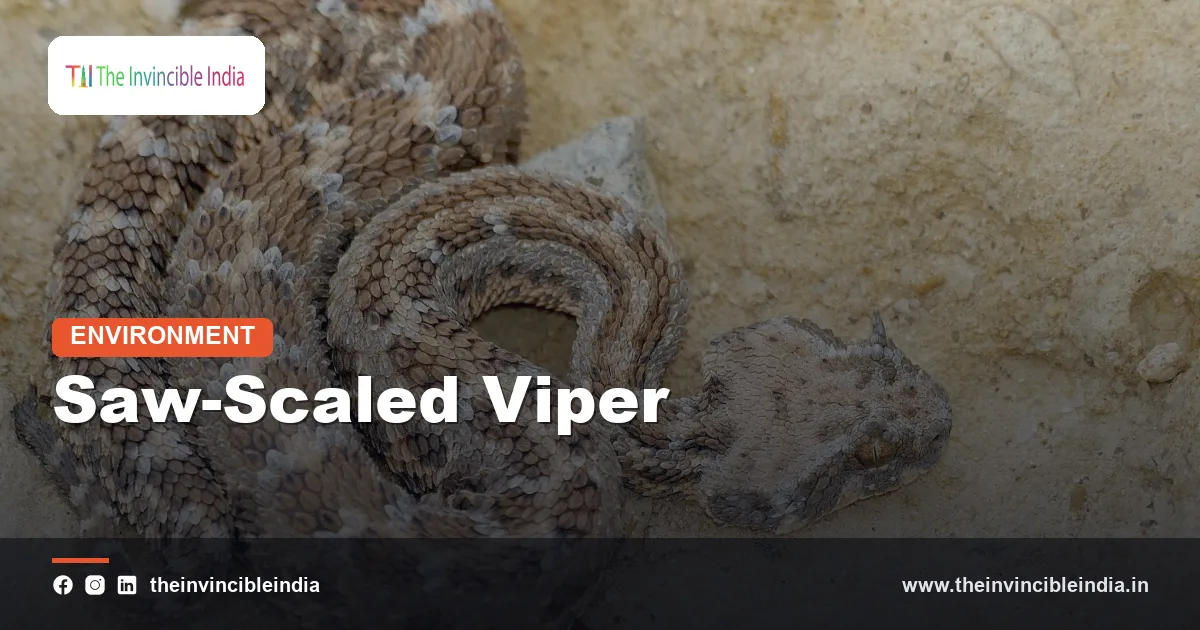
The saw-scaled viper is Echis carinatus, a small, irritable and highly venomous viper of the dry parts of the Indian subcontinent that warns intruders by rubbing its serrated body scales together to make a rasping, sizzling sound. It is the smallest of India’s “Big Four” venomous snakes, but its haemotoxic venom and its habit of living close to farms and villages make it a major cause of snakebite.
This explainer covers how to identify the saw-scaled viper, how it makes its distinctive sound, where it lives, what its venom does, and what to do after a bite. It also describes how the species is treated in hospital, why such a small snake causes so many serious bites, and how people can reduce their risk. Information was last reviewed on 22 October 2026.
Quick Facts
| Common name | Saw-scaled viper, Indian saw-scaled viper, carpet viper (Hindi: phoorsa) |
|---|---|
| Scientific name | Echis carinatus (Schneider, 1801) |
| Family | Viperidae (vipers) |
| Typical adult length | Roughly 30 to 60 centimetres; the smallest of the Big Four |
| Distinctive feature | Keeled, serrated side scales that are rubbed together to produce a rasping sound |
| Venom type | Mainly haemotoxic; disrupts blood clotting and causes bleeding and swelling |
| Habitat | Arid and semi-arid scrub, sandy and rocky ground, farmland and dry grassland |
| Reproduction | Gives birth to live young, with small litters |
| Range | Dry regions of India and neighbouring countries, including Pakistan and Sri Lanka |
Key Takeaways
- The saw-scaled viper (Echis carinatus) is the smallest of India’s “Big Four” medically important venomous snakes but is a major cause of serious snakebite in dry regions.
- The saw-scaled viper makes a rasping, sizzling warning sound by rubbing its serrated side scales together while coiled in loops.
- Saw-scaled viper venom is mainly haemotoxic and can stop blood clotting, causing bleeding, swelling and tissue damage.
- The saw-scaled viper lives in arid and semi-arid scrub, sandy and rocky land and dry farmland, and its camouflage makes it easy to step on by accident.
- Anyone bitten by a suspected saw-scaled viper should be kept still and taken at once to a hospital with antivenom, and should not use folk remedies.
- The saw-scaled viper feeds on scorpions, centipedes, insects, lizards and small rodents and gives birth to live young.
What is the saw-scaled viper?
The saw-scaled viper is a small venomous snake in the viper family (Viperidae), found in the drier regions of South Asia, and it is one of the four species India treats as medically most important for snakebite. Its scientific name, Echis carinatus, refers to its keeled scales, and the species was described in 1801.
Several closely related forms exist, and taxonomists have revised the group over time. The saw-scaled viper of peninsular India and Sri Lanka is Echis carinatus in the strict sense, while the populations of north-western India, including the Thar Desert, are now often treated as a separate species, Echis sochureki. Because older literature treats these forms as subspecies, readers may see both names in different sources.
All these snakes share a compact body, a short tail, a small head distinct from the neck and a mean temper. In English they are also called carpet vipers, a name used mostly in Africa and West Asia, where related species occur.
How can you identify a saw-scaled viper?
A saw-scaled viper can be identified by its small size, light sandy-brown or greyish colour, a wavy, pale zigzag line along each flank, and a pale cross-shaped or arrow-like mark on top of its head. Its eyes have vertical pupils and are relatively large.
The back usually carries a series of pale, dark-edged blotches or saddle-like marks. The scales on the sides of the body are strongly keeled with tiny serrations, the feature that gives the snake its common name. The body is stout for its length and tapers quickly to a short tail.
Which snakes are mistaken for it?
Young Russell’s vipers, sand boas and some harmless racer snakes may be mistaken for a saw-scaled viper. The best clues are the snake’s small size, its rough scales, the rasping sound and the mark on the head, but identification is difficult for non-experts. Anyone bitten by a small, patterned snake in dry scrub should be treated as if bitten by a venomous species until a doctor has assessed the situation.
How does the saw-scaled viper make its sound?
The saw-scaled viper makes its sound by coiling its body into a series of C-shaped loops and rubbing the serrated scales on its sides against each other, producing a dry, sizzling rasp. This behaviour is called stridulation, and it is quite different from hissing, which depends on breath.
The sound is a warning to predators and large animals and is often compared to water drops falling on a hot pan or to a saw cutting wood. The snake moves its coils against one another in alternating motions, and the sound grows louder as it feels more threatened. Often the snake also flicks its head and strikes with remarkable speed.
The warning sound can give people a chance to back away, but it can be hard to hear in noisy fields or when people are wearing headphones or working with machinery. Hearing a sizzling noise in dry grass or sand should prompt a person to stop, locate the source with their eyes, and move away slowly without sudden movements.
Where does the saw-scaled viper live and what does it eat?
The saw-scaled viper lives in the dry, open parts of India, particularly in arid and semi-arid regions with sandy or rocky ground, scrub and sparse vegetation. It is common in places such as Rajasthan, Gujarat, parts of Maharashtra, the Deccan plateau and Tamil Nadu, and it is generally absent from wet evergreen forest.
The snake also occurs in Pakistan, Sri Lanka and other dry regions of South and West Asia. In India it is often found in rocky outcrops, dry stream beds, stone walls, farm fields, brick kilns and the edges of villages. It hides under stones, in crevices, in loose soil and under leaf litter, and it can climb low bushes.
The saw-scaled viper is mostly active at night and in the early evening, although it may be seen in daylight, especially in cool weather. After rain or in warmer months it moves more, which increases contact with people in the countryside. Reports note that its numbers can be high locally, so bites cluster in specific dry districts.
What does the saw-scaled viper eat?
The saw-scaled viper mainly eats scorpions, centipedes, large insects, lizards, frogs and small rodents. It is an ambush predator that waits in a hiding place for prey to approach.
The snake’s reliance on invertebrates such as scorpions is unusual among Indian venomous snakes and helps explain why the species does well in very dry environments. Young snakes tend to eat insects and small lizards.
Female saw-scaled vipers give birth to live young, with litters that are typically small compared with those of Russell’s viper. The newborns are only a few inches long but are venomous and active. Their diet and small size mean that the species plays a role in controlling insects and small vertebrates in dry ecosystems.
How does saw-scaled viper venom affect the body?
Saw-scaled viper venom mainly affects the blood, activating clotting factors until the blood can no longer clot, and it also causes swelling and tissue damage near the bite. This combination can lead to bleeding from the bite site and from other parts of the body.
The venom of Echis species is known worldwide as a leading cause of snakebite complications, and in India the saw-scaled viper is regarded as one of the main species behind severe bites in dry regions. Commonly described effects include:
- Pain and swelling at the bite site that can spread up the limb, sometimes with blisters and bruising
- Bleeding from the gums, nose, wound or the urine, due to failure of blood clotting
- Blood that fails to clot in a simple bedside blood test
- Low blood pressure and, in severe cases, shock
- Kidney injury in some patients, though this is generally reported less often than with Russell’s viper
The amount of venom injected by a small snake is lower than that by a large one, but the venom is potent, and doctors stress that the small size of the snake should never be taken as a sign of low risk. Venom composition is known to vary between regions, which can affect symptoms and treatment response.
What should you do after a saw-scaled viper bite?
After a suspected saw-scaled viper bite, the person should be kept calm and still, the bitten limb should be immobilised, and the patient should be taken to a hospital with antivenom as quickly as possible. Because the venom disrupts blood clotting, delays can allow bleeding and swelling to worsen.
Recommended first-aid steps
- Move away from the snake, which may strike again, and make the person sit or lie down.
- Immobilise the bitten limb, as for a fracture, and remove rings, bangles and tight clothes before swelling begins.
- Arrange immediate transport to a hospital with antivenom, calling an ambulance such as 108 in many states.
- Note the time of the bite and watch for bleeding, swelling or dizziness, and photograph the snake only if safe.
- Avoid giving aspirin or similar painkillers unless a doctor advises it, since they can increase bleeding risk.
What should not be done?
Do not cut the bite, suck the wound, apply a tight tourniquet or ice, or use herbs, oils, stones or other traditional remedies. These practices do not neutralise the venom, may cause infection or worsen swelling, and use up valuable time. The only proven treatment is antivenom given in a hospital, together with supportive care.
How is a saw-scaled viper bite treated?
A saw-scaled viper bite is treated in hospital with intravenous polyvalent antivenom, supported by regular blood-clotting checks, fluids and, if necessary, blood products and care for the bitten limb. Doctors rely on symptoms and tests to decide how much antivenom to give.
Hospitals in India often use the 20-minute whole blood clotting test, in which a few millilitres of the patient’s blood are left in a clean glass tube to see if a clot forms. Failure of the blood to clot supports the diagnosis of viper envenoming and suggests the need for antivenom. The test can be repeated to see whether treatment is working.
The polyvalent antivenom made in India is raised against the Big Four, including the saw-scaled viper. Its effectiveness can differ in some regions because venom composition varies, a point researchers continue to study. Doctors also watch for swelling that puts pressure on muscles (compartment syndrome), give tetanus protection and treat infections. Most patients recover with timely care, but survivors may have lasting tissue damage if treatment is delayed.
Why does such a small snake cause so many bites?
The saw-scaled viper causes many bites because it is well camouflaged, common in dry farmland, quick to strike, and likely to be stepped on or picked up by accident. Its small size makes it easy to overlook in sand, leaf litter and crop stubble.
Most reported bites involve the hands and feet of farm workers, labourers and herders who are working or walking in dry areas, often at dusk. Rural communities in arid districts may have limited access to hospitals that stock antivenom, which raises the risk of severe outcomes. Snakebite envenoming is recognised by the World Health Organization as a neglected tropical disease, and India is widely reported to have the highest snakebite burden in the world.
A national mortality study published in 2020 estimated an average of roughly 58,000 snakebite deaths a year in India over the period 2000 to 2019, though such estimates are uncertain because many rural cases are never recorded in hospitals. The share of bites attributed to each species varies by region and study, so the figures should be read with caution.
How does the saw-scaled viper compare with other Big Four snakes?
The saw-scaled viper is the smallest of the Big Four and shares haemotoxic venom with Russell’s viper, while the cobra and krait have mainly neurotoxic venom. The table below compares their key traits.
| Snake | Approximate adult length | Warning behaviour | Main venom effect |
|---|---|---|---|
| Spectacled cobra | 1.2 to 1.8 metres | Spreads a hood and hisses | Nerve paralysis and local tissue damage |
| Common krait | 0.9 to 1.2 metres | Timid; rarely displays | Nerve paralysis, often painless bite |
| Russell’s viper | 1 to 1.5 metres | Loud, prolonged hiss | Bleeding, clotting failure, kidney injury |
| Saw-scaled viper | 30 to 60 centimetres | Rasping sound from rubbing scales | Bleeding, clotting failure, swelling |
Because one polyvalent antivenom covers all four species, doctors do not need to identify the snake exactly before starting treatment.
Is the saw-scaled viper protected in India?
The saw-scaled viper is a wild animal protected under the Wildlife (Protection) Act, 1972, which restricts hunting, capture and trade in snakes. The schedule listing has been changed by amendments to the law, so the current text of the Act should be checked.
The species is not generally considered globally threatened because of its wide range, although local populations may be affected by habitat change and persecution. Trained snake rescuers can relocate vipers found in homes, farms and work sites. The safest course for the public is to avoid the snake, leave it alone and contact a rescuer or the forest department.
How can people avoid saw-scaled viper bites?
People can avoid saw-scaled viper bites by wearing closed boots, using a torch after dark, watching where they place their hands and feet, and clearing waste and clutter from around their homes and fields. Most bites are on the hands and feet, so protecting them is the key.
- Wear sturdy shoes or boots and long trousers in dry fields, scrub and rocky ground.
- Use a torch and a stick when walking after dark, and listen for the rasping sound.
- Do not pick up stones, logs, bundles of crop residue or firewood with bare hands.
- Keep houses and compounds tidy, and block gaps and holes where snakes can shelter.
- Know the location of the nearest hospital with antivenom, and plan quick transport.
Bottom Line
The saw-scaled viper is small, camouflaged and quick to strike, and its haemotoxic venom makes every bite a medical emergency. Listen for the rasping warning, protect hands and feet, and if bitten, immobilise the limb and reach a hospital with antivenom quickly rather than trying any folk remedy.
Frequently Asked Questions
What is a saw-scaled viper?
The saw-scaled viper is Echis carinatus, a small, highly venomous viper found in the dry parts of the Indian subcontinent. It is one of the “Big Four” venomous snakes of India. It is named for the serrated scales it rubs together to make a warning sound.
Why is it called a saw-scaled viper?
It is called a saw-scaled viper because the scales on its sides are keeled and serrated like the teeth of a saw. When threatened, the snake rubs these scales together to produce a rasping sound. This behaviour is called stridulation.
How dangerous is a saw-scaled viper bite?
A saw-scaled viper bite is a medical emergency because the venom can stop blood from clotting and cause bleeding, swelling and tissue damage. Severity depends on the amount of venom injected and how soon treatment starts. Prompt antivenom and hospital care improve the outcome.
What should I do if a saw-scaled viper bites someone?
Keep the person calm and still, immobilise the bitten limb, remove tight items such as rings, and take them to a hospital with antivenom immediately. Do not cut the wound, suck out venom, apply a tight tourniquet or use folk remedies. Avoid aspirin and similar painkillers unless a doctor advises them.
Where does the saw-scaled viper live in India?
The saw-scaled viper lives in dry, open habitats such as arid scrub, sandy and rocky ground and dry farmland, in places like Rajasthan, Gujarat, the Deccan plateau and Tamil Nadu. It generally avoids wet evergreen forest. It hides under stones and in crevices during the day.
Is the saw-scaled viper the most dangerous snake in India?
No single snake can be called the most dangerous, because risk depends on the region, the venom injected and how fast treatment is given. The saw-scaled viper is one of the Big Four species responsible for most serious snakebites in India. It is small, but its venom is potent and bites need urgent hospital care.
{“@context”:”https://schema.org”,”@graph”:[{“@type”:”FAQPage”,”mainEntity”:[{“@type”:”Question”,”name”:”What is a saw-scaled viper?”,”acceptedAnswer”:{“@type”:”Answer”,”text”:”The saw-scaled viper is Echis carinatus, a small, highly venomous viper found in the dry parts of the Indian subcontinent. It is one of the “Big Four” venomous snakes of India. It is named for the serrated scales it rubs together to make a warning sound.”}},{“@type”:”Question”,”name”:”Why is it called a saw-scaled viper?”,”acceptedAnswer”:{“@type”:”Answer”,”text”:”It is called a saw-scaled viper because the scales on its sides are keeled and serrated like the teeth of a saw. When threatened, the snake rubs these scales together to produce a rasping sound. This behaviour is called stridulation.”}},{“@type”:”Question”,”name”:”How dangerous is a saw-scaled viper bite?”,”acceptedAnswer”:{“@type”:”Answer”,”text”:”A saw-scaled viper bite is a medical emergency because the venom can stop blood from clotting and cause bleeding, swelling and tissue damage. Severity depends on the amount of venom injected and how soon treatment starts. Prompt antivenom and hospital care improve the outcome.”}},{“@type”:”Question”,”name”:”What should I do if a saw-scaled viper bites someone?”,”acceptedAnswer”:{“@type”:”Answer”,”text”:”Keep the person calm and still, immobilise the bitten limb, remove tight items such as rings, and take them to a hospital with antivenom immediately. Do not cut the wound, suck out venom, apply a tight tourniquet or use folk remedies. Avoid aspirin and similar painkillers unless a doctor advises them.”}},{“@type”:”Question”,”name”:”Where does the saw-scaled viper live in India?”,”acceptedAnswer”:{“@type”:”Answer”,”text”:”The saw-scaled viper lives in dry, open habitats such as arid scrub, sandy and rocky ground and dry farmland, in places like Rajasthan, Gujarat, the Deccan plateau and Tamil Nadu. It generally avoids wet evergreen forest. It hides under stones and in crevices during the day.”}},{“@type”:”Question”,”name”:”Is the saw-scaled viper the most dangerous snake in India?”,”acceptedAnswer”:{“@type”:”Answer”,”text”:”No single snake can be called the most dangerous, because risk depends on the region, the venom injected and how fast treatment is given. The saw-scaled viper is one of the Big Four species responsible for most serious snakebites in India. It is small, but its venom is potent and bites need urgent hospital care.”}}]}]}


