

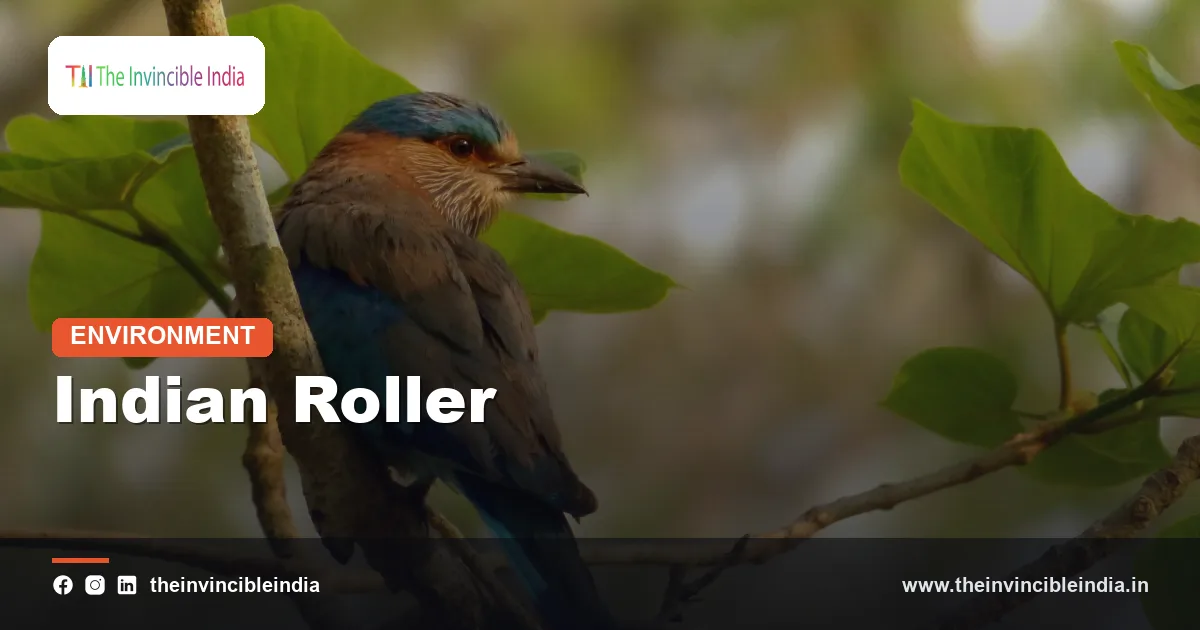
The Indian roller (Coracias benghalensis), known in Hindi as the neelkanth, is a stocky, blue-winged bird of open country that perches on wires and bare branches, drops on insects and other small prey from above, and is named for the tumbling, rolling flight with which the male displays during the breeding season. The Indian roller is one of the most striking and widespread birds of the subcontinent: a dull brownish bird at rest that explodes into shades of turquoise, azure and deep blue the moment it opens its wings.
This explainer covers how to identify the Indian roller, why it is called the neelkanth, how it hunts and breeds, where it is celebrated as a state bird, the Dussehra tradition of sighting it, and the conservation issues it faces. Last updated 22 October 2026.
| Common name | Indian roller (neelkanth, blue jay in older Indian English) |
|---|---|
| Scientific name | Coracias benghalensis |
| Family | Coraciidae (rollers) |
| Body length | Roughly 30 to 34 cm |
| Key colours | Greenish-blue head and body, cinnamon-brown breast, bright turquoise and ultramarine wings |
| Habitat | Open farmland, scrub, grassland, roadsides and light woodland |
| Hunting style | Sit-and-wait perch hunting followed by a pounce on prey |
| State bird of | Karnataka, Andhra Pradesh, Telangana and Odisha |
| IUCN Red List status | Least Concern |
Key Takeaways
- The Indian roller is a thrush-sized to pigeon-sized bird whose wings flash bright turquoise and ultramarine in flight although the body appears brownish-lilac at rest.
- The Indian roller is called the neelkanth, meaning blue-throated, a name it shares with an epithet of Lord Shiva, which is why the bird is regarded as auspicious in many parts of India.
- The Indian roller gets its English name from the courtship and territorial display flight in which the male dives and rolls from side to side while calling harshly.
- The Indian roller hunts by perching on a wire or branch and pouncing on grasshoppers, beetles, scorpions, lizards and other prey on the ground, so it is valued by farmers as a controller of pests.
- The Indian roller is the state bird of Karnataka, Andhra Pradesh, Telangana and Odisha.
- The Indian roller nests in cavities in trees, walls and buildings, and it is not globally threatened, though it faces local pressures from pesticides, road traffic and habitat loss.
What Is the Indian Roller?
The Indian roller is a medium-sized bird in the roller family, Coraciidae, found across the Indian subcontinent in open and semi-open habitats, and it is easily recognised by its blue wings and its habit of sitting upright on exposed perches. Rollers are distant relatives of kingfishers and bee-eaters and share their strong bills, bright colours and cavity-nesting habits.
The species was described scientifically in the 18th century, and its Latin name benghalensis refers to Bengal. It is common enough that many Indians know it by sight, though they may call it by different names in different regions, but neelkanth is the best-known name, and each language has its own local terms.
Subspecies and relatives
The nominate form occupies most of the Indian subcontinent, while a related form, treated by some authorities as the Indochinese roller (Coracias affinis), occurs farther east, including parts of north-eastern India and mainland South-East Asia. Other rollers recorded in India include the European roller (Coracias garrulus), a passage migrant through western India, and the broad-billed roller (Eurystomus orientalis). Taxonomists have revised the arrangement of rollers and their subspecies over time, so the exact boundaries are best checked against a current checklist.
What Does the Indian Roller Look Like?
The Indian roller looks like a heavy-headed, short-necked bird with a thick bill, a brown back, a lilac-brown breast streaked with pale lines, and a blue-green crown and tail. When perched, the roller seems modestly coloured, but the open wing shows alternating bands of dark blue and bright turquoise that are among the most brilliant of any Indian bird.
Sexes look alike, and juveniles are duller with browner tones. The tail is relatively short and squarish, with a dark blue tip and bright central patches, and some birds have elongated outer tail feathers. The bill is dark, strong and slightly hooked at the tip, suited to gripping struggling prey.
Field marks to look for
- Brown, finely streaked breast and lilac wash on the neck.
- Pale blue patch on the forehead and eyebrow area.
- Bright turquoise and deep blue bands on the open wing, visible in flight.
- Upright posture on a wire, post or dead branch overlooking open ground.
Why Is the Indian Roller Called the Neelkanth?
The Indian roller is called the neelkanth because the Hindi word neelkanth means blue-throated, and the bird’s brilliant blue wings and tail made people associate it with Lord Shiva, who is also called Neelkanth after the blue throat he is said to have received on drinking poison in Hindu tradition. The association gave the bird a sacred and auspicious reputation across much of the country.
Because of this link, the Indian roller has been regarded as a bird of good fortune in many regions. Farmers and travellers have traditionally welcomed a sighting, and in some places the bird was believed to bring prosperity or to be a sign of a successful harvest. The same name is applied to other blue birds in some regions, so it is wise to confirm the species when reading folk accounts.
How Does the Indian Roller Hunt?
The Indian roller hunts by sitting motionless on a perch such as a telegraph wire, fence post or bare branch, scanning the ground for movement, and then dropping on its prey in a quick pounce before often returning to the same perch. This sit-and-wait approach is energy-efficient and is shared by shrikes, kingfishers and bee-eaters.
The diet is mostly large insects and other small animals. Typical prey includes grasshoppers, crickets, beetles, caterpillars, termite alates, scorpions, spiders, centipedes and small lizards, and the bird will sometimes catch frogs, small snakes or even nestlings and rodents. Prey is often beaten against the perch before being swallowed. In areas where grasshoppers or locusts erupt, rollers gather in numbers to feed on them.
Why farmers value rollers
Many crop pests are among the Indian roller’s regular prey, so the bird is considered beneficial to agriculture. Ecologists note that the benefit depends on how many birds live in an area, which in turn depends on the availability of perches, nesting sites and unpoisoned insects. Roadside wires, field-edge trees and old buildings all provide useful habitat.
Why Is It Called a Roller?
The Indian roller is called a roller because of the courtship flight in which the male climbs steeply, then folds his wings and tumbles, rolling and twisting from side to side with loud, harsh calls. The behaviour gives the whole family its name, and it is the most spectacular display performed by any bird of Indian farmland.
The aerial display serves two purposes. It advertises the male’s strength and fitness to females, and it warns rival males that the territory is occupied. A pair may take turns diving at intruders, and the same rolling flight is used to chase other birds. The display is most often seen at the start of the breeding season, though it can occur at other times.
Outside the display, the Indian roller’s normal flight is steady and direct, with powerful wingbeats. The contrast between this direct flight and the sudden tumbling dive is one reason that sightings are memorable.
Which Indian States Have the Indian Roller as Their State Bird?
The Indian roller is the state bird of Karnataka, Andhra Pradesh, Telangana and Odisha, which makes it one of the most widely honoured birds in state symbolism. The bird was chosen in part because of its abundance, its beauty and its association with auspicious sightings.
| State | Status of the Indian roller |
|---|---|
| Karnataka | State bird |
| Andhra Pradesh | State bird |
| Telangana | State bird (as a separate state since 2014) |
| Odisha | State bird |
Telangana formed as a separate state in 2014, and the bird was retained as a state symbol there. Readers who need an official list should consult the relevant state government or the Government of India’s compilations, since official designations can be updated. The national bird of India is the Indian peafowl, not the Indian roller.
What Is the Dussehra Belief About the Indian Roller?
The Dussehra belief holds that seeing the Indian roller on Dussehra, also known as Vijayadashami, brings good luck and success, and the tradition is strongest in parts of southern, central and western India. The festival marks the victory of good over evil in Hindu tradition, and the neelkanth’s link with Shiva added to its auspicious reputation on that day.
In the past, some communities captured rollers before Dussehra so that they could be shown to people and released. Such practices harmed birds and are illegal under India’s wildlife law. Wildlife and bird organisations, along with forest departments, have campaigned for generations against the capture of the Indian roller for festival purposes and urge people to celebrate the belief by spotting a bird in the wild rather than catching one.
Responsible ways to honour the tradition
- Look for the bird in open fields or on roadside wires on Dussehra morning, from a distance.
- Never buy, catch or display a captured roller.
- Share photographs and sightings through citizen-science platforms rather than keeping birds.
- Report illegal trapping to the forest department or a local wildlife helpline.
How Does the Indian Roller Breed?
The Indian roller breeds by nesting in a cavity, usually a hole in a tree, a gap in a wall, a hollow in a building or an old woodpecker or barbet hole, where the female lays about three to five white eggs. The nesting season in most of India begins in the spring and runs into the early monsoon, varying with region.
Both parents take part in raising the young. The pair guards a territory around the nest, and the male performs the tumbling display near it. Chicks are fed on insects and small animals brought by both adults. The cavity gives the young protection but also makes the nest vulnerable if large trees and old buildings are removed.
Territory and behaviour
Indian rollers are strongly territorial in the breeding season and may be aggressive towards other birds, including birds of prey, that come near the nest. Outside the breeding season, they are often solitary, but several birds may gather where food is abundant. They are mostly resident, although local movements occur.
Where Is the Indian Roller Found?
The Indian roller is found across the Indian subcontinent, from Pakistan and Nepal through India and Bangladesh to Sri Lanka, and east into parts of Myanmar and mainland South-East Asia. Within India it is widespread in the plains and plateaus and is generally less common in dense forest and at high altitudes.
It prefers open country with scattered trees, such as farmland, grassland, scrubby wasteland, village edges and roadside strips. Many people see it on highways, because the wires and poles along roads provide ideal hunting perches. This habit also makes the species vulnerable to vehicle collisions.
Is the Indian Roller Protected or Threatened?
The Indian roller is not globally threatened and is classified as Least Concern by the IUCN, and it is a protected bird in India under the Wildlife (Protection) Act, 1972, which prohibits hunting and capture. The exact schedule has been revised through amendments, so readers should refer to the current legal text for the listing.
Local threats include pesticide use that poisons insect prey, collisions with vehicles, the loss of old nesting trees, and illegal capture for festivals or the pet trade. Because the species is common, it is sometimes taken for granted, but ornithologists note that long-term monitoring is needed to detect changes before they become serious. Population estimates should be treated with caution and are revised by organisations such as BirdLife International.
Bottom Line
The Indian roller is a brilliant blue perch-hunter whose tumbling courtship flight, Dussehra associations and state-bird status make it one of the best-loved birds of India. It is common and not globally threatened, but it is best honoured by watching it in the wild and protecting the open, insect-rich countryside that it needs.
Frequently Asked Questions
What is the Indian roller known as in Hindi?
The Indian roller is known in Hindi as the neelkanth, meaning blue-throated. The name links the bird to Lord Shiva, who is also called Neelkanth in Hindu tradition. Because of this connection, the bird is considered auspicious in many parts of India.
Why is it called a roller?
The Indian roller is called a roller because of the male’s courtship flight, in which he climbs, then tumbles and rolls from side to side while calling loudly. The display advertises his fitness to females and warns rivals. It gave the whole roller family its name.
What does the Indian roller eat?
The Indian roller eats mainly large insects such as grasshoppers, crickets and beetles, along with scorpions, spiders and small lizards. It hunts by perching on a wire or branch and pouncing on prey on the ground. It sometimes takes frogs or small rodents as well.
Which Indian states have the Indian roller as their state bird?
The Indian roller is the state bird of Karnataka, Andhra Pradesh, Telangana and Odisha. It is not the national bird of India, which is the Indian peafowl. Official designations can be updated, so check the relevant government source for the latest list.
Why is the Indian roller linked to Dussehra?
The Indian roller is linked to Dussehra because of a belief that seeing the neelkanth on that day brings good luck. The belief comes from the bird’s association with Lord Shiva. Capturing rollers for the occasion is illegal, so the bird should be watched only in the wild.
Is the Indian roller an endangered bird?
No, the Indian roller is not endangered and is classified as Least Concern by the IUCN. It remains common in farmland and open country across the subcontinent. Pesticides, road collisions, habitat loss and illegal capture are local concerns.
{“@context”:”https://schema.org”,”@graph”:[{“@type”:”FAQPage”,”mainEntity”:[{“@type”:”Question”,”name”:”What is the Indian roller known as in Hindi?”,”acceptedAnswer”:{“@type”:”Answer”,”text”:”The Indian roller is known in Hindi as the neelkanth, meaning blue-throated. The name links the bird to Lord Shiva, who is also called Neelkanth in Hindu tradition. Because of this connection, the bird is considered auspicious in many parts of India.”}},{“@type”:”Question”,”name”:”Why is it called a roller?”,”acceptedAnswer”:{“@type”:”Answer”,”text”:”The Indian roller is called a roller because of the male’s courtship flight, in which he climbs, then tumbles and rolls from side to side while calling loudly. The display advertises his fitness to females and warns rivals. It gave the whole roller family its name.”}},{“@type”:”Question”,”name”:”What does the Indian roller eat?”,”acceptedAnswer”:{“@type”:”Answer”,”text”:”The Indian roller eats mainly large insects such as grasshoppers, crickets and beetles, along with scorpions, spiders and small lizards. It hunts by perching on a wire or branch and pouncing on prey on the ground. It sometimes takes frogs or small rodents as well.”}},{“@type”:”Question”,”name”:”Which Indian states have the Indian roller as their state bird?”,”acceptedAnswer”:{“@type”:”Answer”,”text”:”The Indian roller is the state bird of Karnataka, Andhra Pradesh, Telangana and Odisha. It is not the national bird of India, which is the Indian peafowl. Official designations can be updated, so check the relevant government source for the latest list.”}},{“@type”:”Question”,”name”:”Why is the Indian roller linked to Dussehra?”,”acceptedAnswer”:{“@type”:”Answer”,”text”:”The Indian roller is linked to Dussehra because of a belief that seeing the neelkanth on that day brings good luck. The belief comes from the bird’s association with Lord Shiva. Capturing rollers for the occasion is illegal, so the bird should be watched only in the wild.”}},{“@type”:”Question”,”name”:”Is the Indian roller an endangered bird?”,”acceptedAnswer”:{“@type”:”Answer”,”text”:”No, the Indian roller is not endangered and is classified as Least Concern by the IUCN. It remains common in farmland and open country across the subcontinent. Pesticides, road collisions, habitat loss and illegal capture are local concerns.”}}]}]}


