

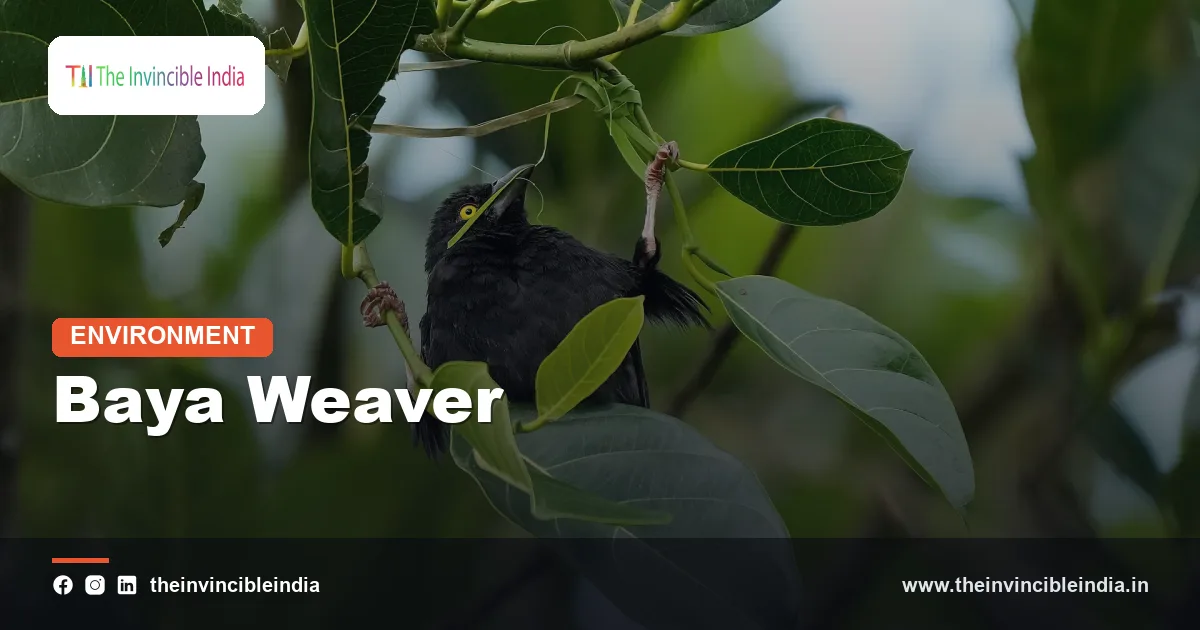
The baya weaver (Ploceus philippinus) is a small, sparrow-sized weaverbird of the Indian subcontinent and South-East Asia, famous for the males’ elaborate, retort-shaped hanging nests that they weave from strips of grass and paddy leaves and suspend from palms, thorny trees and wires, usually over or near water. The baya weaver breeds in noisy colonies during the monsoon, and the nest, not the bird, is what most people remember: a woven, flask-like structure with a long downward entrance tube that has become one of India’s best-known examples of animal architecture.
This explainer describes how the baya weaver builds its nest step by step, why the male builds several nests, how females choose among them, what the bird eats and where it lives, and how the species fares in a changing agricultural landscape. Last updated 22 October 2026.
| Common name | Baya weaver (also baya, weaver bird; Baya sparrow in older texts) |
|---|---|
| Scientific name | Ploceus philippinus |
| Family | Ploceidae (weavers) |
| Body length | About 15 cm, roughly the size of a house sparrow |
| Breeding males | Bright yellow crown, dark brown face mask and yellowish-brown upper parts |
| Nest type | Hanging, retort-shaped woven nest with a downward entrance tube |
| Habitat | Grasslands, farmland, wetlands, reedbeds and open country with scattered trees |
| Breeding season | Mostly the monsoon months in much of India |
| IUCN Red List status | Least Concern |
Key Takeaways
- The baya weaver is a sparrow-sized bird in which only the male builds the elaborate hanging nest, and the nest is woven from long strips torn from grass blades or paddy leaves.
- The baya weaver nest is shaped like a laboratory retort, with a rounded egg chamber at the top and a long narrow entrance tube pointing down.
- The male baya weaver usually builds several nests in a season and tries to attract a female to each; she inspects them and chooses one.
- The baya weaver nests in colonies, often in the crowns of palms, babul trees or other trees overhanging water, which helps shield the nests from some predators.
- The baya weaver lives in open grassland and cultivated country across the Indian subcontinent and is classified as Least Concern by the IUCN.
- The baya weaver is often described as a pest of ripening grain but also eats many insects, especially when feeding its chicks.
What Is the Baya Weaver?
The baya weaver is a small seed-eating bird in the weaver family (Ploceidae) that is native to the Indian subcontinent and parts of South-East Asia and is known for hanging nests that the male weaves. Outside the breeding season it is easily mistaken for a house sparrow or a female finch, because both sexes then wear streaky, buff-brown plumage.
Indian names for the bird include baya in Hindi and several other languages, and similar terms in regional tongues. The species was formally described in the 18th century by Carl Linnaeus. Its scientific name philippinus, meaning “of the Philippines”, is a historical misattribution of origin, since the species does not live there.
Where does it sit among India’s weavers?
India has several weaverbirds, and the baya weaver is the most widespread and familiar. Related species include the streaked weaver (Ploceus manyar), the black-breasted weaver (Ploceus benghalensis) and Finn’s weaver (Ploceus megarhynchus). Each species has a distinct plumage, habitat and nest shape, and the status of the rarer ones is more concerning than the baya weaver’s.
What Does the Baya Weaver Look Like?
The baya weaver looks like a stocky sparrow with a thick, conical bill, and the breeding male is transformed by a bright yellow crown and a blackish-brown mask on the face and throat. In breeding plumage the male’s upper parts are streaked brown and dark, and the yellow cap stands out clearly against the dark face, so he is easy to identify.
The female and non-breeding male are quite different. They have streaky buff-brown upper parts, a pale supercilium (eyebrow stripe), a pale underside and a pinkish-horn bill. This duller plumage leads many people to overlook the bird for most of the year, and it is the reason that the male in breeding dress looks like a different species.
Size and voice
The baya weaver is about 15 cm long and weighs only a few tens of grams. Its voice is a chattering, chirping series of notes, plus a distinctive wheezy trill; a colony at work produces a continuous murmur of sound. Males often hang from the nest, beating their wings while calling to attract a female.
Where Does the Baya Weaver Live in India?
The baya weaver lives across most of India in open habitats such as grasslands, farmland, scrub and wetland edges, and is found from the foothills of the Himalaya to the southern peninsula. It is generally absent from dense forest and from very dry desert, and it is more commonly found in low-lying or irrigated country.
Outside India, the species ranges across Pakistan, Nepal, Bangladesh, Sri Lanka and Myanmar, and related populations extend into South-East Asia. In Nepal and northern India it is mostly found at lower elevations.
Habitat requirements
A good baya weaver habitat has four ingredients:
- Tall grass, reeds or crops that supply nest material and seeds.
- Suitable nesting trees, such as palmyra palms, date palms, coconut palms or thorny acacias, often standing over water or a well.
- Water within easy reach for drinking and for nests that are built over a pond, canal or wetland.
- Open ground for foraging, such as paddy fields, grassy verges or fallow land.
Because these elements often occur together in the rural landscape, the baya weaver is one of the typical birds of the Indian countryside.
How Does the Baya Weaver Build Its Nest?
The baya weaver builds its nest by tearing long, narrow strips from living grass or paddy leaves and weaving them, with its bill, around a supporting branch or stalk, in stages that gradually form a hanging flask. Only the male builds, and the work is done almost entirely with the bill and feet, which makes the knots and loops all the more remarkable.
Ornithologists describe the construction as a sequence of recognisable stages. The details of timing vary between birds, but the shape of each stage is consistent, and this regularity is one reason the baya weaver has long attracted the attention of Indian naturalists, including Salim Ali.
The stages of building
| Stage | Description |
|---|---|
| Anchor | The male starts by knotting long fibre strips to a twig or leaf-stalk to form a secure attachment. |
| Ring | He weaves a loop or ring that hangs from the anchor and acts as the perch, from which he builds outward. |
| Helmet | The ring is extended into a dome, the helmet, which is usually the stage at which a female is invited to inspect. |
| Egg chamber | If the female accepts, the male completes the chamber with a perch-bar and the nest takes its retort shape. |
| Entrance tube | A narrow downward tube is added, making access difficult for snakes, squirrels and other predators. |
The sequence takes days, and a nest that is accepted may be completed over a couple of weeks. The strips can be several tens of centimetres long, and they are drawn through the existing weave and pulled tight.
Do baya weavers use mud and fireflies?
Baya weaver nests sometimes contain small lumps of mud pressed onto the inner wall, and a popular belief holds that the birds stick fireflies into the mud to light the nest at night. There is no solid evidence for the firefly claim. Researchers have suggested that the mud may help to balance or steady the nest, but this explanation is also debated, and it should be treated as a hypothesis rather than a settled fact.
Why Does the Male Baya Weaver Build So Many Nests?
The male baya weaver builds several nests in a season because the nest is both a home and an advertisement, and a female chooses a mate largely by inspecting his work. A male typically starts a series of nests, completes those that attract a female and often abandons the rest or leaves them unfinished.
The baya weaver is generally polygynous, which means a male can mate with more than one female in a season. After a female accepts a nest and settles in, she may complete the lining and the entrance, while the male moves on to start another nest and court another female. Because breeding males invest so much effort in construction, nest quality is a likely signal of a male’s skill and condition.
How does the female choose?
A female inspects a nest by entering the half-built helmet or the finished chamber and examining the structure. If she rejects it, the male may tear it down and rebuild, or he may leave it. Observers have reported that males hang beneath the nest, flutter their wings and call during this process. Studies in various weaverbirds suggest that nests which are compact, firmly attached and well woven are more likely to be chosen, though details vary between studies and species.
Where and When Does the Baya Weaver Breed?
The baya weaver breeds in colonies during the rains, building its nests in clusters on trees that stand over water, along canals or at the edges of fields. In much of India, the breeding season begins with the onset of the monsoon and continues for several months, although timing differs between regions and rainfall patterns.
A single tree can carry dozens of nests, with many males building at the same time. A palmyra palm with its fronds laden with hanging nests is a familiar sight in rural Maharashtra, Karnataka, Tamil Nadu, West Bengal and other states. Nests are placed at the tips of branches or fronds, where the thin supports make it hard for snakes and other predators to reach them.
Eggs and chicks
The female lays a small clutch, usually two to four white eggs, in the chamber. She does the incubating, and both parents may bring food to the young. The chicks are fed on insects and soft-bodied prey in the early days, and later receive more grain. The nest is often so well made that it survives long after the breeding season ends.
What Does the Baya Weaver Eat?
The baya weaver eats mainly grass seeds and cereal grains, and it supplements its diet with insects, especially in the breeding season when the chicks need protein. It feeds in flocks, flying low over fields and settling on stalks to pick the grain from ripening panicles.
This diet has given the bird a mixed reputation. Farmers complain that flocks damage ripening paddy, wheat, millets and sorghum. At the same time, the birds eat large numbers of insects, including many that harm crops, and they feed insects to their young. Ecologists generally emphasise that the net effect depends on the crop, the season and the size of the flock.
- Seeds of wild grasses and sedges.
- Cereal grains from paddy, millets and other crops.
- Insects such as grasshoppers, caterpillars and beetles, particularly for chicks.
- Occasional nectar or other plant matter.
Is the Baya Weaver Protected in India?
The baya weaver is protected in India under the Wildlife (Protection) Act, 1972, which prohibits hunting and capturing most wild birds, and it is rated Least Concern by the IUCN because its range is large and it remains common. The specific schedule in which the species appears has been revised through amendments, so readers should consult the current text of the Act for the exact listing.
Despite this protection, the bird has been trapped for sale in some markets, and its nests have been collected as curios. Conservation bodies advise against buying either. The bigger long-term issues are the loss of wetlands and tall grassland, the removal of nesting palms and trees, pesticide use that reduces insect food, and the conversion of wet fields to other land uses.
Comparing the Indian weavers
| Species | Distinguishing features | Conservation concern |
|---|---|---|
| Baya weaver | Yellow-capped breeding male; retort nest with long entrance tube | Common; Least Concern |
| Streaked weaver | Heavily streaked below; nests in reedbeds in tall grass | Generally lower concern but tied to wetland reeds |
| Black-breasted weaver | Black breast band in breeding male; favours marsh grassland | More local; depends on healthy floodplain grassland |
| Finn’s weaver | Large-billed weaver of tall wet grassland in the Terai | Considered a threatened specialist of a shrinking habitat |
The comparison shows why the baya weaver is a good indicator of agricultural and wetland health but is much less vulnerable than its rarer relatives. Population estimates for all four species are approximate and are revised over time.
Why Is the Baya Weaver Nest Considered So Remarkable?
The baya weaver nest is considered remarkable because it is built by a bird weighing only a few tens of grams using only its bill and feet, yet it involves knots, loops and a design that protects eggs from predators and storms. People have compared it to a miniature piece of textile engineering.
Researchers have studied how the birds learn this skill. Evidence from weaverbirds suggests that both instinct and experience matter: young males produce untidy attempts at first, and their weaving improves with practice. The nest’s hanging design is also practical, because swaying branches, narrow tubes and a position over water all make life harder for climbing predators.
The nest has inspired educators, designers and engineers who study natural structures. It also features in Indian folklore, school textbooks and nature writing, where the baya is often held up as an example of patience and craft.
How Can You Watch Baya Weavers Responsibly?
You can watch baya weavers responsibly by observing the colony from a distance with binoculars, avoiding disturbance to nesting trees, and visiting during the early monsoon when nest building is at its peak. Good places include village ponds, irrigation canals, reservoir edges, grassy wetlands and bird sanctuaries across the peninsula.
- Stay back from the nesting tree and do not shake branches or throw objects.
- Avoid cutting or disturbing palms and thorny trees that carry nests during the breeding season.
- Photograph from a distance and do not remove nests as souvenirs.
- Watch the male hanging from the nest and flapping, which is one of the best displays to see.
- Report illegal trapping or nest collection to the local forest department.
Bottom Line
The baya weaver is a modest-looking bird that builds one of the most intricate nests in India, and its colonies tell a story about monsoon rhythms, wetland health and the long relationship between farmland and wildlife. The species is common and not globally threatened, but the grasslands, ponds and palms that it depends on need protection if its nests are to keep hanging over Indian waters.
Frequently Asked Questions
What is a baya weaver?
The baya weaver is a sparrow-sized weaverbird, Ploceus philippinus, found across the Indian subcontinent and parts of South-East Asia. The male builds hanging, retort-shaped nests from strips of grass and paddy leaves. Breeding males have a bright yellow crown, while females and non-breeding males are streaky brown.
How does a baya weaver build its nest?
The baya weaver builds its nest by tearing long strips from grass or paddy leaves and weaving them with its bill around a branch. The male first makes a ring, then a helmet-shaped dome, and finally an egg chamber with a long downward entrance tube. The work takes days to a couple of weeks.
Why does the male baya weaver build many nests?
The male baya weaver builds many nests because the female chooses a mate partly by inspecting his nest. He usually completes the nests that attract a female and may leave others unfinished. The species is generally polygynous, so one male can mate with more than one female in a season.
When is the baya weaver breeding season?
The baya weaver breeds mainly during the monsoon in much of India, although timing varies by region. Males begin building when the rains start and grass is green. Colonies can carry dozens of nests on a single palm or tree standing over water.
Do baya weavers use fireflies to light their nests?
No, there is no solid evidence that baya weavers use fireflies to light their nests. The idea comes from the small mud lumps that are sometimes found inside nests. Researchers suggest the mud may help steady the nest, but that explanation is also debated.
Is the baya weaver a threatened bird?
No, the baya weaver is not globally threatened and is listed as Least Concern by the IUCN. It remains common in grasslands, farmland and wetlands across India. Loss of wetlands, tall grass and nesting trees remains a local concern.
{“@context”:”https://schema.org”,”@graph”:[{“@type”:”FAQPage”,”mainEntity”:[{“@type”:”Question”,”name”:”What is a baya weaver?”,”acceptedAnswer”:{“@type”:”Answer”,”text”:”The baya weaver is a sparrow-sized weaverbird, Ploceus philippinus, found across the Indian subcontinent and parts of South-East Asia. The male builds hanging, retort-shaped nests from strips of grass and paddy leaves. Breeding males have a bright yellow crown, while females and non-breeding males are streaky brown.”}},{“@type”:”Question”,”name”:”How does a baya weaver build its nest?”,”acceptedAnswer”:{“@type”:”Answer”,”text”:”The baya weaver builds its nest by tearing long strips from grass or paddy leaves and weaving them with its bill around a branch. The male first makes a ring, then a helmet-shaped dome, and finally an egg chamber with a long downward entrance tube. The work takes days to a couple of weeks.”}},{“@type”:”Question”,”name”:”Why does the male baya weaver build many nests?”,”acceptedAnswer”:{“@type”:”Answer”,”text”:”The male baya weaver builds many nests because the female chooses a mate partly by inspecting his nest. He usually completes the nests that attract a female and may leave others unfinished. The species is generally polygynous, so one male can mate with more than one female in a season.”}},{“@type”:”Question”,”name”:”When is the baya weaver breeding season?”,”acceptedAnswer”:{“@type”:”Answer”,”text”:”The baya weaver breeds mainly during the monsoon in much of India, although timing varies by region. Males begin building when the rains start and grass is green. Colonies can carry dozens of nests on a single palm or tree standing over water.”}},{“@type”:”Question”,”name”:”Do baya weavers use fireflies to light their nests?”,”acceptedAnswer”:{“@type”:”Answer”,”text”:”No, there is no solid evidence that baya weavers use fireflies to light their nests. The idea comes from the small mud lumps that are sometimes found inside nests. Researchers suggest the mud may help steady the nest, but that explanation is also debated.”}},{“@type”:”Question”,”name”:”Is the baya weaver a threatened bird?”,”acceptedAnswer”:{“@type”:”Answer”,”text”:”No, the baya weaver is not globally threatened and is listed as Least Concern by the IUCN. It remains common in grasslands, farmland and wetlands across India. Loss of wetlands, tall grass and nesting trees remains a local concern.”}}]}]}


