

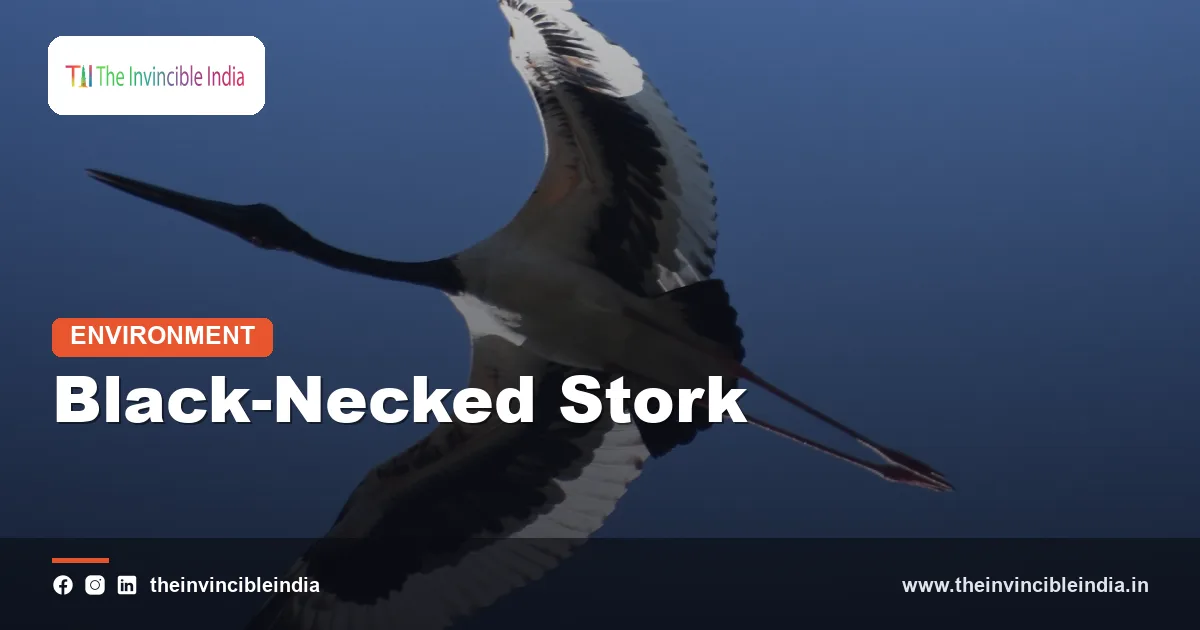
The black-necked stork (Ephippiorhynchus asiaticus) is a very tall, long-legged wading bird of South and Southeast Asia and Australia, and it is the one large stork in India that combines a glossy black head and neck with a white body, a black wing band and a heavy black bill. It is known in Hindi as the loharjang and in Australia as the jabiru, and it is a much rarer and larger bird than the commoner Asian openbill or painted stork. It lives alone or in pairs along wetlands and rivers, and it is a bird that many Indian birdwatchers see only a handful of times in their lives.
The black-necked stork stands well over a metre tall, and its slow, deliberate walk through shallow water makes it one of the most striking wetland birds in the country. It is considered Near Threatened globally, and its stronghold in India lies in a scattering of protected wetlands, river floodplains and grassland-marsh mosaics. This explainer sets out how to identify the black-necked stork, where it lives, what it eats, how it breeds and why it needs protection.
Quick Facts
| Common name | Black-necked stork (Hindi: loharjang; Australia: jabiru) |
|---|---|
| Scientific name | Ephippiorhynchus asiaticus |
| Family | Ciconiidae (storks) |
| Height | Roughly 130 to 150 cm when standing |
| Wingspan | Around 2.3 metres in large adults |
| Distinguishing features | Glossy black head and neck, white body, broad black wing band, long black bill, red legs |
| Habitat | Freshwater marshes, lakes, river floodplains, wet grassland and paddy margins |
| Diet | Fish, frogs, crabs, reptiles, insects and small animals |
| Global conservation status | Near Threatened (IUCN Red List) |
Key Takeaways
- The black-necked stork is the only large Indian stork with a glossy black head and neck set against a mostly white body.
- An adult black-necked stork stands roughly 1.3 to 1.5 metres tall and has a wingspan of around 2.3 metres, making it among the tallest flying birds of the subcontinent.
- Male and female black-necked storks look alike except for the eye: males have a dark brown iris, while females have a yellow one.
- The black-necked stork hunts alone or in pairs in shallow water, catching fish, frogs, crabs and reptiles with a long, slightly upturned bill.
- The black-necked stork is classified as Near Threatened by the IUCN, and wetland drainage and disturbance are its main threats in India.
- The black-necked stork is a different bird from the black-necked crane of Ladakh and Arunachal Pradesh, which is a crane, not a stork.
What is the black-necked stork?
The black-necked stork is a large wading bird in the stork family, Ciconiidae, and one of the two species in the genus Ephippiorhynchus, the other being the saddle-billed stork of Africa. Its scientific name Ephippiorhynchus asiaticus refers to the saddle-like colour pattern on the bill of its African relative and to its Asian range. The species is widely, though thinly, distributed from the Indian subcontinent through Southeast Asia to northern and eastern Australia.
In India the black-necked stork is a resident breeder, which means it does not undertake long seasonal migrations. It is a solitary bird by temperament, usually seen as a single bird or a pair, with occasional family parties of a pair and their young. Unlike painted storks or open-bills, it does not gather in dense breeding colonies, and this low-density lifestyle is one reason the species is never abundant.
How can you identify a black-necked stork?
A black-necked stork is identified by its great height, its glossy black head and neck, a white body and a bold black band across each wing, together with a very long black bill and red-pink legs. In bright light the black of the head and neck shows an iridescent sheen that can look green, blue or purple, depending on the angle of the sunlight. The tail is black, and in flight the contrast between the white body, the black wing band and the trailing red legs is unmistakable.
How do males and females differ?
Male and female black-necked storks differ chiefly in iris colour, because the male has a dark brown eye and the female a yellow one. Males also tend to be slightly larger. Beginners should rely on the overall pattern and the bill rather than on small details such as eye colour, which is visible only at close range.
What do juvenile black-necked storks look like?
Juvenile black-necked storks are duller than adults, with a brownish-grey head and neck, a grey-brown back and wings, and a pale, less strongly marked body. The glossy black head and neck and the crisp white-and-black pattern appear gradually over about two to three years. A young bird standing alone can therefore be mistaken for another species until the bill, the height and the leg colour are checked.
Where is the black-necked stork found in India?
The black-necked stork is found in scattered wetlands across much of India, from the terai and floodplains of the north to the river systems of the east and parts of the peninsula, though it is nowhere common. It has been recorded in protected areas such as Kaziranga National Park in Assam, Dudhwa National Park in Uttar Pradesh, Keoladeo National Park in Rajasthan and stretches of the Chambal and Ganga river systems. It is also known from wetlands in Gujarat and Odisha, and from lakes and marshes in several other states.
Outside India, the black-necked stork occurs in Nepal, Bangladesh, Sri Lanka, Myanmar, Cambodia and other parts of mainland Southeast Asia, and it breeds across northern Australia and in New Guinea. Within India, sightings are best described as patchy, and the number of birds at any single site is usually just a pair or two.
What habitat does the black-necked stork need?
The black-necked stork needs shallow, fish-rich freshwater with open margins, and it favours marshes, lakes, oxbows, river floodplains, flooded grassland and the edges of paddy fields. It generally avoids deep, open water and densely overgrown swamps, because it hunts by wading and needs room to stalk. Large tall trees close to water are also important, since the species builds its nest high above the ground.
This combination of shallow water, abundant prey and tall nest trees is exactly what is lost when wetlands are drained, fields are converted to other uses, or riverbank trees are felled. As a result, the black-necked stork acts as an indicator of a healthy, intact wetland system.
What does the black-necked stork eat?
The black-necked stork eats mainly live aquatic prey, including fish, frogs, crabs, snakes, lizards, eels, large insects and, occasionally, small mammals or the chicks of other waterbirds. Fish form the bulk of the diet in most wetlands, but the bird is an opportunist, and it shifts to frogs and reptiles when water levels fall and fish become harder to catch. In dry-season pools, it can concentrate on trapped fish and feed very efficiently.
Because the black-necked stork stands at the top of its wetland food chain, the health of its population says much about the fish stocks and the water quality of the area where it lives.
How does the black-necked stork hunt?
The black-necked stork hunts by walking slowly through shallow water, probing, jabbing or sweeping its long bill below the surface until it touches prey. Once it feels a fish, frog or crab, it seizes it with a quick snap, often flicks it into the air, and swallows it whole, head first when the prey is a fish. Its long legs allow it to wade into water that is about knee-deep for a person, which gives it access to areas that smaller waders cannot reach.
- Tactile probing: The bird sweeps its slightly upturned bill sideways and feels for movement in muddy or weedy water.
- Visual stalking: In clear water, it walks with deliberate steps and strikes at fish it can see.
- Opportunism: When water levels fall, the bird gathers around shrinking pools where fish and frogs are trapped.
- Patience: The bird may stand motionless for long periods before striking at passing prey.
The black-necked stork is largely silent. It communicates by bill-clattering, a loud rattling sound made by snapping the mandibles together, which is heard mainly at the nest.
How does the black-necked stork breed?
The black-necked stork breeds as a solitary pair that builds a very large platform nest of sticks, lined with grass, reeds or leaves, usually high in a tall tree standing in or beside a wetland. The pair often returns to the same nest year after year, adding material each season, until the structure becomes massive. In northern India, breeding commonly begins after the monsoon, with eggs laid in the cooler months, while timing in other regions varies with local rainfall and water levels.
A typical clutch has two to four whitish eggs, and both parents share incubation and chick care. The chicks stay in the nest for a long time, in the region of three months or more, and are fed by regurgitation of fish and other prey. Because few chicks are raised per season and the nest sites are limited, the population grows slowly, which increases the risk when adult birds are lost.
What threatens the nest?
Nest trees can be felled for timber or cleared during land conversion, and nests are vulnerable to human disturbance, power lines and the loss of surrounding feeding wetlands. In some areas, chicks and eggs have been taken for food or captured, though protection laws forbid this.
Is the black-necked stork endangered?
The black-necked stork is classified as Near Threatened on the IUCN Red List, meaning it is close to qualifying for a threatened category, and its global population is generally described as small and declining. Reliable estimates for India are hard to make because the birds are scattered and low in density; commonly cited figures suggest only a few thousand birds worldwide, with India holding a significant share but likely fewer than a thousand breeding pairs. These numbers should be treated as approximate rather than exact.
The black-necked stork is protected in India under the Wildlife (Protection) Act, 1972, and many of the sites where it is regularly seen are national parks or sanctuaries. The main threats are listed below.
- Drainage and conversion of wetlands, marshes and floodplains for agriculture and construction.
- Felling of large nest trees and clearing of riverside vegetation.
- Pollution and pesticide residues that reduce fish stocks or accumulate in the food chain.
- Disturbance from human activity, fishing and sand mining near nesting sites.
- Overhead power lines, which can cause collisions and electrocution for such a large bird.
- Hunting or egg collection in some regions despite legal protection.
How does the black-necked stork differ from other Indian storks?
The black-necked stork differs from other Indian storks mainly in its size and its colour pattern, since it is taller than the painted stork, the Asian openbill and the woolly-necked stork, and it is the only one with a glossy black head and neck over a white body. The table below compares it with the storks it is most often confused with.
| Stork | Head and neck | Body | Bill | Typical habit |
|---|---|---|---|---|
| Black-necked stork | Glossy black | White with black wing band and black tail | Very long, black, slightly upturned | Solitary or in pairs in wetlands |
| Woolly-necked stork | White woolly neck, black cap | Glossy black | Heavy, dark, slightly curved | Pairs or small groups in fields and wetlands |
| Painted stork | Bare, orange-yellow face | White with black and pink-tinged wings | Long, yellow, down-curved | Nests in noisy colonies |
| Asian openbill | White to grey | Whitish or grey with black wings | Gap between mandibles | Flocks near paddy and ponds |
| Greater adjutant | Bare, pinkish head with throat pouch | Grey and white | Massive wedge-shaped | Scavenger, colonial nester |
The black-necked stork is also often confused with the black-necked crane, a Tibetan-plateau species that visits Ladakh and Arunachal Pradesh. The crane is mostly grey with a black neck and red crown, whereas the stork is white-bodied and found in lowland wetlands.
Where can you see the black-necked stork in India?
The best places to see a black-necked stork in India are large protected wetlands and river-floodplain reserves, such as Kaziranga, Dudhwa, Keoladeo and the Chambal river stretches. Even in these places, a sighting is never guaranteed, and the bird is usually seen standing or walking in shallow water at the edge of a marsh. Early morning and late afternoon are the best times, when birds move out to feed.
- Scan the margins of marshes and oxbow lakes with binoculars rather than approaching on foot, because the bird is wary.
- Look for the white-and-black shape standing taller than any heron or egret around it.
- Check tall trees near water between October and March for large stick nests during the breeding season.
- Keep a respectful distance from nests, since disturbance can make parents abandon eggs or chicks.
What can be done to protect the black-necked stork?
Protecting the black-necked stork depends mainly on conserving whole wetlands, because the bird needs shallow feeding water, clean fish stocks and tall nest trees in the same landscape. Practical measures include safeguarding floodplains from drainage, preserving large trees near water, controlling pollution and agricultural run-off, and keeping disturbance low near known nests. Local communities, forest departments and birdwatchers all contribute through nest monitoring and counts.
Citizen-science records, such as dated sightings submitted to open databases and the annual waterbird counts, help conservationists track where the species still survives. Because the black-necked stork is so thinly spread, every reliably recorded pair adds meaningful information.
Bottom Line
The black-necked stork is one of India’s tallest and most striking wetland birds, a solitary, silent hunter of shallow water with a glossy black neck, a white body and a heavy black bill. It is Near Threatened because the wetlands and tall trees it depends on are shrinking, so its future in India rests on conserving intact marsh and floodplain landscapes.
Frequently Asked Questions
What is a black-necked stork?
A black-necked stork is a very tall wading bird with a glossy black head and neck, a white body, a black wing band and a long black bill. It belongs to the stork family and lives in wetlands across India, other parts of Asia and northern Australia. It is called loharjang in Hindi and jabiru in Australia.
Is the black-necked stork the same as the black-necked crane?
No, the black-necked stork and the black-necked crane are completely different birds. The stork is a white-bodied wetland wader of lowland India, while the crane is a grey bird with a black neck and red crown that breeds on the Tibetan plateau and is seen in Ladakh and Arunachal Pradesh. Storks and cranes belong to different families.
How can you tell a male black-necked stork from a female?
The easiest difference is the iris: males have a dark brown eye and females have a yellow one. Males also tend to be slightly larger than females. Apart from this, the two sexes look almost identical in plumage.
What does the black-necked stork eat?
The black-necked stork eats mainly fish, frogs, crabs, snakes, lizards, eels and large insects. It hunts by wading in shallow water and probing or striking with its long bill. When water levels fall it concentrates on trapped fish and amphibians.
Is the black-necked stork endangered in India?
The black-necked stork is listed as Near Threatened by the IUCN, not Endangered, but its population is small and declining. In India it is thinly scattered, with only a pair or two at most sites. It is protected under the Wildlife (Protection) Act, 1972, and wetland loss is its main threat.
Where can I see a black-necked stork in India?
Black-necked storks can be seen in large protected wetlands and floodplains such as Kaziranga, Dudhwa and Keoladeo and along stretches of the Chambal river. Sightings are never guaranteed because the bird is rare and wary. Early morning and late afternoon, when birds feed in shallow water, are the best times to look.
{“@context”:”https://schema.org”,”@graph”:[{“@type”:”FAQPage”,”mainEntity”:[{“@type”:”Question”,”name”:”What is a black-necked stork?”,”acceptedAnswer”:{“@type”:”Answer”,”text”:”A black-necked stork is a very tall wading bird with a glossy black head and neck, a white body, a black wing band and a long black bill. It belongs to the stork family and lives in wetlands across India, other parts of Asia and northern Australia. It is called loharjang in Hindi and jabiru in Australia.”}},{“@type”:”Question”,”name”:”Is the black-necked stork the same as the black-necked crane?”,”acceptedAnswer”:{“@type”:”Answer”,”text”:”No, the black-necked stork and the black-necked crane are completely different birds. The stork is a white-bodied wetland wader of lowland India, while the crane is a grey bird with a black neck and red crown that breeds on the Tibetan plateau and is seen in Ladakh and Arunachal Pradesh. Storks and cranes belong to different families.”}},{“@type”:”Question”,”name”:”How can you tell a male black-necked stork from a female?”,”acceptedAnswer”:{“@type”:”Answer”,”text”:”The easiest difference is the iris: males have a dark brown eye and females have a yellow one. Males also tend to be slightly larger than females. Apart from this, the two sexes look almost identical in plumage.”}},{“@type”:”Question”,”name”:”What does the black-necked stork eat?”,”acceptedAnswer”:{“@type”:”Answer”,”text”:”The black-necked stork eats mainly fish, frogs, crabs, snakes, lizards, eels and large insects. It hunts by wading in shallow water and probing or striking with its long bill. When water levels fall it concentrates on trapped fish and amphibians.”}},{“@type”:”Question”,”name”:”Is the black-necked stork endangered in India?”,”acceptedAnswer”:{“@type”:”Answer”,”text”:”The black-necked stork is listed as Near Threatened by the IUCN, not Endangered, but its population is small and declining. In India it is thinly scattered, with only a pair or two at most sites. It is protected under the Wildlife (Protection) Act, 1972, and wetland loss is its main threat.”}},{“@type”:”Question”,”name”:”Where can I see a black-necked stork in India?”,”acceptedAnswer”:{“@type”:”Answer”,”text”:”Black-necked storks can be seen in large protected wetlands and floodplains such as Kaziranga, Dudhwa and Keoladeo and along stretches of the Chambal river. Sightings are never guaranteed because the bird is rare and wary. Early morning and late afternoon, when birds feed in shallow water, are the best times to look.”}}]}]}


