

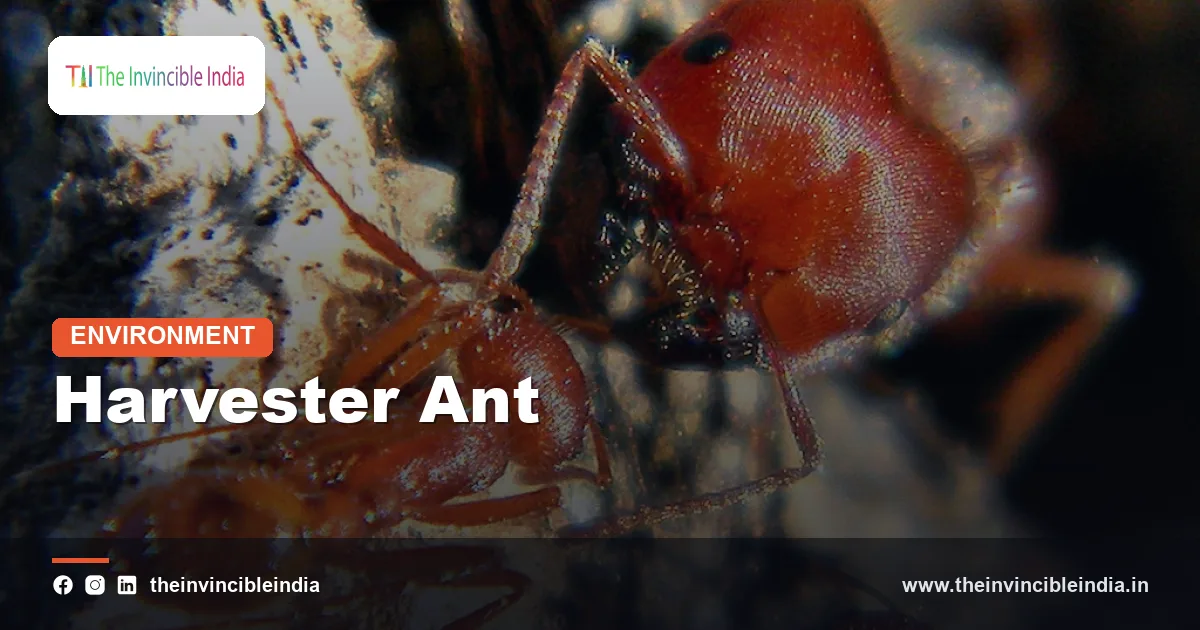
A harvester ant is a seed-collecting ant that gathers seeds from the ground, carries them to an underground nest and stores them in chambers to feed the colony, especially in dry and semi-arid country. In India the harvester ant is best known from the genus Messor, whose workers march along bare, cleared trails in scrubland, dry grassland and the edges of farm fields.
Harvester ants are social insects in the family Formicidae, and a single colony may hold thousands of workers led by one or more queens. This article explains what a harvester ant is, how it stores grain, how its colony is organised, and what role it plays in Indian ecosystems and farmland.
| Quick Facts | Details |
|---|---|
| Scientific name and family | Family Formicidae, subfamily Myrmicinae; harvester ants in India include the genus Messor and some Pheidole and Monomorium species |
| Size | Workers are roughly 3 to 12 mm long, with larger-headed soldiers or majors in some species |
| Habitat in India | Dry scrub, semi-arid plains, open grassland, wasteland and field margins with loose soil |
| Diet | Mainly seeds of grasses and herbs; also some insects and plant matter |
| Life cycle | Complete metamorphosis (egg, larva, pupa, adult); winged queens and males leave on mating flights, usually around the rains |
| Nest | Underground tunnels and chambers, with granaries for seeds and often a cleared patch or trails around the entrance |
| Ecological role | Seed predator, seed disperser and soil aerator |
| Notable features | Strong jaws for seed husking, castes with different body sizes, and long foraging columns |
Key Takeaways
- A harvester ant is a seed-eating ant that collects and stores seeds in underground granaries, and it is common in dry parts of India.
- Harvester ants belong to the family Formicidae, and the genus Messor is the best-known group of harvester ants in India.
- A harvester ant colony is led by a queen and consists mainly of sterile female workers, with some larger workers that crush seeds.
- Harvester ants act as both seed predators and seed dispersers, since some stored or dropped seeds survive and germinate.
- Harvester ants loosen and aerate the soil through their tunnelling, which improves water infiltration around the nest.
- Harvester ants sting rarely and are mostly harmless to people, though they can take grain from stores or newly sown fields.
What is a harvester ant?
A harvester ant is any ant whose colony depends mainly on collected seeds for food, and the name covers many species in several genera rather than one single species. In India the term is most often used for ants of the genus Messor, which are widespread in dry regions.
All harvester ants belong to the large family Formicidae, which contains all ants. They are placed in the subfamily Myrmicinae, a group that includes seed-collecting, fungus-growing and leaf-cutting ants. Species of Pheidole and Monomorium can also behave as harvesters in India, so naturalists often identify a harvester ant by its behaviour, which is to carry seeds in the jaws to a nest.
The workers are usually dark brown to black or reddish, with powerful jaws and, in many species, enlarged heads in the biggest workers. Their long, regular foraging columns are often visible on bare ground in the dry season.
Where do harvester ants live in India?
Harvester ants in India live mostly in dry, open habitats such as semi-arid plains, scrub forests, thorny grassland, wasteland and field margins. They are particularly common in the drier parts of the country, such as the Deccan plateau, Rajasthan, Gujarat and parts of Punjab and Haryana.
The ants prefer loose, well-drained soil in which tunnelling is easy and where seeds are plentiful. Their nests are often seen as a small mound or a ring of excavated soil around one or more entrance holes. Around the nest, workers may clear a bare patch by removing small plants and litter, which makes foraging easier and prevents shading.
Features of typical harvester ant sites include:
- Open ground with grasses and annual herbs that produce many seeds.
- Dry soil that does not flood in the monsoon.
- Footpaths, bunds and field edges where soil is bare.
- Stretches of cleared trail, sometimes several metres long, leading from the nest to food sources.
What does a harvester ant eat?
A harvester ant eats mainly seeds, especially the seeds of grasses and herbaceous plants, and it supplements this diet with small insects and other plant material. Seeds are rich in starch and fat, and they store well, which suits ants living where food supply is seasonal.
Workers pick up seeds from the ground, from the base of plants or from dropped fruit and carry them back in their jaws. Large seeds may be dragged. Inside the nest, majors or other workers crack open the seed coats, and the softened seed is shared with larvae, which digest the food and pass it on. The adult ants themselves feed largely on liquids passed from the larvae and on the nutritious parts of the seed.
Harvester ants are not strictly vegetarian. They sometimes eat dead insects and may feed protein to the developing larvae, which need more protein than adults do.
How does a harvester ant store seeds?
A harvester ant stores seeds in dry underground chambers called granaries, which are lined and deepened to keep the grain safe from rain and rot. The colony can then feed on these reserves during droughts, the hot season and other times when fresh seeds are scarce.
The ant nest is a network of vertical shafts and horizontal galleries that may reach a depth of a metre or more in some species. The granary chambers are kept dry, and ants may carry seeds out into the sun to dry them after rain. Some species are said to bite off the tiny root of a seed so that it cannot germinate, which keeps it from sprouting inside the store. Other seeds that are damp or mouldy are carried out of the nest and dumped on a refuse pile outside.
The stored grain gives the harvester ant a notable advantage over predatory ants. A colony can continue to breed and raise young through lean periods, because it does not need to hunt every day.
How is a harvester ant colony organised?
A harvester ant colony is organised as a social system in which one or a few egg-laying queens are supported by many sterile female workers, and the workers divide tasks according to body size and age. This kind of society is called eusocial.
The castes
- Queen: a winged female at first, who sheds her wings after the mating flight and founds a colony. She may live for many years.
- Workers: sterile females who forage, dig, carry seeds, tend the young and defend the nest.
- Majors or soldiers: larger workers with big heads and strong jaw muscles in species with this caste, who crush hard seeds and help in defence.
- Males: short-lived winged ants that exist to mate with young queens and die soon after.
Division of labour
Younger workers tend to stay inside the nest looking after eggs, larvae and pupae, and older workers go outside to forage, which is riskier work. The colony needs no leader that gives orders. Instead, ants respond to chemical signals called pheromones and to the contact they have with nest mates, and these simple rules produce well-organised foraging.
How do harvester ants find food and mark trails?
Harvester ants find food by scouting and then recruiting nest mates with scent trails, so that many workers follow the same path to a rich patch of seeds. The chemical trail marks the way, and it fades if the food source is exhausted.
Foraging workers walk out on trunk trails, which may be cleared of pebbles and small plants and are worn smooth by countless feet. They fan out at the end of the trail to look for seeds. A worker that finds a good source returns laying a pheromone trail, which other ants follow and reinforce. Ants may also use visual landmarks and the position of the sun to find their way, and they may adjust their foraging to the temperature of the soil, resting in the heat of the day and working in the morning and evening.
This behaviour is a favourite example for students of collective intelligence, in which a group of simple individuals solves problems that no single ant understands.
What is the life cycle of a harvester ant?
The harvester ant life cycle has four stages: egg, larva, pupa and adult, which is called complete metamorphosis. A queen lays eggs in the nest, workers feed the grub-like larvae, the larvae spin or form pupae, and the adults emerge after a few weeks.
Once a year or so, a mature colony raises winged males and young queens. These fly out together on a mating flight, often after the first monsoon rains when the soil is soft and many colonies release their winged ants at the same time. After mating the males die and each fertilised queen lands, sheds her wings, digs a small chamber and lays her first eggs. In many species she raises the first workers using her own body reserves, without leaving to feed, and the new workers then take over foraging.
A harvester ant queen can live for many years, and a colony can persist for a decade or more in some species. Most workers live only for months, so the colony is constantly replacing its labour force.
Are harvester ants good or bad for farmers?
Harvester ants are both useful and troublesome for farmers: they aerate soil and spread some seeds, but they can also remove sown seed and stored grain. The balance depends on the species, the crop and the density of the colonies.
| Effect | Benefit or harm | Explanation |
|---|---|---|
| Soil aeration | Benefit | Tunnels loosen soil and help water and air move down to roots |
| Nutrient cycling | Benefit | Seed husks and refuse piles enrich the soil around the nest |
| Seed dispersal | Benefit | Seeds dropped or discarded on the way can germinate away from the parent plant |
| Weed seed removal | Benefit | Harvester ants eat many weed seeds, reducing weed growth |
| Removal of sown seed | Harm | Ants can carry away seeds from newly sown fields, especially small-seeded crops |
| Grain store raiding | Harm | Ants may enter threshing floors and store rooms to collect grain |
For most farms the best approach is to avoid heavy chemical control, which also harms useful insects, and to protect seeds with simple measures such as deeper sowing, storing grain in sealed containers and keeping threshing floors clean.
Do harvester ants bite or sting?
Harvester ants can bite with their jaws and sting in some cases, but the Indian species are generally not aggressive and rarely cause problems for people. Most bites feel like a light pinch, and any stinging effect is usually mild and brief.
Some harvester ants elsewhere in the world, such as the American Pogonomyrmex, have a notably painful sting. Indian harvester ants such as Messor species are not known for this. They usually defend the nest by biting and by swarming out of the entrance when disturbed. A person who steps on a nest may be bitten on the feet and legs and should simply move away and brush the ants off.
People with allergies to insect stings should be careful, as with any stinging insect. Wearing closed footwear when walking on bare, dry ground helps avoid bites.
How do harvester ants affect seeds and plants?
Harvester ants affect seeds and plants in two opposite ways: they eat many seeds, which limits the plants that produce them, and they also move and drop seeds, which can help some plants spread. The net result differs among plant species and habitats.
Seeds that are large, oily or easy to carry are taken first, so the ants can influence which plants dominate a patch of dry grassland. Some seeds fall from the jaws of workers while being carried and then germinate in the loosened, enriched soil of trails and refuse piles. Because ants carry seeds only short distances, usually a few metres, they spread plants in a local and gradual way rather than over long distances.
Ecologists often treat harvester ants as a keystone group in dry grasslands and deserts, because their foraging shapes the vegetation, which in turn affects birds, rodents and other seed eaters that compete with the ants for the same food. Birds, lizards and other ant-eating animals also depend on harvester ant colonies as a reliable food source.
Bottom Line
The harvester ant is a small but influential part of the dry Indian landscape, storing grain, loosening soil and moving seeds from place to place. Understanding its habits helps in appreciating how much goes on beneath the dry ground of scrub and field edges.
Frequently Asked Questions
What is a harvester ant?
A harvester ant is an ant that collects seeds and stores them in underground chambers to feed the colony. It belongs to the family Formicidae, and in India the best-known harvester ants are in the genus Messor. They live mostly in dry and semi-arid areas.
What do harvester ants eat?
Harvester ants eat mainly seeds of grasses and herbs, and they also eat some insects and plant matter. Workers carry seeds to the nest, where they are cracked open and shared with the larvae and other nest mates.
Do harvester ants live in India?
Yes, harvester ants live in India, particularly in dry, open areas such as scrubland, wasteland and field margins in regions like the Deccan plateau and north-western India. They are seen as long columns of ants carrying seeds along bare trails.
Why do harvester ants clear the ground around their nests?
Harvester ants clear plants and litter near the nest to create bare paths and open ground that make foraging easier. The cleared area also helps the nest stay warm and reduces shade and hiding places for enemies. The trails may extend several metres from the entrance.
Are harvester ants harmful to crops?
Harvester ants can remove newly sown seeds and raid stored grain, so they can be a nuisance on some farms. They also aerate the soil and eat weed seeds, which gives some benefit. The overall effect depends on the species and the number of colonies.
How long does a harvester ant queen live?
A harvester ant queen can live for many years, often much longer than a worker. She mates once on a mating flight, stores the sperm and lays eggs for the rest of her life. Workers usually live for only some months.
{“@context”:”https://schema.org”,”@graph”:[{“@type”:”FAQPage”,”mainEntity”:[{“@type”:”Question”,”name”:”What is a harvester ant?”,”acceptedAnswer”:{“@type”:”Answer”,”text”:”A harvester ant is an ant that collects seeds and stores them in underground chambers to feed the colony. It belongs to the family Formicidae, and in India the best-known harvester ants are in the genus Messor. They live mostly in dry and semi-arid areas.”}},{“@type”:”Question”,”name”:”What do harvester ants eat?”,”acceptedAnswer”:{“@type”:”Answer”,”text”:”Harvester ants eat mainly seeds of grasses and herbs, and they also eat some insects and plant matter. Workers carry seeds to the nest, where they are cracked open and shared with the larvae and other nest mates.”}},{“@type”:”Question”,”name”:”Do harvester ants live in India?”,”acceptedAnswer”:{“@type”:”Answer”,”text”:”Yes, harvester ants live in India, particularly in dry, open areas such as scrubland, wasteland and field margins in regions like the Deccan plateau and north-western India. They are seen as long columns of ants carrying seeds along bare trails.”}},{“@type”:”Question”,”name”:”Why do harvester ants clear the ground around their nests?”,”acceptedAnswer”:{“@type”:”Answer”,”text”:”Harvester ants clear plants and litter near the nest to create bare paths and open ground that make foraging easier. The cleared area also helps the nest stay warm and reduces shade and hiding places for enemies. The trails may extend several metres from the entrance.”}},{“@type”:”Question”,”name”:”Are harvester ants harmful to crops?”,”acceptedAnswer”:{“@type”:”Answer”,”text”:”Harvester ants can remove newly sown seeds and raid stored grain, so they can be a nuisance on some farms. They also aerate the soil and eat weed seeds, which gives some benefit. The overall effect depends on the species and the number of colonies.”}},{“@type”:”Question”,”name”:”How long does a harvester ant queen live?”,”acceptedAnswer”:{“@type”:”Answer”,”text”:”A harvester ant queen can live for many years, often much longer than a worker. She mates once on a mating flight, stores the sperm and lays eggs for the rest of her life. Workers usually live for only some months.”}}]}]}


