

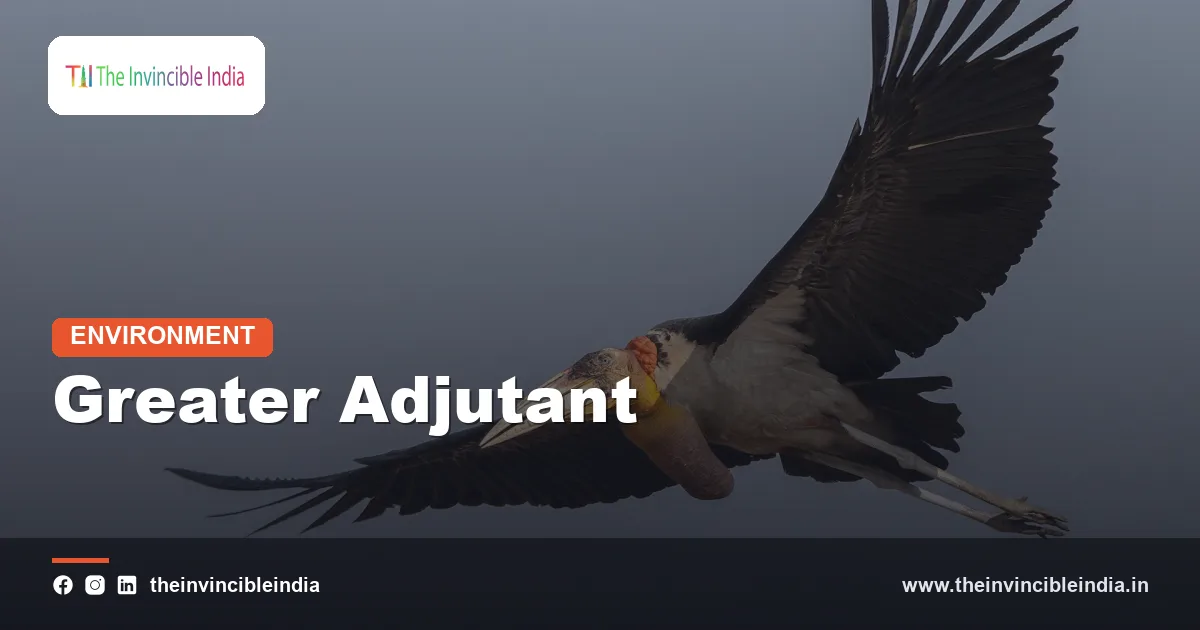
The greater adjutant (Leptoptilos dubius) is a huge, bald-headed scavenging stork with a pendulous throat pouch and a massive wedge-shaped bill, now found in India largely in Assam, where it has become the symbol of one of the country’s best-known community conservation movements. Once widespread across the plains of South and Southeast Asia, the greater adjutant has been reduced to a few breeding strongholds, and it is classified as Endangered on the IUCN Red List.
In Assamese, the bird is called hargila, meaning “bone swallower”, a name earned by its habit of eating carrion and refuse. Its survival in Assam owes much to the Hargila Army, a network of rural women led by wildlife biologist Dr Purnima Devi Barman, who turned a bird once feared as a bad omen into a protected neighbour. This explainer covers how to recognise the greater adjutant, where it lives, how it feeds and breeds, why it declined and how it is being brought back.
Quick Facts
| Common name | Greater adjutant (Assamese: hargila; Bihar: garuda) |
|---|---|
| Scientific name | Leptoptilos dubius |
| Family | Ciconiidae (storks) |
| Height | Roughly 120 to 150 cm |
| Wingspan | Up to around 2.5 metres in large birds |
| Weight | Roughly 5 to 8 kg in adults |
| Key features | Bare pinkish head and neck, hanging throat pouch, thick wedge-shaped bill, white neck ruff |
| Main Indian strongholds | Assam (Brahmaputra valley) and parts of Bihar, with a few other records |
| Global conservation status | Endangered (IUCN Red List) |
Key Takeaways
- The greater adjutant is a very large scavenging stork that can stand about 1.2 to 1.5 metres tall and has a wingspan of up to roughly 2.5 metres.
- The greater adjutant is classified as Endangered on the IUCN Red List, and its global population is small, estimated in the low thousands at most.
- The greater adjutant is known as hargila, “bone swallower”, in Assamese, and Assam holds the largest breeding population of the species in India and the world.
- The Hargila Army, founded by Dr Purnima Devi Barman, is a grassroots movement of women in Assam who protect nests, rescue fallen chicks and celebrate the bird in local culture.
- The greater adjutant nests in colonies in tall trees, often in or near villages, so tree felling and loss of wetlands directly threaten its breeding.
- The greater adjutant performs a natural clean-up service by eating carrion, fish and refuse, much as vultures do.
What is the greater adjutant?
The greater adjutant is a very large stork in the family Ciconiidae and the genus Leptoptilos, a group of “marabou” storks that also includes the lesser adjutant of Asia and the marabou of Africa. Its scientific name is Leptoptilos dubius, and it is among the bulkiest of India’s storks, with a bill that is thick, long and pale. The species is a scavenger and opportunistic predator, feeding on carrion, offal, fish, frogs, reptiles and small animals.
The name “adjutant” refers to the bird’s stiff, upright, strutting gait, which early observers likened to a military adjutant pacing a parade ground. In the nineteenth century, adjutant storks were a familiar sight in the streets and rubbish heaps of colonial Calcutta, now Kolkata, where they helped clear refuse. Today the bird has disappeared from most of those old haunts.
How can you identify a greater adjutant?
A greater adjutant is identified by its giant size, bare pinkish-orange head and neck with sparse hair-like down, a dangling fleshy pouch at the throat, a white ruff at the base of the neck and a huge, wedge-shaped, pale bill. The back and wings are dark slaty-grey with a paler grey panel on the inner wing, and the underparts are white. Standing in a field or on a rubbish heap, the bird has a hunched, shoulders-up posture and looks like an enormous grey-and-white vulture on legs.
In flight, the greater adjutant holds its neck pulled back in an S-shape, unlike most storks, which fly with the neck stretched forward. It soars on thermal air currents with its wings held flat, often alongside vultures, and its large size makes it easy to pick out in the sky.
How does the greater adjutant differ from the lesser adjutant?
The greater adjutant differs from the lesser adjutant in being heavier, in having a prominent hanging throat pouch and in having a paler grey wing panel. The lesser adjutant (Leptoptilos javanicus) is smaller, has no throat pouch, shows a glossy dark upperside and tends to favour wetlands, mangroves and open marshes rather than rubbish dumps. The lesser adjutant is also usually listed as Vulnerable rather than Endangered.
Where does the greater adjutant live?
The greater adjutant now lives mainly in the floodplain wetlands, paddy fields and village groves of Assam, with smaller populations in Bihar and in Cambodia. The Assam population is concentrated in the Brahmaputra valley, including the districts around Guwahati, such as Kamrup, and other parts of the valley such as Nagaon. In Bihar, the Kosi and Ganga floodplain near Bhagalpur is known for the species, where it is called garuda.
In the past the greater adjutant ranged across the Gangetic plains, peninsular India, Myanmar and mainland Southeast Asia. It has disappeared from most of this range because of habitat loss and persecution, and today it is among the rarest storks in the world. The Assam colonies are therefore of global importance.
What does the greater adjutant eat?
The greater adjutant eats carrion, slaughterhouse waste, fish, frogs, snakes, rodents, insects and the young of other birds, and it is best described as a scavenger and opportunistic hunter. It wades in shallow water to catch fish and amphibians, and it also walks across dry fields and garbage dumps in search of dead animals and food scraps. Its heavy bill can tear flesh, and its bare head and neck stay relatively clean when it feeds inside carcasses.
By consuming dead animals and refuse, the greater adjutant helps keep villages and wetlands cleaner and reduces the spread of disease from rotting carcasses. In Guwahati, birds have been recorded feeding at large municipal dumping grounds, which shows both their adaptability and their exposure to waste-related risks such as plastic, sharp debris and contamination.
How does the greater adjutant breed?
The greater adjutant breeds in colonies, building large stick nests high in tall trees, often in or beside villages and wetlands, and it lays its eggs in the cooler months, from about November to February. Nests are platforms of sticks lined with softer material, placed in big trees such as kadam, silk-cotton, banyan and other tall species. Each pair typically raises two or three chicks, which are fed by both parents with regurgitated fish, frogs and other prey.
The chicks stay in the nest for several months before they can fly, which makes them vulnerable to falls, storms and tree felling. Colonies can be noisy and smelly, because droppings, fish remains and food scraps accumulate below the trees, and this has historically made the birds unpopular with neighbours. That attitude is the very thing the Hargila Army set out to change.
What is the Hargila Army?
The Hargila Army is a community conservation movement of women in Assam, founded and led by Dr Purnima Devi Barman, that protects greater adjutant nests, rescues fallen chicks and promotes pride in the bird. The effort began around 2007 to 2008 in villages such as Dadara, Pachariya and Singimari in Kamrup district, after a nesting tree was cut down and chicks fell to the ground, while local people viewed the birds as ill omens. Barman, trained as a wildlife biologist, started working with village women to change this attitude.
The Hargila Army is commonly reported to have grown to many thousands of women members. Its activities show how conservation can combine ecology with livelihoods and culture.
- Nest protection: Members watch colonies, discourage tree felling and rescue and tend chicks that fall.
- Rehabilitation: Injured or fallen birds are cared for and released when they recover.
- Nesting support: Artificial platforms and new trees are used to give the birds safe places to breed.
- Cultural celebration: Members hold ceremonies, including a baby-shower-style festival for the birds, and weave hargila motifs into textiles sold as a source of income.
- Education: Schools and neighbourhoods are involved so that younger generations see the bird as an asset.
The work has received national and international recognition, including India’s Nari Shakti Puraskar in 2017 and the United Nations Champions of the Earth honour in 2022. It is frequently cited as an example of conservation led by local women.
Why did the greater adjutant decline?
The greater adjutant declined mainly because wetlands, large nesting trees and open waste-feeding grounds disappeared, and because many people disliked or hunted the bird. Drainage of marshes for farming and construction removed feeding habitats, and felling of tall trees took away nest sites. Better waste management in towns reduced the food available at open dumps, while poisoning, hunting and egg or chick collection added to the losses.
- Conversion and drainage of floodplain wetlands.
- Felling of large colonial nest trees for timber or land clearing.
- Pollution and contamination of food at dumping grounds.
- Persecution because of the bird’s smell and its reputation as an omen of bad luck.
- Disturbance, collisions and electrocution from power lines.
Is the greater adjutant endangered?
The greater adjutant is classified as Endangered on the IUCN Red List, which means it faces a very high risk of extinction in the wild. The global population is small, generally described as the low thousands at most, and a large share of it breeds in Assam. Numbers in Assam have been reported to be rising in recent years thanks to community conservation, though exact counts vary by survey, and the species still depends on a handful of colonies.
The greater adjutant is protected under India’s Wildlife (Protection) Act, 1972. Because most nests are on private or village land rather than inside parks, protection depends heavily on the goodwill of landowners and on the continued work of local conservation groups.
How does the greater adjutant compare with other scavenging birds?
The greater adjutant occupies a similar ecological role to vultures, but it is a stork with a different body plan, bill and breeding behaviour. The table below compares it with two birds it is often seen with.
| Feature | Greater adjutant | Lesser adjutant | Vultures (for example, white-rumped vulture) |
|---|---|---|---|
| Group | Stork | Stork | Raptor (accipitrid) |
| Throat pouch | Present, hanging | Absent | Absent |
| Bill | Massive, wedge-shaped | Heavy but slimmer | Hooked for tearing flesh |
| Main food | Carrion, fish, frogs, refuse | Fish, frogs, reptiles | Mostly carrion |
| Typical habitat in India | Floodplain wetlands, villages, dumps | Wetlands, marshes, mangroves | Open country, cities, cliffs |
| IUCN status | Endangered | Vulnerable | Several species Critically Endangered |
How can people help protect the greater adjutant?
People can help protect the greater adjutant by preserving large nesting trees, keeping floodplain wetlands intact, managing waste safely and supporting community groups like the Hargila Army. In practice this means avoiding the felling of trees that hold nests, reporting injured or fallen chicks to the local forest department or conservation group, and buying handloom products that fund women’s conservation work.
Visitors in Assam can also contribute by observing colonies from a respectful distance and by not feeding or disturbing the birds. Because the greater adjutant breeds close to human settlements, long-term survival depends on neighbours who value rather than fear it.
Where can you see the greater adjutant in India?
The greater adjutant can be seen most reliably in the villages and wetlands of Kamrup district near Guwahati in Assam, particularly in the Dadara, Pachariya and Singimari area where the Hargila Army is active, and around the Deepor Beel wetland and nearby dumping ground. The best season is the breeding period from about November to February, when adults are busy at the nests and the colonies are most visible. A few birds are also recorded in the Bihar floodplains near Bhagalpur.
- Visit with a local guide or conservation group, because many colonies are on private village land.
- Use binoculars or a long lens and stay well away from nest trees, since disturbance can cause chicks to fall.
- Expect noise and a strong smell near colonies, a natural result of the birds’ diet and nesting habits.
- Respect local residents, whose acceptance of the birds is the main reason the colonies survive.
Why does the greater adjutant matter beyond conservation?
The greater adjutant matters because it shows how an unloved species can become a source of pride, income and ecological health for a community. Where villagers once saw the bird as dirty or inauspicious, many now regard it as a family guest, and its colonies have become a point of local identity. The bird’s role as a scavenger also provides a free sanitation service, particularly valuable in places where vultures have declined sharply.
The story of the greater adjutant in Assam is therefore studied as a model for other threatened species, because it demonstrates that lasting protection depends on community participation rather than regulations alone.
Bottom Line
The greater adjutant is a rare, giant scavenging stork whose Indian stronghold is Assam, where the women of the Hargila Army have helped steady its numbers by turning fear into pride. The bird remains Endangered, so continued protection of nesting trees and wetlands is essential.
Frequently Asked Questions
What is the greater adjutant?
The greater adjutant is a huge, bald-headed scavenging stork with a hanging throat pouch and a massive wedge-shaped bill. It is found in India mainly in Assam and parts of Bihar, and it is classified as Endangered. In Assamese it is called hargila, meaning bone swallower.
Why is it called the adjutant stork?
The bird is called an adjutant because of its stiff, upright, strutting walk, which early observers compared to a military adjutant on parade. The name has nothing to do with the bird’s colour. Other members of the group, such as the lesser adjutant, share the name.
What is the Hargila Army?
The Hargila Army is a conservation movement of women in Assam, founded by wildlife biologist Dr Purnima Devi Barman. Its members protect greater adjutant nests, rescue fallen chicks and celebrate the bird through festivals and woven textiles. It began around 2007 to 2008 in Kamrup district and has since grown to many thousands of women.
Is the greater adjutant endangered?
Yes, the greater adjutant is classified as Endangered on the IUCN Red List. Its global population is small, usually described as the low thousands at most, and much of it breeds in Assam. Numbers in Assam have been reported to be rising with community protection, though the species still depends on a few colonies.
What does the greater adjutant eat?
The greater adjutant eats carrion, offal, fish, frogs, snakes, rodents and the young of other birds. It scavenges on dead animals and refuse as well as wading for live prey in shallow water. By removing carrion and waste, it helps keep its surroundings cleaner, much like a vulture.
How is the greater adjutant different from the lesser adjutant?
The greater adjutant is heavier than the lesser adjutant and has a hanging throat pouch that the lesser adjutant lacks. It also has a paler grey wing panel and a more massive bill. The lesser adjutant favours wetlands and mangroves and is listed as Vulnerable, whereas the greater adjutant is Endangered.
{“@context”:”https://schema.org”,”@graph”:[{“@type”:”FAQPage”,”mainEntity”:[{“@type”:”Question”,”name”:”What is the greater adjutant?”,”acceptedAnswer”:{“@type”:”Answer”,”text”:”The greater adjutant is a huge, bald-headed scavenging stork with a hanging throat pouch and a massive wedge-shaped bill. It is found in India mainly in Assam and parts of Bihar, and it is classified as Endangered. In Assamese it is called hargila, meaning bone swallower.”}},{“@type”:”Question”,”name”:”Why is it called the adjutant stork?”,”acceptedAnswer”:{“@type”:”Answer”,”text”:”The bird is called an adjutant because of its stiff, upright, strutting walk, which early observers compared to a military adjutant on parade. The name has nothing to do with the bird’s colour. Other members of the group, such as the lesser adjutant, share the name.”}},{“@type”:”Question”,”name”:”What is the Hargila Army?”,”acceptedAnswer”:{“@type”:”Answer”,”text”:”The Hargila Army is a conservation movement of women in Assam, founded by wildlife biologist Dr Purnima Devi Barman. Its members protect greater adjutant nests, rescue fallen chicks and celebrate the bird through festivals and woven textiles. It began around 2007 to 2008 in Kamrup district and has since grown to many thousands of women.”}},{“@type”:”Question”,”name”:”Is the greater adjutant endangered?”,”acceptedAnswer”:{“@type”:”Answer”,”text”:”Yes, the greater adjutant is classified as Endangered on the IUCN Red List. Its global population is small, usually described as the low thousands at most, and much of it breeds in Assam. Numbers in Assam have been reported to be rising with community protection, though the species still depends on a few colonies.”}},{“@type”:”Question”,”name”:”What does the greater adjutant eat?”,”acceptedAnswer”:{“@type”:”Answer”,”text”:”The greater adjutant eats carrion, offal, fish, frogs, snakes, rodents and the young of other birds. It scavenges on dead animals and refuse as well as wading for live prey in shallow water. By removing carrion and waste, it helps keep its surroundings cleaner, much like a vulture.”}},{“@type”:”Question”,”name”:”How is the greater adjutant different from the lesser adjutant?”,”acceptedAnswer”:{“@type”:”Answer”,”text”:”The greater adjutant is heavier than the lesser adjutant and has a hanging throat pouch that the lesser adjutant lacks. It also has a paler grey wing panel and a more massive bill. The lesser adjutant favours wetlands and mangroves and is listed as Vulnerable, whereas the greater adjutant is Endangered.”}}]}]}


