

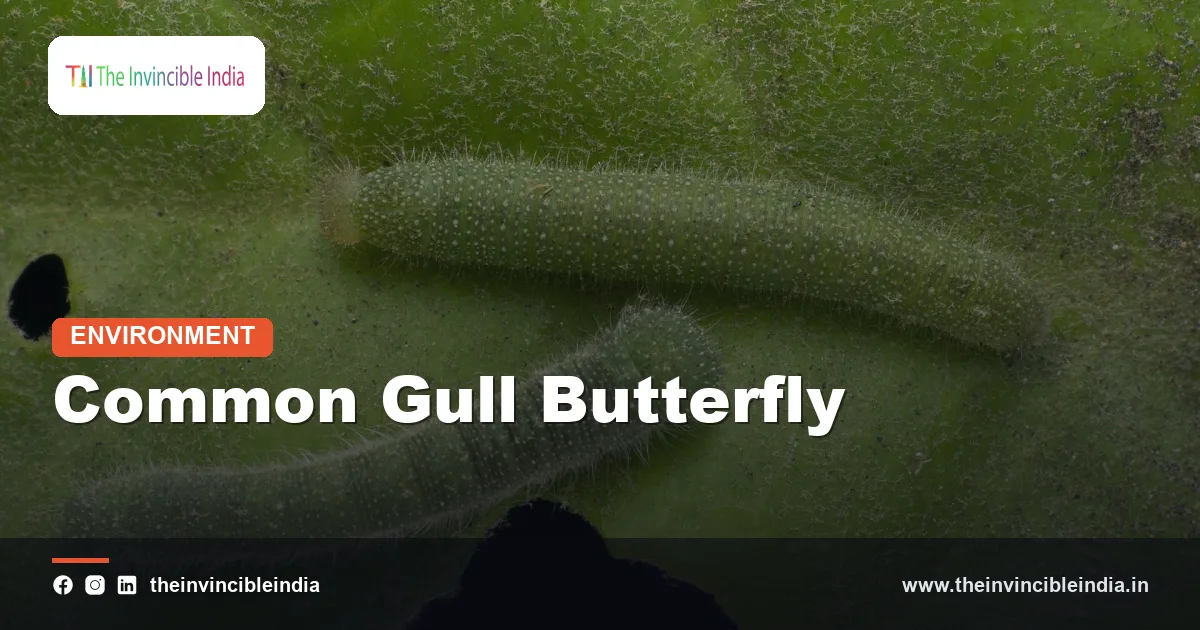
The common gull (Cepora nerissa) is a medium-sized white-and-black butterfly of the family Pieridae that is found across most of India, from scrub forests and village outskirts to hill roads and garden edges. It is one of the “gulls”, a small group of white pierids that earned their English name from the soft grey-and-white look of their wings, which is somewhat reminiscent of a seabird. Because it breeds on common caper-family shrubs, the common gull can be seen in many Indian habitats and is a rewarding species for beginners learning to watch butterflies.
This guide explains how to recognise the common gull, where it lives, what its caterpillars eat, how its life cycle works and why its appearance changes with the seasons. It also compares the common gull with look-alike species and offers practical tips for finding and photographing it.
Common Gull Quick Facts
| Common name | Common gull |
|---|---|
| Scientific name | Cepora nerissa (Fabricius, 1775) |
| Family | Pieridae (whites and yellows) |
| Wingspan | Roughly 5 to 6.5 cm, with females often a little larger than males |
| Caterpillar host plants | Caper-family plants (Capparaceae), especially Capparis shrubs and related genera |
| Range and habitat in India | Widely recorded across peninsular India, the Western and Eastern Ghats, central and eastern India, the north-east and the Himalayan foothills; scrub, dry and moist deciduous forest, plantations and gardens |
| Flight season | Seen through much of the year in warm regions, with several broods; most numerous during and after the monsoon |
| Notable features | Distinct wet-season and dry-season forms; females are variable and some forms resemble jezebel butterflies |
Key Takeaways
- The common gull (Cepora nerissa) is a white pierid butterfly with black-marked wings that occurs in most Indian states.
- Common gull caterpillars feed on Capparis and other caper-family shrubs, so the butterfly is most reliably found where these plants grow.
- The common gull shows seasonal forms, meaning the wet-season and dry-season generations look noticeably different.
- Female common gulls are more variable than males, and some forms look similar to distasteful jezebel butterflies.
- The common gull is a strong-looking but easy-going flier that often visits flowers and damp patches, which makes it easy to photograph.
- The common gull is not considered globally threatened, but local numbers depend on the survival of scrub and forest-edge caper shrubs.
What Is the Common Gull Butterfly?
The common gull is a pierid butterfly in the genus Cepora, described scientifically by the Danish zoologist Johan Christian Fabricius in 1775 under the name Cepora nerissa. Pierids are the family commonly called whites, yellows, albatrosses and jezebels, and the common gull belongs to the “whites” side of that family.
The English name “gull” reflects the black-tipped, greyish-white appearance that suggests a seagull in flight. In India the common gull sits alongside several other white pierids that people routinely mix up, including the jezebels, the albatrosses and the psyche. The species is named “common” because it is widespread rather than because it is uninteresting; in many parts of the country it is one of the more regularly seen medium-sized white butterflies.
Like all butterflies, the common gull belongs to the order Lepidoptera, whose members have scale-covered wings and go through complete metamorphosis. Its closest relatives in India include the lesser gull (Cepora nadina), which has a similar plan but different markings and a more restricted distribution.
How Can You Identify the Common Gull?
You can identify the common gull by its white upperside with a broad black border along the forewing tip and dark scaling along the veins, combined with an underside washed pale yellow or cream with black-edged veins. The body is slender and dark, and the butterfly is noticeably bigger than small whites such as the psyche but smaller than the large albatross butterflies.
Males
Male common gulls are the more regular and recognisable form. The upperside is largely white, with a black band running around the outer edge of the forewing and a series of dark vein-tips on the hindwing margin. The underside is cleaner and paler than the upperside, with dusky veins that look as if they have been drawn in with a fine pen.
Females
Female common gulls are far more variable. Some are paler and similar to the males, while others are darker and show heavier black or smoky marking, with a yellowish wash on the hindwing. Several of these darker forms resemble jezebel butterflies of the genus Delias, which have bright underwings and are widely regarded as unpalatable to birds. Biologists often interpret this resemblance as protective mimicry, in which a palatable species gains safety by looking like a distasteful one.
Quick field marks
- White ground colour with a black outer border on the forewing tip.
- Black-edged veins that are clearly visible on the underside of the wings.
- Slow, deliberate wingbeats compared with the quick flicker of smaller whites.
- A habit of settling on low shrubs, wildflowers and damp earth.
Where Is the Common Gull Found in India?
The common gull is found across most of peninsular India, the Western and Eastern Ghats, central India, the north-eastern states and the foothills of the Himalaya, and it is also recorded in Sri Lanka and in parts of South-East Asia. It is therefore one of the more broadly distributed members of its genus in the Indian subcontinent.
Within India the common gull prefers warm, bushy country rather than dense wet evergreen forest. Typical habitats include:
- Scrub jungle and thorn forest where caper shrubs are common.
- Dry and moist deciduous forest, especially along tracks and clearings.
- Forest edges, hill slopes and the shrubby sides of roads.
- Village outskirts, farm bunds, parks and large gardens with a wild corner.
The butterfly mostly stays at low to moderate elevations. Records from higher hills exist, but the common gull is typically a lowland and foothill species. In dry regions it tends to concentrate near watercourses, irrigation channels and other places where the vegetation stays green for longer.
What Does the Common Gull Eat and Which Plants Does It Use?
Common gull caterpillars feed on plants of the caper family (Capparaceae), and the adult butterflies feed on flower nectar and on minerals from damp ground. Female common gulls search for tender new growth on Capparis shrubs, and they lay their eggs there so that the hatching caterpillars begin life on suitable food.
Host plants for caterpillars
The most important host plants belong to the genus Capparis, which includes several thorny, scrambling shrubs of dry forests and scrub across India. Related caper-family plants are also used in different regions. Because these shrubs often grow wild on field edges and rocky slopes, they are easy to overlook, but a patch of healthy Capparis is a strong sign that gulls, jezebels and other pierids may be breeding nearby.
Adult food
Adult common gulls visit small, easily reached flowers in open sun. They are frequently seen on wildflowers, lantana, shrubs along roadsides and garden plants with flat flower clusters. Males also gather at wet sand and mud, a behaviour known as mud-puddling, to take up salts and minerals that are useful for reproduction.
What Is the Life Cycle of the Common Gull?
The common gull completes a full four-stage life cycle of egg, caterpillar, pupa and adult, and in warm parts of India this cycle can repeat several times in a year. A full cycle from egg to adult can be as short as a few weeks in favourable weather.
- Egg: The female lays small, spindle-shaped eggs on young leaves of caper-family host plants, usually singly or in very small numbers.
- Caterpillar: The larva is slender and green, often with fine pale lines, and it feeds on the soft leaves. Its colour blends with the foliage, and it grows through several moults called instars.
- Pupa: When fully grown, the caterpillar attaches itself to a twig or stem with a silk pad and a silk girdle, then forms a slim, green-to-brown chrysalis typical of the whites.
- Adult: The butterfly emerges, dries and expands its wings, and soon begins to feed and, in the case of males, to look for mates.
Because the generations overlap, a single patch of shrubs can hold eggs, caterpillars and chrysalises at the same time. This is why careful observers who return to the same bush through the monsoon often see the whole life cycle unfold.
How Does the Common Gull Behave?
The common gull behaves as a sun-loving, moderately active butterfly that patrols low bushes and open ground, pausing frequently to feed or rest. It is not as hurried as the fast-flying swallowtails and not as weak a flier as the tiny psyche, which gives it a comfortable middle pace that is pleasant to watch.
Feeding and resting
Common gulls spend much of the day feeding on flowers and moving between shrubs. In the heat of the day they often seek partial shade, and at night they rest among foliage with the wings closed, which hides the bright upperside.
Mating and territory
Males patrol their local area in search of freshly emerged or receptive females. Courtship in pierids typically involves the male following a female in flight and then settling near her. Females generally fly more slowly and spend more time searching host plants than males do.
Gatherings
Groups of common gulls sometimes gather at mud and damp sand, often mixing with other whites, yellows and blues. These gatherings are a good chance to compare species side by side and to learn the small differences in vein pattern and wing shape.
Why Do Common Gull Wet-Season and Dry-Season Forms Differ?
Wet-season and dry-season common gulls differ because butterflies of tropical regions often grow different wing patterns depending on the temperature and humidity experienced by the caterpillar and pupa. This is called seasonal polyphenism, and it is a documented feature of the common gull.
In general terms, generations that develop in the warm, humid monsoon months show slightly different amounts of dark marking and different underside shades than generations that develop in the cooler, drier months. The exact patterns vary by region, so local butterfly guides are the best reference for what to expect where you live.
Seasonal forms have a likely survival value. The dry-season butterflies must survive months when leaves are dull and dusty, and a subdued underside can help them hide when resting with closed wings. For a beginner, the main lesson is to expect some variation and to avoid treating each slightly different gull as a new species.
How Is the Common Gull Different from Similar Butterflies?
The common gull differs from similar white butterflies mainly in size, in the extent of black on its wings and in the pattern of lines on the underside. Careful comparison is worthwhile because several Indian pierids look alike at a glance.
| Butterfly | How it differs from the common gull |
|---|---|
| Lesser gull (Cepora nadina) | A related gull with different wing markings and a smaller, more restricted range in India. |
| Psyche (Leptosia nina) | Much smaller and more delicate, with a single dark spot on the forewing tip and a slow, bobbing flight in shade. |
| Common jezebel (Delias eucharis) | Bolder red-and-yellow underside and a larger black margin; the jezebel is the model that some gull forms are thought to imitate. |
| Small salmon Arab (Colotis amata) | Distinct salmon-pink wing tips on the upperside and a different, more restless flight. |
| Pioneer (Belenois aurota) | Larger, more strongly migratory and mostly white with a clearer, simpler pattern. |
If a medium-sized white butterfly has black-edged veins on the underside, a cream or pale yellow wash and a black wingtip border, the common gull is a strong candidate. Photographs of the underside are especially helpful for confirming identification later.
Is the Common Gull Butterfly Threatened?
The common gull is not regarded as a globally threatened butterfly, and it remains widespread across India. However, its numbers at any one place depend heavily on the survival of caper-family shrubs and the scrubby, uncultivated land where they grow.
Several pressures affect local populations:
- Clearing of scrub and field boundaries for farming, roads and buildings, which removes host plants.
- Heavy use of pesticides and herbicides along crops and verges.
- Overly tidy gardens and parks that remove wild flowering shrubs and weeds.
- Changing rainfall patterns that can shift the timing of the monsoon broods.
Collecting wild butterflies in protected areas is prohibited in India, and photography is a far better way to enjoy them. Conservation of the common gull rarely needs special programmes; it mostly needs landowners and gardeners to leave patches of native scrub and caper shrubs untouched.
How Can You See and Photograph the Common Gull?
You can see the common gull most easily by walking slowly along scrubby tracks, forest edges and garden borders in warm, sunny weather and checking low flowers and Capparis shrubs. The best hours are mid-morning, when butterflies are warm and active but not yet flustered by midday heat.
Practical tips
- Look for Capparis and other caper-family shrubs, and check young leaves for eggs and tiny caterpillars.
- Visit damp patches, stream banks and irrigation edges where males come to drink.
- Approach slowly with your shadow behind you, as sudden movement often startles butterflies.
- Photograph both the upperside and the underside if the butterfly changes posture, since identification features appear on both.
- Note the date and place; butterfly counts and community-science records are useful for tracking seasonal change.
Anyone can plant caper-family shrubs in a large garden or farm boundary if the climate suits them, adding nectar plants nearby. Within a season or two, common gulls may begin to use the patch.
Bottom Line
The common gull is a widespread, easy-to-watch Indian pierid whose wing pattern shifts with the seasons and whose caterpillars depend on caper-family shrubs. Protecting scrub, leaving wild shrubs standing and avoiding pesticides are the simplest ways to keep the common gull flying in your area.
Frequently Asked Questions
What is the scientific name of the common gull butterfly?
The scientific name of the common gull butterfly is Cepora nerissa. It was described by Johan Christian Fabricius in 1775 and belongs to the family Pieridae, the whites and yellows.
Where can I see the common gull in India?
The common gull can be seen across most of peninsular India, the Western and Eastern Ghats, central and north-eastern India and the Himalayan foothills. Look for it in scrub, deciduous forest edges, roadsides and gardens where caper-family shrubs grow.
What do common gull caterpillars eat?
Common gull caterpillars eat the leaves of caper-family plants, especially Capparis shrubs. The female lays her eggs on tender new growth so that the young caterpillars hatch beside suitable food.
How big is the common gull butterfly?
The common gull is a medium-sized butterfly with a wingspan of roughly 5 to 6.5 cm. Females are often slightly larger and more variable in colour than males.
Why does the common gull look different in different seasons?
The common gull looks different across seasons because it produces distinct wet-season and dry-season forms. Temperature and humidity during development influence the amount of dark marking and the shade of the underside.
Is the common gull the same as the lesser gull?
No, the common gull (Cepora nerissa) and the lesser gull (Cepora nadina) are different species in the same genus. They share a general look, but they differ in wing markings and in how widely they are found in India.
{“@context”:”https://schema.org”,”@graph”:[{“@type”:”FAQPage”,”mainEntity”:[{“@type”:”Question”,”name”:”What is the scientific name of the common gull butterfly?”,”acceptedAnswer”:{“@type”:”Answer”,”text”:”The scientific name of the common gull butterfly is Cepora nerissa. It was described by Johan Christian Fabricius in 1775 and belongs to the family Pieridae, the whites and yellows.”}},{“@type”:”Question”,”name”:”Where can I see the common gull in India?”,”acceptedAnswer”:{“@type”:”Answer”,”text”:”The common gull can be seen across most of peninsular India, the Western and Eastern Ghats, central and north-eastern India and the Himalayan foothills. Look for it in scrub, deciduous forest edges, roadsides and gardens where caper-family shrubs grow.”}},{“@type”:”Question”,”name”:”What do common gull caterpillars eat?”,”acceptedAnswer”:{“@type”:”Answer”,”text”:”Common gull caterpillars eat the leaves of caper-family plants, especially Capparis shrubs. The female lays her eggs on tender new growth so that the young caterpillars hatch beside suitable food.”}},{“@type”:”Question”,”name”:”How big is the common gull butterfly?”,”acceptedAnswer”:{“@type”:”Answer”,”text”:”The common gull is a medium-sized butterfly with a wingspan of roughly 5 to 6.5 cm. Females are often slightly larger and more variable in colour than males.”}},{“@type”:”Question”,”name”:”Why does the common gull look different in different seasons?”,”acceptedAnswer”:{“@type”:”Answer”,”text”:”The common gull looks different across seasons because it produces distinct wet-season and dry-season forms. Temperature and humidity during development influence the amount of dark marking and the shade of the underside.”}},{“@type”:”Question”,”name”:”Is the common gull the same as the lesser gull?”,”acceptedAnswer”:{“@type”:”Answer”,”text”:”No, the common gull (Cepora nerissa) and the lesser gull (Cepora nadina) are different species in the same genus. They share a general look, but they differ in wing markings and in how widely they are found in India.”}}]}]}


