

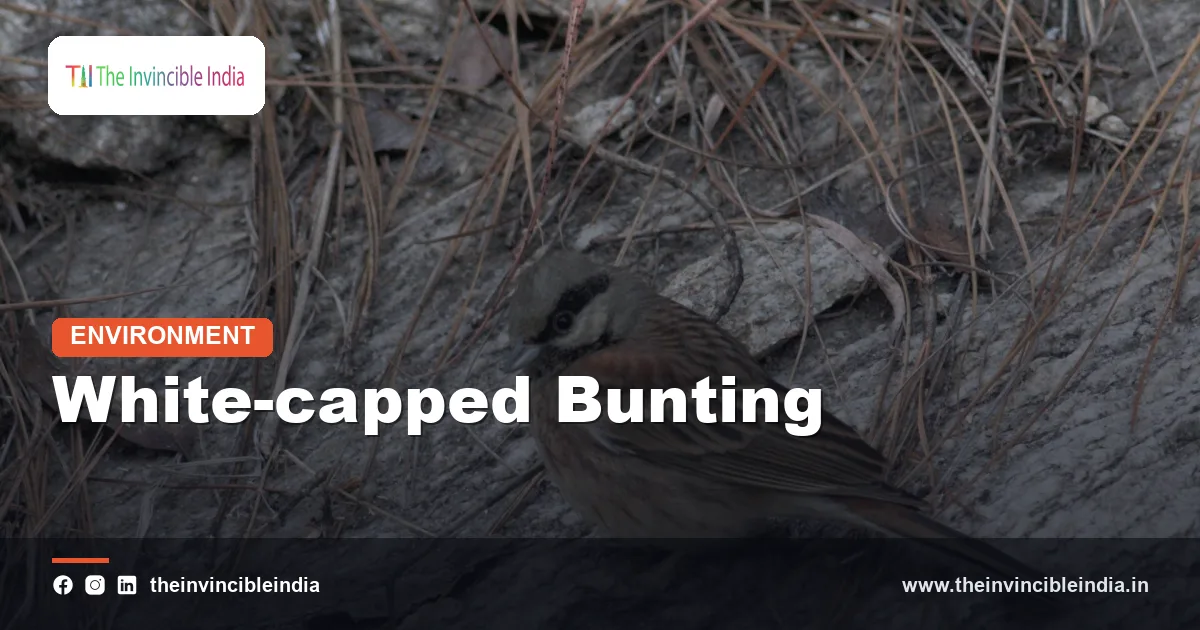
The white-capped bunting (Emberiza stewarti) is a small, seed-eating songbird of the bunting family that breeds on dry, stony Himalayan slopes and spends the winter in the dry plains, scrub and foothills of northern and north-western India. The male is easy to recognise in good plumage because of its pale, whitish head set against a chestnut back and breast band, while the female is a much plainer, streaked bird.
For most Indian birdwatchers the white-capped bunting is a cold-season visitor to dry country, seen in small flocks on stony ground, stubble fields and thorny scrub. This article explains how to identify the bird, where it lives, what it eats, how it breeds, how it moves between the mountains and the plains, and why a modest seed-eater of rocky hillsides is a useful indicator of healthy dry habitats.
| Quick Facts | White-capped Bunting |
|---|---|
| Common name | White-capped bunting |
| Scientific name | Emberiza stewarti |
| Family | Emberizidae (buntings and allies), order Passeriformes |
| Size | About 15 to 16 cm long, roughly the size of a house sparrow |
| Range and habitat in India | Breeds on dry, rocky slopes of the western Himalaya; winters on dry scrub, stony hillsides, fallow land and crop stubble across northern and north-western India |
| Diet | Mainly grass and crop seeds; insects are taken, especially for feeding nestlings |
| Breeding | Summer breeder in mountain country; builds a cup nest on or close to the ground among rocks and low bushes |
| Migration | Altitudinal and short-distance migrant; descends from the hills to the plains in the cold season |
| Conservation status | Least Concern on the IUCN Red List |
Key Takeaways
- The white-capped bunting is a sparrow-sized songbird whose scientific name is Emberiza stewarti and which belongs to the bunting family, Emberizidae.
- Male white-capped buntings in breeding plumage show a pale, whitish head, a chestnut back and a chestnut breast band, while females are streaked and much duller.
- The white-capped bunting breeds on dry, rocky slopes in the western Himalaya and winters in dry country across northern and north-western India.
- Seeds of grasses and crop plants form the bulk of the white-capped bunting’s diet, and insects become important when chicks are being fed.
- The white-capped bunting is a ground-nesting bird whose cup nest is hidden among stones, grass tufts or low shrubs.
- The IUCN Red List treats the white-capped bunting as a species of Least Concern, although it depends on open, dry habitats that can be lost to intensive land use.
What is the white-capped bunting?
The white-capped bunting is a small passerine, or perching bird, in the family Emberizidae, the group that contains the buntings of the Old World. Its scientific name is Emberiza stewarti, and the species is native to the mountains of Central Asia and the western Himalaya, with a winter range that extends into the Indian plains.
Buntings are close relatives of finches and sparrows, but they are usually placed in their own family because of their bill shape and some features of their anatomy. A bunting bill is short, conical and strong, built for cracking small seeds. The upper and lower parts of the bill meet along a slightly irregular edge, which helps the bird hold a seed while it removes the husk.
The white-capped bunting is a typical member of its genus in behaviour. It forages quietly on the ground, hops or walks in short bursts, and flies up to a low perch when disturbed. It is not a dramatic bird, and many sightings are brief glimpses of a small shape flushing from a dry slope or a field edge. The male’s pale head, however, makes the species one of the more distinctive buntings in northern India.
The word bunting itself is old, and in everyday English it covers a whole family of seed-eating songbirds. Several buntings occur in India, either as breeding birds in the Himalaya or as winter visitors to the plains, and the white-capped bunting is one of the visitors that birdwatchers in Delhi, Punjab, Rajasthan and Gujarat look out for in the cold months.
How do you identify a white-capped bunting?
A white-capped bunting is identified by its small size, conical seed-eater’s bill, chestnut upperparts and, in the male, a pale whitish head with darker markings on the face and throat. Because the cap is not always obvious in winter, the best approach is to combine several features rather than rely on one.
The male
The adult male in fresh plumage is the most striking form. The head looks pale and whitish-grey, contrasting with dark lines on the face and throat. A chestnut band crosses the breast, and the back and rump carry rich chestnut tones with dark streaks on the mantle. The underparts below the band are pale. After the moult, fresh feathers have buff or brownish fringes that soften the pattern, and these fringes wear away through the winter, so the head often looks cleaner and brighter by late winter than in autumn.
The female and young birds
The female lacks the pale cap and strong head pattern. She is brownish and streaked above, paler and finely streaked below, with only a hint of chestnut on the rump. Young birds are similar to the female. These plain birds are the ones most easily overlooked, and the presence of a few bright males in a flock is often the first sign that the group contains white-capped buntings.
Behaviour and call
White-capped buntings often feed in loose flocks, sometimes mixed with other buntings, larks or sparrows. They give soft, short contact calls as they move over open ground. Males sing from rocks or bush tops in the breeding season, with a short, simple, repeated phrase typical of buntings. Birdwatchers usually find the species by scanning stony ground in the early morning and late afternoon, when the birds come out to feed.
A useful list of field marks follows.
- Size close to that of a house sparrow, but slimmer, with a longer tail.
- Short, conical bill suited to seeds.
- Males with a pale head pattern and a chestnut breast band.
- Chestnut rump and streaked back.
- Habit of feeding on bare or sparsely vegetated ground and flying to a low rock or bush when alarmed.
Where is the white-capped bunting found in India?
The white-capped bunting is found in India mainly as a winter visitor to the dry plains and foothills of the north and north-west, and as a breeding bird on dry Himalayan slopes in the west of the mountain range. Its overall range stretches from the mountains of Central Asia through Afghanistan and Pakistan into the Indian Himalaya.
In the cold season, the species spreads across northern India, including the dry belts of Punjab, Haryana, Rajasthan and Gujarat and the dry country around the Delhi region. Smaller numbers reach further into central India, and records further south are generally scarce and irregular. The exact numbers seen in a given winter vary from place to place, depending on weather, food supply and the state of local habitats.
Within the breeding range, the bird occupies the lower and middle elevations of the western Himalaya, favouring open, dry slopes rather than forest or damp meadows. These slopes are warm, stony and thinly vegetated, with scattered shrubs and clumps of grass. Birdwatchers in Jammu and Kashmir, Himachal Pradesh and parts of Uttarakhand look for the bird in such terrain during spring and summer.
Because the white-capped bunting is a short-distance and altitudinal migrant, it does not need to cross great distances. It moves down the slopes and out onto the plains as snow and cold make the high ground hard to live in. This movement is more modest than the long flights of ducks and waders but is important in the annual cycle of the bird.
What habitat does the white-capped bunting prefer?
The white-capped bunting prefers dry, open habitat with bare or stony ground, scattered shrubs and a supply of grass seeds. In the breeding season this means rocky mountain slopes, and in winter it means dry scrub, rocky hillsides, fallow land and harvested fields.
The common thread in all of these places is open ground where the bird can walk and feed. Dense forest, tall crops and wet marshes are not suited to the species. The bird needs low cover nearby so that it can retreat from predators, and it often keeps close to a bush, a boulder or the edge of a field.
- Breeding season: dry, stony Himalayan slopes with scattered bushes and tufts of grass.
- Winter: dry scrub, stony or sandy wasteland, fallow fields, stubble and thorn-scrub edges in the plains and low hills.
- Features that matter: open ground, a seed supply, low cover and a lack of heavy disturbance.
Dry habitats of this kind are sometimes described as wasteland in official land records, which can make them easy targets for conversion to plantations, irrigated farms or construction. The white-capped bunting is one of many small birds whose winter survival depends on such land being left reasonably open and uncluttered.
What does the white-capped bunting eat?
The white-capped bunting eats mainly seeds, especially those of grasses and weeds, and it adds insects to its diet during the breeding season. Seeds are easy to find on dry ground in winter, and the bird’s bill is well adapted to husk them quickly.
In the plains, flocks gather at the edges of cultivation where weed seeds and spilled grain are available. They search the ground methodically, picking up fallen seeds from the surface. They may also take small insects and other invertebrates when they are available, which provides extra protein at the time of year when the body needs it.
During breeding, adults catch insects to feed their nestlings. Insect food is rich in protein, which young birds need for rapid growth, and many seed-eating songbirds switch to this food for their chicks even though the adults continue to eat mostly seeds. The white-capped bunting follows this widespread pattern.
Like other ground-feeding songbirds, the white-capped bunting often swallows small grit, which stays in the gizzard and helps grind hard seeds. Birds may be seen picking at gravel on tracks and stony ground for this reason.
How does the white-capped bunting breed?
The white-capped bunting breeds in the northern summer, building a cup-shaped nest on or very near the ground, hidden among stones, grass or low shrubs on a dry mountain slope. The female does most of the nest building and incubation, while the male defends the territory and sings from a prominent perch.
The nest is a neat cup made of grass stems and similar fibres and lined with finer material. Its position under a rock ledge or a tuft of vegetation hides it from predators and from the strong sun of an open slope. A clutch usually contains a few eggs, commonly three to five, which are pale with darker streaks or blotches. Both parents feed the chicks, which leave the nest while still weak flyers and are looked after on the ground for a time.
Ground nesting is a risky strategy. Eggs and chicks are exposed to snakes, small mammals, birds of prey and, in some places, grazing livestock. The birds compensate by choosing hidden sites and by raising more than one brood where conditions allow. The timing of breeding follows the arrival of warm weather in the mountains, when seeds and insects become plentiful.
Because the breeding season takes place in remote hill country, the species is far less often seen with a nest than seen in winter flocks. Many details of its nesting biology in India are known mainly from a limited number of observations by field ornithologists.
Does the white-capped bunting migrate?
Yes, the white-capped bunting migrates, but mostly over short distances, moving from its breeding slopes in the mountains down to the plains in the cold season. This type of movement is called altitudinal or short-distance migration, and it is common among mountain birds.
The reason is simple. In the Himalaya, winter brings snow cover, freezing nights and a shortage of seeds. Dropping to the plains puts the bird in a warmer climate with exposed ground and plenty of seed. As spring approaches, birds move back toward the hills to breed.
The timing of these movements varies with the year. Birdwatchers generally record the first winter birds in the plains in the autumn months, with numbers building into the cold season and falling again as spring comes. Weather can alter the pattern, and a harsh spell in the hills can push more birds down than usual.
The table below compares the two parts of the annual cycle.
| Season | Where the bird is | What it does |
|---|---|---|
| Spring and summer | Dry rocky slopes of the western Himalaya | Males sing and hold territories; pairs nest on the ground; adults feed chicks insects |
| Autumn | Moving downhill and into the plains | Birds gather in small flocks and begin foraging in stubble and fallow land |
| Winter | Dry plains, scrub and low hills of northern and north-western India | Flocks feed on seeds on open ground, often with other seed-eating birds |
| Late winter and early spring | Plains, then moving back toward the hills | Males moult into brighter plumage and the return movement begins |
How is the white-capped bunting different from similar birds?
The white-capped bunting differs from other buntings and from sparrows chiefly in its male head pattern, chestnut tones and habit of living in dry stony country. Several similar-looking birds share its range, so comparison helps.
Buntings as a group look alike to a casual observer, with streaked brown plumage, a conical bill and a habit of feeding on the ground. Experienced birdwatchers separate species by head pattern, the colour of the underparts and the tone of the rump. Female and young birds can be especially hard to identify, and a flock may need to be watched for some time before every bird can be named.
- House sparrow: heavier bill and bulkier build, with different head and chest patterns; sparrows also stay near human settlements throughout the year.
- Other buntings: different head and breast markings, and often different preferences in habitat; some prefer wet grass or higher ground.
- Larks: longer hind claws, more upright stance, and a streaked, sandy pattern without chestnut.
- Finches: bills and flight calls differ, and most finches feed in trees and shrubs more than on bare ground.
The practical advice is to take time, use binoculars, note the tail and rump colour, and photograph any bird whose identity is uncertain. Photographs help later comparison with field guides and digital checklists.
Is the white-capped bunting threatened?
No, the white-capped bunting is not considered threatened; the IUCN Red List classes it as a species of Least Concern because of its large range and its overall numbers. It is, however, tied to open, dry habitats that can be altered by human activity.
Several pressures affect birds of dry, open country across the Indian subcontinent. They include the conversion of scrubland and wasteland into plantations or irrigated farmland, over-grazing, the spread of invasive plants, the use of pesticides that reduce seeds and insects, and development on stony hillsides. Disturbance near breeding sites in the hills may also matter, although the remote location of many breeding slopes gives the species some natural protection.
A Least Concern listing does not mean that conservation is unnecessary. It means that the species is not currently judged to be at risk of disappearing. Local populations can still decline if habitats are lost, and monitoring through citizen-science records helps detect such changes early.
Why does the white-capped bunting matter?
The white-capped bunting matters because it is an indicator of dry, open habitats and because it plays a part in the ecology of seed and insect communities. Small seed-eaters help control weed seeds, serve as prey for raptors and carry out a quiet role in the food web of dry country.
Dry habitats are often undervalued. A stony hillside or a patch of thorny scrub may look empty, but it supports specialist plants, insects, reptiles and birds. The white-capped bunting belongs to this community, and its winter presence on a field edge is a sign that open, seed-rich ground still exists there.
The species is also useful for those learning birdwatching. Buntings introduce beginners to the challenge of telling similar species apart, and winter flocks give regular opportunities for practice. Records submitted by amateur birdwatchers to online databases add to the knowledge of where and when the bird occurs.
Tips for watching white-capped buntings
- Visit dry scrub and stony ground in the cold months, preferably in the early morning.
- Scan the ground at the edges of fields and tracks for small flocks.
- Move slowly and keep a good distance, since ground-feeding birds flush easily.
- Look for bright males among duller birds and compare the rump and breast colour.
- Record the date, place and habitat when you submit a sighting.
Bottom Line
The white-capped bunting is a small, chestnut-and-pale seed-eater that breeds on dry Himalayan slopes and winters across the dry plains of northern India. Though it is currently secure, it relies on open, stony habitats that are easy to overlook and easy to lose.
Frequently Asked Questions
What is a white-capped bunting?
A white-capped bunting is a small songbird in the bunting family, with the scientific name Emberiza stewarti. It breeds on dry, rocky slopes in the western Himalaya and winters on dry ground in northern India. The male has a pale head and a chestnut breast band, while the female is streaked and plain.
Where can I see a white-capped bunting in India?
You can see a white-capped bunting in winter on dry scrub, stony ground and harvested fields across northern and north-western India. It is also found on dry slopes of the western Himalaya in the breeding season. Early mornings in the cold months are usually the best time to look.
What does the white-capped bunting eat?
The white-capped bunting eats mainly the seeds of grasses and weeds, picked from the ground. It also catches insects, especially to feed its young during the breeding season. Seeds make up most of the diet for the rest of the year.
Is the white-capped bunting a migratory bird?
Yes, the white-capped bunting is a migratory bird, though it travels mostly short distances. It moves from the Himalayan breeding slopes down to the plains for the cold season and returns to the hills in spring. This is often described as altitudinal migration.
How can I tell a male white-capped bunting from a female?
A male white-capped bunting has a pale, whitish head with darker facial markings and a chestnut band across the breast. A female is brownish and streaked, without the pale cap or the strong head pattern. Young birds resemble the female.
Is the white-capped bunting endangered?
No, the white-capped bunting is not endangered. The IUCN Red List classifies it as Least Concern because it has a wide range and a stable overall population. Loss of dry open habitat can still affect local numbers.
{“@context”:”https://schema.org”,”@graph”:[{“@type”:”FAQPage”,”mainEntity”:[{“@type”:”Question”,”name”:”What is a white-capped bunting?”,”acceptedAnswer”:{“@type”:”Answer”,”text”:”A white-capped bunting is a small songbird in the bunting family, with the scientific name Emberiza stewarti. It breeds on dry, rocky slopes in the western Himalaya and winters on dry ground in northern India. The male has a pale head and a chestnut breast band, while the female is streaked and plain.”}},{“@type”:”Question”,”name”:”Where can I see a white-capped bunting in India?”,”acceptedAnswer”:{“@type”:”Answer”,”text”:”You can see a white-capped bunting in winter on dry scrub, stony ground and harvested fields across northern and north-western India. It is also found on dry slopes of the western Himalaya in the breeding season. Early mornings in the cold months are usually the best time to look.”}},{“@type”:”Question”,”name”:”What does the white-capped bunting eat?”,”acceptedAnswer”:{“@type”:”Answer”,”text”:”The white-capped bunting eats mainly the seeds of grasses and weeds, picked from the ground. It also catches insects, especially to feed its young during the breeding season. Seeds make up most of the diet for the rest of the year.”}},{“@type”:”Question”,”name”:”Is the white-capped bunting a migratory bird?”,”acceptedAnswer”:{“@type”:”Answer”,”text”:”Yes, the white-capped bunting is a migratory bird, though it travels mostly short distances. It moves from the Himalayan breeding slopes down to the plains for the cold season and returns to the hills in spring. This is often described as altitudinal migration.”}},{“@type”:”Question”,”name”:”How can I tell a male white-capped bunting from a female?”,”acceptedAnswer”:{“@type”:”Answer”,”text”:”A male white-capped bunting has a pale, whitish head with darker facial markings and a chestnut band across the breast. A female is brownish and streaked, without the pale cap or the strong head pattern. Young birds resemble the female.”}},{“@type”:”Question”,”name”:”Is the white-capped bunting endangered?”,”acceptedAnswer”:{“@type”:”Answer”,”text”:”No, the white-capped bunting is not endangered. The IUCN Red List classifies it as Least Concern because it has a wide range and a stable overall population. Loss of dry open habitat can still affect local numbers.”}}]}]}


