

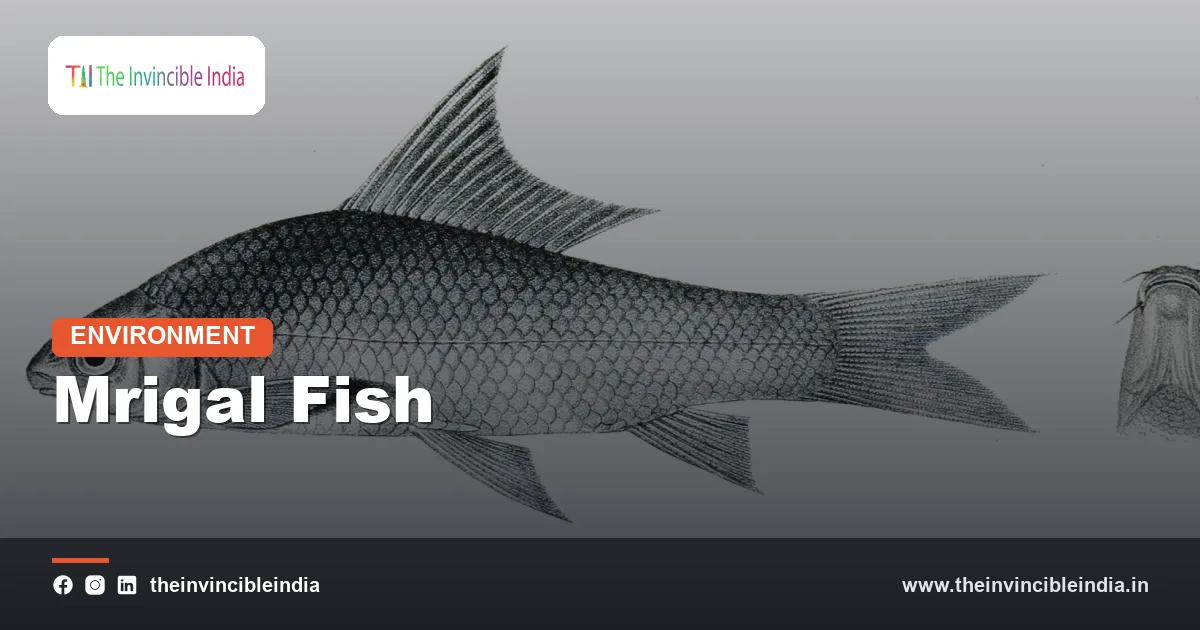
The mrigal (Cirrhinus cirrhosus) is a slender, silvery freshwater carp native to the rivers of northern and eastern India, and it is one of the three Indian major carps, along with catla and rohu, that form the backbone of freshwater fish farming in the country. It is a bottom-feeding fish, known in Hindi-speaking regions as naini, and is stocked alongside its two relatives in ponds because it uses a different layer of the water.
The mrigal rarely gets the attention given to the rohu or the hilsa, yet it is one of the most economically useful fishes in Indian aquaculture. Fast-growing, hardy and able to feed on material other fish ignore, the mrigal helps farmers turn a single pond into a productive, multi-level food system. This explainer covers the fish’s biology, habitat, breeding, role in composite culture and market value.
Quick Facts: Mrigal at a Glance
| Scientific name | Cirrhinus cirrhosus (formerly Cirrhinus mrigala) |
|---|---|
| Common names | Mrigal, mirgal, naini (Hindi), mrigel (Bengali), mrigala |
| Family | Cyprinidae (carps and minnows) |
| Typical size | Commonly about 0.5 to 1 kg in a year of farm growth; wild adults can grow to a metre or more in length and exceed 10 kg |
| Habitat and range in India | Rivers, canals, reservoirs and ponds; native to the Indus, Ganga and Brahmaputra systems and introduced widely in peninsular India |
| Diet | Bottom feeder: detritus, decaying plant matter, algae and plankton from the pond or river floor |
| Breeding | Spawns in flooded rivers during the monsoon; in farms, bred by induced breeding with hormones |
| Economic importance | One of the three Indian major carps used in composite fish culture; important for inland fish production |
| Status | Abundant in culture; wild river stocks have declined in parts of the range |
Key Takeaways
- The mrigal (Cirrhinus cirrhosus) is one of the three Indian major carps, alongside catla (Labeo catla) and rohu (Labeo rohita).
- Mrigal is a bottom feeder, which means it lives and eats near the floor of a pond or river, in contrast to the surface-feeding catla and column-feeding rohu.
- Composite fish culture stocks mrigal, rohu and catla together so that each species uses a different food niche and the pond yields more fish.
- Mrigal does not usually breed naturally in ponds, so hatcheries use induced breeding, a technique developed in India in the 1950s, to produce seed.
- Mrigal flesh is milder and often cheaper than that of rohu or catla, which makes the fish an affordable source of protein in many markets.
- Pond-raised mrigal can reach roughly half to one kilogram in the first year under good management, making it a fast and dependable farmed carp.
What is the mrigal and what does it look like?
The mrigal is a medium-to-large carp with an elongated, cylindrical body, a blunt head and a small, terminal mouth with thick lips. Its body is silvery with a darker greyish back, and the barbels, which are present in many carps, are absent or very short in this species.
Compared with the catla, which has a broad head and upturned mouth, the mrigal looks more streamlined. Compared with the rohu, it has a smaller head and less deep body. The fins are usually tinged with a darker or reddish shade in adults, and the scales are moderately large with a clear pattern of radiating lines.
The lips and mouth parts are adapted to scraping and sucking material from soft sediments. These features reflect the fish’s role as a ground feeder.
Where does the mrigal live in India?
The mrigal lives in the slow to moderately flowing rivers, canals, oxbow lakes, reservoirs and ponds of India, with a natural range covering the Indus, Ganga and Brahmaputra river systems and their tributaries. It also occurs in neighbouring Pakistan, Nepal and Bangladesh.
Because mrigal adapts well to captivity, it has been transplanted to rivers and reservoirs of peninsular India, including the Krishna, Godavari and Cauvery basins, where it is now widely found as an introduced species. In the wild it prefers deeper pools and quiet stretches with soft, silty or sandy beds.
The fish tolerates a fairly wide range of temperatures typical of the Indian plains, though it grows fastest in warm water between roughly 25 and 32 degrees Celsius. Growth slows in winter, particularly in northern states where ponds cool sharply, and farmers adjust stocking and feeding to the season.
- Natural range: the Indus, Ganga and Brahmaputra drainages and the larger tributaries of these systems.
- Introduced range: reservoirs and rivers across peninsular India through stocking programmes.
- Preferred habitat: deep, quiet pools with soft beds and good plankton growth.
What does the mrigal eat?
The mrigal feeds mainly on decaying vegetation, detritus, algae and other organic matter found on the bottom of ponds and rivers. It is classed as a column-to-bottom feeder and often described as a detritivore or bottom-dwelling omnivore.
Young mrigal, called fry and fingerlings, begin by eating zooplankton and phytoplankton in the upper water layers. As they grow, they shift to the bottom, where they scoop and sift mud, taking up microscopic organisms, partially decomposed plants and fine particles.
In ponds, farmers support this natural diet by adding organic manure and fertiliser, which encourages plankton growth, and by giving supplementary feed such as a mix of rice bran and oil cake. Mrigal readily accepts such feed, which supports rapid growth. Because the species forages in the sediment, it also stirs up nutrients, which can help phytoplankton growth in the water above.
How does composite fish culture use the mrigal?
Composite fish culture uses the mrigal as the bottom-feeding component of a multi-species pond, stocked together with surface-feeding catla and column-feeding rohu so that all layers of the pond are used. This system, promoted in India from the 1970s onward, became the standard method of freshwater aquaculture across much of the country.
The idea is simple: a pond is not a single feeding zone but three. Catla feeds on zooplankton near the surface. Rohu feeds on a mixture of plankton and vegetation in the middle. Mrigal feeds on detritus and settled organic matter on the bottom. When the three are raised together, they compete less and convert the pond’s natural productivity more efficiently into fish flesh.
Farmers may also add exotic carps, such as silver carp, grass carp and common carp, to occupy additional niches. The following table shows how the main Indian major carps divide the pond.
| Species | Feeding zone | Main food |
|---|---|---|
| Catla (Labeo catla) | Surface and upper layer | Zooplankton |
| Rohu (Labeo rohita) | Middle or column layer | Plankton, plant matter and detritus |
| Mrigal (Cirrhinus cirrhosus) | Bottom layer | Detritus, decayed vegetation and benthic organisms |
Stocking ratios vary with the farm, water quality and market demand, but mrigal usually makes up a quarter to a third of the stocked carps. Farmers adjust numbers to match the productivity of the pond and the availability of seed.
How does the mrigal breed?
The mrigal breeds in rivers during the monsoon, when rising floodwater triggers spawning, but it generally does not spawn on its own in still ponds. This is true of all three Indian major carps and is why hatchery technology is essential.
In nature, mature mrigal migrate to flooded river stretches and spawn in the current. The eggs drift, hatch within a day or so, and the larvae grow in the nutrient-rich floodplains. For many decades, farmers depended on collecting wild spawn from rivers, a method that was unreliable and harmed wild stocks.
Induced breeding
The breakthrough came in the late 1950s, when Indian scientists at the Central Inland Fisheries Research Institute in Cuttack, Odisha, demonstrated induced breeding of Indian major carps by injecting fish with pituitary gland extract, a method known as hypophysation. Today hatcheries use synthetic hormone preparations to bring brood fish to spawning in a controlled setting.
The process generally follows these steps:
- Selecting healthy male and female brood fish, usually two to three years old, and conditioning them in separate ponds.
- Injecting the hormone preparation at a carefully measured dose.
- Allowing the fish to spawn in a hatchery tank or a breeding pool, often with flowing water to mimic a river.
- Collecting eggs, hatching them in jars or tanks and rearing the larvae into fry and fingerlings.
This technique supplies farmers with seed all over India and ranks among the major achievements of Indian fisheries science.
How fast does the mrigal grow?
Pond-raised mrigal grows fast, commonly reaching about 500 grams to 1 kilogram within the first year under good management and often more in the second year. Growth depends on temperature, stocking density, feed and water quality.
Fish farmers usually raise carps in stages. Hatchlings become fry in nursery ponds, fry become fingerlings in rearing ponds, and fingerlings are then stocked in grow-out ponds for several months. At harvest, fish are caught by repeated netting or by draining the pond.
Mrigal sexual maturity is attained at about two years, though they can mature earlier in warm conditions. In the wild, the species can live several years and grow to a metre or more, but farm fish are usually harvested well before that size to meet market preferences.
Why is the mrigal valuable to farmers and consumers?
The mrigal is valuable because it grows quickly, feeds low on the food chain, tolerates handling and fits easily into composite culture, giving small and large farmers a reliable crop. Its ability to use the pond bottom increases total production without requiring extra feed for every species.
For consumers, the mrigal is a familiar and inexpensive freshwater fish sold fresh in markets across northern, eastern and central India. It is cooked in curries, fried or steamed. Many cooks consider its flavour mild and its flesh softer than that of rohu, though it also contains small intermuscular bones that require some care while eating.
The fish matters for rural livelihoods too. Carp farming offers income through pond leasing, seed production, feed supply, harvesting, ice and transport. India is among the world’s leading fish-producing countries, and inland aquaculture based on Indian major carps is a large contributor to this output.
What problems affect the mrigal?
The mrigal faces threats in the wild from river regulation, overfishing, pollution and habitat loss, and in farms from disease, poor water quality and inbreeding. These issues affect both wild populations and the quality of hatchery stocks.
- River dams and barrages: block migration to spawning areas and alter flow.
- Overfishing: removes breeding adults and juveniles from rivers.
- Pollution: industrial and agricultural runoff can reduce oxygen and cause fish kills.
- Genetic decline in hatcheries: repeated breeding from a small number of related fish can slow growth and weaken stocks, so good brood-stock management is essential.
- Diseases: bacterial infections, parasites and ulcer syndromes can spread in crowded ponds if water quality is poor.
Good practice includes maintaining water quality, avoiding excessive stocking, using certified seed from reputed hatcheries and following health guidelines from state fisheries departments and research institutes.
Bottom Line
The mrigal is the bottom-dwelling member of India’s trio of major carps and plays an essential part in composite fish culture. Through induced breeding, hatcheries supply seed that allows farmers across the country to raise it in ponds. Protecting wild river stocks while improving hatchery quality is the main task for the future.
Frequently Asked Questions
What is mrigal fish?
Mrigal is a freshwater carp (Cirrhinus cirrhosus) native to northern and eastern Indian rivers and one of the three Indian major carps. It feeds on the bottom of ponds and rivers. It is widely farmed and sold as an affordable food fish.
Which are the three Indian major carps?
The three Indian major carps are catla, rohu and mrigal. Catla feeds at the surface, rohu in the middle layer and mrigal near the bottom. Raising them together in composite culture makes full use of a pond.
Is mrigal a bottom feeder?
Yes, mrigal is a bottom feeder that eats detritus, decayed plant matter and tiny organisms from the floor of a pond or river. Young fish eat plankton in the upper layers before shifting to the bottom as they grow. This habit lets it share ponds with surface and mid-water carps.
How big does mrigal grow?
Mrigal commonly reaches about half to one kilogram in the first year in a well-managed pond. In the wild it can grow to a metre or more in length and exceed 10 kilograms. Growth depends on water temperature, feed and stocking density.
How is mrigal bred in India?
Mrigal is bred by induced breeding, in which brood fish are given hormones so they spawn in controlled conditions. The method was developed in India in the late 1950s. It supplies farmers with fry and fingerlings without depending on wild spawn from rivers.
Is mrigal good to eat?
Mrigal is a widely eaten, mild-flavoured freshwater fish that is usually cheaper than rohu or catla. It provides protein and is cooked in curries or fried. Like other carps, it has small bones, so it should be eaten carefully.
{“@context”:”https://schema.org”,”@graph”:[{“@type”:”FAQPage”,”mainEntity”:[{“@type”:”Question”,”name”:”What is mrigal fish?”,”acceptedAnswer”:{“@type”:”Answer”,”text”:”Mrigal is a freshwater carp (Cirrhinus cirrhosus) native to northern and eastern Indian rivers and one of the three Indian major carps. It feeds on the bottom of ponds and rivers. It is widely farmed and sold as an affordable food fish.”}},{“@type”:”Question”,”name”:”Which are the three Indian major carps?”,”acceptedAnswer”:{“@type”:”Answer”,”text”:”The three Indian major carps are catla, rohu and mrigal. Catla feeds at the surface, rohu in the middle layer and mrigal near the bottom. Raising them together in composite culture makes full use of a pond.”}},{“@type”:”Question”,”name”:”Is mrigal a bottom feeder?”,”acceptedAnswer”:{“@type”:”Answer”,”text”:”Yes, mrigal is a bottom feeder that eats detritus, decayed plant matter and tiny organisms from the floor of a pond or river. Young fish eat plankton in the upper layers before shifting to the bottom as they grow. This habit lets it share ponds with surface and mid-water carps.”}},{“@type”:”Question”,”name”:”How big does mrigal grow?”,”acceptedAnswer”:{“@type”:”Answer”,”text”:”Mrigal commonly reaches about half to one kilogram in the first year in a well-managed pond. In the wild it can grow to a metre or more in length and exceed 10 kilograms. Growth depends on water temperature, feed and stocking density.”}},{“@type”:”Question”,”name”:”How is mrigal bred in India?”,”acceptedAnswer”:{“@type”:”Answer”,”text”:”Mrigal is bred by induced breeding, in which brood fish are given hormones so they spawn in controlled conditions. The method was developed in India in the late 1950s. It supplies farmers with fry and fingerlings without depending on wild spawn from rivers.”}},{“@type”:”Question”,”name”:”Is mrigal good to eat?”,”acceptedAnswer”:{“@type”:”Answer”,”text”:”Mrigal is a widely eaten, mild-flavoured freshwater fish that is usually cheaper than rohu or catla. It provides protein and is cooked in curries or fried. Like other carps, it has small bones, so it should be eaten carefully.”}}]}]}


