

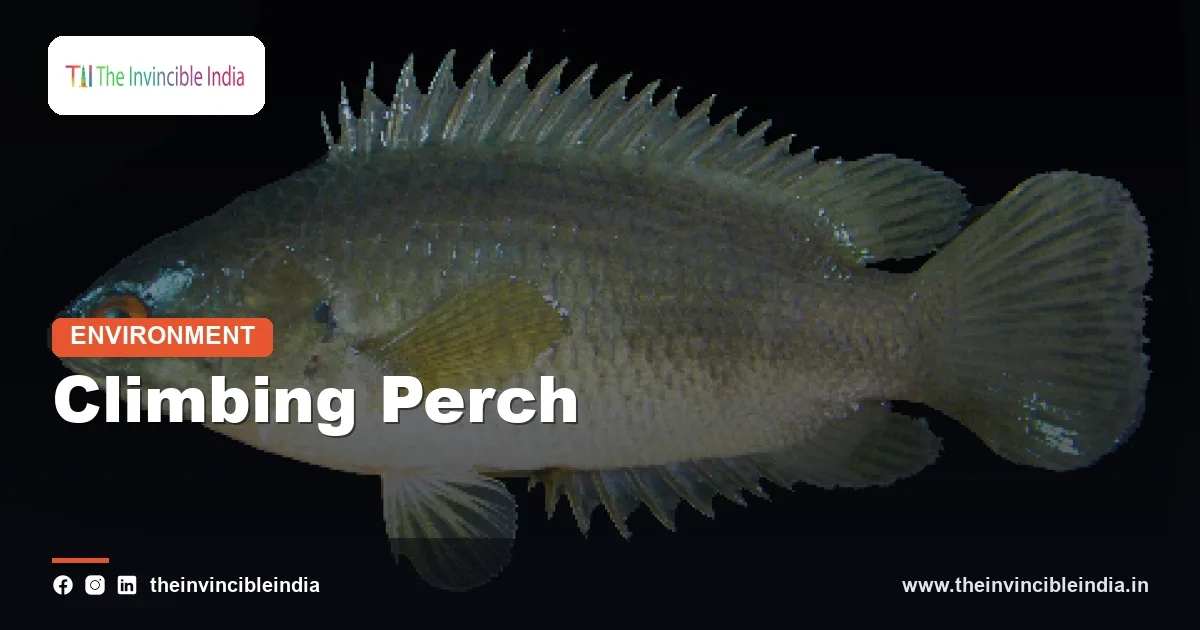
The climbing perch is a hardy freshwater fish, Anabas testudineus, that breathes air through a special organ above its gills and can survive out of water for many hours, even wriggling across damp ground from one pond to another. Found in ponds, ditches, swamps and paddy fields across much of India and South and Southeast Asia, it is known by regional names such as koi in Bengal and eastern India.
The fish does not literally climb trees, although old reports and local stories say it does. Its real talent is surviving where other fish die, which has made the climbing perch a valued food fish, a favourite subject for biology classes and an object of curiosity.
Quick Facts
| Scientific name | Anabas testudineus |
|---|---|
| Common names | Climbing perch (English), koi (Bengali and Assamese), and other regional names across India |
| Family | Anabantidae (climbing gouramis and related labyrinth fishes), within the labyrinth fish group |
| Size | Usually about 10 to 20 cm; large individuals can approach 25 cm |
| Habitat and range in India | Ponds, ditches, canals, swamps, marshes, rice fields and slow rivers, especially in eastern, north-eastern and southern India, and across South and Southeast Asia |
| Diet | Omnivorous: insects and their larvae, small crustaceans, small fish, worms, plant material and organic debris |
| Breeding and life cycle | Breeds mainly in the rainy season; lays many small floating eggs that hatch within about a day; parents give little or no care |
| Economic importance | Popular food fish in eastern India, sold alive in markets, and used in small-scale aquaculture |
| Status | Widespread and not regarded as globally threatened; some researchers treat it as a complex of closely related species |
Key Takeaways
- The climbing perch is an air-breathing freshwater fish, Anabas testudineus, that belongs to the labyrinth fishes and is found across India and Southeast Asia.
- The labyrinth organ of the climbing perch is a folded, blood-rich chamber above the gills that absorbs oxygen straight from the air.
- The climbing perch can live out of water for hours if its skin and gills stay damp, and it can move over land using its fins, tail and spiny gill covers.
- The climbing perch does not climb trees in any habitual sense, and the tree-climbing stories date to early naturalists’ reports that scientists still treat with caution.
- The climbing perch is an omnivore that breeds in the rainy season and lays floating eggs without caring for its young.
- The climbing perch is a prized live food fish in eastern India, and it is hardy enough to be raised in small ponds with little oxygen.
What Is the Climbing Perch?
The climbing perch is a small to medium-sized freshwater fish of the family Anabantidae that has evolved to breathe air, allowing it to live in oxygen-poor water and to cross short stretches of land. Its scientific name is Anabas testudineus, and it is the most widely known member of the labyrinth fishes.
The body is oval, thick and slightly compressed, covered in tough, rough scales. Colour ranges from olive and dark brown to greenish grey, often with a dark spot near the tail base, and some fish show a golden or bronze shine. The head is broad, the mouth is large and slightly upturned, and the fins are strong. A short, stiff dorsal fin and anal fin carry sharp spines.
The name “perch” is somewhat misleading. The climbing perch is not a true perch of the family Percidae, but it resembles one in general shape and has been called by this name in English since early scientific descriptions. In India, the fish is better known by local names: koi in Bengali and Assamese, and different words in other languages.
How Does the Climbing Perch Breathe Air?
The climbing perch breathes air using a labyrinth organ, a maze-like, highly folded structure of thin bone covered with blood-rich tissue that sits in a chamber above the gills. This organ takes oxygen directly from air gulped at the surface.
The process works in a few simple steps:
- The fish rises to the surface and takes a mouthful of air.
- The air passes into the suprabranchial chamber, a cavity above the gills, where it contacts the labyrinth organ.
- Oxygen moves through the thin, moist membrane into the blood, and used air is let out through the gill opening.
The gills of the climbing perch are small and not very efficient on their own. The fish therefore depends on air breathing, and a climbing perch that is kept from reaching the surface can actually drown. This unusual fact surprises many people, who assume that a fish which survives on land cannot drown.
The ability is useful in the warm, stagnant, weedy waters where the fish lives. In summer, shallow ponds and paddy fields can lose most of their dissolved oxygen, and a fish that depends only on gills may suffocate. The climbing perch simply switches to breathing air, and thus occupies a habitat that is closed to many competitors.
Can the Climbing Perch Really Walk on Land?
Yes, the climbing perch can move over land for short distances, usually when the ground is wet, by pushing its body forward with its pectoral fins, its tail and its spiny gill covers. It does not walk in the sense of using legs, but its movement is a kind of wriggling crawl.
The fish uses the sharp spines on its gill covers (the opercula) as anchors. It braces one side, flexes its body, and pushes ahead, rather like a person pulling themselves forward on their elbows. The tail provides additional thrust.
There are several reasons a climbing perch leaves the water:
- Drying ponds: When a pond shrinks in the dry season, fish move toward deeper water or a nearby pool.
- Monsoon movement: After heavy rain, flooded fields and ditches become temporary links, and the fish uses them to disperse.
- Escape: A fish may leave a net or a container and make its way across wet ground.
Overland movement is limited. The skin and the gills must stay moist, and the fish cannot cross dry, hot ground for long. It travels mostly on rainy nights and after downpours. Under damp conditions, it can survive out of water for many hours, and in some conditions, even longer, which is why fish sellers in eastern India can keep it alive in a shallow container without water for a long time.
Does the Climbing Perch Climb Trees?
The climbing perch does not climb trees in any regular or proven way, although its common name comes from old reports that it did. The best-known account dates to the late eighteenth century, when a Danish naturalist working in south India described a specimen apparently found in a palm tree, and the story passed into popular lore.
Modern biologists generally explain the claim in more ordinary ways. A fish found far from water may have been carried by a bird, left by a flood, or moved across wet ground and then stranded. Some people have also reported fish moving up the slippery roots and trunks of fallen or leaning trees after rain. Such climbing, if it happens, is slight and accidental.
What is certain is that the climbing perch can move over ground and over obstacles such as banks and small barriers, and that its fins and spines give it surprising grip. The name “climbing” therefore reflects a real ability that was exaggerated by early travellers.
Where Does the Climbing Perch Live in India?
The climbing perch lives in still and slow-moving fresh water, such as ponds, ditches, canals, swamps and rice fields, and it is found in many parts of India, especially the eastern, north-eastern and southern regions. Outside India, it is spread across Sri Lanka, Bangladesh, Myanmar, Thailand, Malaysia, Indonesia, southern China and the Philippines.
It favours warm, weedy and often muddy water with plenty of cover. It also tolerates low oxygen, high temperature and some salinity, which helps it survive in places that change a great deal through the year. In dry spells, the fish may burrow into mud and wait for the rains, a behaviour known as aestivation, and it can survive in damp mud with little or no standing water.
Fish biologists have noted that the species shows considerable variation in shape and colour across its wide range. Some researchers think the name Anabas testudineus covers more than one closely related species, so the taxonomy may be refined in the future.
What Does the Climbing Perch Eat?
The climbing perch is an omnivore that eats insects, larvae, small crustaceans, worms, small fish, plant matter and decaying organic material. It adjusts its diet to whatever is available in its habitat and season.
Young fish feed mainly on tiny animals in the water, such as zooplankton, while adults take larger prey and a good deal of plant material. Fish living in rice fields eat mosquito larvae and other insects, and this has led to interest in the species as a form of natural pest and mosquito control, though it is not a replacement for proper public health measures.
Because it eats a wide range of foods, the climbing perch adapts easily to ponds and is cheap to feed in aquaculture. It will accept farm-made feeds, kitchen waste and agricultural by-products, which is part of its appeal to small farmers.
How Does the Climbing Perch Breed?
The climbing perch breeds mainly in the rainy season, when the female lays thousands of small, buoyant eggs that float near the surface and hatch within about a day. The parents do not guard the eggs or the young, so the survival of the offspring depends on sheer numbers.
The cycle can be summarised as follows:
| Stage | What happens |
|---|---|
| Spawning | Fish pair up in shallow, weedy water at the start of the monsoon, often after rain |
| Eggs | Many small, floating eggs are laid; they hatch in roughly one day, depending on temperature |
| Larvae | Tiny larvae live on their yolk for a short time, then feed on microscopic life |
| Juveniles | Young fish grow in shallow vegetated margins and begin to use the labyrinth organ as it develops |
| Adults | Fish mature within a year or so and may breed in more than one season |
In hatcheries, the climbing perch can be induced to breed with hormone injections, a technique already used for carps and catfish. Hatchery production of seed has helped farming of the species, and it reduces pressure on wild populations.
Why Is the Climbing Perch Valued as Food?
The climbing perch is valued as food because its flesh is considered tasty and nourishing, and because it can be sold alive, which assures buyers of freshness. In eastern India, particularly West Bengal, Assam, Odisha and Bihar, koi is a popular fish at the market and in the kitchen.
Several features explain its popularity:
- Freshness: Sold live in tubs or baskets, the fish is known to be fresh, which matters in hot climates.
- Taste: The flesh is firm and flavoursome, and it is cooked in mustard-based or tomato gravies, fried or made into light curries.
- Traditional belief: In many households, koi is regarded as a nourishing food for people recovering from illness. This is a cultural belief, not an established medical claim, and it should not replace medical advice.
- Bones and spines: The fish has sharp spines, so it needs careful handling when cleaning and eating.
The climbing perch is a small fish with a modest yield of meat, but its hardy nature, steady local demand and good price per kilogram make it an attractive crop for small farmers. A common pattern is for villagers to catch it in ponds and fields after the monsoon.
Can the Climbing Perch Be Farmed?
Yes, the climbing perch can be farmed in ponds and tanks, and it is considered a good species for small-scale aquaculture because it tolerates crowding, low oxygen and poor water quality. Because the fish breathes air, farmers can stock it at high densities in small ponds without costly aeration.
In practice, farmers use a few key steps:
- Prepare a shallow pond with mud and aquatic vegetation, and keep predators out.
- Stock seed raised in a hatchery or collected from the wild.
- Provide a feed mix with protein from fish meal or oilcake, along with natural food in the pond.
- Cover the pond edge with netting to stop the fish from escaping over land, since it can wriggle out, especially after rain.
Research institutions and state fisheries departments have promoted the species as a livelihood option, but growth is slower than that of major carps. For this reason, farmers usually treat the climbing perch as a high-value niche species. Specific yields and prices change, and are best checked with local fisheries offices.
Is the Climbing Perch a Threat to Other Ecosystems?
The climbing perch is a native and ordinary member of freshwater life in India, but in some other countries it has become an invasive species, and its hardiness and overland movement make it hard to contain once it has arrived. In India itself, the concerns are mainly about habitat loss and overfishing, not invasion.
Outside its native range, the fish has been introduced in places such as northern Australia, where authorities have worked to contain its spread. This illustrates a general rule: the same traits that make the species useful, such as tolerance of poor water, wide diet and ability to disperse over land, also make it a potential problem when introduced into a new region.
In India, the greater threats include:
- Drainage and filling of ponds, ditches and wetlands.
- Pesticide and fertiliser runoff from farmland.
- Over-collection in some places during the post-monsoon harvest.
Despite these pressures, the species is widespread and is not considered globally threatened. People should avoid releasing aquarium or farm fish into natural waters, because even a native species can spread disease or compete with local stocks.
Bottom Line
The climbing perch is a tough, air-breathing freshwater fish of India and Asia that can survive out of water, cross damp ground and thrive in oxygen-poor ponds. It owes its fame to a real and unusual biology, partly exaggerated by old stories of tree climbing. As a food fish and a candidate for small-scale farming, the climbing perch remains important to many rural communities in eastern India.
Frequently Asked Questions
Can a climbing perch really climb trees?
The climbing perch does not habitually climb trees, although the common name and old stories suggest it does. The claim goes back to an eighteenth-century report of a fish found in a palm in south India. What the fish can do is crawl over wet ground and low obstacles using its fins and spiny gill covers.
How long can a climbing perch live out of water?
A climbing perch can live out of water for many hours, and sometimes longer, as long as its skin and gills remain moist. It breathes air through a labyrinth organ above the gills. In hot, dry conditions, however, it will dry out and die.
How does a climbing perch breathe?
A climbing perch breathes by gulping air at the surface and passing it over the labyrinth organ, a folded, blood-rich structure above the gills. The organ absorbs oxygen directly from the air. The fish has small gills and can drown if it is prevented from reaching the surface.
Is the climbing perch edible?
Yes, the climbing perch is edible and is a popular food fish in eastern India, where it is known as koi. It is often sold alive and cooked in mustard or tomato gravies or fried. The flesh is firm, but the fish has sharp spines that need careful handling.
Where is the climbing perch found in India?
The climbing perch is found in ponds, ditches, canals, swamps and rice fields in many parts of India, especially in the east, north-east and south. It also occurs across South and Southeast Asia, from Sri Lanka and Bangladesh to Indonesia and southern China. It prefers warm, weedy, slow-moving water.
Can the climbing perch be kept or farmed?
Yes, the climbing perch can be kept and farmed because it tolerates crowded, low-oxygen water. Farmers raise it in ponds with simple feeds, and hatcheries can breed it using hormone injections. Pond edges should be netted, since the fish can wriggle out and move over damp ground.
{“@context”:”https://schema.org”,”@graph”:[{“@type”:”FAQPage”,”mainEntity”:[{“@type”:”Question”,”name”:”Can a climbing perch really climb trees?”,”acceptedAnswer”:{“@type”:”Answer”,”text”:”The climbing perch does not habitually climb trees, although the common name and old stories suggest it does. The claim goes back to an eighteenth-century report of a fish found in a palm in south India. What the fish can do is crawl over wet ground and low obstacles using its fins and spiny gill covers.”}},{“@type”:”Question”,”name”:”How long can a climbing perch live out of water?”,”acceptedAnswer”:{“@type”:”Answer”,”text”:”A climbing perch can live out of water for many hours, and sometimes longer, as long as its skin and gills remain moist. It breathes air through a labyrinth organ above the gills. In hot, dry conditions, however, it will dry out and die.”}},{“@type”:”Question”,”name”:”How does a climbing perch breathe?”,”acceptedAnswer”:{“@type”:”Answer”,”text”:”A climbing perch breathes by gulping air at the surface and passing it over the labyrinth organ, a folded, blood-rich structure above the gills. The organ absorbs oxygen directly from the air. The fish has small gills and can drown if it is prevented from reaching the surface.”}},{“@type”:”Question”,”name”:”Is the climbing perch edible?”,”acceptedAnswer”:{“@type”:”Answer”,”text”:”Yes, the climbing perch is edible and is a popular food fish in eastern India, where it is known as koi. It is often sold alive and cooked in mustard or tomato gravies or fried. The flesh is firm, but the fish has sharp spines that need careful handling.”}},{“@type”:”Question”,”name”:”Where is the climbing perch found in India?”,”acceptedAnswer”:{“@type”:”Answer”,”text”:”The climbing perch is found in ponds, ditches, canals, swamps and rice fields in many parts of India, especially in the east, north-east and south. It also occurs across South and Southeast Asia, from Sri Lanka and Bangladesh to Indonesia and southern China. It prefers warm, weedy, slow-moving water.”}},{“@type”:”Question”,”name”:”Can the climbing perch be kept or farmed?”,”acceptedAnswer”:{“@type”:”Answer”,”text”:”Yes, the climbing perch can be kept and farmed because it tolerates crowded, low-oxygen water. Farmers raise it in ponds with simple feeds, and hatcheries can breed it using hormone injections. Pond edges should be netted, since the fish can wriggle out and move over damp ground.”}}]}]}


