

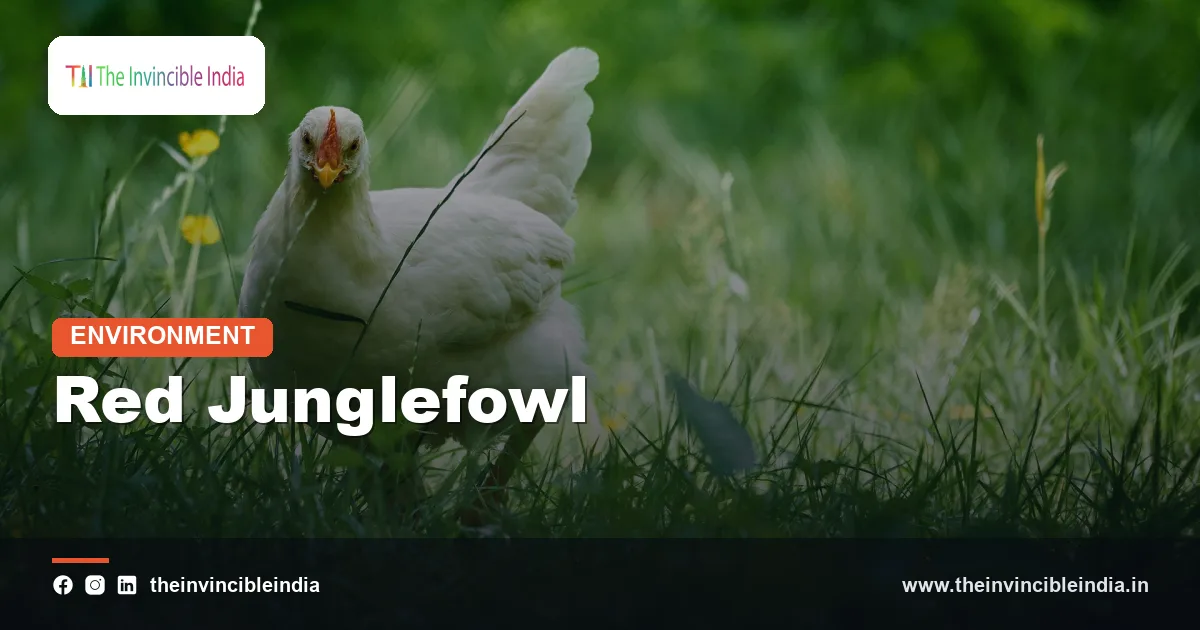
The red junglefowl (Gallus gallus) is a wild forest bird of South and Southeast Asia, including northern and north-eastern India, and it is the principal wild ancestor of the domestic chicken. The male has a fiery orange-red mane, a bright red comb and long arching tail feathers glossed with green, while the female is a modest, camouflaged brown.
Although a farmyard hen and a red junglefowl look different today, the wild bird still shares the same body plan, the same crowing instinct and the same habit of scratching the ground for food. Understanding the red junglefowl helps explain how people in this region turned a shy forest bird into one of the most numerous domestic animals on Earth.
| Scientific name | Gallus gallus |
|---|---|
| Family and order | Phasianidae (pheasants and allies); order Galliformes |
| Size | Males about 65 to 75 cm including the tail; females noticeably smaller and lighter |
| Habitat and range in India | Forests, bamboo thickets and scrub in the Himalayan foothills, the Terai and north-eastern states, extending beyond India into Southeast Asia |
| Diet | Seeds, grains, shoots, fruits, termites, insects and other small invertebrates |
| Breeding | Ground nest lined with leaves; clutch of a handful of eggs; incubation of about 21 days by the female |
| Ecological and cultural role | Seed and insect eater; wild ancestor of the domestic chicken |
| Status | Widespread; considered of low global concern, but wild bloodlines are threatened locally by interbreeding with domestic fowl |
Key Takeaways
- The red junglefowl (Gallus gallus) is the main wild ancestor of the domestic chicken, which was domesticated in South and Southeast Asia several thousand years ago.
- Male red junglefowl moult into a duller “eclipse” plumage after the breeding season, losing the long neck feathers and tail plumes that give them their showy look.
- The red junglefowl lives in India mainly in the forests and scrub of the north and north-east, and it should not be confused with the grey junglefowl of peninsular India.
- The crow of a wild red junglefowl is shorter and more clipped than the long crow of a domestic rooster.
- Female red junglefowl lay a small clutch on the ground and incubate it for about three weeks, relying on camouflage rather than a hidden nest cavity.
- Interbreeding with free-ranging village chickens is the main long-term threat to genetically pure wild red junglefowl.
What is the red junglefowl?
The red junglefowl is a medium-sized, ground-dwelling gamebird in the pheasant family, Phasianidae, that lives in the forests of South and Southeast Asia. The word “junglefowl” simply means a wild forest fowl, and four junglefowl species exist: the red, the grey, the Sri Lankan and the green junglefowl.
The red junglefowl is a strongly built bird with a laterally flattened tail that is held in an arch, a fleshy red comb on top of the head, red wattles hanging beneath the beak and a bare red face. The male’s neck and back are covered with long, narrow, pointed feathers called hackles, which are golden-orange to red and glossy. His wing coverts are chestnut and maroon, and his tail is a dark metallic green-black. A male is armed with a sharp spur on each leg that he uses in contests with rivals.
The female has a smaller comb, little or no facial skin colouring and a brownish body streaked with buff, which blends into dead leaves. Her camouflage matters because she sits on a ground nest for weeks.
How is the red junglefowl related to the domestic chicken?
The red junglefowl is the principal wild ancestor of the domestic chicken, and genetic studies indicate that the domestic fowl descends mostly from red junglefowl populations in Southeast Asia and the Indian subcontinent. Domestication probably happened several thousand years ago, though scientists still debate the exact place and date.
One interesting finding concerns the yellow skin of many domestic chickens. A gene variant linked to yellow skin is thought to have entered the domestic gene pool through hybridisation with the grey junglefowl (Gallus sonneratii) of peninsular India, which means that the modern chicken is a mainly red junglefowl bird with a small genetic contribution from at least one other species.
The chicken did not start as a food animal alone. Early keepers prized the birds for cockfighting, ritual and display, and egg and meat production grew in importance later as selective breeding raised egg numbers and body size. Compared with its wild ancestor, a laying hen produces far more eggs per year, while a wild female lays only a short seasonal clutch.
Where does the red junglefowl live in India?
The red junglefowl lives in India mainly in the forests and scrub of the Himalayan foothills, the Terai belt and the north-eastern states, with populations extending through Southeast Asia to Indonesia. In India the northern race is often listed as the subspecies murghi.
It favours deciduous and moist forest with dense undergrowth, bamboo clumps, forest edges, abandoned fields and tea or farm borders where cover remains. Sal forest and tall grass near water suit it well. It moves between thick cover and open clearings, scratching for food in the morning and evening and resting in shade during the heat of the day.
In the peninsular India and Western Ghats belt, the junglefowl that people meet is typically the grey junglefowl rather than the red. The two species overlap very little, and the table below sets out the main differences.
| Feature | Red junglefowl | Grey junglefowl |
|---|---|---|
| Scientific name | Gallus gallus | Gallus sonneratii |
| Main Indian range | North and north-east India, Himalayan foothills | Peninsular India and the Western Ghats |
| Male colour | Orange-red hackles, red and maroon wings | Grey body with white-shafted, golden-spotted feathers |
| Comb | Single, serrated red comb | Smooth, red-edged comb |
| Relation to chicken | Main wild ancestor | Likely source of the yellow skin trait |
What does a red junglefowl look and sound like?
A red junglefowl looks like a lean, lighter and more alert version of a domestic rooster, with a brilliant orange-red mane and glossy dark tail in the male and mottled brown plumage in the female. Wild birds are slimmer, longer-legged and better flyers than most farm chickens.
The male
The male’s showy hackles and tail are mainly sexual ornaments, and a healthy bright male attracts females. The male also has a conspicuous red face and wattle. His body weight is typically around one kilogram or a little more.
The female
The female weighs less than the male and lacks the long tail. Her colours of buff, brown and black streaks hide her well on the forest floor. A hen that hears a predator stays still and relies on being unseen.
The crow and other calls
The male crows from a perch or the ground, mainly at dawn and dusk, to announce his territory. The wild crow is shorter and ends more abruptly than the drawn-out crow of a domestic cockerel, and it carries clearly through the forest. Birds also give quick alarm calls, cackles when flushed and soft clucks when feeding.
What does the red junglefowl eat?
The red junglefowl eats a mixed omnivorous diet of seeds, grains, shoots, fallen fruits and a wide range of insects and other small animals. The birds forage by walking and scratching the leaf litter with their feet and then pecking at what they expose.
Termites, ants, beetles, grasshoppers, worms and small snails form the animal part of the diet, and the birds sometimes take small lizards or frogs. Plant food includes grass seeds, bamboo seeds, wild grains, berries, buds and tender leaves. During the year, the diet changes with availability, and bamboo seeding can bring birds together in numbers.
Because they eat insects, including some crop pests, and because they scatter seeds, red junglefowl contribute to the health of forest edges. Near farms, however, flocks may feed on ripening grain, which sometimes causes friction with villagers.
How does the red junglefowl breed?
The red junglefowl breeds by laying a clutch of a few buff or cream-coloured eggs in a shallow scrape on the ground, which the female alone incubates for about three weeks. The male does not help with incubation or chick-rearing.
A male defends a territory and may mate with several females, a system known as polygyny. The female scrapes a hollow among leaves, grass, bamboo or the base of a bush and lines it with dry vegetation. The breeding season varies with region and climate, and in much of northern India it falls roughly in the spring and early summer before the monsoon, though local timing differs.
The chicks are precocial, which means they hatch with open eyes and downy feathers and can leave the nest within hours of hatching. They follow the mother, feeding themselves under her guidance and sheltering beneath her wings. The young fly short distances within a couple of weeks and gain adult plumage over several months.
How does the red junglefowl spend its day and night?
The red junglefowl is active during the day, foraging on the ground, and at night it flies up into trees to roost beyond the reach of most predators. Roosting is a key survival habit that domestic fowl have kept.
- Dawn: Males call and birds leave the roost to feed in clearings and along paths.
- Mid-morning to afternoon: Birds rest in shade, dust-bathe and preen.
- Late afternoon: Feeding resumes and birds return to roost sites.
- Night: Birds sleep on branches several metres above the ground.
The birds form small groups, usually a male with a few females, or groups of females with young outside the breeding season. The birds are wary and usually flee by running into cover, taking short, noisy flights only when pressed. Predators include jungle cats, leopards, civets, snakes, raptors and, in places, humans.
Why does the male lose his colourful feathers?
The male red junglefowl loses his colourful neck hackles and tail plumes after breeding because he moults into a duller eclipse plumage. This temporary change makes him less conspicuous at a time when he no longer needs to display.
In the eclipse plumage the glossy, pointed hackles are replaced by short, dark, blunt feathers and the long central tail feathers are shed. The male looks rather like a darker, plainer bird with a smaller tail. Before the next breeding season, a fresh moult restores the elegant look. This seasonal switch is not seen in domestic roosters, which keep their ornamental plumage through the year, and it is one of the traits that distinguishes truly wild birds.
Is the red junglefowl endangered?
The red junglefowl is not considered globally endangered because it is widespread across a large region, but genetically pure wild populations face a serious local problem from interbreeding with domestic chickens. This hybridisation can dilute the wild gene pool.
Habitat loss, forest fragmentation, hunting and trapping also reduce numbers in some areas. In India, wild birds are generally protected under the Wildlife (Protection) Act, 1972, which prohibits hunting and capture. Free-ranging village poultry near forests can carry diseases such as avian influenza and Newcastle disease, which may spill over to wild birds, and wild birds can in turn expose village flocks.
Conservation options include protecting forest corridors, limiting free-ranging poultry near reserves, and monitoring wild populations. Because pure junglefowl are valuable as a genetic reservoir for chicken breeding, scientists are interested in preserving them.
Where can you see a red junglefowl in India?
You can see a red junglefowl in the forests of protected areas across northern and north-eastern India, particularly early in the morning along forest tracks and clearings. Reserves in the Terai, the Himalayan foothills and north-east provide the best chances.
Walking quietly at dawn or dusk, listening for the male’s crow, and watching clearings near water improve the odds. Because the birds are shy and fast on foot, patient observation from a vehicle or hide is often more productive than approaching on foot. Binoculars help identify the wild bird and tell it apart from free-ranging village fowl, which are often longer-bodied and show more varied colours.
Bottom Line
The red junglefowl is a small forest bird with large significance: it connects the wild forests of South and Southeast Asia to the poultry sheds and kitchens of the modern world. Protecting wild populations keeps alive both a native Indian species and the living ancestor of the chicken.
Frequently Asked Questions
Is the red junglefowl the ancestor of the chicken?
Yes, the red junglefowl (Gallus gallus) is the main wild ancestor of the domestic chicken. Genetic evidence also suggests that the grey junglefowl contributed some traits, such as yellow skin, through hybridisation.
Where is the red junglefowl found in India?
The red junglefowl is found mainly in the forests and scrub of northern and north-eastern India, including the Himalayan foothills and the Terai. In peninsular India, the grey junglefowl takes its place.
What is the difference between red and grey junglefowl?
The main difference is that the red junglefowl has orange-red hackles and a serrated comb, while the grey junglefowl has a grey body with white-shafted spotted feathers and a smooth comb. Their ranges in India also differ, with the red in the north and north-east and the grey in the peninsula.
What does a red junglefowl eat?
A red junglefowl eats seeds, grains, shoots, fruits and insects such as termites, ants and beetles. It finds food by scratching the leaf litter with its feet and pecking at what is uncovered.
Can red junglefowl fly?
Yes, red junglefowl can fly short distances, and they fly up into trees to roost at night. They prefer to run into cover when alarmed and take noisy, low flights only when necessary.
Is the red junglefowl protected in India?
Yes, wild red junglefowl are protected from hunting and capture in India under the Wildlife (Protection) Act, 1972. The species is widespread, but wild bloodlines face pressure from habitat loss and interbreeding with domestic chickens.
{“@context”:”https://schema.org”,”@graph”:[{“@type”:”FAQPage”,”mainEntity”:[{“@type”:”Question”,”name”:”Is the red junglefowl the ancestor of the chicken?”,”acceptedAnswer”:{“@type”:”Answer”,”text”:”Yes, the red junglefowl (Gallus gallus) is the main wild ancestor of the domestic chicken. Genetic evidence also suggests that the grey junglefowl contributed some traits, such as yellow skin, through hybridisation.”}},{“@type”:”Question”,”name”:”Where is the red junglefowl found in India?”,”acceptedAnswer”:{“@type”:”Answer”,”text”:”The red junglefowl is found mainly in the forests and scrub of northern and north-eastern India, including the Himalayan foothills and the Terai. In peninsular India, the grey junglefowl takes its place.”}},{“@type”:”Question”,”name”:”What is the difference between red and grey junglefowl?”,”acceptedAnswer”:{“@type”:”Answer”,”text”:”The main difference is that the red junglefowl has orange-red hackles and a serrated comb, while the grey junglefowl has a grey body with white-shafted spotted feathers and a smooth comb. Their ranges in India also differ, with the red in the north and north-east and the grey in the peninsula.”}},{“@type”:”Question”,”name”:”What does a red junglefowl eat?”,”acceptedAnswer”:{“@type”:”Answer”,”text”:”A red junglefowl eats seeds, grains, shoots, fruits and insects such as termites, ants and beetles. It finds food by scratching the leaf litter with its feet and pecking at what is uncovered.”}},{“@type”:”Question”,”name”:”Can red junglefowl fly?”,”acceptedAnswer”:{“@type”:”Answer”,”text”:”Yes, red junglefowl can fly short distances, and they fly up into trees to roost at night. They prefer to run into cover when alarmed and take noisy, low flights only when necessary.”}},{“@type”:”Question”,”name”:”Is the red junglefowl protected in India?”,”acceptedAnswer”:{“@type”:”Answer”,”text”:”Yes, wild red junglefowl are protected from hunting and capture in India under the Wildlife (Protection) Act, 1972. The species is widespread, but wild bloodlines face pressure from habitat loss and interbreeding with domestic chickens.”}}]}]}


