

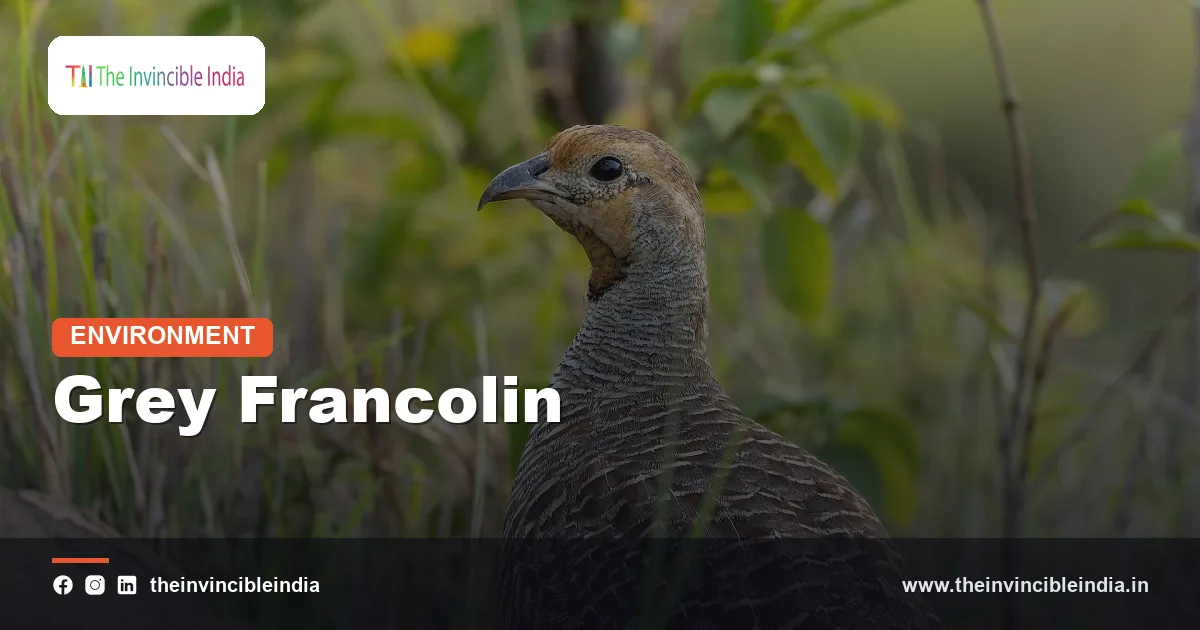
The grey francolin (Ortygornis pondicerianus) is a small, ground-dwelling gamebird of the pheasant family that lives in the dry scrub, farmland and village edges of the Indian subcontinent, and it is best known for its loud, repeated dawn call that sounds like “teetar”. Known in Hindi and Urdu as titar, it is one of the most common wild gamebirds of the Indian plains.
The grey francolin is a plain, barred, sandy-grey bird that is easy to miss until it calls or bursts into a low whirring flight. It lives close to people in many regions, feeding among crops and roadside bushes, and its voice is a familiar part of the early morning in rural north, west and peninsular India.
| Scientific name | Ortygornis pondicerianus (formerly placed in the genus Francolinus) |
|---|---|
| Family and order | Phasianidae (pheasants, partridges and allies); order Galliformes |
| Size | About 30 to 34 cm long, a little larger than a quail and smaller than a domestic hen |
| Habitat and range in India | Dry scrub, semi-arid plains, farmland, and village edges across most of India below the higher Himalaya |
| Diet | Seeds, grain, shoots, termites, ants and other insects |
| Breeding | Ground scrape nest, typically with several cream-coloured eggs, incubated for roughly three weeks |
| Ecological role | Seed eater and insect eater; prey for raptors and mammals; hunted as a gamebird |
| Status | Widespread and common; considered of low global concern, but pressured by hunting and trapping in places |
Key Takeaways
- The grey francolin (Ortygornis pondicerianus) is a common gamebird of the Indian subcontinent that lives in dry scrub, farmland and village margins.
- The grey francolin’s loud call, rendered in Hindi as “teetar”, gives the bird its local name titar and is most often given at dawn and dusk.
- A grey francolin is a sandy-grey bird with fine dark barring, a buff throat framed by a dark necklace-like border, and chestnut feathers in the tail that show in flight.
- Grey francolins live in small groups called coveys and prefer to run through cover rather than fly, taking short low flights only when surprised.
- Grey francolins nest on the ground in a simple scrape, and the female incubates the eggs for about three weeks.
- Hunting and live trapping for fighting and pet birds are the main human pressures on the grey francolin, even though the species remains widespread.
What is the grey francolin?
The grey francolin is a medium-small, ground-living bird of the family Phasianidae, native to South Asia and parts of the Middle East, that is adapted to dry open country. A francolin is a type of partridge-like gamebird, and the grey francolin is the one most commonly seen in everyday rural India.
The bird is fairly plump, with a rounded body, short legs and a short rounded tail. Its overall colour is a pale brownish-grey with fine wavy barring on the back and flanks and a buff, scaled-looking belly. The throat is pale yellowish-buff and is bordered by a dark line that forms a loose necklace. The bill is dark and the legs are reddish to dull orange. When the bird flies, rusty-chestnut feathers on the tail show briefly, a useful field mark.
The sexes look alike. The male is slightly larger and typically bears one or two blunt spurs on each leg, whereas females usually have none or only small knobs. These spurs are used in fights between rival males.
Where is the grey francolin found in India?
The grey francolin is found across most of India’s plains and plateau, from the dry north-west and Gangetic plain to the Deccan and the southern peninsula, wherever scrub, thorn bushes and cultivation are available. It avoids dense forest, wet evergreen belts and high mountains.
Beyond India, the grey francolin ranges through Pakistan, Sri Lanka, Bangladesh and Nepal’s lowlands westward into Iran and the Arabian Peninsula. It has also been introduced by people in several other places, including island groups in the Indian Ocean and the Pacific, where it has formed breeding populations.
Its typical haunts include thorn scrub, dry grassland, hedgerows, field borders, orchards, railway embankments and the edges of villages. It does especially well in semi-arid areas such as Rajasthan, Gujarat, Maharashtra and the Deccan, where mosaics of crops and bushes provide food and cover.
Why is it called the “teetar”?
The grey francolin is called the teetar or titar because its call resembles that word, repeated rapidly in a ringing, rhythmic series. The call carries far, especially in the still early morning.
People describe the call in different ways, such as “ke-tar, ke-tar” or “kateela, kateela”, and the exact phrasing differs by listener and region. Males call from a bush, a low mound, a wall or a branch, and neighbouring males often answer each other, creating a chorus at dawn. Calling is most intense in the breeding season, which marks territory and attracts females.
Besides the main call, the birds give a variety of cackles, squeaks and chattering notes when feeding or when alarmed. A covey that is startled may scatter with a burst of noisy calls.
How does the grey francolin behave?
The grey francolin is a wary, mostly terrestrial bird that forages in small groups, runs fast through cover and flies only when forced to. At other times it stays hidden under bushes and among crops.
Daily rhythm
The bird is most active in the early morning and late afternoon, when it comes out to feed along field edges and tracks. During the hot midday hours, it rests in shade, often under a thorn bush, and may dust-bathe in loose soil. Dust bathing helps keep feathers in good condition and discourages parasites.
Groups and territory
Outside the breeding season, grey francolins live in coveys of about five to ten birds. In the breeding season, pairs separate from the group, and males defend territories with calls and sometimes fights. The birds roost at night, often in low trees or dense shrubs rather than on the open ground, for safety from foxes and jackals.
Flight
When flushed, the grey francolin explodes from cover with rapid wingbeats and glides low for a short distance before dropping back into cover. It is not a strong long-distance flyer, so its movements are mostly local.
What does the grey francolin eat?
The grey francolin eats mainly seeds, grain and insects, picking food from the ground as it walks. Its diet shifts with the season and with what the farmland offers.
- Plant food: seeds of grasses and weeds, spilled grain, tender shoots, buds and small fruits.
- Animal food: termites, ants, beetles, grasshoppers and other insects, taken especially when feeding chicks.
- Water: The birds drink regularly where water is available, but they can manage in dry areas on food moisture and dew.
By eating insects, including crop pests such as termites and grasshoppers, grey francolins give some benefit to farmers. By eating weed seeds, they also help limit weeds, although flocks may eat sown seeds and ripening grain on occasion. Overall, their ecological role is that of a small, steady seed and insect eater that also feeds many predators.
How does the grey francolin breed?
The grey francolin breeds by laying several creamy or pale buff eggs in a simple scrape on the ground, which the female incubates for about three weeks. The nest is usually hidden beneath a bush, clump of grass or crop.
The breeding season varies across the range and is often tied to rainfall and food supply, with many birds breeding around the monsoon, though some nest in other months. The pair typically bonds for the season, and the male stays close to the nest, guarding the territory. The nest is a shallow depression, sometimes lined with a few bits of grass or leaves.
The chicks are precocial, covered in down and able to run within hours of hatching. Both parents may lead and protect them, and the family stays together for some time before joining a wider covey. Many nests are lost to predators such as snakes, mongooses, crows and dogs, and farm operations can also destroy nests in fields.
How can you tell the grey francolin from similar birds?
You can tell the grey francolin from similar birds by its overall pale barred-grey look, its buff throat with a dark border and the chestnut tail seen in flight. Other gamebirds in India differ in colour, size or habitat.
| Bird | Key identification features | Typical habitat |
|---|---|---|
| Grey francolin | Pale grey-brown with fine barring; buff throat with dark border; chestnut tail | Dry scrub and farmland |
| Black francolin | Male is black with white spots and a chestnut collar | Tall grass and cultivation, mainly north India |
| Painted francolin | Dark with chestnut and white spotting, heavily patterned | Grassland and scrub in parts of India |
| Jungle bush quail | Smaller, round and quail-like | Scrub and rocky ground |
| Red spurfowl | Reddish, with a bare red face patch | Hill forest and scrub |
The differences are easy to learn in the field. The grey francolin’s call and its dry-country habitat are strong clues, and it is usually the only francolin in the dry plains of the peninsula.
Is the grey francolin hunted or kept as a pet?
Yes, the grey francolin has long been hunted for food and sport and trapped alive for keeping as a cage or fighting bird in parts of South Asia. These activities are restricted by wildlife law in India.
Wild birds in India are generally protected under the Wildlife (Protection) Act, 1972, which restricts hunting and capture, and the sale of wild birds is also regulated. In practice, illegal trapping still takes place in some regions, where males are valued for their calls and fighting spirit. Trapping often removes the calling males and can reduce local breeding.
The species has a large range and healthy overall numbers, so it is not considered globally threatened. Even so, local declines occur where hunting is intense, where scrub is cleared, or where pesticides and heavy farm mechanisation reduce insects and cover.
Why does the grey francolin matter for farmland and ecology?
The grey francolin matters for farmland ecology because it eats weed seeds and insects, forms prey for many predators and indicates whether scrub and field edges still support wildlife. It is one of the species that signals the health of semi-arid agricultural landscapes.
Hedgerows, field bunds, thorn thickets and fallow patches give the bird shelter and nest sites. When these are removed for larger fields or when pesticide use is heavy, grey francolins decline. Because the bird tolerates people and is easy to hear, it is a useful species for citizen-science counts and for local biodiversity surveys.
The bird also has a place in culture. Its call is part of rural soundscapes and its name appears in folk sayings and poetry in north India and Pakistan, and in some places the bird is used as a symbol of the countryside.
Where can you see a grey francolin?
You can see a grey francolin along dry field edges, scrubby roadsides and the borders of wildlife reserves in most of the Indian plains, especially in the early morning when the birds call and feed. Listening for the call is the easiest way to find one.
Walking slowly along a track at first light, scanning bushes and open patches, usually works. The birds tend to run ahead of an approaching person, so a vehicle or a quiet seated approach gives better views. Photographers often find them using a bush or termite mound as a perch for calling.
Bottom Line
The grey francolin is a humble but characterful bird whose dawn call is one of the signature sounds of rural India. Keeping scrub patches, hedgerows and uncultivated margins in farmland helps this adaptable bird, and many other creatures, to continue sharing the countryside.
Frequently Asked Questions
What is a grey francolin?
A grey francolin is a small, ground-dwelling gamebird of the pheasant family found across the Indian subcontinent. It has barred grey-brown plumage, a buff throat with a dark border and a loud, repeated call.
Why is the grey francolin called titar in Hindi?
The grey francolin is called titar or teetar because its call sounds like that word repeated in a quick rhythm. The name is used widely in Hindi and Urdu for francolins and partridges.
What does the grey francolin eat?
The grey francolin eats seeds, grain, shoots, termites, ants and other insects. It finds this food by walking and pecking at the ground, often along field edges and under bushes.
Can the grey francolin fly?
Yes, the grey francolin can fly, but only for short, low distances. It generally prefers to run through cover and flies when surprised, usually dropping into the next patch of vegetation.
Where does the grey francolin nest?
The grey francolin nests on the ground in a shallow scrape, usually hidden under a bush, grass tuft or crop. The female lays several pale eggs and incubates them for about three weeks.
Is the grey francolin protected in India?
Yes, wild grey francolins are covered by the protection that the Wildlife (Protection) Act, 1972 gives to wild birds in India, which restricts hunting, capture and trade. The species is still common, but illegal trapping occurs in some areas.
{“@context”:”https://schema.org”,”@graph”:[{“@type”:”FAQPage”,”mainEntity”:[{“@type”:”Question”,”name”:”What is a grey francolin?”,”acceptedAnswer”:{“@type”:”Answer”,”text”:”A grey francolin is a small, ground-dwelling gamebird of the pheasant family found across the Indian subcontinent. It has barred grey-brown plumage, a buff throat with a dark border and a loud, repeated call.”}},{“@type”:”Question”,”name”:”Why is the grey francolin called titar in Hindi?”,”acceptedAnswer”:{“@type”:”Answer”,”text”:”The grey francolin is called titar or teetar because its call sounds like that word repeated in a quick rhythm. The name is used widely in Hindi and Urdu for francolins and partridges.”}},{“@type”:”Question”,”name”:”What does the grey francolin eat?”,”acceptedAnswer”:{“@type”:”Answer”,”text”:”The grey francolin eats seeds, grain, shoots, termites, ants and other insects. It finds this food by walking and pecking at the ground, often along field edges and under bushes.”}},{“@type”:”Question”,”name”:”Can the grey francolin fly?”,”acceptedAnswer”:{“@type”:”Answer”,”text”:”Yes, the grey francolin can fly, but only for short, low distances. It generally prefers to run through cover and flies when surprised, usually dropping into the next patch of vegetation.”}},{“@type”:”Question”,”name”:”Where does the grey francolin nest?”,”acceptedAnswer”:{“@type”:”Answer”,”text”:”The grey francolin nests on the ground in a shallow scrape, usually hidden under a bush, grass tuft or crop. The female lays several pale eggs and incubates them for about three weeks.”}},{“@type”:”Question”,”name”:”Is the grey francolin protected in India?”,”acceptedAnswer”:{“@type”:”Answer”,”text”:”Yes, wild grey francolins are covered by the protection that the Wildlife (Protection) Act, 1972 gives to wild birds in India, which restricts hunting, capture and trade. The species is still common, but illegal trapping occurs in some areas.”}}]}]}


