

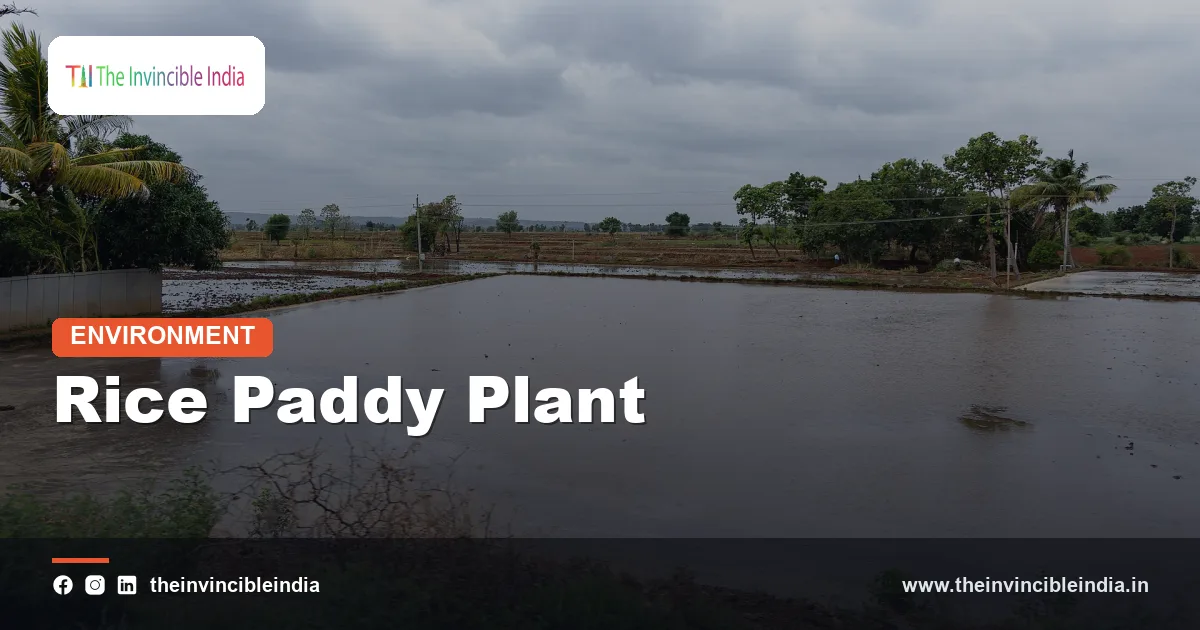
The rice plant (Oryza sativa) is an annual cereal grass, grown mostly in flooded fields called paddies, whose grain is the staple food of a very large part of India’s population. In everyday Indian usage the growing plant and the unhusked grain are called paddy, and the milled, edible grain is called rice (chawal).
The rice plant is India’s most widely grown food crop by area and a cornerstone of the country’s food security, culture and rural economy. This explainer covers what the rice plant is, how it grows, where and when it is cultivated, the main types and varieties, how it is processed, its water and environmental footprint, and its place in Indian life.
| Quick Facts: Rice Plant (Paddy) | |
|---|---|
| Common names | Rice plant, paddy (Hindi: dhaan for the crop, chawal for the milled grain) |
| Scientific name | Oryza sativa (the Asian cultivated rice), with indica and japonica types |
| Family | Poaceae (the grass family) |
| Where grown in India | Across most states; major areas include West Bengal, Uttar Pradesh, Punjab, Andhra Pradesh, Telangana, Odisha, Bihar, Chhattisgarh, Tamil Nadu and Assam |
| Season | Mainly kharif (sown May-July, harvested October-November), with rabi or summer rice in eastern and southern states |
| Part used | Grain (a seed), with straw, husk and bran as by-products |
| Main products | Raw and parboiled rice, basmati, puffed rice, flattened rice (poha), rice flour, rice bran oil, straw and husk |
| Importance | Staple cereal for much of the population, the largest crop by area in India, and a major export; the crop is covered by government minimum support prices and public distribution |
Key Takeaways
- The rice plant (Oryza sativa) is an annual grass of the family Poaceae, and its grain is the staple food of a large share of India’s people.
- The rice plant is India’s largest food crop by area, grown on well over 40 million hectares in a typical year across almost every state.
- The rice plant is grown mainly in the kharif season, sown with the arrival of the monsoon and harvested in October and November, though rabi and summer crops are common in eastern and southern India.
- The rice plant is commonly grown by transplanting seedlings into puddled, flooded fields, a method that suppresses weeds but uses a large amount of water.
- The rice plant produces many products besides cooked rice, including parboiled rice, poha, puffed rice, rice flour, rice bran oil, straw for fodder and husk for fuel.
- India is one of the world’s two largest rice producers and, in recent years, the world’s largest rice exporter, with basmati a prized export variety.
What is the rice plant?
The rice plant is a semi-aquatic cereal grass of the species Oryza sativa that grows to about one metre or more in height, produces tillers (extra stems) from its base, and bears its grain on a drooping cluster called a panicle. The grain is a seed enclosed in a hard husk, and removing the husk and bran produces the white rice that people cook.
The rice plant belongs to the grass family Poaceae, the same family as wheat, maize, millets and sugarcane. It was domesticated thousands of years ago in Asia from a wild ancestor, and archaeological evidence points to early rice cultivation in the Ganga plain and other parts of the subcontinent, as well as in China. The cultivated Asian rice is divided into two main subspecies, indica (long, slender grains, grown widely in the tropics) and japonica (shorter, stickier grains).
Rice has an unusual feature for a cereal: its stems and roots contain air channels called aerenchyma that carry oxygen to the roots in waterlogged soil. This is what allows the rice plant to thrive in flooded fields where most other crops would drown.
How does the rice plant grow?
The rice plant grows through a sequence of stages, from seed germination and a seedling stage, through tillering and panicle formation, to flowering, grain filling and ripening, over a period of roughly three to five months depending on the variety. Short-duration varieties may mature in about 90-110 days, while long-duration traditional types can need 150 days or more.
The main growth stages
- Germination and seedling: seed sprouts in a nursery bed or in the field and forms the first leaves.
- Tillering: the plant produces side shoots from the base, each of which can bear a grain-bearing panicle.
- Panicle initiation and booting: the flower cluster develops inside the stem.
- Flowering: the panicle emerges, and each small flower (spikelet) self-pollinates within hours.
- Grain filling: starch fills the grain over about three to four weeks.
- Ripening and harvest: the panicle turns golden and the plant dries, signalling time to harvest.
Rice is a warm-season crop. It generally needs temperatures of about 20 to 35 degrees Celsius, plenty of water and sunshine during grain filling. Cold snaps at flowering or high heat during grain filling can cause sterile spikelets and reduce yields, which is why timing of sowing matters so much.
Where is rice grown in India?
Rice is grown in almost every Indian state, with the largest areas in the eastern and southern states and the Indo-Gangetic plain, including West Bengal, Uttar Pradesh, Odisha, Bihar, Chhattisgarh, Andhra Pradesh, Telangana, Tamil Nadu, Assam and Punjab. The crop thrives where rainfall is high or irrigation is dependable.
The table below groups the main rice regions and what they are known for. Rankings in area and output vary from year to year, so only broad patterns are given.
| Region or state group | Typical rice features |
|---|---|
| West Bengal, Odisha, Assam, Bihar, eastern Uttar Pradesh | Very large rice area; mostly rain-fed and flood-prone fields; several crops a year in places (aus, aman, boro) |
| Punjab and Haryana | High yields on irrigated land; major contributors to government procurement; home of much basmati |
| Andhra Pradesh and Telangana | Canal and well-irrigated deltas of the Godavari and Krishna; large surplus production |
| Tamil Nadu, Karnataka and Kerala | Multiple seasons (kuruvai, samba, thaladi in Tamil Nadu); traditional varieties like Ponni and Navara |
| Chhattisgarh | Often called the “rice bowl” of central India, with many traditional scented varieties |
| North-east and hill states | Terraced fields, jhum and valley rice; unique local varieties such as black rice of Manipur |
When is rice sown and harvested in India?
Rice in India is mainly a kharif crop, sown in June and July with the arrival of the south-west monsoon and harvested from October to November, although some regions grow a winter (rabi) or summer crop as well. Kharif rice provides the bulk of India’s production.
In the east, seasonal names reflect the cropping pattern. Aus rice is sown in spring and harvested in late summer. Aman (winter) rice is sown in the monsoon and harvested in November-December. Boro rice is grown in the dry season on irrigated or low-lying land and harvested in April-May. In southern states, a similar pattern of two or three crops a year is followed where water is available.
Some states regulate the transplanting date to protect groundwater. In Punjab, for example, a law known as the Punjab Preservation of Subsoil Water Act, 2009 delays paddy transplanting until mid-June so that crops use the monsoon rather than only pumped groundwater. Such rules illustrate how closely rice cultivation is tied to water management in India.
How is rice cultivated?
Rice is most often cultivated by raising seedlings in a nursery for about three to four weeks and then transplanting them by hand or machine into a flooded, puddled field. Puddling is the churning of waterlogged soil into a soft mud that holds water and keeps weeds down.
Transplanting and direct seeding
Transplanted rice is still the most common system in India, especially in irrigated areas, and it needs a standing layer of water, often a few centimetres deep, for much of the growing period. Direct-seeded rice, where seeds are sown straight into the field, saves labour and water and is promoted in water-short regions. The System of Rice Intensification (SRI), which uses young seedlings, wider spacing and alternate wetting and drying, is another approach followed by some farmers.
Inputs and protection
Rice needs nitrogen, phosphorus and potassium fertiliser or organic manure, careful weed control and protection from pests and diseases. Common problems include stem borers, brown planthoppers, leaf folders, blast disease and bacterial leaf blight. Integrated pest management, resistant varieties and timely sowing are standard recommendations.
Harvesting is done by sickle or combine harvester once the grains are mature. The cut crop is dried, threshed to separate the grain from the straw, and stored at a safe moisture level. Paddy is then milled to remove the husk and bran.
What are the main types and varieties of rice in India?
The main types of rice in India include long-grain aromatic basmati, medium-grain non-basmati varieties such as Sona Masoori and Ponni, and a large number of traditional landraces with local scent, colour and taste. Indian rice may also be classified by processing, for example raw (white) rice, parboiled rice and brown rice.
- Basmati: a long, slender, aromatic grain grown in the Himalayan foothills and northern plains; the name Basmati carries a geographical indication (GI) for the traditional growing region, and Pusa Basmati 1121 is a well-known modern variety.
- Non-basmati varieties: include high-yielding types such as Swarna (MTU 7029), IR-64, Sona Masoori and Ponni, widely used for daily meals.
- Scented regional rice: includes Gobindobhog and Kalanamak (West Bengal and eastern Uttar Pradesh), Joha (Assam) and Kataribhog; several have GI recognition.
- Coloured and special rice: includes Chak-Hao black rice of Manipur and Navara of Kerala, valued for taste and use in traditional medicine and cuisine.
- Parboiled rice: paddy that is steamed or soaked and partially boiled before milling, which keeps more nutrients and makes grains firmer.
The Green Revolution of the 1960s brought dwarf, high-yielding varieties such as IR8, developed at the International Rice Research Institute (IRRI) in the Philippines, and later Indian varieties like Jaya. These raised yields dramatically and helped India move from food shortage to surplus. India is also thought to hold a very large number of traditional landraces, and research institutions like the ICAR-National Rice Research Institute in Cuttack, established in the 1940s, work to conserve and improve them.
What products are made from the rice plant?
The rice plant yields not only cooked rice but also a wide range of food, feed and industrial products from its grain, bran, husk and straw. Almost every part of the harvest finds a use in Indian homes and industry.
- Cooked rice: eaten with dal, curry or sambar, or as biryani, pulao, khichdi, idli and dosa batter.
- Poha and murmura: flattened and puffed rice, used for breakfast dishes and snacks.
- Rice flour: used in dosa, idiyappam, pitha, papad and many sweets.
- Rice bran oil: an edible oil extracted from the bran, used for cooking.
- Rice straw: used as cattle fodder, thatch, mulch and in paper or packaging in some places.
- Rice husk: used as fuel in boilers and brick kilns, in ash-based products and as bedding.
- Fermented drinks and starch: traditional rice beers in some tribal communities and starch for industry.
Rice is also central to ritual. It is offered in puja, thrown over newlyweds as a blessing, and used in the first-feeding ceremony of infants, called annaprashan. Harvest festivals such as Pongal in Tamil Nadu, Onam in Kerala, Makar Sankranti, Bihu in Assam and Nabanna in Bengal celebrate the rice harvest.
Why is the rice plant important to India?
The rice plant is important to India because it feeds a large share of the population, supports millions of farming households and underpins food security through public procurement and distribution. It is also an important export crop.
The Government of India announces a Minimum Support Price (MSP) for paddy each year, and agencies such as the Food Corporation of India (FCI) buy grain from farmers for the Public Distribution System (PDS). Under the National Food Security Act, 2013, rice is one of the main grains supplied to eligible households at highly subsidised prices. India also exports both basmati and non-basmati rice, and in recent years it has ranked as the largest rice exporter in the world, although export policy has changed from time to time in response to domestic prices.
Rice cultivation shapes landscapes and livelihoods too. Paddy fields support egrets, pipits, frogs and fish, and the wet-field cycle of ploughing, transplanting and harvesting gives a rhythm to village life across the country.
What is the environmental impact of rice farming?
Rice farming has a large environmental footprint because flooded paddies use a great deal of water and release methane, a potent greenhouse gas, from waterlogged soil. In northwestern India, heavy pumping for irrigated paddy has contributed to falling groundwater levels.
Other concerns include fertiliser runoff, and the burning of paddy straw after harvest in parts of Punjab, Haryana and western Uttar Pradesh, which contributes to smoke and air pollution in autumn. Governments and researchers promote solutions such as direct-seeded rice, alternate wetting and drying, shorter-duration varieties, crop diversification, and machines that incorporate or collect straw instead of burning it.
At the same time, rice paddies provide habitats for wetland species, and traditional systems such as fish-rice farming in the north-east show how food production and biodiversity can coexist. Balancing food security with water and climate goals remains one of the main challenges for Indian rice farming.
Bottom Line
The rice plant is a water-loving cereal grass that feeds much of India, grows in nearly every state and supports a vast network of farmers, millers and traders. Its future depends on growing enough grain while using less water and cutting emissions.
Frequently Asked Questions
What is the rice plant?
The rice plant is an annual cereal grass, scientifically called Oryza sativa, that is grown mostly in flooded fields called paddies. Its grain is the staple food for a large part of India. The crop and unhusked grain are called paddy, and the milled grain is called rice.
Is rice a kharif or rabi crop in India?
Rice is mainly a kharif crop in India, sown with the monsoon in June and July and harvested in October and November. However, some states also grow rabi or summer rice, such as boro rice in the east, where irrigation is available. Kharif rice gives the bulk of national output.
Which states grow the most rice in India?
West Bengal, Uttar Pradesh, Punjab, Andhra Pradesh, Telangana, Odisha, Bihar and Chhattisgarh are among the leading rice-growing states, and Tamil Nadu and Assam are also important. The exact ranking changes year to year with weather and area sown. Rice is grown in almost every state.
Why does the rice plant need so much water?
The rice plant is usually grown in flooded fields because standing water suppresses weeds and suits the plant’s air-conducting stems. A paddy field is often kept under a few centimetres of water for much of the season, which requires heavy irrigation. Water-saving methods such as direct seeding and alternate wetting and drying can reduce use.
What is the difference between paddy and rice?
Paddy is the harvested, unmilled grain still enclosed in its husk, and the term is also used for the rice plant or crop in the field. Rice is the edible grain left after milling removes the husk and, usually, the bran. Brown rice keeps the bran, while white rice has it polished off.
What are the main varieties of rice grown in India?
Major rice varieties in India include aromatic basmati, high-yielding non-basmati types such as Swarna, IR-64 and Sona Masoori, and regional scented rice like Gobindobhog, Kalanamak and Joha. India also has special types such as Chak-Hao black rice and Navara. Many traditional landraces are also grown locally.
{“@context”:”https://schema.org”,”@graph”:[{“@type”:”FAQPage”,”mainEntity”:[{“@type”:”Question”,”name”:”What is the rice plant?”,”acceptedAnswer”:{“@type”:”Answer”,”text”:”The rice plant is an annual cereal grass, scientifically called Oryza sativa, that is grown mostly in flooded fields called paddies. Its grain is the staple food for a large part of India. The crop and unhusked grain are called paddy, and the milled grain is called rice.”}},{“@type”:”Question”,”name”:”Is rice a kharif or rabi crop in India?”,”acceptedAnswer”:{“@type”:”Answer”,”text”:”Rice is mainly a kharif crop in India, sown with the monsoon in June and July and harvested in October and November. However, some states also grow rabi or summer rice, such as boro rice in the east, where irrigation is available. Kharif rice gives the bulk of national output.”}},{“@type”:”Question”,”name”:”Which states grow the most rice in India?”,”acceptedAnswer”:{“@type”:”Answer”,”text”:”West Bengal, Uttar Pradesh, Punjab, Andhra Pradesh, Telangana, Odisha, Bihar and Chhattisgarh are among the leading rice-growing states, and Tamil Nadu and Assam are also important. The exact ranking changes year to year with weather and area sown. Rice is grown in almost every state.”}},{“@type”:”Question”,”name”:”Why does the rice plant need so much water?”,”acceptedAnswer”:{“@type”:”Answer”,”text”:”The rice plant is usually grown in flooded fields because standing water suppresses weeds and suits the plant’s air-conducting stems. A paddy field is often kept under a few centimetres of water for much of the season, which requires heavy irrigation. Water-saving methods such as direct seeding and alternate wetting and drying can reduce use.”}},{“@type”:”Question”,”name”:”What is the difference between paddy and rice?”,”acceptedAnswer”:{“@type”:”Answer”,”text”:”Paddy is the harvested, unmilled grain still enclosed in its husk, and the term is also used for the rice plant or crop in the field. Rice is the edible grain left after milling removes the husk and, usually, the bran. Brown rice keeps the bran, while white rice has it polished off.”}},{“@type”:”Question”,”name”:”What are the main varieties of rice grown in India?”,”acceptedAnswer”:{“@type”:”Answer”,”text”:”Major rice varieties in India include aromatic basmati, high-yielding non-basmati types such as Swarna, IR-64 and Sona Masoori, and regional scented rice like Gobindobhog, Kalanamak and Joha. India also has special types such as Chak-Hao black rice and Navara. Many traditional landraces are also grown locally.”}}]}]}


