

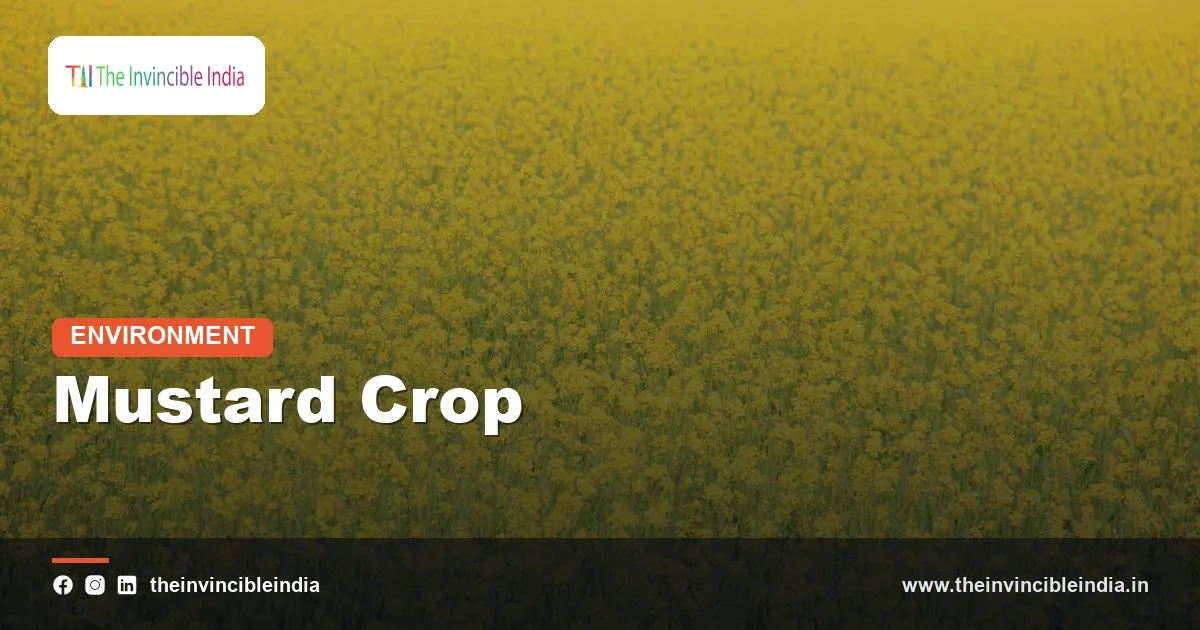
The mustard crop (chiefly Brassica juncea, known as sarson or rai) is a cool-season oilseed of the cabbage family, grown in India’s winter (rabi) season for its small seeds that yield pungent mustard oil, and its carpets of yellow flowers are a signature sight of the northern plains. Along with the closely related rapeseed types such as toria and yellow sarson, the mustard crop forms the backbone of India’s rapeseed-mustard group of oilseeds.
The mustard crop is sown in October-November and harvested in February-March, mainly in Rajasthan, Haryana, Madhya Pradesh, Uttar Pradesh and West Bengal. This explainer covers what the crop is, how it grows, where it is cultivated, what it produces, its role in food and farming, and the debates around mustard oil and genetically modified mustard.
| Quick Facts: Mustard Crop | |
|---|---|
| Common names | Mustard, Indian mustard, sarson, rai (Hindi); shorshe (Bengali); kadugu (Tamil and Malayalam) |
| Scientific name | Brassica juncea (Indian mustard); related oilseed Brassicas include Brassica rapa (toria, yellow sarson) and Eruca sativa (taramira) |
| Family | Brassicaceae (the mustard or cabbage family) |
| Where grown in India | Rajasthan (the leading state), Haryana, Madhya Pradesh, Uttar Pradesh, West Bengal, Gujarat, Assam and Punjab |
| Season | Rabi: sown October-November, harvested February-March (earlier sowing in some northern areas) |
| Part used | Seed (for oil and spice), leaves (mustard greens), and the oilcake left after pressing |
| Main products | Mustard oil, mustard seed spice and paste, sarson ka saag, mustard cake for cattle feed, mustard honey |
| Importance | India’s most important winter oilseed and a major source of cooking oil, especially in northern and eastern India; seeds typically contain roughly 35-42 per cent oil |
Key Takeaways
- The mustard crop is a winter oilseed of the family Brassicaceae, grown in India as a rabi crop that is sown in October-November and harvested in February-March.
- The mustard crop is mainly Indian mustard (Brassica juncea), and its seeds typically contain roughly 35-42 per cent oil.
- The mustard crop is grown most heavily in Rajasthan, followed by Haryana, Madhya Pradesh, Uttar Pradesh and West Bengal.
- The mustard crop gives the pungent mustard oil that is a traditional cooking medium in north and east India, and a by-product, mustard cake, that is used as cattle feed.
- The mustard crop also supplies edible leaves for sarson ka saag, a classic Punjabi winter dish, as well as mustard seed for tempering, pickles and pastes.
- The mustard crop is central to India’s effort to cut edible oil imports, and its genetically modified hybrid DMH-11 has been the subject of a long regulatory and legal debate.
What is the mustard crop?
The mustard crop is a field crop of annual herbs in the genus Brassica that are grown for their oil-rich seeds, with Indian mustard (Brassica juncea) being the main species in India. It belongs to the family Brassicaceae, also called Cruciferae, which includes cabbage, cauliflower, radish, turnip and rapeseed.
The plant is an erect herb that grows about one to two metres tall, with lobed leaves, branched stems and clusters of bright yellow flowers that have four petals arranged like a cross. After flowering, it forms slender pods called siliquae, each holding a row of small round seeds that are brown, reddish-brown or yellow. Sarson is the common Hindi name for the oilseed forms and for the plant in the field, while rai usually refers to the brown seeds used as a spice.
Mustard has been used in the Indian subcontinent for thousands of years as a food, medicine and source of oil. Its exact origin and early history are debated, but it is deeply woven into the cooking and festivals of the north, the east and Kashmir.
What are the types of mustard and rapeseed grown in India?
India grows several oilseed Brassicas under the broad name rapeseed-mustard, of which Indian mustard (Brassica juncea) is the most important, followed by toria, brown sarson, yellow sarson and taramira. They differ in species, seed colour, sowing time and the regions where they thrive.
| Type | Species | Notes |
|---|---|---|
| Indian mustard (rai, raya) | Brassica juncea | Most widely grown; brown seeds; tolerates drier conditions; the main commercial oilseed of the group |
| Toria | Brassica rapa var. toria | Short-duration crop sown early in autumn; often grown before wheat |
| Yellow sarson | Brassica rapa var. yellow sarson | Yellow-seeded; grown in the eastern plains and Assam |
| Brown sarson | Brassica rapa var. brown sarson | Brown-seeded; cultivated in parts of the north |
| Taramira (rocket) | Eruca sativa | Hardy crop for dry, sandy and rainfed areas of Rajasthan |
| Gobhi sarson | Brassica napus | Rapeseed type grown in Punjab; some varieties are low in erucic acid |
Because all these crops are closely related, farmers, traders and officials often group them as “rapeseed-mustard”, and national statistics usually report them together.
Where is the mustard crop grown in India?
The mustard crop is grown mainly in northern, central and eastern India, with Rajasthan as the largest producer by a wide margin, followed by Haryana, Madhya Pradesh, Uttar Pradesh and West Bengal. Gujarat, Assam, Punjab, Bihar and Jharkhand also grow significant areas.
Rajasthan’s dry climate, cool winters and extensive rainfed and lightly irrigated land suit Indian mustard well, and districts around Bharatpur, Alwar, Sri Ganganagar, Tonk and Sawai Madhopur are among the main belts. Haryana and Uttar Pradesh grow mustard often as a companion or rotation crop with wheat. In West Bengal and Assam, the yellow sarson and toria types are common, and mustard oil is a kitchen staple.
Rankings and exact area vary from year to year with rainfall, prices and policy. The research hub for the crop is the ICAR rapeseed-mustard research institute in Bharatpur, Rajasthan, which develops varieties and agronomic advice for farmers across states.
How is the mustard crop grown?
The mustard crop is grown by sowing seed in prepared, well-drained loamy soil in October-November, thinning the seedlings, giving one or two irrigations and harvesting in February-March when most pods turn yellow-brown. It prefers cool, dry weather with bright sunshine, and a temperature range of about 10-25 degrees Celsius suits it best.
Sowing and care
Seed is usually sown in rows, about 30-45 cm apart, at a shallow depth, with thinning after about three weeks to keep healthy spacing. The crop needs far less water than wheat, and one to three irrigations, at the rosette, flowering and pod-filling stages, are often enough. Fertiliser, particularly nitrogen and sulphur, boosts oil content and yield. Sulphur is especially important because mustard oil’s pungency comes from sulphur-containing compounds.
Pests, diseases and weather risks
Mustard aphid is the most serious pest in many regions, and its attack on flowering shoots can cut yield sharply. Other problems include painted bug, sawfly and diseases such as Alternaria leaf blight, white rust and downy mildew. Frost at flowering and heavy rain during harvest can also cause losses. Using recommended varieties, timely sowing and integrated pest management reduces these risks.
Harvest and threshing
Plants are cut when the lower pods turn brown, bundled to dry, and then threshed to release the seed. The seed is cleaned and dried before sale to oil mills. Yields rise with improved varieties and irrigation, though average national yields are still modest compared with those of leading rapeseed-growing countries.
What does the mustard crop produce?
The mustard crop produces seed for oil and spice, edible leaves, fodder, honey and a protein-rich cake, so almost all of the plant is used. The seed is the economic centrepiece, but the other products matter in local diets and farm economies.
- Mustard oil (sarson ka tel): pressed from the seed, used for cooking, pickling, frying and, in traditional practice, for massage and hair care.
- Mustard seed (rai or sarson): used whole in tempering (tadka), in pickles, curries and spice blends such as panch phoron, and ground into pastes like Bengal’s shorshe and kasundi.
- Mustard greens (sarson ka saag): tender leaves cooked with spices and eaten with makki di roti, a famous winter meal of Punjab and Haryana.
- Mustard cake: the residue after oil extraction, rich in protein and used as cattle feed or organic manure.
- Mustard honey: produced when beekeepers place hives near flowering fields, and a regional specialty in several northern states.
- Straw and stalks: used as fuel or ploughed back into the soil.
The yellow blooms attract bees and other pollinators, so the crop also supports apiculture and boosts its own yield through cross-pollination.
Why is mustard oil important in Indian cooking?
Mustard oil is important in Indian cooking because its sharp, nutty pungency is the signature flavour of many traditional dishes of northern, eastern and Kashmiri cuisine, and it is valued for pickles because it helps preserve food. It has long been a household staple in states such as Punjab, Haryana, Uttar Pradesh, Bihar, West Bengal, Odisha and Assam.
The oil’s pungent taste comes from compounds such as allyl isothiocyanate, which are released when the seeds are crushed. Cooks often heat the oil until it smokes lightly before using it, a step that mellows the raw edge. The oil is rich in monounsaturated fats and contains omega-3 and omega-6 fatty acids, though traditional mustard oil is also high in erucic acid.
That erucic acid content is the subject of debate. Some countries restrict high-erucic oils for food, and India’s food regulator, the Food Safety and Standards Authority of India (FSSAI), sets limits on erucic acid and has banned blending of mustard oil with other edible oils in packaged form. Plant breeders have developed low-erucic, low-glucosinolate “double-zero” varieties, such as Pusa Double Zero Mustard 31, for use in milder oil and in feed. Consumers who prefer traditional pungency still favour the original cold-pressed (kachi ghani) type.
Why is the mustard crop important to India?
The mustard crop is important to India because it is the country’s leading winter oilseed, it supplies a major share of domestic edible oil, and it offers small and dryland farmers a low-water, relatively low-cost rabi crop. India imports a substantial share of its edible oil, and raising domestic oilseed output, especially mustard, is a national priority.
The Government of India announces a Minimum Support Price (MSP) for rapeseed-mustard each year, and public agencies may buy seed at the support price when market rates fall. Policy missions such as the National Mission on Edible Oils (Oilseeds) aim to raise production, improve seed supply and expand the area under oilseeds. Mustard fits well into crop rotations after kharif rice or pearl millet and as a diversification away from wheat in areas where water is scarce.
Mustard also matters culturally. The yellow fields are associated with the festival of Vasant Panchami and the arrival of spring, and they feature heavily in Punjabi folk songs, Hindi cinema and photography.
What is genetically modified mustard (DMH-11)?
Genetically modified mustard refers to Dhara Mustard Hybrid-11 (DMH-11), a transgenic hybrid developed by researchers at the Centre for Genetic Manipulation of Crop Plants at Delhi University that uses a three-gene system to allow hybrid seed production in mustard. Its supporters say that it could raise yields, while critics raise concerns about safety, biodiversity and herbicide tolerance.
India’s Genetic Engineering Appraisal Committee (GEAC) recommended environmental release of DMH-11 in 2022, but the move was challenged in the Supreme Court. In July 2024 the Court delivered a split verdict and asked the government to frame a national policy on genetically modified crops, so the matter has remained unsettled. Readers should check the latest official position, because regulatory decisions on GM crops can change.
Outside the GM debate, conventional breeding continues to deliver improved hybrids and varieties, such as Pusa Bold, Varuna, RH 749 and Giriraj, that offer higher yield, better oil content or tolerance to disease.
Bottom Line
The mustard crop is India’s main winter oilseed, producing the pungent oil, spice, greens and cattle feed that shape northern and eastern kitchens and farms. It offers a low-water route to more domestic oil, but progress depends on good varieties, pest control and clear policy.
Frequently Asked Questions
What is the mustard crop?
The mustard crop is a cool-season oilseed of the family Brassicaceae, chiefly Indian mustard (Brassica juncea), also called sarson or rai. It is grown for seeds that give mustard oil, and its leaves are eaten as greens. In India it is a rabi crop.
When is mustard sown and harvested in India?
Mustard is sown in India mainly in October and November and harvested in February and March. It is a rabi crop that grows through the cool, dry winter. Some short-duration types like toria are sown earlier, in September-October.
Which state is the largest producer of mustard in India?
Rajasthan is the largest producer of mustard in India, followed by Haryana, Madhya Pradesh, Uttar Pradesh and West Bengal. Rankings change somewhat from year to year with rain and prices. Rajasthan’s dry climate and large area suit the crop well.
What is the difference between sarson and mustard?
Sarson is the Hindi name for the oilseed mustard and rapeseed plants, and in everyday speech it is used for mustard fields and for yellow-flowered oilseed Brassicas. Rai usually means the brown seeds of Indian mustard used as a spice. Botanically, sarson types include Brassica rapa varieties, while Indian mustard is Brassica juncea.
How much oil does mustard seed contain?
Mustard seed typically contains roughly 35 to 42 per cent oil by weight, depending on the variety, growing conditions and nutrition. Good sulphur supply and suitable weather can increase oil content. The remaining pressed cake is used as animal feed.
Is mustard oil safe to eat?
Mustard oil is widely eaten in India and is regulated by the FSSAI, which sets limits on erucic acid and prohibits blending of packaged mustard oil with other oils. Traditional mustard oil is high in erucic acid, so some countries restrict it for food, and people with health conditions should seek medical advice. Low-erucic varieties have been developed as an alternative.
{“@context”:”https://schema.org”,”@graph”:[{“@type”:”FAQPage”,”mainEntity”:[{“@type”:”Question”,”name”:”What is the mustard crop?”,”acceptedAnswer”:{“@type”:”Answer”,”text”:”The mustard crop is a cool-season oilseed of the family Brassicaceae, chiefly Indian mustard (Brassica juncea), also called sarson or rai. It is grown for seeds that give mustard oil, and its leaves are eaten as greens. In India it is a rabi crop.”}},{“@type”:”Question”,”name”:”When is mustard sown and harvested in India?”,”acceptedAnswer”:{“@type”:”Answer”,”text”:”Mustard is sown in India mainly in October and November and harvested in February and March. It is a rabi crop that grows through the cool, dry winter. Some short-duration types like toria are sown earlier, in September-October.”}},{“@type”:”Question”,”name”:”Which state is the largest producer of mustard in India?”,”acceptedAnswer”:{“@type”:”Answer”,”text”:”Rajasthan is the largest producer of mustard in India, followed by Haryana, Madhya Pradesh, Uttar Pradesh and West Bengal. Rankings change somewhat from year to year with rain and prices. Rajasthan’s dry climate and large area suit the crop well.”}},{“@type”:”Question”,”name”:”What is the difference between sarson and mustard?”,”acceptedAnswer”:{“@type”:”Answer”,”text”:”Sarson is the Hindi name for the oilseed mustard and rapeseed plants, and in everyday speech it is used for mustard fields and for yellow-flowered oilseed Brassicas. Rai usually means the brown seeds of Indian mustard used as a spice. Botanically, sarson types include Brassica rapa varieties, while Indian mustard is Brassica juncea.”}},{“@type”:”Question”,”name”:”How much oil does mustard seed contain?”,”acceptedAnswer”:{“@type”:”Answer”,”text”:”Mustard seed typically contains roughly 35 to 42 per cent oil by weight, depending on the variety, growing conditions and nutrition. Good sulphur supply and suitable weather can increase oil content. The remaining pressed cake is used as animal feed.”}},{“@type”:”Question”,”name”:”Is mustard oil safe to eat?”,”acceptedAnswer”:{“@type”:”Answer”,”text”:”Mustard oil is widely eaten in India and is regulated by the FSSAI, which sets limits on erucic acid and prohibits blending of packaged mustard oil with other oils. Traditional mustard oil is high in erucic acid, so some countries restrict it for food, and people with health conditions should seek medical advice. Low-erucic varieties have been developed as an alternative.”}}]}]}


