

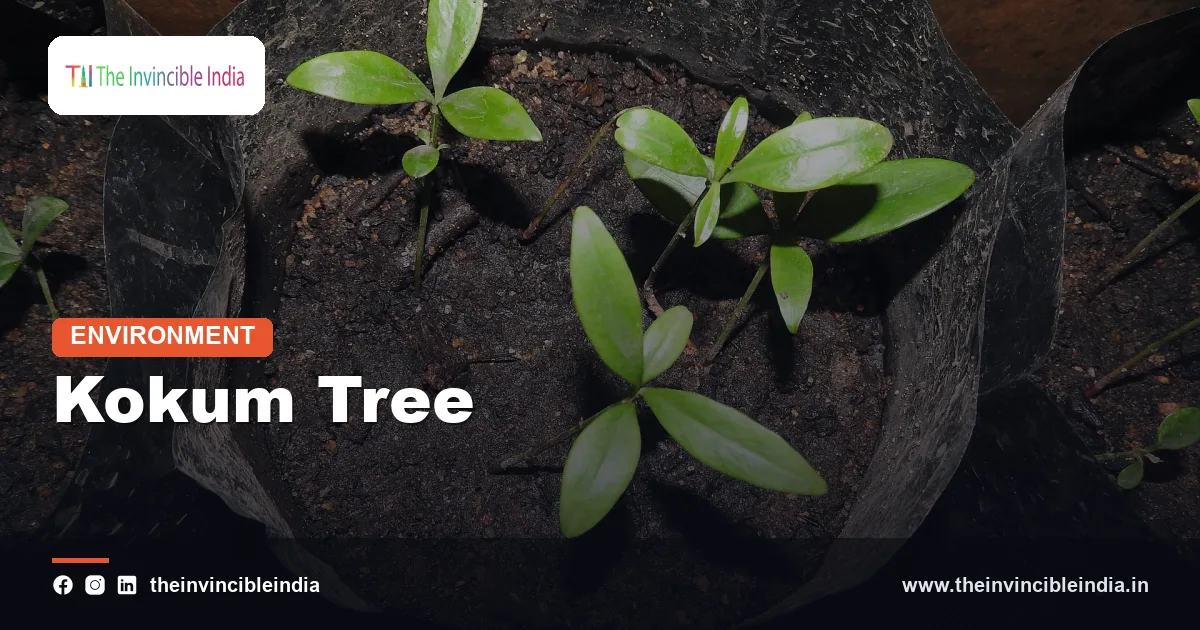
Kokum (Garcinia indica) is an evergreen fruit tree endemic to the Western Ghats whose tangy, deep purple fruit rind is dried and used as a souring agent in Konkan, Goan and Gujarati cooking, and whose seeds yield a hard, pale fat known as kokum butter. The tree is also called aamsul or amsul in Marathi, and its dried rind is one of the signature flavours of coastal western India.
Kokum is closely linked with the Konkan coast of Maharashtra, Goa and coastal Karnataka, where it grows wild in forest patches and is also cultivated around homes and orchards. This explainer covers what the kokum tree is, where it grows, how the fruit is processed, what kokum butter is and how the tree is cultivated.
Quick Facts
| Common names | Kokum, kokam, aamsul or amsul (Marathi), murgal or punarpuli (Kannada), bhirand (Konkani), Indian butter tree |
|---|---|
| Scientific name | Garcinia indica |
| Family | Clusiaceae (also called Guttiferae) |
| Native range | Western Ghats and the adjoining coastal strip of western India |
| Where grown in India | Konkan region of Maharashtra (Ratnagiri, Sindhudurg, Raigad), Goa, coastal and Malnad Karnataka, and parts of Kerala and Gujarat |
| Height and key features | Slender evergreen tree of about 10 to 15 metres with drooping branches, glossy leaves and round purple-red fruit |
| Main uses | Dried rind as a souring spice and for cooling drinks; seed fat as kokum butter for foods, cosmetics and soap |
| Notable facts | Fruit ripens in the hot weeks before the monsoon; a close relative is Garcinia gummi-gutta (kudampuli); an improved variety series was developed at Dapoli, Maharashtra |
Key Takeaways
- Kokum is the common name of Garcinia indica, an evergreen tree of the Clusiaceae family that is endemic to the Western Ghats of India.
- Kokum fruit ripens to a deep purple-red in the weeks before the monsoon, usually between March and May in the Konkan.
- Dried kokum rind, known as aamsul, is a souring agent used in curries, dals and the cooling Konkan drink sol kadhi.
- Kokum butter is a solid, pale vegetable fat extracted from the seeds, and it stays firm at normal room temperature.
- Kokum grows mainly in the Konkan districts of Maharashtra, in Goa and in coastal Karnataka, where the tree is often planted around houses and in mixed orchards.
- Kokum is a different species from Garcinia gummi-gutta, the Malabar tamarind or kudampuli, which is used in a similar way in Kerala.
What is the kokum tree?
The kokum tree is a slender, evergreen fruit tree, Garcinia indica, that grows naturally in the humid forests of the Western Ghats and bears round, purple-red fruit. It belongs to the genus Garcinia, a group of tropical trees that also includes the mangosteen, which is famous for its sweet white segments.
The tree typically grows to about 10 to 15 metres in height and has a neat, conical to pyramidal shape, with branches that droop toward the ground. The leaves are opposite, glossy, dark green and oblong, and young leaves flush in a pale reddish or coppery tone. The bark is dark brown to greyish and exudes a yellowish latex when cut, a feature common to the Clusiaceae family.
Kokum is called by several names across the region. The Marathi term aamsul refers to the dried rind, while kokum is the common English and Hindi name. In Kannada the tree is known as murgal, and in Konkani the fruit is often called bhirand. The name “Indian butter tree” refers to the seed butter.
Where does kokum grow in India?
Kokum grows mainly along the western coast of India, in the Konkan belt of Maharashtra, in Goa, and in coastal and Malnad parts of Karnataka. It is native to the evergreen and semi-evergreen forests of the Western Ghats, and it is also found in parts of Kerala and southern Gujarat.
Within Maharashtra, the districts of Ratnagiri, Sindhudurg and Raigad are the main kokum-growing areas, and the tree is a familiar sight in village courtyards and on hillsides. In Goa, kokum trees are common in orchards and backyards, and in Karnataka the tree grows in the coastal districts of Uttara Kannada and Dakshina Kannada.
The species prefers warm, humid conditions with heavy monsoon rainfall and well-drained, slightly acidic soils such as red laterite. It does not thrive in dry plains or places with severe frost, which explains why its natural range is confined to the wet west coast and its hills.
What does the kokum fruit look like and when does it ripen?
The kokum fruit is a round, smooth-skinned fruit about the size of a small orange, which turns from green to deep purple-red as it ripens. Inside the thin rind lies a juicy, sweet-sour reddish pulp that surrounds a handful of large seeds, usually between four and eight.
In the Konkan, kokum ripens in the hot months before the monsoon, generally from March to May, and the harvest is a seasonal event for families who gather the fruit from their own trees. Because the flavour and colour are strongest at full ripeness, growers pick the fruit when it has turned dark and falls easily.
Flowers and tree sex
Kokum flowers are small, pinkish-red and appear in the cool season. Kokum trees are largely dioecious, meaning that male and female flowers are carried on separate trees, although some trees bear both. Only female trees produce fruit, so growers prefer to plant grafted trees of known female types.
How is dried kokum (aamsul) made and used?
Dried kokum, called aamsul, is made by separating the rind from the pulp and seeds, then drying the rind in the sun until it turns dark and leathery. The rinds are often soaked in the reserved fruit juice and dried again, which deepens the colour and sourness.
Kokum rind is a souring agent in the way tamarind is in other regions, and it also imparts a pinkish-purple hue to dishes. A few pieces are added to curries and dals toward the end of cooking, and the rind is removed or eaten after it has imparted its flavour.
- Sol kadhi: a pink, cooling Konkan drink made from kokum and coconut milk, often served after a meal.
- Kokum sherbet or agal: a syrup of kokum rind, sugar and water, diluted into a refreshing summer drink.
- Fish curries: Malvani and Goan fish curries often use kokum to provide a sharp sourness along with coconut.
- Amti and dals: Maharashtrian and Gujarati dals use aamsul as a mild souring agent.
- Pickles and chutneys: dried or fresh rind is sometimes ground into chutney or preserved with salt.
The fruit is not usually eaten raw in large amounts, but the fresh pulp is sometimes made into syrups and squashes. Commercial kokum syrup, concentrate and ready-to-drink beverages are now sold across India.
What is kokum butter?
Kokum butter is a pale, hard vegetable fat obtained from the seeds of Garcinia indica, and it remains solid at normal room temperature. After the pulp is removed, the seeds are dried, crushed and then pressed or extracted to yield the fat, which is brittle and white to light yellow.
Kokum butter is rich in saturated and monounsaturated fatty acids, mainly stearic acid and oleic acid, and has a relatively high melting point close to body temperature. This composition gives it a firm, quickly melting texture, which is useful in cosmetics and confectionery.
| Application | How kokum butter is used |
|---|---|
| Cosmetics and skin care | Ingredient in creams, lotions, lip balms and soaps for its firm, non-greasy feel |
| Confectionery | Used as a cocoa butter equivalent in some chocolates and sweets |
| Traditional cooking | Locally used as an edible fat in parts of the Konkan |
| Traditional medicine | Applied to cracked skin, burns and sores in folk practice |
| Soap and candle making | Added for hardness and stable lather |
Kokum butter is often described as non-comedogenic in cosmetic literature, but claims about skin or health benefits vary in strength and should be treated cautiously. The seed fat is a recognised commercial product in India and is exported in small quantities.
How is kokum cultivated?
Kokum is cultivated from seed or, increasingly, from grafted plants that ensure a female, fruit-bearing tree of known quality. Seedlings take many years to bear fruit and produce a mix of male and female trees, so grafting is the preferred method for orchards.
Orchards are usually planted at the start of the monsoon in pits filled with compost and soil, at wide spacing of about 6 to 7 metres. The trees need little irrigation once established in high-rainfall regions, though young plants benefit from watering in their first dry seasons.
Improved varieties
Agricultural researchers at Dr. Balasaheb Sawant Konkan Krishi Vidyapeeth in Dapoli, Maharashtra, have released improved kokum selections, such as Konkan Amruta and Konkan Hatis, chosen for larger fruit and better rind yield. Grafted plants of these varieties begin bearing in roughly four to five years, far sooner than many seedlings.
Pests and care
Kokum is generally a hardy tree with few serious pests. Common management practices include pruning dead branches, applying farmyard manure and protecting young plants from grazing animals and wind.
What is the difference between kokum and kudampuli?
Kokum and kudampuli are two related but different Garcinia species: kokum is Garcinia indica, while kudampuli, also called Malabar tamarind, is Garcinia gummi-gutta. Both are used as souring agents, but kudampuli is typically dried into dark, shrivelled pieces with a smoky flavour, and it is used chiefly in Kerala fish curries.
| Feature | Kokum | Kudampuli (Malabar tamarind) |
|---|---|---|
| Scientific name | Garcinia indica | Garcinia gummi-gutta |
| Fruit shape | Round and smooth, purple-red when ripe | Pumpkin-like with ridges, yellow to orange when ripe |
| Main region | Konkan, Goa, coastal Karnataka | Kerala and southern Karnataka |
| Typical processed form | Sun-dried purple-black rind (aamsul) | Smoked, dried dark pieces |
| Signature use | Sol kadhi, Konkan fish curry, agal | Kerala fish curry (meen curry) |
Both species contain hydroxycitric acid and related compounds in their rinds, and both have been studied in connection with weight management supplements. The scientific evidence on such supplements remains debated, and anyone considering them should seek medical advice.
Why is kokum important to Konkan cooking and culture?
Kokum is important to Konkan cooking because it supplies the main source of sourness in a cuisine built around coconut, fish and rice, and because it grows readily in the region. In the humid coastal climate, the cooling drinks made from kokum are valued as a response to the heat.
Households in the Konkan commonly prepare their own aamsul each summer, drying rind on rooftops and in courtyards, and sell the surplus at village markets. For many small farmers the tree is a low-input, steady source of income, and women’s self-help groups often process and sell kokum syrup, dried rind and butter.
Because the trees grow well in forest-edge landscapes and do not require clearing land, kokum is also a useful tree for sustainable livelihoods in the Western Ghats, a recognised biodiversity hotspot.
Is kokum a protected or threatened species?
Kokum is widely planted and is not generally regarded as a rare species, but its wild populations in the Western Ghats face pressure from habitat loss and over-harvesting. The tree has a limited natural range confined to a biodiversity hotspot, so forest fragmentation remains a concern for wild stands even though farmers cultivate it extensively.
Conservationists encourage cultivation in home gardens and orchards, along with careful collection in the wild, so that the species is maintained for both food and biodiversity. Many Garcinia species of the Western Ghats are endemic, which increases the importance of protecting forest habitat.
Bottom Line
Kokum is a Western Ghats tree whose dried rind and seed butter have made it a valued crop on India’s western coast. Its sour rind flavours daily meals in the Konkan, while kokum butter finds use in food and cosmetics. As a native, low-input and locally loved tree, it offers farmers a dependable income and a good reason to keep tree cover in the Ghats.
Frequently Asked Questions
What is kokum?
Kokum is the fruit of Garcinia indica, an evergreen tree of the Western Ghats. The ripe fruit is round and purple-red, and its rind is dried and used as a souring agent in Konkan, Goan and Gujarati dishes. The seeds yield a hard fat called kokum butter.
What is aamsul?
Aamsul is the Marathi name for dried kokum rind. It is made by drying the fruit rind in the sun until it turns dark and leathery. Cooks add a few pieces to curries and dals to give a mild, fruity sourness and a pinkish tint.
What is kokum butter used for?
Kokum butter is used in cosmetics, soaps, chocolates and traditional cooking. It is a firm, pale vegetable fat from kokum seeds that stays solid at room temperature. Makers value it for its hardness and its quick melt on contact with skin.
Where does the kokum tree grow in India?
The kokum tree grows mainly in the Western Ghats and along the western coast, especially in the Konkan region of Maharashtra, Goa and coastal Karnataka. It prefers humid, high-rainfall areas with well-drained, laterite-type soils. It is also found in parts of Kerala and Gujarat.
When is the kokum season?
The kokum season in the Konkan generally runs from March to May. The fruit ripens in the hot weeks before the monsoon, and families harvest and dry the rind during this period. Exact timing varies with location and the weather in a given year.
Is kokum the same as Malabar tamarind?
No, kokum is not the same as Malabar tamarind. Kokum is Garcinia indica, whereas Malabar tamarind, also called kudampuli, is Garcinia gummi-gutta. Both are used as souring agents, but they differ in fruit shape, colour and regional use.
{“@context”:”https://schema.org”,”@graph”:[{“@type”:”FAQPage”,”mainEntity”:[{“@type”:”Question”,”name”:”What is kokum?”,”acceptedAnswer”:{“@type”:”Answer”,”text”:”Kokum is the fruit of Garcinia indica, an evergreen tree of the Western Ghats. The ripe fruit is round and purple-red, and its rind is dried and used as a souring agent in Konkan, Goan and Gujarati dishes. The seeds yield a hard fat called kokum butter.”}},{“@type”:”Question”,”name”:”What is aamsul?”,”acceptedAnswer”:{“@type”:”Answer”,”text”:”Aamsul is the Marathi name for dried kokum rind. It is made by drying the fruit rind in the sun until it turns dark and leathery. Cooks add a few pieces to curries and dals to give a mild, fruity sourness and a pinkish tint.”}},{“@type”:”Question”,”name”:”What is kokum butter used for?”,”acceptedAnswer”:{“@type”:”Answer”,”text”:”Kokum butter is used in cosmetics, soaps, chocolates and traditional cooking. It is a firm, pale vegetable fat from kokum seeds that stays solid at room temperature. Makers value it for its hardness and its quick melt on contact with skin.”}},{“@type”:”Question”,”name”:”Where does the kokum tree grow in India?”,”acceptedAnswer”:{“@type”:”Answer”,”text”:”The kokum tree grows mainly in the Western Ghats and along the western coast, especially in the Konkan region of Maharashtra, Goa and coastal Karnataka. It prefers humid, high-rainfall areas with well-drained, laterite-type soils. It is also found in parts of Kerala and Gujarat.”}},{“@type”:”Question”,”name”:”When is the kokum season?”,”acceptedAnswer”:{“@type”:”Answer”,”text”:”The kokum season in the Konkan generally runs from March to May. The fruit ripens in the hot weeks before the monsoon, and families harvest and dry the rind during this period. Exact timing varies with location and the weather in a given year.”}},{“@type”:”Question”,”name”:”Is kokum the same as Malabar tamarind?”,”acceptedAnswer”:{“@type”:”Answer”,”text”:”No, kokum is not the same as Malabar tamarind. Kokum is Garcinia indica, whereas Malabar tamarind, also called kudampuli, is Garcinia gummi-gutta. Both are used as souring agents, but they differ in fruit shape, colour and regional use.”}}]}]}


