

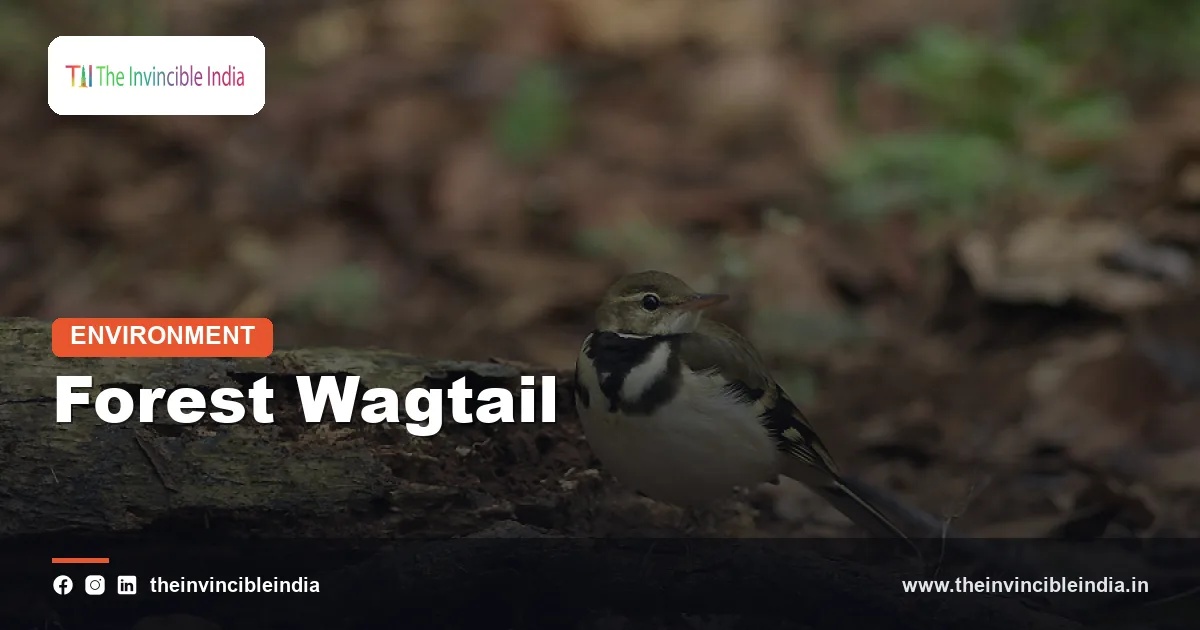
The forest wagtail (Dendronanthus indicus) is a slim, olive-brown and white wagtail that walks on the floor and branches of shaded forests and, unlike every other wagtail, sways its tail and rear body from side to side instead of bobbing it up and down. It breeds in East Asia and spends the winter in the forests of India, Sri Lanka and Southeast Asia, where it is recognised by its double black breast band and two bold wing bars.
The forest wagtail is the only member of its genus, a lineage that sits somewhat apart from the other wagtails. This explainer covers its identification, its odd swaying walk, its tree-branch habits, its diet, its long migration to India, its call and its conservation.
| Quick Facts: Forest Wagtail | |
|---|---|
| Common name | Forest wagtail |
| Scientific name | Dendronanthus indicus |
| Family and order | Motacillidae (wagtails and pipits), order Passeriformes |
| Size | Roughly 16-18 cm; a slim wagtail with a moderately long tail |
| Key field marks | Olive-brown upperparts, white underparts, double black breast band (the lower one often broken), two white or yellowish wing bars, pale eyebrow stripe |
| Habitat in India | Shaded forest floors, forest tracks, plantations, wooded stream sides and damp clearings, especially in the Western Ghats and the northeast |
| Diet | Insects and other small invertebrates, taken from the ground and from low branches |
| Breeding and migration | Breeds in East Asia, including northeastern China, Korea and the Russian Far East; a winter migrant to South and Southeast Asia |
| Conservation status | Least Concern on the IUCN Red List |
Key Takeaways
- The forest wagtail is a slim olive-brown and white wagtail, about 16-18 cm long, with a double black breast band and two bold wing bars.
- The forest wagtail is the only wagtail that sways its tail and rear body sideways like a pendulum, instead of bobbing the tail up and down.
- The forest wagtail is the only species in the genus Dendronanthus, whose name means “tree-flower”, and it often perches lengthwise on horizontal tree branches.
- The forest wagtail breeds in East Asia and winters in the forests of India, Sri Lanka and Southeast Asia, arriving in India from around autumn.
- The forest wagtail feeds on insects and other small invertebrates, which it picks from leaf litter, forest tracks and low branches.
- The IUCN lists the forest wagtail as Least Concern, but the species depends on shaded forest and is vulnerable to the loss of woodland.
What is the forest wagtail?
The forest wagtail is a woodland songbird of the wagtail and pipit family, Motacillidae, and it is unusual for choosing shaded forest rather than open water edges or fields. Most wagtails, such as the grey wagtail and the white wagtail, are birds of streams, lawns and open ground, but the forest wagtail is a species of forest floors and trees.
The forest wagtail is placed in its own genus, Dendronanthus, because its structure, behaviour and nest differ from those of true wagtails in the genus Motacilla. The Latin genus name combines Greek words for “tree” and “flower”, an unusual and slightly poetic choice for a plain-looking forest bird. The species name indicus refers to India, where the bird was first described from wintering birds.
The forest wagtail is not common anywhere in India, and it is a quiet, solitary bird, so many birdwatchers count it as a pleasing find in a day spent in the forest.
How can you identify a forest wagtail?
A forest wagtail can be identified by its olive-brown back, white underparts, a double black breast band and two broad wing bars, combined with a distinctive side-to-side swaying of the tail. These marks make it unlike any other bird on a forest floor.
Key field marks
- Breast band: two dark bands across the white breast, the upper one complete and the lower one usually narrower or broken in the middle.
- Back and head: olive-brown to greyish-brown, with a pale eyebrow stripe and a darker eye-line.
- Wing bars: two broad white or buff-yellow bars across the dark wing, easy to see in flight and at rest.
- Tail: moderately long, dark brown with white outer feathers, which flash in flight.
- Legs: pinkish, and the bird walks rather than hops.
The forest wagtail’s pattern is subtle in dappled shade, but its movement is distinctive enough that experienced birdwatchers often identify it from the sway before they see the markings.
Why does the forest wagtail sway its tail sideways?
The forest wagtail sways its tail and rear body from side to side because that is how this species has evolved to move, in contrast with the up-and-down tail wagging of other wagtails. The sway looks like the swing of a pendulum, and it is repeated almost constantly as the bird walks.
The exact purpose of the swaying is not settled. One idea is that it helps the bird signal to others of its species in dim forest light, where visual cues are limited. Another is that it may help flush hidden insects from leaf litter or reduce the bird’s visibility to predators. Whatever its reason, the movement is the most useful identification clue in the field.
- Other wagtails wag the tail vertically, up and down.
- The forest wagtail swings the whole hind body and tail sideways.
- The movement continues even when the bird stands on a branch.
Watching this motion, and then confirming the double breast band, is the standard way to confirm the species.
Where does the forest wagtail live in India?
The forest wagtail lives in shaded forest and wooded habitats across parts of India during winter, with records concentrated in the Western Ghats, the Eastern Ghats, central India and the northeast, and scattered sightings elsewhere. It prefers moist, shady ground under a tree canopy.
The forest wagtail is a bird of the forest floor, forest tracks and the edges of streams under trees. It is also found in plantations such as coffee and teak, in damp clearings and along shaded roads that cut through woodland. Because it is scarce and solitary, it is usually recorded as a single bird.
- Evergreen and moist deciduous forest with leaf litter and bare patches.
- Forest tracks, trails and roadsides under tree cover.
- Shaded plantations and orchards with sparse ground vegetation.
- Wooded stream banks and damp, shaded clearings.
The forest wagtail also tends to return to the same wintering area year after year, so a good spot found in one season may produce the species again in the next.
How is the forest wagtail different from other wagtails?
The forest wagtail differs from other wagtails in its habitat, its sideways tail swing, its double breast band and its tree-branch habits. Several other wagtails visit India, and comparing them clarifies why the forest wagtail is considered special.
| Species | Typical habitat | Distinguishing points |
|---|---|---|
| Forest wagtail | Shaded forest floors and tracks | Sways tail sideways, double breast band, two wing bars, olive-brown back |
| Grey wagtail | Rocky streams and rivers | Grey back, yellow underparts, very long tail wagged up and down |
| White wagtail | Open ground, water edges, towns | Black-and-white pattern, tail bobbed up and down |
| Yellow wagtail | Fields, grassland, marsh edges | Yellow underparts in most forms, shorter tail, tail wagged up and down |
| Citrine wagtail | Marshy ground and wet meadows | Bright yellow head and underparts in males, grey back |
The forest wagtail is thus the odd one out in the group: a wagtail that has moved into the trees and changed the way it moves.
What does the forest wagtail eat?
The forest wagtail eats insects and other small invertebrates, such as ants, beetles, flies, caterpillars and spiders, which it picks from leaf litter, bare ground and low branches. It walks steadily over the forest floor, stopping to peck at prey, then moves on with its swaying gait.
The forest wagtail feeds both on the ground and in the lower parts of trees, a mixed habit that fits its name. It may also fly up to a low branch to rest, where it often sits along the branch rather than across it. This habit of perching lengthwise on a horizontal limb is another feature that distinguishes it from many ground-dwelling birds.
By feeding on forest-floor insects, the forest wagtail takes a small part in the food web of the woodland, linking leaf-litter invertebrates to larger predators such as raptors and snakes.
How does the forest wagtail breed?
The forest wagtail breeds in East Asia, building a small cup nest on a horizontal tree branch, which is unusual among wagtails because most species nest on or near the ground. The nest is made of grasses and plant fibres and is placed on a limb some distance above the ground.
The female lays a clutch of several speckled eggs, and both parents help feed the chicks on insects. The breeding range covers parts of northeastern China, Korea and the Russian Far East. Because breeding takes place outside India, the forest wagtail seen in Indian forests is always a non-breeding visitor.
- Nest site: on a horizontal branch of a tree, often in open woodland.
- Nest material: grass stems, fine roots and plant fibres.
- Breeding season: the northern summer, after which birds migrate south.
Why does the forest wagtail migrate to India?
The forest wagtail migrates to India because its East Asian breeding grounds become cold and insect-poor in winter, while the forests of South and Southeast Asia stay warm and rich in prey. The journey takes birds across thousands of kilometres and several countries.
In India, the forest wagtail arrives from around autumn, stays through winter and leaves in spring. Most records come from forested regions, with relatively few from the open plains. The species migrates at night in small numbers, which makes the movement hard to observe, and this contributes to the impression of rarity.
The yearly cycle
- Summer: breeding in East Asian woodland.
- Autumn: southward migration through Southeast Asia and into India.
- Winter: solitary foraging on Indian forest floors and tracks.
- Spring: northward return journey.
What does the forest wagtail sound like?
The forest wagtail gives a sharp, metallic “chik” or “tzeep” call, often uttered as the bird flies up from the ground into a tree. The call is short and clear and is easiest to hear in the quiet of early morning in the forest.
A walking forest wagtail is mostly silent, so the flight call is an important cue. It also has a brief song on its breeding grounds, a series of clear, rather thin notes, but this is rarely heard in India. The forest wagtail’s alarm call and the sound of its flight help observers pick it out among the many small sounds of a forest floor.
Noting a metallic call and a pale wing-barred bird flying to a low branch is often how a first forest wagtail is found.
Is the forest wagtail threatened?
The forest wagtail is not globally threatened: the IUCN lists it as Least Concern because of its large range. Nonetheless, it depends on shaded woodland at both ends of its migration, so deforestation and forest degradation are the main long-term concerns.
The forest wagtail may be affected by habitat loss in its wintering grounds in South and Southeast Asia and by changes to forest structure in its East Asian breeding range. Its numbers are hard to estimate because the bird is shy and thinly spread, and so records submitted by birdwatchers have real scientific value.
- Protect moist forest and shaded plantations that provide leaf-litter habitat.
- Keep forest tracks quiet in the early morning, when birds forage on the ground.
- Report sightings to citizen science platforms to help map the species’ winter range.
How can you see a forest wagtail?
You can see a forest wagtail by walking quietly along forest tracks and shaded trails in winter and watching the ground for a slim bird with a swaying tail. Early morning is best, when the bird forages on open patches of track and leaf litter.
- Visit forests in the Western Ghats, Eastern Ghats, central India or the northeast from autumn to early spring.
- Scan the ground ahead rather than only the canopy, and move slowly.
- Look for the rhythmic sideways sway of the tail.
- If the bird flies, watch which low branch it lands on, because it often perches lengthwise.
- Photograph the breast bands and wing bars for later confirmation.
Patient observers are often rewarded with close views, because the forest wagtail tends to walk calmly ahead of people rather than flying far.
Bottom Line
The forest wagtail is a quiet traveller with a peculiar swaying walk, a bird that has taken the wagtail design into the shade of the forest. Seeing one in an Indian winter forest is a reminder of how far its migration takes it from East Asia.
Frequently Asked Questions
What is a forest wagtail?
A forest wagtail is a slim olive-brown and white wagtail that lives in shaded forests and is known for swaying its tail sideways. Its scientific name is Dendronanthus indicus. It breeds in East Asia and winters in India and Southeast Asia.
Why does the forest wagtail sway its tail sideways?
The forest wagtail sways its tail sideways as a distinctive part of its walking movement, unlike other wagtails that bob the tail up and down. The exact reason is not settled. It may help with signalling in dim light or flushing insects.
Where can I see a forest wagtail in India?
You can see a forest wagtail in shaded forests and plantations, especially in the Western Ghats, Eastern Ghats, central India and the northeast. It is a winter visitor, so look from autumn to early spring. Forest tracks and damp clearings are good places to search.
What does the forest wagtail eat?
The forest wagtail eats insects and other small invertebrates, such as ants, beetles and caterpillars. It feeds on the forest floor and on low branches. It walks and pecks rather than hopping.
Does the forest wagtail breed in India?
No, the forest wagtail does not breed in India, and it breeds in East Asia instead. It nests on a horizontal tree branch in northeastern China, Korea and the Russian Far East. Birds in India are non-breeding winter visitors.
Is the forest wagtail rare?
The forest wagtail is not globally threatened and is listed as Least Concern by the IUCN, but it is uncommon and thinly spread in India. It is shy and solitary, so it is easily missed. Many birdwatchers count it as a special find.
{“@context”:”https://schema.org”,”@graph”:[{“@type”:”FAQPage”,”mainEntity”:[{“@type”:”Question”,”name”:”What is a forest wagtail?”,”acceptedAnswer”:{“@type”:”Answer”,”text”:”A forest wagtail is a slim olive-brown and white wagtail that lives in shaded forests and is known for swaying its tail sideways. Its scientific name is Dendronanthus indicus. It breeds in East Asia and winters in India and Southeast Asia.”}},{“@type”:”Question”,”name”:”Why does the forest wagtail sway its tail sideways?”,”acceptedAnswer”:{“@type”:”Answer”,”text”:”The forest wagtail sways its tail sideways as a distinctive part of its walking movement, unlike other wagtails that bob the tail up and down. The exact reason is not settled. It may help with signalling in dim light or flushing insects.”}},{“@type”:”Question”,”name”:”Where can I see a forest wagtail in India?”,”acceptedAnswer”:{“@type”:”Answer”,”text”:”You can see a forest wagtail in shaded forests and plantations, especially in the Western Ghats, Eastern Ghats, central India and the northeast. It is a winter visitor, so look from autumn to early spring. Forest tracks and damp clearings are good places to search.”}},{“@type”:”Question”,”name”:”What does the forest wagtail eat?”,”acceptedAnswer”:{“@type”:”Answer”,”text”:”The forest wagtail eats insects and other small invertebrates, such as ants, beetles and caterpillars. It feeds on the forest floor and on low branches. It walks and pecks rather than hopping.”}},{“@type”:”Question”,”name”:”Does the forest wagtail breed in India?”,”acceptedAnswer”:{“@type”:”Answer”,”text”:”No, the forest wagtail does not breed in India, and it breeds in East Asia instead. It nests on a horizontal tree branch in northeastern China, Korea and the Russian Far East. Birds in India are non-breeding winter visitors.”}},{“@type”:”Question”,”name”:”Is the forest wagtail rare?”,”acceptedAnswer”:{“@type”:”Answer”,”text”:”The forest wagtail is not globally threatened and is listed as Least Concern by the IUCN, but it is uncommon and thinly spread in India. It is shy and solitary, so it is easily missed. Many birdwatchers count it as a special find.”}}]}]}


