

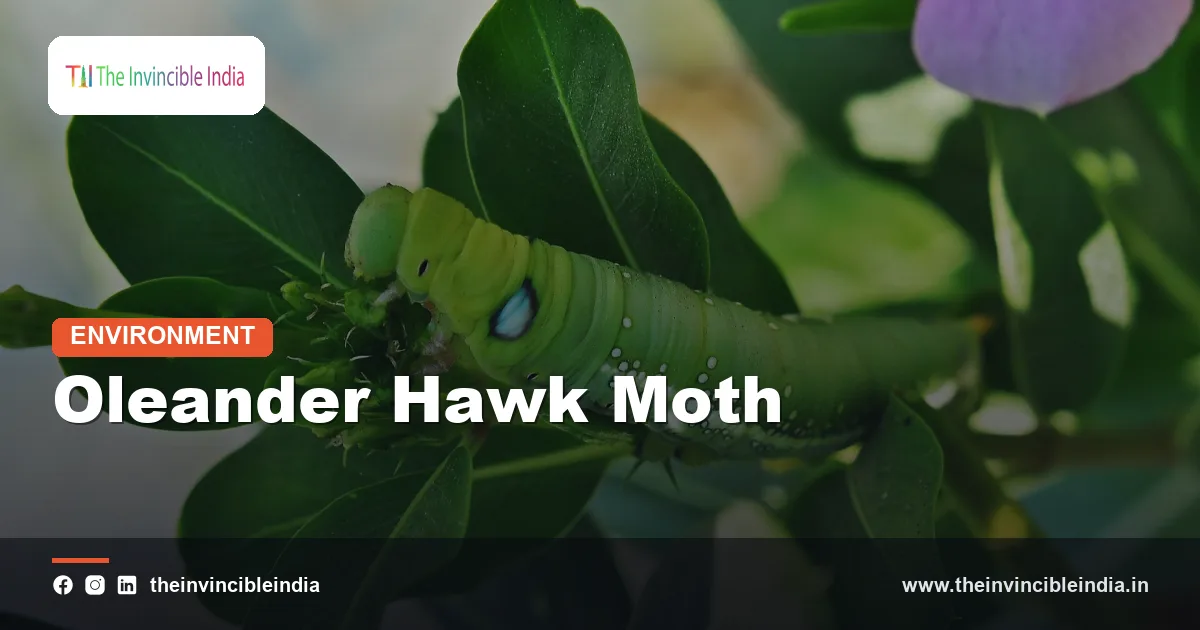
The oleander hawk moth (Daphnis nerii) is a large, strong-flying moth of the family Sphingidae, recognised by its green and olive camouflage pattern and by a caterpillar that feeds on poisonous oleander and related plants. Found across Africa, Asia and parts of Europe, it is one of the most widespread hawk moths in India and is often seen at dusk around gardens and hedges.
Many people first notice the oleander hawk moth as a startling green-and-pink insect resting on a wall in the morning, or as a plump green caterpillar with large eye-like spots on an oleander shrub. Both stages are harmless to people, but the species is a good example of how camouflage, flight and diet are linked in a hawk moth.
| Quick Fact | Detail |
|---|---|
| Common name | Oleander hawk moth (also called army green moth) |
| Scientific name | Daphnis nerii |
| Family | Sphingidae (hawk moths or sphinx moths) |
| Wingspan | Roughly 9 to 12 cm |
| Caterpillar host plants | Oleander (Nerium oleander), periwinkle (Catharanthus and Vinca), crape jasmine (Tabernaemontana) and other plants of the dogbane family (Apocynaceae) |
| Range and habitat in India | Widespread across the country, from plains and cities to forest edges and lower hills |
| Flight and season | Active at dusk and at night; seen in many months, with peaks in the warm and rainy seasons |
| Notable features | Green and pink camouflage, powerful flight, long tongue, caterpillar with eyespots |
Key Takeaways
- The oleander hawk moth (Daphnis nerii) is a large green hawk moth of the family Sphingidae that occurs across most of India.
- Oleander hawk moth caterpillars feed on oleander and related plants of the dogbane family, which are poisonous to many animals.
- Adult oleander hawk moths fly mainly at dusk and at night and feed on nectar from tubular, scented flowers using a very long proboscis.
- The green, olive and pink patterning of the oleander hawk moth camouflages it against foliage and bark when it rests during the day.
- Young oleander hawk moth caterpillars are green with a pale tail horn, and larger ones show a pair of large eye-like spots that may startle predators.
- The oleander hawk moth is a strong, long-distance flier and a useful night pollinator, and it is harmless to people.
What is the oleander hawk moth?
The oleander hawk moth is a large moth of the hawk moth family Sphingidae, scientifically named Daphnis nerii, that is found in tropical and subtropical regions of the Old World. Hawk moths get their name from their swift, hawk-like flight, and they are among the fastest flying insects.
The species belongs to the genus Daphnis. Its species name, nerii, refers to Nerium, the genus of oleander on which its caterpillars famously feed. In India it is also informally called the army green moth because of the olive-green camouflage pattern of its wings.
The oleander hawk moth is among the larger moths that gardeners and naturalists in India encounter. With a wingspan that can approach 12 cm, it is easy to mistake for a bird or bat when it hovers at dusk near a flower.
What does the oleander hawk moth look like?
The oleander hawk moth has olive-green forewings marked with pale, pinkish and white bands, a plump spindle-shaped body, and pink-and-brown hindwings. The overall pattern resembles a green leaf or a piece of lichen-covered bark, which helps the moth hide when it rests.
The adult moth
- Forewings: long and angular, olive green with white and pink wavy lines.
- Hindwings: smaller, pinkish or brown with a green patch, hidden when the wings are folded.
- Body: thick, tapered and covered with fine scales, with a pointed tip.
- Antennae: slender and slightly thickened, as in other hawk moths.
- Proboscis: a long coiled tongue that is extended to reach nectar deep in flowers.
The caterpillar
The oleander hawk moth caterpillar is plump and smooth, with a pale curved horn at the rear end. Younger caterpillars are usually green. Older ones are often green or yellowish with a pair of large eyespots near the front, and just before pupation they may turn brownish. When disturbed, the caterpillar draws its head inward and shows its eyespots, a display believed to startle small predators.
Where is the oleander hawk moth found?
The oleander hawk moth is found across most of India, from cities and villages to forest edges, and it is also widespread across Africa, the Middle East, Central and South Asia and South-East Asia. The species can fly long distances and is known to spread to new areas, including parts of southern Europe, during warm seasons.
In India, it commonly occurs wherever its host plants grow. Oleander is a popular ornamental plant along roads, in parks and around houses, so the moth is a familiar insect in many urban and semi-urban settings. In more natural areas it uses native plants of the dogbane family.
The species avoids very cold places, so it is more regular in the plains, hills and coastal areas than at high altitudes. Because adults are strong fliers, they may turn up some distance from the nearest host plant, attracted by lights or by flowers.
What do oleander hawk moths eat?
Oleander hawk moth caterpillars eat leaves of oleander and related plants, whereas the adults feed on nectar from tubular flowers using a long proboscis. This division means that the larval and adult diets are entirely separate.
Caterpillar host plants
The caterpillars specialise on plants of the dogbane family (Apocynaceae). Common hosts include:
- Oleander (Nerium oleander), widely planted as an ornamental
- Periwinkle (Catharanthus roseus and Vinca species)
- Crape jasmine (Tabernaemontana divaricata)
- Other dogbane-family shrubs and climbers
Many of these plants contain bitter and toxic compounds, including cardiac glycosides in the case of oleander. The caterpillar has evolved the ability to eat them without harm, and this gives it a degree of protection from some predators.
Adult food
Adult moths hover in front of flowers at dusk and dip their long tongue into the blossoms. They favour scented, tubular or trumpet-shaped flowers that open in the evening, including garden petunias, jasmines and similar plants.
How does the oleander hawk moth life cycle work?
The oleander hawk moth goes through complete metamorphosis with four stages: egg, caterpillar, pupa and adult moth. In warm Indian conditions, the cycle can be completed in about two months or less, and several generations can occur in a year.
| Stage | What happens |
|---|---|
| Egg | The female lays small, round, pale green eggs singly on the leaves of host plants. |
| Caterpillar | The larva feeds heavily on leaves and grows through several instars, changing colour and developing eyespots in later stages. |
| Pupa | The full-grown caterpillar wanders from the plant and forms a brownish pupa in leaf litter, soil or a loose silken covering. |
| Adult | The moth emerges, pumps fluid into its wings to expand them, and takes flight at dusk to feed and mate. |
A single caterpillar can eat a large number of leaves in its last growth stages. On a small oleander bush, a few caterpillars may strip many branches, although healthy plants generally recover once feeding stops.
How does the oleander hawk moth fly?
The oleander hawk moth flies with powerful, rapid wingbeats that allow it to hover in front of flowers and to travel long distances. Its thorax is packed with strong flight muscles, and it can warm these muscles by shivering before take-off.
Like other hawk moths, it can fly in cool evening air and can hold its position in the air while feeding. This is useful because it saves the moth from landing on delicate flowers, which might bend or hide predators.
Why hover rather than land?
- Hovering lets the moth reach deep nectar without crushing the petals.
- The moth can escape quickly from ambush predators such as spiders hiding in flowers.
- A long proboscis allows feeding from a distance, keeping the body clear of the flower.
The species is also a known migrant. In some regions, populations move seasonally with the winds and are able to reach areas far from where they were born.
Is the oleander hawk moth harmful?
The oleander hawk moth is not harmful to people or animals, since it does not bite, sting or carry disease. Its only common impact is feeding damage by caterpillars on ornamental oleander and periwinkle plants.
It is worth noting that the oleander plant itself is poisonous, and the caterpillars that feed on it should not be handled carelessly or eaten by pets. Touching the caterpillar is generally safe, but washing hands afterwards is a sensible precaution.
Gardeners who want to keep both plants and moths can try the following:
- Tolerate light feeding, because plants usually regrow.
- Move caterpillars by hand to a spare host plant, using gloves if preferred.
- Avoid broad-spectrum insecticides, which also kill pollinators and natural enemies.
How can the oleander hawk moth be distinguished from other hawk moths?
The oleander hawk moth is distinguished from other hawk moths by its overall olive-green colour with pink and white bands, which few other Indian hawk moths share. Several hawk moths occur in India, and some are brown or grey.
| Hawk moth | Main distinguishing feature |
|---|---|
| Oleander hawk moth (Daphnis nerii) | Olive-green forewings with pink and white bands; large and angular. |
| Convolvulus hawk moth (Agrius convolvuli) | Grey-brown with a banded pink-and-black abdomen and a very long tongue. |
| Death’s-head hawk moth (Acherontia styx) | Dark with a skull-like marking on the thorax and yellow-banded hindwings. |
| Hummingbird hawk moth (Macroglossum stellatarum) | Smaller, grey-brown, day-flying, with orange hindwings and a tail tuft. |
The caterpillars, with their large eyespots and curved horn, are also distinctive and are usually found on oleander or periwinkle leaves.
Why does the oleander hawk moth matter?
The oleander hawk moth matters as a night pollinator, as a food source for other animals and as a visible example of insect adaptation to toxic plants. Its long tongue and strong flight allow it to visit flowers that many other insects cannot reach.
Hawk moths are recognised pollinators of several scented, night-blooming flowers. By transferring pollen as they move between plants, they contribute to seed set in a range of wild and garden species. At the same time, caterpillars and pupae are eaten by birds, wasps and other predators, so the species is a link in the food chain.
For students and nature watchers, the oleander hawk moth is also an easy species to study. The caterpillar is large, slow and easy to find on a known host plant, making it a good subject for classroom observation and for citizen science records of insect presence.
How do oleander hawk moths protect themselves?
Oleander hawk moths protect themselves mainly through camouflage, speed and, in the caterpillar stage, a display of eyespots. Each stage of the life cycle relies on a different defence, which is a common pattern among hawk moths.
- Egg: small, pale and laid singly, so it is hard for predators to find.
- Caterpillar: green colouring that matches leaves, a diet of toxic plants and a startle display with large eyespots.
- Pupa: hidden in leaf litter or soil, away from the host plant.
- Adult: olive-green camouflage at rest and fast, powerful flight when disturbed.
At rest during the day, the adult usually holds its wings folded back along its body against a trunk, wall or leafy branch. The pattern of the forewings then breaks up the moth’s outline, making it hard for birds to see.
Can oleander hawk moths be attracted to lights?
Oleander hawk moths are attracted to artificial lights, as are many other night-flying moths. They are often found near verandah lamps and street lights in the morning, resting on nearby walls. Switching off unnecessary outdoor lights, or using shielded warm-coloured lamps, reduces the pull on moths and other nocturnal insects, which can otherwise exhaust themselves circling a light.
Bottom Line
The oleander hawk moth is a large green hawk moth whose caterpillar feeds on oleander and related plants and whose adult is a strong-flying evening pollinator. It is common, harmless to people and an easy species to observe in Indian gardens and green spaces.
Frequently Asked Questions
What is the oleander hawk moth?
The oleander hawk moth (Daphnis nerii) is a large, olive-green hawk moth of the family Sphingidae, found across Africa, Asia and parts of Europe, including most of India. Its caterpillar feeds on oleander and related plants, and the adult is a strong-flying evening pollinator.
What does the oleander hawk moth caterpillar eat?
The oleander hawk moth caterpillar eats the leaves of oleander, periwinkle, crape jasmine and other plants of the dogbane family (Apocynaceae). These plants are toxic to many animals, but the caterpillar can feed on them without harm.
Is the oleander hawk moth harmful to humans?
The oleander hawk moth is not harmful to humans, as it does not bite, sting or carry disease. The oleander plant on which its caterpillars feed is poisonous, so hands should be washed after handling plants or caterpillars.
When is the oleander hawk moth active?
The oleander hawk moth is active mainly at dusk and at night. During the day it rests camouflaged on foliage, bark or walls, and it is often found near lights in the morning.
How big is the oleander hawk moth?
The oleander hawk moth has a wingspan of roughly 9 to 12 cm, which makes it one of the larger moths seen in Indian gardens. Its plump, angular body and strong flight sometimes cause it to be mistaken for a small bird or bat.
How can I attract or protect oleander hawk moths in my garden?
Planting oleander, periwinkle or crape jasmine for caterpillars and scented evening flowers for adults attracts oleander hawk moths. Avoiding broad-spectrum pesticides and tolerating light leaf damage helps protect them.
{“@context”:”https://schema.org”,”@graph”:[{“@type”:”FAQPage”,”mainEntity”:[{“@type”:”Question”,”name”:”What is the oleander hawk moth?”,”acceptedAnswer”:{“@type”:”Answer”,”text”:”The oleander hawk moth (Daphnis nerii) is a large, olive-green hawk moth of the family Sphingidae, found across Africa, Asia and parts of Europe, including most of India. Its caterpillar feeds on oleander and related plants, and the adult is a strong-flying evening pollinator.”}},{“@type”:”Question”,”name”:”What does the oleander hawk moth caterpillar eat?”,”acceptedAnswer”:{“@type”:”Answer”,”text”:”The oleander hawk moth caterpillar eats the leaves of oleander, periwinkle, crape jasmine and other plants of the dogbane family (Apocynaceae). These plants are toxic to many animals, but the caterpillar can feed on them without harm.”}},{“@type”:”Question”,”name”:”Is the oleander hawk moth harmful to humans?”,”acceptedAnswer”:{“@type”:”Answer”,”text”:”The oleander hawk moth is not harmful to humans, as it does not bite, sting or carry disease. The oleander plant on which its caterpillars feed is poisonous, so hands should be washed after handling plants or caterpillars.”}},{“@type”:”Question”,”name”:”When is the oleander hawk moth active?”,”acceptedAnswer”:{“@type”:”Answer”,”text”:”The oleander hawk moth is active mainly at dusk and at night. During the day it rests camouflaged on foliage, bark or walls, and it is often found near lights in the morning.”}},{“@type”:”Question”,”name”:”How big is the oleander hawk moth?”,”acceptedAnswer”:{“@type”:”Answer”,”text”:”The oleander hawk moth has a wingspan of roughly 9 to 12 cm, which makes it one of the larger moths seen in Indian gardens. Its plump, angular body and strong flight sometimes cause it to be mistaken for a small bird or bat.”}},{“@type”:”Question”,”name”:”How can I attract or protect oleander hawk moths in my garden?”,”acceptedAnswer”:{“@type”:”Answer”,”text”:”Planting oleander, periwinkle or crape jasmine for caterpillars and scented evening flowers for adults attracts oleander hawk moths. Avoiding broad-spectrum pesticides and tolerating light leaf damage helps protect them.”}}]}]}


