

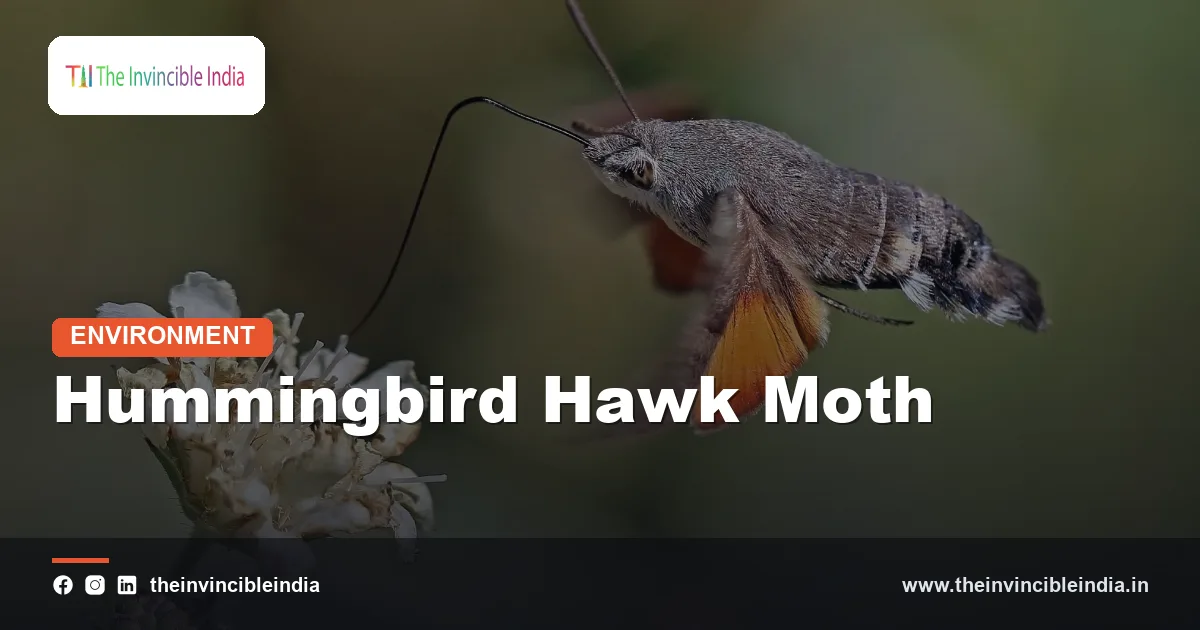
The hummingbird hawk moth (Macroglossum stellatarum) is a day-flying hawk moth that hovers in front of flowers like a tiny hummingbird, sipping nectar through a very long tongue. Although India has no true hummingbirds, this moth, and a few closely related day-flying hawk moths, fills a similar role at garden and wild flowers and is often mistaken for a small bird.
The hummingbird hawk moth is a member of the family Sphingidae and is one of the best-known hovering insects in the world. It is a strong, migratory flier with a wide Old World range that includes the Himalayan region and parts of northern India.
| Quick Fact | Detail |
|---|---|
| Common name | Hummingbird hawk moth |
| Scientific name | Macroglossum stellatarum |
| Family | Sphingidae (hawk moths or sphinx moths) |
| Wingspan | Roughly 4 to 5 cm |
| Caterpillar host plants | Bedstraws (Galium) and madders (Rubia), plants of the coffee family (Rubiaceae) |
| Range and habitat in India | Mainly the Himalayan region and parts of northern India, in gardens, meadows, scrub and forest edges; part of a wide Old World range |
| Flight and season | Day-flying, most active in bright sun; present mainly in warm months in cooler areas |
| Notable features | Hovers at flowers, audible humming wingbeats, long proboscis, orange hindwings, tufted tail |
Key Takeaways
- The hummingbird hawk moth (Macroglossum stellatarum) is a small, grey-brown hawk moth that flies by day and hovers in front of flowers while feeding.
- Hummingbird hawk moth wings beat so fast that they make an audible hum, and the moth can hold its position in mid-air while it extends its long tongue into flowers.
- Hummingbird hawk moth caterpillars feed on bedstraws and madders, which belong to the coffee family (Rubiaceae).
- The hummingbird hawk moth is a strong migrant with a wide Old World distribution that includes the Himalayan region and parts of northern India.
- India has no true hummingbirds, so any small hovering creature seen at flowers in India is usually a hawk moth, a sunbird or another insect.
- The hummingbird hawk moth is harmless, does not sting and is a valuable daytime pollinator of tubular flowers.
What is the hummingbird hawk moth?
The hummingbird hawk moth is a small to medium-sized moth, scientifically named Macroglossum stellatarum, that belongs to the hawk moth family Sphingidae and feeds while hovering. The name Macroglossum means “large tongue”, and it refers to the moth’s long proboscis.
Most moths are nocturnal, but the hummingbird hawk moth is one of the exceptions. It is most active in bright sun and warm weather, and this day-flying habit is a key reason people confuse it with a bird or a bee.
The moth is widespread across Europe, North Africa and Asia, and it is a regular migrant. Its name is borrowed from the New World hummingbirds, but the resemblance is an example of convergent evolution, in which unrelated animals develop similar behaviour in response to similar needs.
What does the hummingbird hawk moth look like?
The hummingbird hawk moth has grey-brown forewings, orange-brown hindwings, a stocky body with a black-and-white chequered abdomen and a fan-like tuft of scales at the tail end. The compact, plump shape and fast wingbeat give it a bird-like look as it hovers.
Key features
- Forewings: greyish brown with faint dark lines.
- Hindwings: bright orange to rusty, visible in flight as a flash of colour.
- Abdomen: dark with black-and-white side patches and a broad tail tuft that it can spread like a rudder.
- Eyes: large and well adapted for day vision.
- Tongue: a very long proboscis, longer than the body, which is coiled under the head when not in use.
The wingspan is only about 4 to 5 cm, much smaller than the oleander hawk moth. At a casual glance, the moth looks like a small hovering bird, but a closer look shows antennae, six legs and wings that are mostly a blur.
How does the hummingbird hawk moth hover?
The hummingbird hawk moth hovers by beating its wings very rapidly, typically several tens of times each second, while holding its body almost still. The rapid beat generates an audible hum, and the moth steers by adjusting its wing angle and by using its tail tuft as a rudder.
Hovering lets the moth feed on flowers without landing. This reduces the risk from predators that wait on petals, and it allows the moth to visit many flowers quickly, moving from one to the next in a smooth sequence.
What makes hovering possible?
- Powerful flight muscles in the thorax, warmed by shivering before activity
- Rapid, controlled wingbeats that create lift on both the downstroke and upstroke
- Large eyes that track the flower and keep the head steady
- A long proboscis that reaches nectar from a distance
Researchers have studied the moth’s flight because it can hover with very little drift, and it can also learn the colour and position of flowers it has visited before. These abilities make it one of the most agile flying insects in its habitat.
Where is the hummingbird hawk moth found in India?
In India, the hummingbird hawk moth is found mainly in the Himalayan region and parts of northern India, as part of a very wide Old World range. It is a migratory species, and individuals may appear in other regions, particularly in warm months.
The moth likes sunny places with flowers, such as meadows, forest clearings, village gardens, terraced fields and roadside shrubs. In the hills it may be seen visiting garden plants and wildflowers on bright days.
It is worth noting that India has several other day-flying hawk moths in the genus Macroglossum and related genera. These species also hover at flowers and are often called hummingbird hawk moths in everyday language. Identifying them to species level usually needs a close look at the abdominal tuft and the wing markings.
What does the hummingbird hawk moth eat?
Hummingbird hawk moth adults drink nectar from tubular flowers, while the caterpillars feed on bedstraws and madders. These host plants belong to the coffee family, Rubiaceae, and they are common weeds and wild plants in many regions.
Adult nectar sources
The moth is attracted to flowers with nectar held deep inside tubes, because its long tongue gives it access that many insects lack. Preferred types often include flowers that are blue, purple, pink or white, and many cultivated flowers such as verbena, phlox, lavender and jasmine-type blooms are visited. Wild flowers of meadows and hills are equally popular.
Caterpillar food
Females lay small, round, pale green eggs on the leaves of bedstraw (Galium) and madder (Rubia). The green caterpillar has a pale line along its side and a blue-tipped horn at the rear, and it feeds mostly during the day.
How does the hummingbird hawk moth life cycle work?
The hummingbird hawk moth develops through complete metamorphosis, with egg, caterpillar, pupa and adult stages, and it can complete its life cycle in a matter of weeks in warm weather. Where seasons are cooler, the adult moth can survive the cold by sheltering and becoming inactive.
| Stage | What happens |
|---|---|
| Egg | Small, round, pale green eggs are laid singly on host-plant leaves. |
| Caterpillar | A smooth green caterpillar with a horn at the tail feeds on bedstraw or madder for a few weeks. |
| Pupa | The caterpillar descends to the ground and forms a brownish pupa in leaf litter or in a loose cocoon. |
| Adult | The moth emerges and begins feeding by day, mating and laying eggs; some adults can overwinter in cooler regions. |
Because the life cycle is fast in warm conditions, several generations can appear in a year. This helps the species recover quickly after harsh weather.
Is the hummingbird hawk moth a bird, bee or moth?
The hummingbird hawk moth is a moth, not a bird or a bee, even though its hovering flight and size cause frequent confusion. True hummingbirds live only in the Americas, so no hummingbird occurs in India.
The confusion is understandable. The moth hovers, hums and probes flowers with a long, thin mouthpart. Yet there are easy ways to tell the animals apart.
| Animal | How to recognise it |
|---|---|
| Hummingbird hawk moth | Insect with antennae, six legs, powdery scaled wings and a tail tuft; flies in short, fast darts. |
| Sunbird (such as the purple sunbird) | A true bird with a curved bill and feathers; often perches on a twig while feeding. |
| Bee | Hairy body, shorter tongue, usually lands on the flower and has a different buzzing sound. |
| Other hovering hawk moths | Often similar in behaviour, but differ in size, colour and body pattern. |
Sunbirds are the true bird counterparts in India. They are small, nectar-feeding birds that occasionally hover, and they are sometimes mistaken for hummingbirds as well.
Is the hummingbird hawk moth harmful or beneficial?
The hummingbird hawk moth is beneficial and harmless, since it does not bite or sting and its caterpillars feed mainly on wild plants of little economic value. Its main role is as a pollinator of tubular flowers.
Because it flies in daylight, it fills a niche that is otherwise taken by bees, butterflies and birds. It also visits flowers that are shaped to reward long-tongued visitors, helping those plants to reproduce.
Gardeners who wish to attract the moth can do so with simple steps:
- Plant nectar-rich, tubular flowers that bloom through the warm months.
- Leave a patch of wild herbs, including bedstraw-type plants, for caterpillars.
- Avoid broad-spectrum pesticides, which can harm moths and their caterpillars.
- Provide sun-warmed, sheltered spots, since the moth is most active in warm conditions.
Why does the hummingbird hawk moth matter?
The hummingbird hawk moth matters as a daytime pollinator and as an example of how unrelated animals evolve similar solutions. Its hover-feeding behaviour is a striking case of convergent evolution with hummingbirds and sunbirds.
It is also an accessible species for people who are new to nature watching. Unlike most moths, it can be seen in bright daylight, which makes it easy to spot and record, and observations from gardeners and photographers help scientists follow its movements across seasons. As a migrant, it can also provide clues about how insects respond to changing weather and climate patterns.
How can the hummingbird hawk moth be observed and photographed?
The hummingbird hawk moth is best observed on sunny, calm days beside a patch of nectar-rich flowers, where it returns repeatedly to the same blooms. Patience works better than pursuit, because the moth moves on quickly if it is startled.
- Choose a time between mid-morning and late afternoon, when sunshine is strongest.
- Stand still near a flower bed, shrub or wildflower patch the moth has already visited.
- Use a fast shutter speed, since the wings move too quickly for slow exposures to freeze them.
- Note the date and place of the sighting, as records help researchers follow the moth’s seasonal movements.
Does the hummingbird hawk moth migrate?
The hummingbird hawk moth does migrate, and in many parts of its range populations move north in spring and summer and return or die back in cooler months. Individuals are able to cover long distances, which explains why the moth can appear suddenly in gardens far from where it breeds. In cool hill regions, adults that survive the cold may hide in sheltered places such as crevices and buildings until warmth returns.
Bottom Line
The hummingbird hawk moth is a small, day-flying hawk moth that hovers at flowers like a bird, using a long tongue to reach nectar. It is harmless, beneficial and easy to enjoy wherever sunny, flower-rich spaces are kept free of heavy pesticides.
Frequently Asked Questions
What is the hummingbird hawk moth?
The hummingbird hawk moth (Macroglossum stellatarum) is a day-flying hawk moth that hovers in front of flowers and drinks nectar through a long tongue. It belongs to the family Sphingidae and is widespread across the Old World, including the Himalayan region and parts of northern India.
Are there hummingbirds in India?
No, there are no true hummingbirds in India, as hummingbirds live only in the Americas. Small hovering creatures at Indian flowers are usually hawk moths such as the hummingbird hawk moth, or nectar-feeding birds called sunbirds.
How does the hummingbird hawk moth hover?
The hummingbird hawk moth hovers by beating its wings very rapidly while holding its body nearly still. The fast wingbeat produces an audible hum, and the moth steers using its wings and its fan-like tail tuft.
What do hummingbird hawk moths eat?
Adult hummingbird hawk moths drink nectar from tubular flowers, while the caterpillars eat bedstraws and madders of the coffee family (Rubiaceae). The long proboscis lets the adult reach nectar deep inside flowers.
Does the hummingbird hawk moth sting or bite?
The hummingbird hawk moth does not sting or bite and is harmless to people. It is a beneficial pollinator that visits flowers by day.
How can I tell a hummingbird hawk moth from a bee or bird?
A hummingbird hawk moth has antennae, six legs, powdery scaled wings and a tail tuft, whereas a bird has feathers and a bill and a bee has a hairy body and usually lands on flowers. The moth hovers and darts rapidly from bloom to bloom, with orange hindwings showing in flight.
{“@context”:”https://schema.org”,”@graph”:[{“@type”:”FAQPage”,”mainEntity”:[{“@type”:”Question”,”name”:”What is the hummingbird hawk moth?”,”acceptedAnswer”:{“@type”:”Answer”,”text”:”The hummingbird hawk moth (Macroglossum stellatarum) is a day-flying hawk moth that hovers in front of flowers and drinks nectar through a long tongue. It belongs to the family Sphingidae and is widespread across the Old World, including the Himalayan region and parts of northern India.”}},{“@type”:”Question”,”name”:”Are there hummingbirds in India?”,”acceptedAnswer”:{“@type”:”Answer”,”text”:”No, there are no true hummingbirds in India, as hummingbirds live only in the Americas. Small hovering creatures at Indian flowers are usually hawk moths such as the hummingbird hawk moth, or nectar-feeding birds called sunbirds.”}},{“@type”:”Question”,”name”:”How does the hummingbird hawk moth hover?”,”acceptedAnswer”:{“@type”:”Answer”,”text”:”The hummingbird hawk moth hovers by beating its wings very rapidly while holding its body nearly still. The fast wingbeat produces an audible hum, and the moth steers using its wings and its fan-like tail tuft.”}},{“@type”:”Question”,”name”:”What do hummingbird hawk moths eat?”,”acceptedAnswer”:{“@type”:”Answer”,”text”:”Adult hummingbird hawk moths drink nectar from tubular flowers, while the caterpillars eat bedstraws and madders of the coffee family (Rubiaceae). The long proboscis lets the adult reach nectar deep inside flowers.”}},{“@type”:”Question”,”name”:”Does the hummingbird hawk moth sting or bite?”,”acceptedAnswer”:{“@type”:”Answer”,”text”:”The hummingbird hawk moth does not sting or bite and is harmless to people. It is a beneficial pollinator that visits flowers by day.”}},{“@type”:”Question”,”name”:”How can I tell a hummingbird hawk moth from a bee or bird?”,”acceptedAnswer”:{“@type”:”Answer”,”text”:”A hummingbird hawk moth has antennae, six legs, powdery scaled wings and a tail tuft, whereas a bird has feathers and a bill and a bee has a hairy body and usually lands on flowers. The moth hovers and darts rapidly from bloom to bloom, with orange hindwings showing in flight.”}}]}]}


