

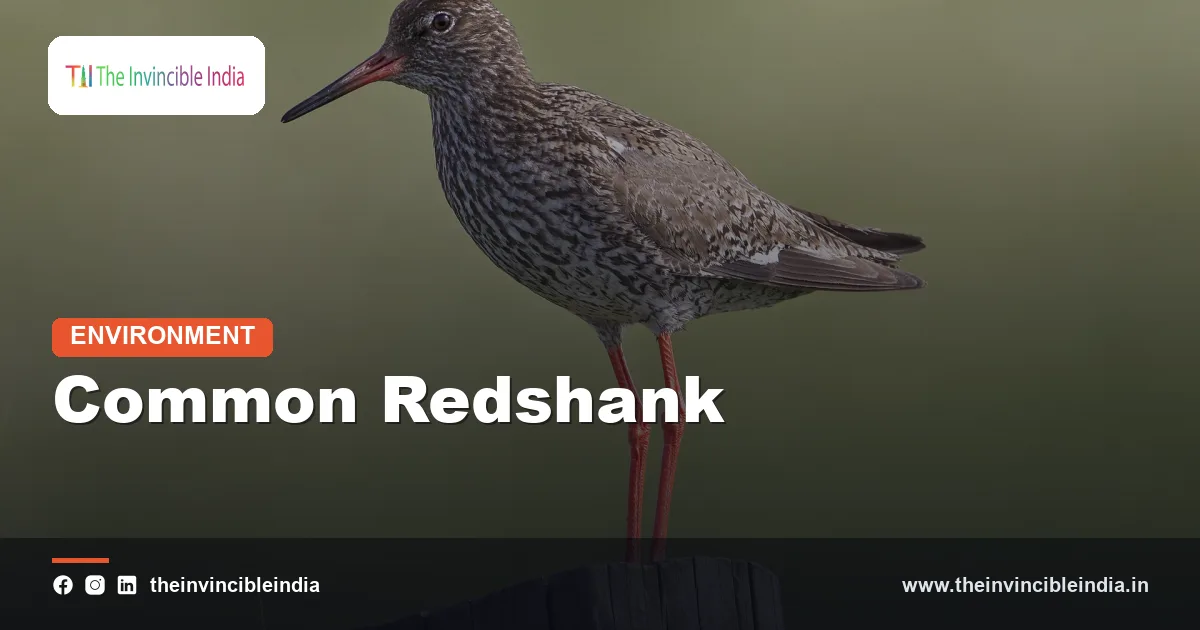
The common redshank (Tringa totanus) is a medium-sized, grey-brown wading bird with bright orange-red legs and a loud, ringing alarm call, and in India it is a widespread winter visitor to wetlands, estuaries and coasts. It belongs to the sandpiper family and is nicknamed the “sentinel of the marsh” because it raises the alarm at the first sign of danger. Its white-edged wings and red legs make it one of the easier waders to identify.
This guide explains what the common redshank looks like, where and when it is seen in India, what it eats, how it breeds and migrates, and how it differs from similar waders such as the spotted redshank, the common greenshank and the marsh sandpiper. It is written for general readers and beginning birdwatchers who want a clear, reliable introduction.
| Quick Facts | Common redshank |
|---|---|
| Scientific name | Tringa totanus |
| Family and order | Scolopacidae (sandpipers and allies), order Charadriiformes |
| Size | About 27 to 29 cm long, with a wingspan of roughly 60 cm |
| Appearance | Grey-brown plumage, orange-red legs, a red-based bill, and broad white edges on the rear of the wings visible in flight |
| India range and habitat | Coasts, mudflats, estuaries, salt pans, lagoons, lakes, marshes and river banks across much of the country |
| Diet | Worms, small crustaceans, molluscs and insects |
| Breeding and migration | Breeds in northern and central Eurasia; a winter visitor to India, usually from autumn to spring |
| Flyway | Part of the Central Asian Flyway and neighbouring flyways |
| Conservation status | Least Concern on the IUCN Red List |
Key Takeaways
- The common redshank (Tringa totanus) is a grey-brown wader of about 27 to 29 cm that is identified by its bright orange-red legs.
- The common redshank is a winter visitor to India, arriving from its northern breeding grounds in autumn and leaving in spring.
- The common redshank shows broad white trailing edges on its wings in flight, which separates it from most other medium-sized waders.
- The common redshank gives a loud, ringing alarm call that alerts other birds on a wetland to danger.
- The common redshank feeds on worms, small crustaceans, molluscs and insects, which it finds by probing mud and picking from the surface.
- The common redshank is classified as Least Concern globally, but it relies on coastal and inland wetlands that are under pressure from development.
What is the common redshank?
The common redshank is a wading bird of the sandpiper family that breeds across Eurasia and winters in Africa, southern Asia and the Middle East. It belongs to the genus Tringa, a group of “shanks” that have long legs and slender bills. The name “redshank” refers to the colour of its legs, because “shank” is an old word for the lower leg.
The species is one of the most widespread waders in the Old World, and several subspecies are recognised, differing slightly in size and shade of plumage. In India, birds are seen along the coast and at inland wetlands for much of the year, though most of them are winter visitors from the north. The common redshank is a social bird and often forms flocks with other waders.
Its reputation as a watchful bird comes from its habit of sounding the alarm. A single redshank that calls and takes off can cause hundreds of other waders to lift into the air together.
What does the common redshank look like?
The common redshank is a grey-brown wader with a slim body, long orange-red legs and a straight bill that is red at the base and dark at the tip. In non-breeding plumage, which is the plumage seen in India, the upperparts are plain grey-brown and the underparts are paler with fine streaks on the breast. A narrow white eye ring gives the bird a slightly wide-eyed look.
In flight, the common redshank shows white on the rear edge of the wings, called the trailing edge, as well as a white rump and a white wedge extending up the back. This pattern is the single best field mark. The legs trail behind the tail, and the flight is quick, with a flickering wingbeat. Breeding birds are more heavily streaked and spotted, with brighter legs.
Key identification marks
- Bright orange-red legs, which are paler in winter.
- A bill with a red base and a dark tip.
- Broad white trailing edge on the wings in flight.
- White rump and wedge on the back.
- Grey-brown upperparts and pale underparts with fine streaks.
When and where is the common redshank seen in India?
The common redshank is seen in India mainly from autumn to spring, with the first birds usually arriving in late summer or early autumn and most leaving by April or May. It is found on both the east and west coasts and at many inland wetlands. Some birds, particularly young ones, may stay through the summer.
The bird is recorded on tidal mudflats, estuaries, creeks, salt pans, lagoons, mangrove edges, reservoirs, marshes and the muddy shores of rivers and lakes. Well-known wetlands where it is regularly seen include Chilika Lake in Odisha, Pulicat Lake on the border of Tamil Nadu and Andhra Pradesh, the Little Rann of Kutch and the coast of Gujarat, as well as many inland sites that attract migratory waders. Counts of the species are included in the annual Asian Waterbird Census, which takes place in January.
Its use of both coastal and freshwater habitats makes the common redshank more widespread than many other waders. It can be seen on a busy urban lake as well as on a remote estuary.
What does the common redshank eat?
The common redshank eats worms, small crustaceans, molluscs and insects that it finds in mud, sand and shallow water. On the coast, it feeds heavily on marine worms, small crabs, shrimps and snails. At freshwater sites, it eats insects, insect larvae, earthworms and other small invertebrates.
The bird feeds by walking steadily through shallow water or over wet mud, picking items from the surface and probing with its bill. It sometimes sweeps the bill from side to side through water. It is also quick to chase small prey. Feeding is closely linked to the tides on the coast, with the bird following the water’s edge as it rises and falls.
As a link in the wetland food web, the common redshank helps to control invertebrate numbers in muddy habitats. It also serves as a food source for birds of prey and other predators.
Why is the common redshank called the sentinel of the marsh?
The common redshank is called the sentinel of the marsh because it is among the first waders to see danger and the first to sound a loud alarm. When the bird spots a falcon, a harrier or a person approaching, it flies up with a ringing, repeated call, often described as “tyu-tyu-tyu” or “teu-hu-hu”. Other birds react quickly and take off with it.
This behaviour makes the redshank a useful bird to have in a mixed flock, because other waders benefit from the warning. It can also frustrate wildlife photographers and hunters, as it often spoils attempts to approach other birds quietly. The same call is given in the breeding season, when it is part of the bird’s defence of the nest.
The alarm call is therefore one of the best ways to identify the species. Birders can often hear a redshank long before they see it, particularly on a misty morning at a coastal wetland.
How does the common redshank breed?
The common redshank breeds on the ground in wet meadows, saltmarshes and moorland across northern and central Eurasia, and it does not normally breed in the Indian plains. The nest is a shallow scrape in a grass tussock, often partly roofed over by the surrounding grass. The female lays about four pale, blotched eggs, and both parents incubate them and guard the nest.
The chicks are precocial, meaning that they leave the nest within hours of hatching and feed themselves under the guidance of their parents. The parents give loud alarm calls and use distraction displays to lead predators away. Some populations of the species breed on high-altitude wetlands in the Himalayan and Tibetan regions, so a small number of birds may breed within or near the northern edge of the Indian region.
After breeding, adults and young begin to move south, and many arrive in India in autumn.
How does the common redshank migrate?
The common redshank migrates in stages, flying from its breeding grounds in the north to wintering areas in the south, using wetlands as stopover sites along the way. Birds reaching India belong mainly to populations that travel along the Central Asian Flyway, which links the Arctic and central Asia with the Indian subcontinent. The journey includes crossing deserts and mountains, with rests at lakes and estuaries.
The Central Asian Flyway is one of the major bird migration routes of the world, covering more than thirty countries. India has drawn up a national plan to conserve migratory birds along this flyway, recognising its position at the southern end of the route. The common redshank is one of many species that benefit from the protection of wetlands under such plans.
| Stage | Typical timing | What happens |
|---|---|---|
| Breeding | Spring to early summer | Pairs nest on northern wet meadows and marshes |
| Southward migration | Late summer to autumn | Birds move south, stopping at wetlands |
| Wintering in India | Autumn to spring | Birds feed on coasts and inland wetlands |
| Northward migration | Spring | Birds return to breeding areas |
How is the common redshank different from similar waders?
The common redshank differs from similar waders mainly in its red legs, its bill pattern and the white trailing edge on its wings. Several other waders in the genus Tringa look alike at a distance, and the right identification depends on leg colour, bill shape and flight pattern.
| Species | Legs | Bill | Other clues |
|---|---|---|---|
| Common redshank | Orange-red | Straight, red at the base | White trailing edge on the wings |
| Spotted redshank | Dark red | Longer, with a slight droop at the tip | Paler overall in winter, no white wing edge, longer legs |
| Common greenshank | Greenish | Slightly upturned | Larger, with a white wedge on the back |
| Marsh sandpiper | Greenish | Thin and needle-like | Very long legs and slim build |
| Wood sandpiper | Yellowish | Shorter | Speckled back and strong pale eyebrow |
The spotted redshank (Tringa erythropus) is the closest look-alike. In non-breeding plumage it is paler, has a longer bill and shows no white on the wings, and its call is a sharp, two-note “chu-it”. Learning the calls is often the quickest way to separate the two.
Is the common redshank threatened?
The common redshank is classed as Least Concern by the International Union for Conservation of Nature (IUCN) because of its very large range and population. Even so, numbers have fallen in several parts of Europe, mainly because of the loss of breeding meadows and saltmarshes. In India, the species depends on coastal and inland wetlands that face many pressures.
The main threats are the reclamation of tidal flats, pollution, the conversion of wetlands for aquaculture and industry, and disturbance by people and dogs. Since the bird follows the tides and roosts in groups, it is especially vulnerable to the loss of high-tide roosting sites. Protecting estuaries, salt pans, lagoons and mudflats, and keeping them clean, helps the common redshank and the many other migratory waders that share them.
In India, wild birds are protected under the Wildlife (Protection) Act, 1972. Volunteer counts, such as the annual waterbird census, give valuable information on trends in the species.
How can you watch a common redshank in India?
The best way to watch a common redshank is to visit a coastal wetland, estuary or lake between autumn and spring and scan the muddy edges with binoculars. Look for a slim, grey-brown wader with bright legs, and wait for it to fly, because the white wing edges confirm the identification. Early morning and the hours around high tide are good times, when birds gather in flocks.
- Stay at a distance, so that flocks are not frightened off.
- Listen for the loud alarm call, which often warns of a bird nearby.
- Check the legs, bill and wings against similar waders.
- Take part in a local bird count to contribute useful data.
Bottom Line
The common redshank is a vigilant, red-legged wader that spends the winter on India’s coasts and wetlands and breeds far to the north. Its white-edged wings and loud alarm call make it easy to identify, and its presence is a good sign of a healthy wetland.
Frequently Asked Questions
What is a common redshank?
A common redshank is a grey-brown wading bird of the sandpiper family with bright orange-red legs. It breeds across northern Eurasia and winters in India and other warm regions. It is known for its loud alarm call.
Is the common redshank a resident or a migratory bird in India?
The common redshank is mainly a migratory winter visitor to India. It arrives from its northern breeding grounds in autumn and leaves in spring. A few non-breeding birds may stay through the summer.
How can you tell a common redshank from a spotted redshank?
You can tell a common redshank from a spotted redshank by the white trailing edge on the wings and the shorter, red-based bill. The spotted redshank has a longer, slightly drooping bill, darker red legs and no white wing edge. Their calls also differ, with the spotted redshank giving a sharp, two-note “chu-it”.
What does the common redshank eat?
The common redshank eats worms, small crustaceans, molluscs and insects. It finds them by walking through shallow water and mud and picking or probing for food. On the coast, it follows the tides to feed.
Where can you see the common redshank in India?
You can see the common redshank on coastal mudflats, estuaries, salt pans, lagoons and inland wetlands across India. Chilika Lake, Pulicat Lake and the Gujarat coast are well-known sites. The best time is between autumn and spring.
Why is the common redshank called the sentinel of the marsh?
The common redshank is called the sentinel of the marsh because it gives a loud alarm call at the first sign of danger. Other waders react to the call and fly up with it. This habit makes it a useful watchman in mixed flocks.
{“@context”:”https://schema.org”,”@graph”:[{“@type”:”FAQPage”,”mainEntity”:[{“@type”:”Question”,”name”:”What is a common redshank?”,”acceptedAnswer”:{“@type”:”Answer”,”text”:”A common redshank is a grey-brown wading bird of the sandpiper family with bright orange-red legs. It breeds across northern Eurasia and winters in India and other warm regions. It is known for its loud alarm call.”}},{“@type”:”Question”,”name”:”Is the common redshank a resident or a migratory bird in India?”,”acceptedAnswer”:{“@type”:”Answer”,”text”:”The common redshank is mainly a migratory winter visitor to India. It arrives from its northern breeding grounds in autumn and leaves in spring. A few non-breeding birds may stay through the summer.”}},{“@type”:”Question”,”name”:”How can you tell a common redshank from a spotted redshank?”,”acceptedAnswer”:{“@type”:”Answer”,”text”:”You can tell a common redshank from a spotted redshank by the white trailing edge on the wings and the shorter, red-based bill. The spotted redshank has a longer, slightly drooping bill, darker red legs and no white wing edge. Their calls also differ, with the spotted redshank giving a sharp, two-note “chu-it”.”}},{“@type”:”Question”,”name”:”What does the common redshank eat?”,”acceptedAnswer”:{“@type”:”Answer”,”text”:”The common redshank eats worms, small crustaceans, molluscs and insects. It finds them by walking through shallow water and mud and picking or probing for food. On the coast, it follows the tides to feed.”}},{“@type”:”Question”,”name”:”Where can you see the common redshank in India?”,”acceptedAnswer”:{“@type”:”Answer”,”text”:”You can see the common redshank on coastal mudflats, estuaries, salt pans, lagoons and inland wetlands across India. Chilika Lake, Pulicat Lake and the Gujarat coast are well-known sites. The best time is between autumn and spring.”}},{“@type”:”Question”,”name”:”Why is the common redshank called the sentinel of the marsh?”,”acceptedAnswer”:{“@type”:”Answer”,”text”:”The common redshank is called the sentinel of the marsh because it gives a loud alarm call at the first sign of danger. Other waders react to the call and fly up with it. This habit makes it a useful watchman in mixed flocks.”}}]}]}


