

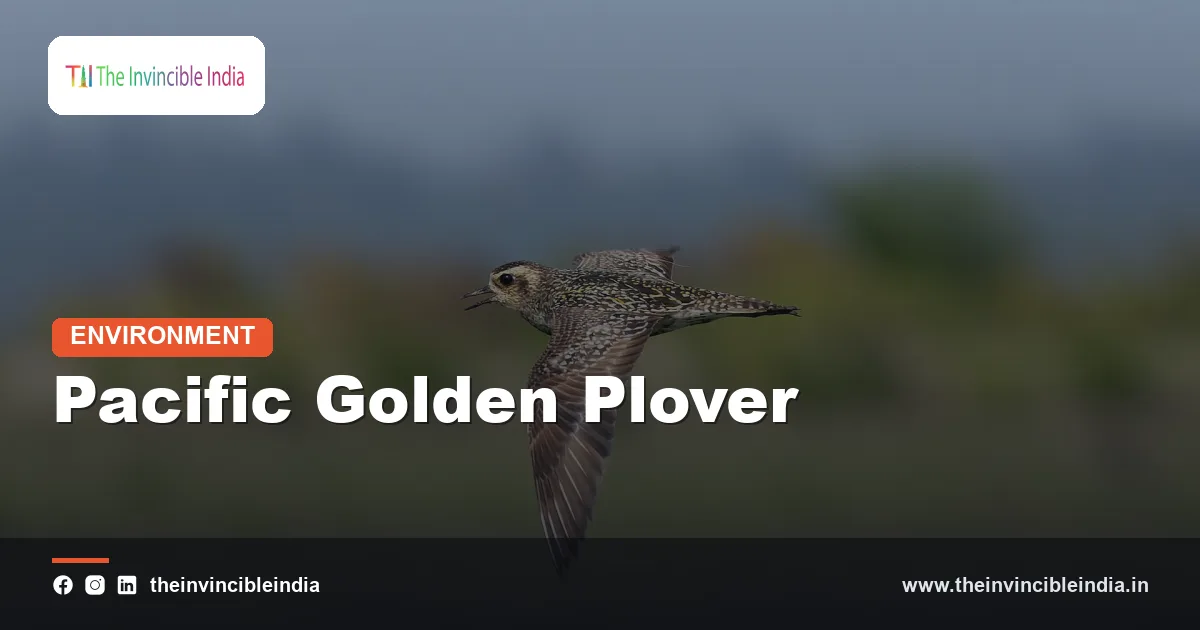
The Pacific golden plover (Pluvialis fulva) is a medium-sized, long-legged wading bird whose back is spangled with gold and black, and which breeds on the Arctic tundra of Siberia and western Alaska before flying thousands of kilometres to spend the non-breeding season on the fields, mudflats and coasts of South Asia, including India. Visitors arrive in the Indian subcontinent from about August and leave by April or May, so the species is classed in India as a winter migrant. Its quiet habit of standing motionless on short grass or a drying mudflat makes it easy to overlook, yet it is one of the most remarkable long-distance travellers among Indian waders.
This explainer covers how to recognise the Pacific golden plover, where it lives in India, what it eats, how its migration works, how it differs from lookalike plovers, and what its conservation status means. The facts below are long-established findings from field ornithology and are not tied to any one season.
| Attribute | Detail |
|---|---|
| Common name | Pacific golden plover |
| Scientific name | Pluvialis fulva |
| Family | Charadriidae (plovers and lapwings), order Charadriiformes |
| Size | About 23 to 26 cm long; a slim, long-legged plover |
| Range and habitat in India | Coasts, estuaries, mudflats, saltpans, wet fields, short grassland and the margins of lakes across much of the country |
| Diet | Insects, worms, small crustaceans, molluscs, and some seeds and berries |
| Breeding and migration | Breeds on Arctic tundra in northern Siberia and western Alaska; winters from East Africa and South Asia to Southeast Asia, Australasia and Pacific islands |
| Conservation status | Least Concern on the IUCN Red List; a regular winter visitor to India |
Key Takeaways
- The Pacific golden plover (Pluvialis fulva) is a migratory wader that breeds in the Arctic and winters in South Asia, including coastal and inland India.
- A Pacific golden plover in non-breeding plumage looks golden-buff and speckled above, with a pale face, a dark cap and a slim, long-legged build.
- The Pacific golden plover reaches India from about August and generally departs by April or May, often after moulting into black-bellied breeding plumage.
- The Pacific golden plover feeds by running, stopping and pecking, taking insects, worms, small crustaceans and molluscs from short grass and mud.
- The Pacific golden plover was once treated as one species with the American golden plover, and the two were formally separated by ornithologists in the late twentieth century.
- The Pacific golden plover is listed as Least Concern globally, although the loss of coastal wetlands and tidal flats remains the main long-term pressure on it.
What is the Pacific golden plover?
The Pacific golden plover is a migratory shorebird in the plover family, Charadriidae, with the scientific name Pluvialis fulva. It belongs to a small group of four large plovers in the genus Pluvialis, which also includes the grey plover, the European golden plover and the American golden plover. The genus name comes from the Latin word for rain, a reference to old European beliefs that golden plovers gathered when rain was near.
For many decades the bird was lumped with the American golden plover and called the lesser golden plover. Differences in size, leg length, call, moult timing and genetics eventually persuaded ornithologists to treat the Pacific golden plover and the American golden plover as two separate species. The Pacific golden plover is the one that regularly reaches India, because its Siberian and Alaskan breeding grounds lie along flyways pointing towards Asia and the Pacific.
Compared with other waders seen on Indian shores, the Pacific golden plover is neither large nor showy. It is about the size of a pigeon but more slender, with a rounded head, a short dark bill and a calm, upright stance. Its beauty lies in the fine pattern of the upperparts, which looks as though gold dust has been scattered over a dark brown background.
How do you identify a Pacific golden plover in India?
A Pacific golden plover in India is best identified by its golden-spangled brown upperparts, pale buffy underparts, dark cap and short dark bill, combined with a slender body and noticeably long legs. Most birds seen in India between September and March are in non-breeding plumage, which is subtle rather than striking.
Non-breeding plumage
In winter, the crown and back are dark brown with golden-yellow and buff spots, giving a speckled look. The face and breast are washed with buff, and the belly is whitish. A pale eyebrow stripe gives the face an open expression, and the dark eye stands out against it. Young birds that arrive in their first autumn are often the most golden of all, with bright yellowish spangling on the back.
Breeding plumage
Before leaving for the Arctic, many birds moult into breeding plumage in March and April. The face, throat, breast and belly turn jet black, separated from the golden-spangled upperparts by a broad white band that runs from the forehead down the sides of the neck and along the flanks. Birds in patchy, half-changed plumage are regularly seen in India in spring and are among the most photographed Pacific golden plovers.
Voice and flight
The usual flight call is a clear, whistled, two-note sound, often written as a rising “chu-whee”. In flight the bird shows plain grey-brown underwings, with no black armpit patch and no white wing bar, which is an important clue when separating it from the grey plover. The wings are narrow and pointed, and the flight is fast and direct.
Where does the Pacific golden plover live in India?
The Pacific golden plover lives in India across a wide variety of open, low habitats, including tidal mudflats, estuaries, beaches, saltpans, sewage ponds, wet fields, harvested paddy stubble, airfields and short-grazed grassland. It is more strongly associated with coasts than many inland waders, but it also visits fields and lake shores well away from the sea.
Along the peninsula, the species is recorded on the coasts of Gujarat, Maharashtra, Goa, Karnataka, Kerala, Tamil Nadu, Andhra Pradesh, Odisha and West Bengal, and in the Andaman and Nicobar Islands. Large tidal wetlands such as Chilika Lake in Odisha, the Pulicat Lake lagoon on the Tamil Nadu and Andhra Pradesh border, the Gulf of Kutch and the Sundarbans fringe provide feeding and roosting areas for waders in general.
Inland records come from reservoirs, floodplain grasslands and river margins, particularly where the vegetation is short and the ground is open enough for the bird to see predators. Short grass is important because the Pacific golden plover hunts by sight, scanning the ground for movement before it dashes forward.
- Coastal habitats: tidal flats, creeks, lagoons, beaches and saltpans.
- Agricultural habitats: wet fallow fields, ploughed land and stubble after harvest.
- Open grasslands: airfields, lawns, cattle pastures and the edges of village tanks.
- Island habitats: coral and sandy shores in the Lakshadweep and the Andaman and Nicobar groups.
When does the Pacific golden plover arrive in and leave India?
The Pacific golden plover arrives in India from roughly August to September and departs between March and May, so it is present for most of the winter half of the year. Early arrivals are often adults that have finished breeding and begun their southward journey as soon as the short Arctic summer ends.
Adult birds generally leave the tundra first, and the juveniles follow some weeks later. This staggered departure means that Indian observers see adults in worn, partly black plumage in the early autumn, while the young birds appear a little later in fresh, bright golden feathers.
A feature of the species is site fidelity. Studies of colour-ringed birds in Asia and Australia have shown that many individuals return year after year to the same wintering patch, sometimes the same stretch of lawn or mudflat, and defend a feeding territory against other plovers. A small number of non-breeding birds remain in the tropics through the northern summer instead of migrating, which is why occasional sightings occur in June and July.
How far does the Pacific golden plover migrate?
The Pacific golden plover migrates several thousand kilometres each way, travelling between Arctic breeding grounds and wintering areas that stretch from East Africa and South Asia to Southeast Asia, Australia and islands across the Pacific. The distance covered by an individual depends on where it breeds and where it settles for winter.
Birds that breed in western Alaska are well known for flying non-stop over the open Pacific Ocean to Hawaii and other island groups, a flight of several days over water. Birds that breed in Siberia move south and southwest across Asia, and it is these populations that supply most of the birds seen in India and the wider Indian Ocean region.
Such journeys rely on body fat laid down before departure. Before leaving, the plovers feed intensively and lay down a large store of body fat, which is then burned as fuel during long flights. Because of this, the quality of stopover and wintering wetlands matters as much as the breeding grounds, and a degraded mudflat on a migration route can affect birds that breed thousands of kilometres away.
| Stage of the year | Where the Pacific golden plover is |
|---|---|
| May to July | Breeding on Arctic tundra in Siberia and western Alaska |
| July to September | Southward migration begins; first birds reach India |
| October to February | Wintering on Indian coasts, fields and wetlands |
| March to May | Moult into breeding plumage and departure northwards |
What does the Pacific golden plover eat?
The Pacific golden plover eats a mixed diet of small invertebrates, mainly insects, earthworms, crustaceans and molluscs, along with some seeds and berries picked up opportunistically. On the tundra the diet is dominated by insects and berries, while on Indian coasts and fields it shifts toward whatever small animal prey is available.
Its method is the classic plover technique known as run, stop and peck. The bird sprints a few steps, stops with its head cocked, and then stabs at prey it has spotted on the surface. Large dark eyes help with this visual hunting, which works best in good light and on open, uncluttered ground. Pacific golden plovers also feed at night on bright moonlit coasts, a common habit among waders that need to make the most of low tide.
- On mudflats: small crabs, shrimps, marine worms and tiny snails.
- On fields and lawns: beetles, grasshoppers, ants, caterpillars and earthworms.
- Occasionally: seeds, berries and small fish stranded in drying pools.
Feeding often takes place in loose scatter rather than tight flocks. Each bird keeps a few metres from its neighbours, particularly when it is defending a winter territory, so a dozen plovers may be spread across a single playground-sized lawn.
How is the Pacific golden plover different from similar plovers?
The Pacific golden plover differs from similar plovers mainly in its body proportions, wing and leg length, underwing colour and call. The greatest confusion arises with the American golden plover, the European golden plover and the grey plover, and careful observation of structure is more reliable than colour alone.
| Species | Scientific name | Key points of difference |
|---|---|---|
| Pacific golden plover | Pluvialis fulva | Slender, long-legged, golden-buff tones; wings project only a little beyond the tail |
| American golden plover | Pluvialis dominica | Stockier, shorter-legged, greyer; long wing tips extend well beyond the tail; rare vagrant in India |
| European golden plover | Pluvialis apricaria | Larger and bulkier; white underwing; breeds in northern Europe; very rare in India |
| Grey plover | Pluvialis squatarola | Larger and silvery-grey; black armpit patches and white wing bar visible in flight; also a winter visitor |
The grey plover is the species most often seen alongside the Pacific golden plover on Indian shores, and the two are routinely mistaken for each other by beginners. The grey plover is bulkier, paler overall and shows black patches under the wings in flight, whereas the Pacific golden plover lacks them. A useful beginner’s rule is that a golden or yellowish tone to the back points toward the Pacific golden plover, while a cold silver-grey look points toward the grey plover.
How does the Pacific golden plover breed?
The Pacific golden plover breeds only in the far north, nesting on open Arctic tundra from late May to July, and it does not breed in India. Birds seen in India in winter are non-breeding visitors that will not nest until they return to the tundra the following summer.
On the breeding grounds the male performs a display flight over his territory, flying high with slow, deep wingbeats and calling. The nest is a shallow scrape in the ground, lined sparingly with lichens, moss or leaves, and the female usually lays four buff eggs blotched with dark brown, which blend well with the tundra. Both parents share the incubation, and the downy chicks leave the nest within hours of hatching to feed themselves while the adults guard them.
The black breeding plumage is not simply decoration. It signals condition to a mate and helps defend territory, and it is the reason why many Indian observers see the dramatic black-and-gold look only for a few weeks in spring, just before departure.
Is the Pacific golden plover threatened?
The Pacific golden plover is not globally threatened and is listed as Least Concern on the IUCN Red List because it has a very large range and a large overall population. Even so, its dependence on coastal and wetland habitats along a long migratory route means that local declines are possible and worth monitoring.
The main pressures are the loss and reclamation of tidal flats, pollution of estuaries, disturbance by people and dogs on beaches and the conversion of wet grasslands to other uses. Because the species is faithful to its wintering sites, the destruction of a single feeding area can displace birds that have used it for years. Climate change adds further uncertainty, since warming in the Arctic may alter insect abundance and the timing of the breeding season.
In India, waders benefit from the protection of coastal wetlands, bird sanctuaries and Ramsar sites, as well as from national frameworks for migratory birds such as the Central Asian Flyway initiative and the East Asian-Australasian Flyway cooperation. Citizen-science records contribute useful data, and sightings logged by birdwatchers help scientists see long-term changes in arrival dates and numbers.
How can you watch Pacific golden plovers responsibly?
You can watch Pacific golden plovers responsibly by keeping a respectful distance, using binoculars, avoiding flushing flocks and visiting coastal flats at mid to high tide when birds gather to roost. The best months for sightings in India are between October and March.
- Scan short grass, airfield margins and drying mudflats rather than only deep water.
- Look for a golden-speckled bird standing still, then wait for the characteristic run and peck.
- Listen for the whistled two-note call when a bird takes off.
- Avoid walking through roosts, and keep dogs away from beaches and tidal flats.
- Record sightings with a date and place on a citizen-science platform to support monitoring.
Early morning and the hours around high tide give the best light and the least disturbance. A telescope or a good camera lens helps because the plovers are wary and tend to move off if approached closely.
Bottom Line
The Pacific golden plover is an Arctic breeder that turns up each winter on Indian coasts, fields and mudflats after a journey of thousands of kilometres. It is easily overlooked, but its golden speckling, upright stance and two-note whistle reward patient observation, and its fate depends on the health of tidal wetlands across Asia.
Frequently Asked Questions
What is a Pacific golden plover?
A Pacific golden plover is a medium-sized migratory wading bird, Pluvialis fulva, in the plover family Charadriidae. It breeds on the Arctic tundra of Siberia and western Alaska and winters across South and Southeast Asia, Australasia and Pacific islands. In India it is a regular winter visitor to coasts, mudflats and wet fields.
When can you see the Pacific golden plover in India?
The Pacific golden plover can be seen in India mainly from September to April, with the first arrivals in August and the last departures in April or May. Birds that stay on into spring are often moulting into black-bellied breeding plumage. A few non-breeding individuals may remain through the summer.
How do you tell a Pacific golden plover from a grey plover?
A Pacific golden plover is smaller, slimmer and longer-legged than a grey plover, with golden-buff speckling on the back. In flight the grey plover shows black armpit patches and a white wing bar, whereas the Pacific golden plover shows plain grey-brown underwings. The calls also differ, the golden plover giving a two-note whistle.
What does the Pacific golden plover eat?
The Pacific golden plover eats insects, earthworms, small crustaceans and molluscs, with seeds and berries taken occasionally. It hunts by sight, using a run, stop and peck method on short grass and open mud. In India it feeds on fields, lawns, mudflats and saltpans.
Does the Pacific golden plover breed in India?
No, the Pacific golden plover does not breed in India. It nests only on Arctic tundra in northern Siberia and western Alaska between about late May and July. Birds in India are non-breeding winter visitors that fly north again in spring.
Is the Pacific golden plover endangered?
No, the Pacific golden plover is listed as Least Concern on the IUCN Red List because its range and population are large. Even so, it depends on coastal wetlands and tidal flats that are shrinking in many places. Protecting such habitats along its flyway remains important for the species.
{“@context”:”https://schema.org”,”@graph”:[{“@type”:”FAQPage”,”mainEntity”:[{“@type”:”Question”,”name”:”What is a Pacific golden plover?”,”acceptedAnswer”:{“@type”:”Answer”,”text”:”A Pacific golden plover is a medium-sized migratory wading bird, Pluvialis fulva, in the plover family Charadriidae. It breeds on the Arctic tundra of Siberia and western Alaska and winters across South and Southeast Asia, Australasia and Pacific islands. In India it is a regular winter visitor to coasts, mudflats and wet fields.”}},{“@type”:”Question”,”name”:”When can you see the Pacific golden plover in India?”,”acceptedAnswer”:{“@type”:”Answer”,”text”:”The Pacific golden plover can be seen in India mainly from September to April, with the first arrivals in August and the last departures in April or May. Birds that stay on into spring are often moulting into black-bellied breeding plumage. A few non-breeding individuals may remain through the summer.”}},{“@type”:”Question”,”name”:”How do you tell a Pacific golden plover from a grey plover?”,”acceptedAnswer”:{“@type”:”Answer”,”text”:”A Pacific golden plover is smaller, slimmer and longer-legged than a grey plover, with golden-buff speckling on the back. In flight the grey plover shows black armpit patches and a white wing bar, whereas the Pacific golden plover shows plain grey-brown underwings. The calls also differ, the golden plover giving a two-note whistle.”}},{“@type”:”Question”,”name”:”What does the Pacific golden plover eat?”,”acceptedAnswer”:{“@type”:”Answer”,”text”:”The Pacific golden plover eats insects, earthworms, small crustaceans and molluscs, with seeds and berries taken occasionally. It hunts by sight, using a run, stop and peck method on short grass and open mud. In India it feeds on fields, lawns, mudflats and saltpans.”}},{“@type”:”Question”,”name”:”Does the Pacific golden plover breed in India?”,”acceptedAnswer”:{“@type”:”Answer”,”text”:”No, the Pacific golden plover does not breed in India. It nests only on Arctic tundra in northern Siberia and western Alaska between about late May and July. Birds in India are non-breeding winter visitors that fly north again in spring.”}},{“@type”:”Question”,”name”:”Is the Pacific golden plover endangered?”,”acceptedAnswer”:{“@type”:”Answer”,”text”:”No, the Pacific golden plover is listed as Least Concern on the IUCN Red List because its range and population are large. Even so, it depends on coastal wetlands and tidal flats that are shrinking in many places. Protecting such habitats along its flyway remains important for the species.”}}]}]}


