

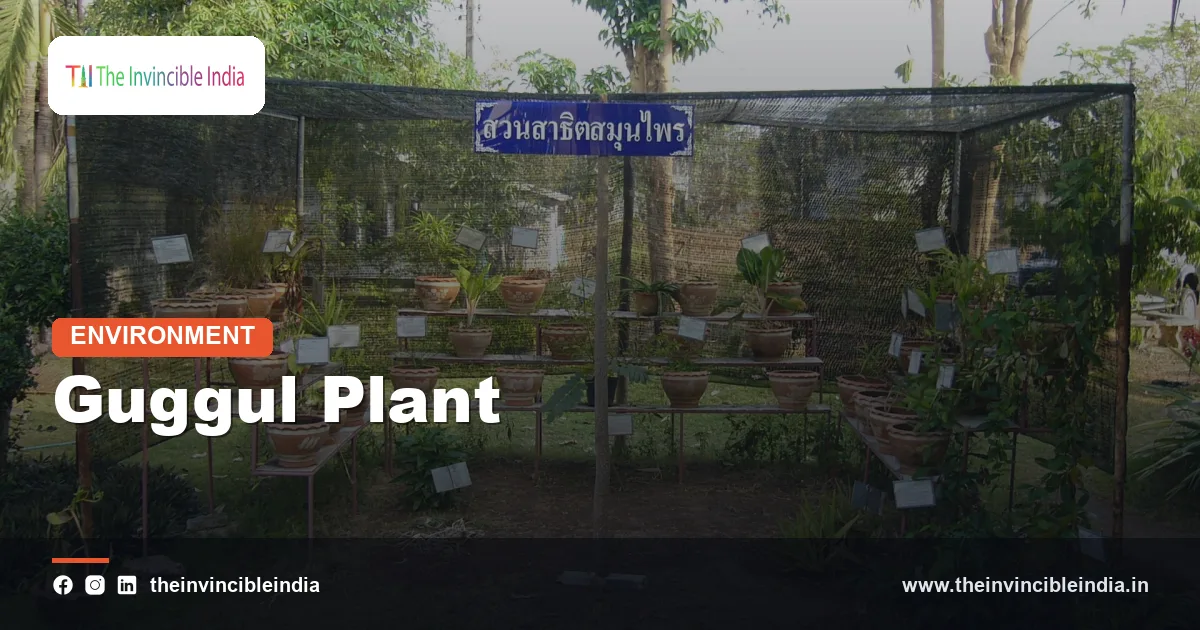
Guggul is the aromatic gum resin obtained from Commiphora wightii, a small, thorny, slow-growing desert shrub of the family Burseraceae that grows in the dry regions of Rajasthan and Gujarat, and the same name is also used for the plant itself. In India guggul has been burnt as incense and used in traditional Ayurvedic formulations for centuries, but over-harvesting of wild plants has made the shrub a threatened species.
The guggul plant is a close relative of the trees that give the world frankincense and myrrh. It survives in harsh, rocky, semi-arid country where few other plants can grow, and the sticky resin that oozes from its bark is the reason it has been valued, and nearly lost. This explainer covers what the guggul plant is, where it grows, how the resin is collected, its traditional use, and why conservation matters. The medicinal uses discussed are traditional, not proven, and readers should consult a qualified professional before using guggul.
| Common names | Guggul, guggulu (Sanskrit), Indian bdellium, mukul myrrh tree |
|---|---|
| Scientific name | Commiphora wightii (older synonym: Commiphora mukul) |
| Family | Burseraceae (the incense-tree family, which includes frankincense and myrrh) |
| Plant type | Small, thorny, many-branched deciduous shrub or tree, typically 1 to 4 metres tall |
| Where found in India | Arid and semi-arid regions of Rajasthan and Gujarat, with scattered populations in some other dry parts of the country |
| Part used | Gum resin (oleo-gum resin) tapped from the bark |
| Main uses | Incense and ritual fumigation; Ayurvedic formulations; perfumery |
| Key plant chemicals | Guggulsterones (Z and E forms), volatile oils and resin acids |
| Conservation status | Threatened; listed as a threatened species on the IUCN Red List because of heavy collection and poor regeneration |
Key Takeaways
- Guggul is the gum resin of Commiphora wightii, a thorny desert shrub in the Burseraceae family found mainly in Rajasthan and Gujarat.
- Commiphora wightii belongs to the same family as the trees that produce frankincense and myrrh, and its resin has a balsamic, incense-like fragrance.
- Guggul resin is collected by making shallow cuts in the bark, and over-tapping and uprooting of wild plants have led to the species being classed as threatened.
- In Ayurveda, guggulu is the base of many classical formulations such as Triphala Guggulu and Yogaraj Guggulu, but these uses are traditional and not proven treatments.
- The plant grows slowly, sheds its leaves in the dry season and is hard to regenerate, so conservation and cultivation programmes aim to protect wild populations.
- Anyone considering guggul for health reasons should consult a qualified doctor or Ayurvedic practitioner, because the resin is not suitable for everyone.
What Is the Guggul Plant?
The guggul plant is Commiphora wightii, a spiny, drought-hardy shrub that produces a fragrant, sticky gum resin from its bark. It is a member of the family Burseraceae, and the genus Commiphora contains about 190 species of resin-bearing shrubs and trees found mainly in the dry regions of Africa, Arabia and South Asia.
The plant has several stout, crooked branches covered with grey-brown bark that peels off in thin, papery flakes. Branchlets end in sharp spines, and the leaves are small and compound, usually with three leaflets. The shrub drops its leaves in the dry season and then stands bare for months, a typical adaptation of desert plants.
The scientific name honours the Scottish botanist Robert Wight, and the species was earlier known as Commiphora mukul, a name that still appears in many older books and herbal product labels. The Sanskrit name guggulu is used for the resin, while the same word in Hindi and other languages often refers to both the plant and the gum.
Where Does Guggul Grow in India?
Guggul grows in the arid and semi-arid regions of western India, mainly in Rajasthan and Gujarat, where it occupies rocky hillsides, gravelly plains and dry scrub. The plant also occurs in some other dry parts of the country, as well as in the neighbouring dry zones of Pakistan.
In Rajasthan, guggul is associated with the Aravalli hills and the dry western districts. In Gujarat, it is found in the Kutch and Saurashtra regions. The plant tolerates scanty rainfall, high summer heat and poor, stony or sandy soil, but it is sensitive to waterlogging and to frost.
Because the shrub grows slowly and sets seed poorly, wild populations recover slowly after harvesting. Surveys by forest departments and researchers have repeatedly reported that the plant has disappeared from areas where it was once common.
How Is Guggul Resin Collected?
Guggul resin is collected by tapping, in which shallow cuts are made in the bark of mature plants and the sticky sap that oozes out hardens on the stem and is later scraped off as lumps. The traditional collecting season is the cool, dry months of the year, when the sap flows best.
The tapping process
- Collectors make small incisions in the bark of the main stem and larger branches.
- A pale, aromatic, sticky liquid oozes out and slowly hardens in the dry air.
- After several days to weeks the hardened tears are gathered by hand.
- The crude resin is sorted, cleaned of bark and sand, and sold to traders and manufacturers.
Why careful tapping matters
If cuts are too deep or too many, or if the same plant is tapped year after year, it weakens and may die. Unsustainable practices, such as cutting plants for easier tapping or tapping very young plants, have been a major reason for the decline of wild guggul. Sustainable methods keep to a limited number of small cuts on healthy mature plants and allow rest periods between harvests.
What Is Guggul Used For Traditionally?
Guggul is traditionally used in Ayurveda as the base of many classical formulations and as a ritual incense. Its uses are described in Ayurvedic texts for conditions such as joint complaints and weight and lipid imbalance, but these are traditional uses and have not been established as proven treatments.
Several well-known classical preparations are built around purified guggulu. These include Triphala Guggulu, Yogaraj Guggulu, Kaishore Guggulu and Gokshuradi Guggulu, each of which combines the resin with specific herbs and is used for different traditional indications. Ayurveda also prescribes a purification process called shodhana, in which the raw resin is processed with herbal decoctions before being used in formulae.
Outside medicine, guggul is burnt as an incense and as a fumigant in homes, temples and during rituals such as havan. Its smoke has a warm, resinous, balsamic scent. The resin is also used in some natural perfumes and as a fixative.
These traditional applications form a part of cultural practice. They are not a substitute for medical advice, and an ordinary reader should consult a qualified practitioner before taking guggul in any form.
What Does Modern Research Say About Guggul?
Modern research on guggul is mixed: laboratory studies have identified guggulsterones as active compounds, but human clinical trials have given inconsistent results, and the resin is not an established treatment for any condition. Researchers continue to study its effects.
Guggulsterones, the Z and E forms of a plant steroid, are the most studied chemicals in the resin. Early studies in India in the second half of the twentieth century suggested a possible effect on blood fats. However, some later and larger trials, including a widely cited randomised trial in the United States published in 2003, did not find a benefit for cholesterol, and one or two studies reported other effects.
Scientists point out that the chemical content of raw resin varies greatly with the plant and the harvest, and that many commercial products have not been standardised. For these reasons guggul should not be treated as a proven drug. Anyone with a medical condition should talk to a doctor before using it.
Is Guggul Safe to Use?
Guggul is not safe for everyone, and it should be used only on the advice of a qualified doctor or Ayurvedic practitioner. Like any potent natural product, it can cause side effects and may interact with other medicines.
- Pregnancy and breastfeeding: traditional and modern guidance generally advise avoiding guggul.
- Thyroid conditions: people with thyroid disorders should take medical advice, because guggul has been reported to affect thyroid function in some studies.
- Medicines: people who take blood thinners, hormonal drugs or heart and cholesterol medicines should consult a doctor to avoid interactions.
- Reactions: stomach upset, rash or headache have been reported in some users.
- Product quality: choose products from licensed manufacturers, because adulterated or unregulated resin is common in markets.
Readers should remember that traditional use does not equal proven safety, and a qualified professional should be consulted before any use.
Is the Guggul Plant Endangered?
Yes, Commiphora wightii is a threatened species, and it appears on the IUCN Red List of Threatened Species, mainly because of over-collection of resin, uprooting of plants and loss of dry-land habitat. In India the plant is treated as a priority species for conservation.
Several factors combine to put the guggul plant at risk.
- Over-tapping: repeated, deep or careless cuts kill adult plants.
- Slow growth and poor regeneration: seeds germinate poorly, and young seedlings are eaten by livestock or die in drought.
- Dioecious reproduction: the species is reported to have separate male and female plants, which limits seed production when numbers are low.
- Habitat loss: clearing of scrub for farming, mining, roads and grazing removes plants.
- Demand: heavy demand from the herbal and incense trades has pushed collection beyond what wild populations can sustain.
Collection and transport of guggul from forest land are regulated through state forest departments, so harvesters and traders are expected to follow local rules and permits.
How Is Guggul Being Conserved and Cultivated?
Guggul is being conserved through protection of wild populations, nursery-raised planting and cultivation trials, supported by research institutions, forest departments and bodies such as the National Medicinal Plants Board under the Ministry of AYUSH. The aim is to meet demand without further depleting wild stands.
| Approach | What it involves |
|---|---|
| In-situ conservation | Protecting existing wild stands in forest and community lands |
| Nursery propagation | Raising plants from cuttings treated with rooting hormone, since seed germination is poor |
| Cultivation | Planting guggul on private and farm land in dry regions as a medicinal crop |
| Sustainable tapping | Limiting the number and depth of cuts and allowing rest periods |
| Community involvement | Training collectors in sustainable harvesting and fair sale |
| Research | Studying genetics, propagation and resin yield to support better planting material |
Cultivation is not easy, because the plant grows slowly and takes several years to reach tapping size. Even so, planting on farm land offers a way to ease pressure on wild plants while giving dryland farmers an additional income.
How Can You Identify and Grow Guggul?
Guggul can be identified by its crooked, spiny branches, peeling papery grey bark, small trifoliate leaves and the fragrant sticky resin that oozes from cut bark, and it can be grown from cuttings in well-drained, dry conditions. The plant is slow-growing and does best in sunny, arid sites with sandy or stony soil.
- Identification: look for a shrub of 1 to 4 metres with thorn-tipped branchlets, flaking bark, small three-lobed leaves in the rainy season, small reddish-pink flowers and small red, rounded fruits.
- Propagation: semi-hardwood cuttings treated with rooting hormone root more reliably than seed.
- Site: full sun, very good drainage and low rainfall; avoid waterlogged soil.
- Care: protect young plants from grazing animals and water sparingly; established plants tolerate drought.
Because the species is threatened, gardeners and farmers should obtain planting material only from legal, reputable nurseries and not from wild plants.
Bottom Line
Guggul is the fragrant resin of the thorny desert shrub Commiphora wightii, long used in Indian incense and Ayurvedic formulations. Its medicinal uses are traditional rather than proven, and because the plant is threatened, sustainable harvesting and cultivation matter as much as the resin itself.
Frequently Asked Questions
What is guggul made from?
Guggul is made from the gum resin of the thorny shrub Commiphora wightii. The resin is collected from cuts made in the bark, where it hardens into lumps, and it is then cleaned and processed for use in incense and Ayurvedic formulations.
Where does the guggul plant grow in India?
The guggul plant grows mainly in the dry regions of Rajasthan and Gujarat, including the Aravalli hills and parts of Kutch and Saurashtra. It prefers rocky or sandy soil and low rainfall, and it cannot survive waterlogging or frost.
Is guggul the same as myrrh?
No, guggul is not the same as myrrh, although the two come from related plants in the Burseraceae family. Guggul comes from Commiphora wightii in India, while true myrrh comes from other Commiphora species of Africa and Arabia, and the resins differ in aroma and chemistry.
Is guggul an endangered plant?
Yes, the guggul plant is a threatened species, listed as such on the IUCN Red List. Over-tapping, uprooting, slow regeneration and habitat loss have reduced wild populations, and conservation and cultivation programmes are working to protect it.
Is guggul proven to lower cholesterol or cure disease?
No, guggul is not proven to cure any disease, and its use for cholesterol and joint complaints is traditional rather than established. Early studies suggested benefits, but later trials, including a notable 2003 trial in the United States, did not confirm them, so a doctor should be consulted.
Who should avoid guggul?
Pregnant and breastfeeding women, and people with thyroid disorders or on regular medicines, should avoid guggul unless a qualified doctor or Ayurvedic practitioner advises otherwise. Guggul can cause side effects and interactions, so professional advice should come before use.
{“@context”:”https://schema.org”,”@graph”:[{“@type”:”FAQPage”,”mainEntity”:[{“@type”:”Question”,”name”:”What is guggul made from?”,”acceptedAnswer”:{“@type”:”Answer”,”text”:”Guggul is made from the gum resin of the thorny shrub Commiphora wightii. The resin is collected from cuts made in the bark, where it hardens into lumps, and it is then cleaned and processed for use in incense and Ayurvedic formulations.”}},{“@type”:”Question”,”name”:”Where does the guggul plant grow in India?”,”acceptedAnswer”:{“@type”:”Answer”,”text”:”The guggul plant grows mainly in the dry regions of Rajasthan and Gujarat, including the Aravalli hills and parts of Kutch and Saurashtra. It prefers rocky or sandy soil and low rainfall, and it cannot survive waterlogging or frost.”}},{“@type”:”Question”,”name”:”Is guggul the same as myrrh?”,”acceptedAnswer”:{“@type”:”Answer”,”text”:”No, guggul is not the same as myrrh, although the two come from related plants in the Burseraceae family. Guggul comes from Commiphora wightii in India, while true myrrh comes from other Commiphora species of Africa and Arabia, and the resins differ in aroma and chemistry.”}},{“@type”:”Question”,”name”:”Is guggul an endangered plant?”,”acceptedAnswer”:{“@type”:”Answer”,”text”:”Yes, the guggul plant is a threatened species, listed as such on the IUCN Red List. Over-tapping, uprooting, slow regeneration and habitat loss have reduced wild populations, and conservation and cultivation programmes are working to protect it.”}},{“@type”:”Question”,”name”:”Is guggul proven to lower cholesterol or cure disease?”,”acceptedAnswer”:{“@type”:”Answer”,”text”:”No, guggul is not proven to cure any disease, and its use for cholesterol and joint complaints is traditional rather than established. Early studies suggested benefits, but later trials, including a notable 2003 trial in the United States, did not confirm them, so a doctor should be consulted.”}},{“@type”:”Question”,”name”:”Who should avoid guggul?”,”acceptedAnswer”:{“@type”:”Answer”,”text”:”Pregnant and breastfeeding women, and people with thyroid disorders or on regular medicines, should avoid guggul unless a qualified doctor or Ayurvedic practitioner advises otherwise. Guggul can cause side effects and interactions, so professional advice should come before use.”}}]}]}


