

The Indian giant centipede is the common name for the large, fast-moving, venomous centipedes of the genus Scolopendra that live in Indian forests, farmland, gardens and houses, with a bite that is painful but rarely dangerous to healthy adults. The name is used loosely, because several big Scolopendra species share the Indian landscape, and most people who say “giant centipede” are describing a reddish-brown to dark animal about the length of a hand.
The Indian giant centipede is a nocturnal predator that hides under stones, logs and damp debris by day and hunts insects, spiders and small vertebrates at night. This article explains what the animal is, how it lives, how its venom works, what to do after a bite, and how it differs from the harmless millipede.
| Quick Fact | Detail |
|---|---|
| Common name | Indian giant centipede (also called giant centipede or Scolopendra) |
| Scientific classification | Genus Scolopendra; order Scolopendromorpha; family Scolopendridae; class Chilopoda; phylum Arthropoda |
| Typical size | Usually about 10 to 20 cm long; larger specimens are exceptional |
| Habitat in India | Forests, plantations, farmland, gardens, rock crevices, and damp corners of houses across most of the country |
| Diet | Carnivorous: insects, spiders, earthworms, other centipedes, and sometimes small lizards, frogs and rodents |
| Life cycle | Eggs laid in a hidden chamber, guarded by the mother; young hatch with a full set of legs and moult as they grow |
| Ecological role | Top invertebrate predator of the leaf litter and soil surface |
| Notable features | One pair of legs per body segment, a pair of venom-injecting claws (forcipules), and flat, fast-running bodies |
Key Takeaways
- The Indian giant centipede is a venomous arthropod of the genus Scolopendra that usually measures about 10 to 20 cm in length.
- An Indian giant centipede injects venom through a pair of modified front legs called forcipules, not through its tail or its many walking legs.
- A bite from an Indian giant centipede causes sharp pain, swelling and redness that usually settles within days, and deaths in healthy adults are extremely rare.
- The Indian giant centipede is a nocturnal hunter that eats insects, spiders and sometimes small lizards, frogs and rodents.
- A female Indian giant centipede guards her eggs and newly hatched young, which is unusual behaviour among arthropods.
- Sealing gaps, clearing clutter and shaking out shoes and clothes are the most effective ways to avoid centipede bites at home.
What is the Indian giant centipede?
The Indian giant centipede is a large predatory arthropod in the class Chilopoda, belonging to the genus Scolopendra, which is placed in the family Scolopendridae and the order Scolopendromorpha. It is not an insect. Centipedes are close relatives of insects, spiders and crustaceans only in the broad sense that all are arthropods, animals with jointed legs and a hard external skeleton.
The phrase “Indian giant centipede” is a popular name rather than a single strictly defined species. Several large Scolopendra species occur in India, and well-known ones include the Indian tiger centipede (Scolopendra hardwickei) and the widespread jungle or red-headed centipede (Scolopendra subspinipes). Identifying the exact species usually needs a close look at the legs and the last body segment, so naturalists often refer to them simply as Scolopendra.
The word “centipede” means “hundred feet”, but no centipede has exactly one hundred legs. The number of leg pairs in centipedes is always odd, and the typical Scolopendra has 21 pairs, which means 42 legs. Each body segment carries a single pair of legs, which is the key feature that separates centipedes from millipedes.
What does the Indian giant centipede look like?
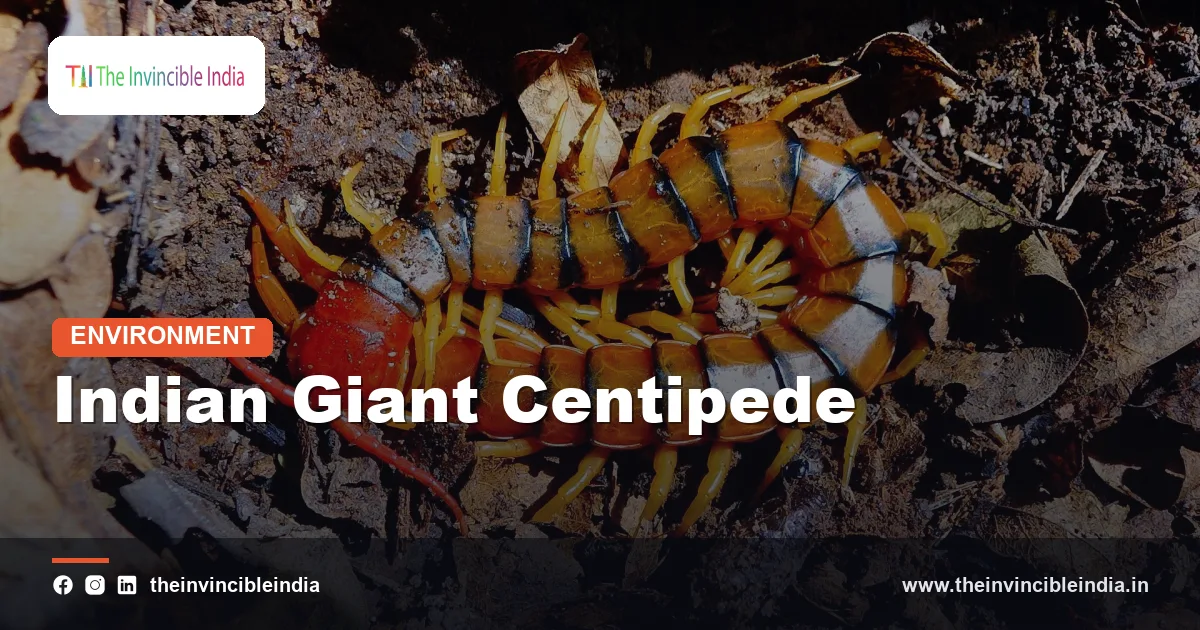
The Indian giant centipede has a long, flattened, segmented body, usually reddish-brown, orange, olive or dark brown, with a head that is often a different shade from the trunk. Adults are generally about 10 to 20 cm long, which is roughly the length of a human hand, though the size depends on the species, age and food supply.
Several features are easy to recognise:
- A pair of antennae on the head, used for touch and smell, since the animal sees poorly.
- Forcipules, a pair of curved, claw-like appendages beneath the head. They are modified first legs, and they carry the venom glands.
- Long final legs, directed backwards, which look like a second pair of antennae and can pinch if the animal is held.
- A flattened body, which lets the centipede squeeze into very narrow cracks and under tight-fitting stones.
- Segmented plates along the back, often with a darker or lighter band at the edges of each segment.
Young Indian giant centipedes are smaller and often paler but have the same body plan. Their colours darken as they age and as they moult, the process by which an arthropod sheds its hard outer skin to grow.
Where does the Indian giant centipede live in India?
The Indian giant centipede lives in almost every part of India that offers moisture, shelter and prey, from the Western Ghats and the north-eastern hills to dry scrub, plains and city gardens. It prefers dark, humid places and avoids open, dry, sunlit ground.
Typical hiding places include:
- Under logs, bark, rocks and fallen leaves in forests and plantations.
- In termite mounds, rodent burrows and crevices in old walls.
- In compost heaps, woodpiles, flowerpots and heaps of bricks or building material.
- In bathrooms, drains, store rooms and ground-floor corners of houses, especially during the monsoon.
Centipedes lose water through their thin skin, so they depend on damp surroundings. During heavy monsoon rain, water floods their burrows and drives many of them above ground and into buildings, which explains why encounters rise sharply between June and September in much of India.
What does the Indian giant centipede eat?
The Indian giant centipede is a strict carnivore that feeds on whatever it can catch and overpower, mainly insects such as crickets, cockroaches, beetles and termites. It also takes spiders, earthworms, snails and other centipedes, and larger individuals can kill small lizards, frogs, nestling birds and mice.
The centipede hunts mostly by touch and chemical sense. It senses vibrations and scents with its antennae and legs, seizes prey with its forcipules, injects venom, and then holds the prey while it chews it with its mouthparts. Some prey is killed within seconds, which is important because a centipede may be attacking an animal that can fight back.
A well-fed centipede may rest for days between meals. This slow, patient lifestyle, combined with a cool and damp hiding place, helps the animal survive long periods without food.
How does the venom of the Indian giant centipede work?
The venom of the Indian giant centipede is a mixture of proteins, peptides and other compounds produced in glands at the base of the forcipules, and it works by quickly paralysing and killing prey. The venom contains substances that cause pain, inflammation and local tissue effects, and researchers have found that some of its components act on the ion channels of nerves and muscles.
For a human, the effect of a bite depends on the species, the size of the animal, the amount of venom delivered and the person’s own sensitivity. Typical reactions include:
- Immediate, sharp, burning pain at the site, often with two small puncture marks.
- Redness, warmth and swelling around the bite.
- Numbness, itching or a throbbing sensation that may spread along the limb.
- Swollen, tender lymph nodes near the bite in some cases.
- Headache, nausea or general discomfort in a minority of patients.
The pain is often described as the worst feature of the bite. It commonly peaks within the first hour or two and fades over the following days, though redness and tenderness may last longer.
Is the Indian giant centipede dangerous to humans?
The Indian giant centipede is venomous and its bite can be very painful, but it is rarely dangerous to healthy adults, and fatal cases are extremely uncommon. The animal does not hunt people, and it bites only when it is pressed against skin, trapped in clothing or bedding, or handled.
The greater risks are specific groups and situations:
- Young children and infants, who have a smaller body size relative to the dose of venom.
- People with allergies, who may react with hives, swelling of the face or difficulty breathing, which is a medical emergency.
- Secondary infection, when a bite wound is scratched or left dirty.
- Bites to sensitive areas, such as the face, hands or eyelids, which can cause more distressing swelling.
Most bites in India happen at night, when a person rolls over onto a centipede in bed, steps on one barefoot, or pulls on a shoe or a piece of clothing that a centipede has crawled into. Understanding this pattern is the basis of prevention.
What should you do after a centipede bite?
After a centipede bite, the first step is to wash the area with soap and clean water, apply a cold compress to reduce pain and swelling, and take a simple pain reliever if appropriate. A cool pack wrapped in cloth for short periods is more helpful than anything else done at home.
A sensible first-aid routine includes:
- Keep the person calm and the bitten limb still and, if possible, slightly raised.
- Clean the wound gently and keep it covered with a clean dressing.
- Do not cut the wound, suck the venom out, apply a tight tourniquet or put chemicals, ash or tobacco on the bite.
- Watch for signs of infection, such as spreading redness, pus or fever, over the next few days.
Medical help should be sought without delay if the person is a young child, if swelling spreads fast, if there is difficulty in breathing, dizziness, a rash all over the body, or if the pain does not ease. A doctor may recommend painkillers, an antihistamine, a check on tetanus immunisation, or other treatment. No specific antivenom for centipede bites is in routine use, and treatment is mainly supportive.
How does the Indian giant centipede reproduce and grow?
The Indian giant centipede reproduces by laying eggs in a hidden chamber in soil, rotting wood or a similar sheltered spot, and the female typically stays with the eggs and guards them. This maternal care is a striking behaviour in a group of animals that is often thought of as solitary and aggressive.
The life cycle follows these stages:
- Mating: the male deposits a small packet of sperm, called a spermatophore, on a silk pad, and the female picks it up. The two animals do not have a prolonged embrace, and the male usually moves away.
- Egg laying: the female lays a clutch of eggs, often a few dozen, in a burrow or crevice, usually in the warm, wet months.
- Brooding: the female coils her body around the eggs and keeps them clean and moist, which protects them from fungus and predators. She often does not feed during this period.
- Hatching: the young emerge with the full number of leg pairs, and they remain with the mother for a while.
- Growth: the young moult several times, and size increases in steps over a few years.
Scolopendra species are long-lived compared with most insects. Many live for several years, and some individuals in captivity are reported to live considerably longer. This slow life cycle means that a population recovers slowly if the habitat is heavily disturbed.
How is a centipede different from a millipede?
A centipede differs from a millipede mainly in having one pair of legs per body segment, a flattened body, and venomous forcipules, while a millipede has two pairs of legs per segment, a rounded body and no venom. Confusing the two is common, but their behaviour and risk to humans are very different.
| Feature | Centipede (Chilopoda) | Millipede (Diplopoda) |
|---|---|---|
| Legs per body segment | One pair | Two pairs |
| Body shape | Flattened | Round or cylindrical |
| Speed | Fast and agile | Slow and steady |
| Diet | Carnivorous | Mostly decaying plant matter |
| Venom | Yes, through forcipules | No venom, though some secrete irritating fluids |
| Defence | Runs, bites | Curls into a coil, may release chemicals |
| Risk to humans | Painful bite | Generally harmless |
A millipede, when touched, tends to curl up in a tight spiral. A centipede, in contrast, runs away at speed and may turn to bite if it is cornered.
Why does the Indian giant centipede matter in nature?
The Indian giant centipede matters because it is one of the main invertebrate predators of the forest floor and the soil surface, helping to control the numbers of insects and other small animals. By feeding on termites, crickets, cockroaches and similar pests, it plays a quiet role in keeping garden and farm ecosystems balanced.
The centipede also forms part of the food chain. Birds such as owls, mongooses, civets, some snakes and lizards, and larger predatory insects take centipedes, though the animal’s speed, chemical defences and nocturnal habits limit how often this occurs. Centipede venom is also of scientific interest, because its peptides are being studied for the way they act on pain and nerve signalling, and such research can help in the understanding of the nervous system.
Because centipedes depend on damp leaf litter and soil, they are a useful indicator of healthy ground-level habitat. Very tidy, dry and chemically treated surroundings tend to support few of them, while untouched woodland and gardens with leaf litter support many.
How can you keep centipedes out of your home?
You can keep centipedes out of your home by sealing cracks, reducing damp, removing hiding places and controlling the insects they feed on. Killing centipedes one by one is rarely effective if the conditions that attract them remain.
- Seal gaps around doors, windows, pipes and the base of walls, and fit mesh over drains.
- Repair leaking taps and pipes, and keep bathrooms and store rooms dry and well ventilated.
- Clear heaps of firewood, bricks, cardboard and old clothes from near the house.
- Keep the area around the building free of long grass, and keep compost and mulch away from walls.
- Shake out shoes, towels and clothes before use, especially in the monsoon.
- Raise the bed off the floor and tuck mosquito nets in carefully.
- Reduce insect pests in the house, since fewer insects means fewer reasons for centipedes to come in.
When one is found, the safest approach is to avoid handling it. It can be coaxed into a container with a long stick or tongs and released outdoors, away from the house.
Bottom Line
The Indian giant centipede is a fast, nocturnal, venomous predator of the Scolopendra group that belongs to India’s natural leaf-litter ecosystem. Its bite hurts but is seldom serious, and simple habits such as sealing gaps, drying damp spots and shaking out shoes prevent nearly all encounters.
Frequently Asked Questions
Is the Indian giant centipede poisonous or venomous?
The Indian giant centipede is venomous, not poisonous, because it injects its toxin through a bite instead of releasing it when eaten or touched. The venom is delivered through the forcipules, which are modified front legs. It is meant to kill prey, and in humans it causes pain and swelling.
Can an Indian giant centipede bite kill a human?
A bite from an Indian giant centipede very rarely kills a human, and healthy adults normally recover fully within days. The few serious cases usually involve young children, severe allergic reactions or untreated infection. Anyone with breathing difficulty or fast-spreading swelling should seek urgent medical care.
How big can the Indian giant centipede get?
The Indian giant centipede usually grows to about 10 to 20 cm in length, with 21 pairs of legs in the typical Scolopendra body plan. Size varies with species, age and food. Reports of much larger specimens exist, but they are exceptional.
Why do centipedes come into houses during the monsoon?
Centipedes come into houses during the monsoon because heavy rain floods their burrows and raises humidity, which pushes them to look for dry, sheltered spots. Bathrooms, drains, store rooms and ground-floor corners are common entry points. Sealing gaps and keeping the area around the house clear of debris reduces the risk.
What is the difference between a centipede and a millipede?
A centipede has one pair of legs on each body segment and a venomous bite, while a millipede has two pairs on each segment and is a slow, harmless feeder on decaying plants. Centipedes are flat and fast, and millipedes are round and tend to curl up when touched. The difference in behaviour is the easiest way to tell them apart.
What should I do if a centipede bites me?
If a centipede bites you, wash the bite with soap and water, apply a cold compress, keep the area still and take a simple painkiller if needed. Do not cut the wound or try to suck out the venom. See a doctor if the bitten person is a child, or if there is spreading swelling, a rash, difficulty in breathing or signs of infection.
{“@context”:”https://schema.org”,”@graph”:[{“@type”:”FAQPage”,”mainEntity”:[{“@type”:”Question”,”name”:”Is the Indian giant centipede poisonous or venomous?”,”acceptedAnswer”:{“@type”:”Answer”,”text”:”The Indian giant centipede is venomous, not poisonous, because it injects its toxin through a bite instead of releasing it when eaten or touched. The venom is delivered through the forcipules, which are modified front legs. It is meant to kill prey, and in humans it causes pain and swelling.”}},{“@type”:”Question”,”name”:”Can an Indian giant centipede bite kill a human?”,”acceptedAnswer”:{“@type”:”Answer”,”text”:”A bite from an Indian giant centipede very rarely kills a human, and healthy adults normally recover fully within days. The few serious cases usually involve young children, severe allergic reactions or untreated infection. Anyone with breathing difficulty or fast-spreading swelling should seek urgent medical care.”}},{“@type”:”Question”,”name”:”How big can the Indian giant centipede get?”,”acceptedAnswer”:{“@type”:”Answer”,”text”:”The Indian giant centipede usually grows to about 10 to 20 cm in length, with 21 pairs of legs in the typical Scolopendra body plan. Size varies with species, age and food. Reports of much larger specimens exist, but they are exceptional.”}},{“@type”:”Question”,”name”:”Why do centipedes come into houses during the monsoon?”,”acceptedAnswer”:{“@type”:”Answer”,”text”:”Centipedes come into houses during the monsoon because heavy rain floods their burrows and raises humidity, which pushes them to look for dry, sheltered spots. Bathrooms, drains, store rooms and ground-floor corners are common entry points. Sealing gaps and keeping the area around the house clear of debris reduces the risk.”}},{“@type”:”Question”,”name”:”What is the difference between a centipede and a millipede?”,”acceptedAnswer”:{“@type”:”Answer”,”text”:”A centipede has one pair of legs on each body segment and a venomous bite, while a millipede has two pairs on each segment and is a slow, harmless feeder on decaying plants. Centipedes are flat and fast, and millipedes are round and tend to curl up when touched. The difference in behaviour is the easiest way to tell them apart.”}},{“@type”:”Question”,”name”:”What should I do if a centipede bites me?”,”acceptedAnswer”:{“@type”:”Answer”,”text”:”If a centipede bites you, wash the bite with soap and water, apply a cold compress, keep the area still and take a simple painkiller if needed. Do not cut the wound or try to suck out the venom. See a doctor if the bitten person is a child, or if there is spreading swelling, a rash, difficulty in breathing or signs of infection.”}}]}]}


