

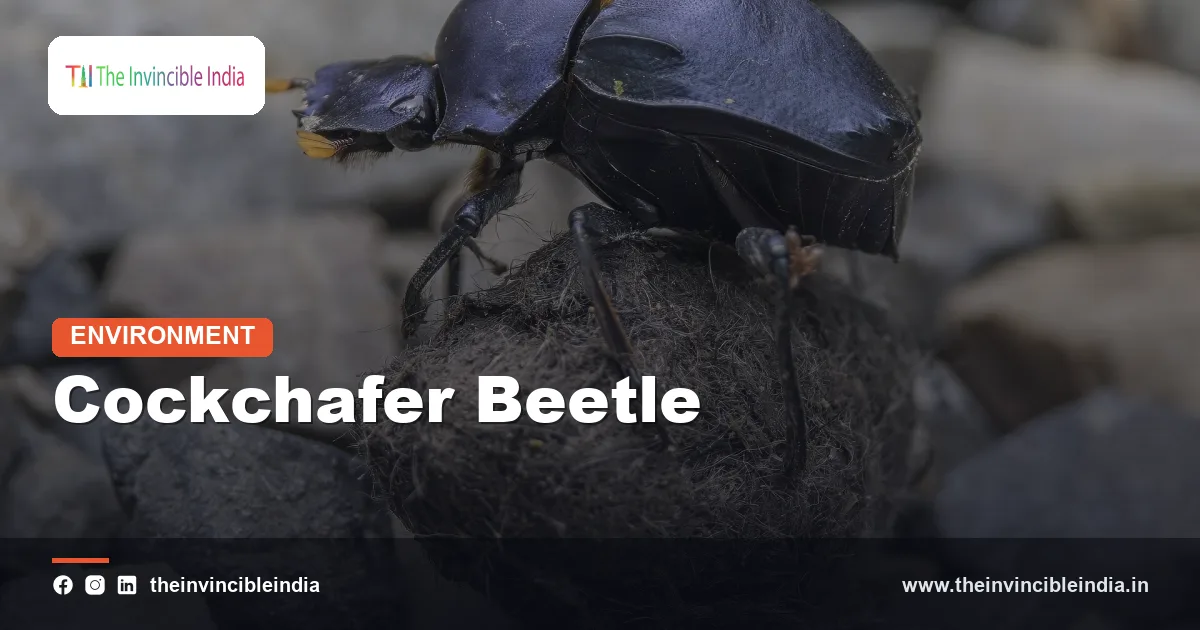
The cockchafer is a stout, brown, night-flying scarab beetle whose fat, C-shaped, root-eating larvae are known as white grubs, and in India the name is applied to the chafer beetles that emerge with the first monsoon showers and damage crops. Strictly, “cockchafer” belongs to the European species Melolontha melolontha, but Indian farmers and entomologists use “white grub beetle” for closely related Indian chafers such as Holotrichia, Anomala and Lepidiota.
The cockchafer matters in India because its underground grubs feed on the roots of groundnut, sugarcane, potato, maize, millets and many other crops. This article explains what the cockchafer is, how its life cycle works, why it appears with the rains, and how farmers manage it.
| Quick Fact | Detail |
|---|---|
| Common names | Cockchafer, chafer beetle, white grub beetle, May bug (in Europe); “white grub” for the larva |
| Scientific classification | Order Coleoptera; family Scarabaeidae; subfamily Melolonthinae (true cockchafer: Melolontha melolontha) |
| Size | Adults about 1.5 to 3 cm long; grubs grow to several centimetres when fully fed |
| Habitat in India | Light, sandy and well-drained farmland, scrub, orchards, hedgerows and village trees, mainly in northern, western and central India |
| Diet | Adults eat leaves of trees such as neem, ber and babul; grubs eat roots and other underground plant parts |
| Life cycle | Complete metamorphosis: egg, grub (three instars), pupa, adult; often one generation a year in India |
| Ecological role | Soil recycler and food for birds, bats and other predators, but a major crop pest in large numbers |
| Notable features | Fan-like (lamellate) antennae, a hard wing-case, attraction to light, and mass emergence after the first monsoon rains |
Key Takeaways
- The cockchafer is a scarab beetle of the family Scarabaeidae, and the term “white grub beetle” covers the Indian chafers that behave in the same way.
- A white grub is the soil-dwelling larva of a cockchafer-type beetle, and it is white to cream, C-shaped and brown-headed.
- Cockchafer adults in India usually emerge at dusk after the first heavy monsoon showers, then feed on tree leaves and mate.
- White grubs damage crops by eating roots, so affected plants wilt, yellow and can be pulled out of the soil with ease.
- Groundnut, sugarcane, potato, maize, sorghum and millets are among the crops that white grubs damage in India.
- Management of the cockchafer combines deep summer ploughing, collection of adults after the first rains, light traps, and biological agents such as the fungus Metarhizium anisopliae.
What is a cockchafer?
A cockchafer is a medium-sized scarab beetle of the subfamily Melolonthinae, known for its heavy brown body, fan-shaped antennae and clumsy night flights. The word comes from older English usage, and the true cockchafer, Melolontha melolontha, is a European insect often called the May bug.
The cockchafer belongs to the order Coleoptera, the beetles, which is the largest order of insects. Within it, the family Scarabaeidae includes dung beetles, rhinoceros beetles, flower beetles and chafers. The chafers (Melolonthinae) are the group in which adults eat leaves and the larvae eat roots.
The cockchafer is therefore best understood in India as a group name rather than a single species. Several Indian species behave in exactly the same way and have the same body plan, and agricultural writers use “cockchafer” and “white grub beetle” for them interchangeably.
Is the cockchafer found in India?
The true European cockchafer is not an Indian species, but India has many closely related chafer beetles that fill the same ecological role and are commonly called cockchafers or white grub beetles. The best-known Indian white grub pests belong to genera such as Holotrichia, Anomala, Leucopholis, Lepidiota, Maladera and Schizonycha.
Among these, Holotrichia consanguinea is widely recorded as a serious pest of groundnut and other crops in the drier regions of northern and western India. Other species cause damage in sugarcane belts, hill potato fields, and cardamom and tea areas of the south and north-east. India has dozens of white grub species, and the dominant one differs from region to region.
This diversity is why local extension services give region-specific advice. The timing of adult emergence, the soil types and the crops attacked change with the species and the climate.
What does a cockchafer look like?
An adult cockchafer is a stout, oval beetle about 1.5 to 3 cm long, usually reddish-brown, chestnut or dark brown, with a hard shiny or dull wing-case (elytra) and short legs adapted for digging. The most distinctive feature is the antenna, which ends in a clump of flat plates (lamellae) that the beetle can open and close like a small fan.
The antennae of the male are generally larger than those of the female, because he uses them to detect the scent of females. Under the wing-cases lies a pair of membranous flying wings. The beetle sometimes raises the wing-cases and unfolds the hind wings before take-off, and its flight is noisy and heavy.
The cockchafer has a tail end (pygidium) that extends slightly beyond the wing-cases. In many species, the shape of this tip and of the male genitalia are used by specialists to separate similar species. The beetle is easily mistaken for other scarabs, but the heavy brown body, the leaf-eating habit and the monsoon emergence are strong clues.
What is a white grub?
A white grub is the larva of a cockchafer or related scarab beetle, a fat, soft, creamy-white, C-shaped caterpillar-like grub with a hard brown head, three pairs of legs near the head and a dark, swollen tail end. It lives underground, close to the roots it eats, and it is the destructive stage of the insect.
White grubs are easy to find by digging around the base of a wilting plant. They lie curled on their side, and when exposed they often stay curled and slowly wriggle. A mature grub can be several centimetres long and as thick as a finger in the larger species.
It is worth separating the grub of the cockchafer from other beetle grubs:
- Rhinoceros beetle grubs are usually found in compost, manure and rotting wood or coconut trunks, and they feed on decaying matter, not on living crop roots.
- Dung beetle larvae develop in or beneath dung balls.
- Cockchafer white grubs are found in the root zone of living plants in cultivated or grassy soil.
What is the life cycle of a cockchafer?
The life cycle of a cockchafer has four stages, egg, grub, pupa and adult, and in most Indian species the whole cycle takes about one year. The beetle undergoes complete metamorphosis, in which the larva looks and behaves nothing like the adult.
| Stage | Where it lives | What it does |
|---|---|---|
| Egg | Soil, a few centimetres deep | Laid singly or in small batches by the female after mating; hatches in roughly two to three weeks |
| Grub (three instars) | Soil, around plant roots | Feeds and grows through three growth stages; the third stage is the most destructive |
| Pupa | An earthen cell deeper in the soil | The grub transforms into an adult without feeding |
| Adult | Emerges from the soil, then feeds on tree leaves | Feeds at night, mates, and females return to the soil to lay eggs |
In much of northern and western India, the grubs feed during the monsoon and early autumn, then go deeper into the soil to spend the winter as larvae. They pupate in the pre-monsoon months, and the new adults stay in the soil until the first heavy rain softens the ground. Some species in cooler hill regions take longer to complete a cycle, and the true European cockchafer takes about three to four years.
Why do cockchafers appear with the first monsoon rains?
Cockchafers appear with the first monsoon rains because the rain softens the hard, dry soil and triggers the adults waiting below to dig out and fly. The emergence is often synchronised, so thousands of beetles may leave the ground on the same evening after a good shower.
After emerging at dusk, the beetles fly to nearby trees, where they feed on leaves through the night. They are strongly attracted to artificial lights, which is why many beetles are found circling street lamps and tube lights, falling on the floor and crawling around verandas in July. By dawn, most have retreated to the soil, a hedge or the tree canopy.
The adult feeding phase lasts a few weeks. Common host trees include neem, ber (jujube), babul (acacia), khejri, mango and guava, and heavy feeding can strip a tree of its leaves. The trees usually recover, and the larger economic loss comes from the grubs that hatch later.
What crops does the cockchafer damage?
The cockchafer damages crops mainly through its white grubs, which are polyphagous, meaning they feed on the roots of many different plants. In India, the crops affected include groundnut, sugarcane, potato, maize, sorghum, pearl millet, finger millet, cotton, vegetables, and nurseries of forest trees.
The grubs gnaw the fine roots first, then the main root, and sometimes the underground part of the stem or the tuber. The above-ground signs are:
- Yellowing, drooping or wilting plants, which do not recover after watering.
- Patches of dead or stunted plants scattered across the field.
- Seedlings and young plants that can be lifted out of the soil with no resistance because the roots are cut.
- Gnawed pods in groundnut or holes in potato tubers.
- Reduced tillering and weak growth in sugarcane.
Because the damage is underground, a farmer may notice it only when the plants are already lost. Light, sandy and well-drained soils with plenty of nearby host trees tend to carry the highest populations, and the damage can be severe in rainfed areas where the crop depends on a single sowing.
How do farmers manage white grubs and cockchafers?
Farmers manage white grubs and cockchafers with an integrated approach that combines field hygiene, mechanical collection, biological agents and, where needed, seed or soil treatment recommended by agricultural authorities. No single measure is enough, because the grubs are hidden underground and the adults fly in from neighbouring land.
- Deep summer ploughing: turning the soil in the hot pre-monsoon months exposes pupae and grubs to the sun and to birds.
- Collecting adults after the first rains: shaking host trees such as neem and ber early in the evening or morning and destroying the fallen beetles, preferably across a whole village together.
- Light traps: using a lamp above a tray of water with a little oil attracts and drowns large numbers of beetles in the early monsoon nights.
- Crop rotation and clean farming: avoiding repeated susceptible crops in the same field and removing weeds that harbour grubs.
- Biological control: applying the fungus Metarhizium anisopliae or entomopathogenic nematodes that infect the grubs, and encouraging birds that feed on them.
- Seed and soil treatment: using only the chemicals and doses approved by state agricultural universities and the Central Insecticides Board and Registration Committee, since misuse harms soil life and natural enemies.
The key to success is timing and community action. Because adults move freely, a single farmer’s effort gives limited relief, while coordinated village-wide collection in the first week of the monsoon can sharply reduce the next generation.
Does the cockchafer have a role in nature?
The cockchafer plays a real role in nature, because it recycles plant matter, aerates the soil and serves as food for many animals. Its larvae feed on roots in natural grassland and woodland as well as in fields, and its adults feed on leaves, so the beetle is part of the normal cycle of plant growth and renewal.
A large number of predators depend on the cockchafer. Bats, owls, nightjars, mynas, crows, drongos, shrews, mongooses, wild boar and many other animals eat adults or grubs, and the sudden mass emergence in the monsoon provides a rich meal at a season when many birds are breeding. Parasitic wasps, ground beetles and fungi attack the immature stages.
The beetle becomes a pest only when it is abundant, usually in places where monoculture, loss of predators and widespread use of broad-spectrum chemicals have disturbed the balance. Cockchafers do not bite or sting people, and they carry no known disease, so they are harmless to humans in a direct sense.
Bottom Line
The cockchafer, or white grub beetle, is a monsoon scarab whose root-eating grubs are a standing challenge for Indian farmers. Understanding its yearly cycle, from the first-rain emergence to the underground grub, makes it possible to time control measures well and to protect the soil’s natural predators.
Frequently Asked Questions
What is a cockchafer in simple words?
A cockchafer is a heavy brown scarab beetle that flies at night and whose larvae, called white grubs, eat plant roots. The true cockchafer is a European species, but in India the name is used for similar chafer beetles. Adults eat tree leaves, and the grubs live in the soil.
Is the cockchafer a pest in India?
Yes, the cockchafer group is a significant crop pest in India because the white grubs of several chafer species damage roots. Groundnut, sugarcane, potato, maize and millets are among the crops affected. Damage is greatest in light, sandy soils and in areas with many host trees nearby.
Why do so many beetles come out after the first monsoon rain?
Many beetles come out after the first monsoon rain because the rain softens the soil and signals the adults, which have been waiting underground, to emerge. They fly at dusk to feed on tree leaves and to mate. Emergence is often synchronised, so large numbers appear on the same evening.
What is the difference between a white grub and other grubs?
A white grub is a cream-coloured, C-shaped larva with a brown head that feeds on living plant roots. Other grubs, such as those of the rhinoceros beetle, are usually found in compost, manure or rotting wood. The location where the grub is found is the best clue to its type.
How can farmers control white grubs without harming the soil?
Farmers can control white grubs by deep summer ploughing, collecting adults after the first rains, using light traps, rotating crops and applying biological agents such as Metarhizium anisopliae. These methods reduce the population without heavy chemical use. Where chemicals are needed, only recommended products and doses should be used.
Are cockchafers dangerous to people?
Cockchafers are not dangerous to people, because they do not bite, sting or spread disease. They may fly into lights, crawl indoors and cause a nuisance in the monsoon. Switching off outdoor lights or covering them for a few nights reduces the number that gather.
{“@context”:”https://schema.org”,”@graph”:[{“@type”:”FAQPage”,”mainEntity”:[{“@type”:”Question”,”name”:”What is a cockchafer in simple words?”,”acceptedAnswer”:{“@type”:”Answer”,”text”:”A cockchafer is a heavy brown scarab beetle that flies at night and whose larvae, called white grubs, eat plant roots. The true cockchafer is a European species, but in India the name is used for similar chafer beetles. Adults eat tree leaves, and the grubs live in the soil.”}},{“@type”:”Question”,”name”:”Is the cockchafer a pest in India?”,”acceptedAnswer”:{“@type”:”Answer”,”text”:”Yes, the cockchafer group is a significant crop pest in India because the white grubs of several chafer species damage roots. Groundnut, sugarcane, potato, maize and millets are among the crops affected. Damage is greatest in light, sandy soils and in areas with many host trees nearby.”}},{“@type”:”Question”,”name”:”Why do so many beetles come out after the first monsoon rain?”,”acceptedAnswer”:{“@type”:”Answer”,”text”:”Many beetles come out after the first monsoon rain because the rain softens the soil and signals the adults, which have been waiting underground, to emerge. They fly at dusk to feed on tree leaves and to mate. Emergence is often synchronised, so large numbers appear on the same evening.”}},{“@type”:”Question”,”name”:”What is the difference between a white grub and other grubs?”,”acceptedAnswer”:{“@type”:”Answer”,”text”:”A white grub is a cream-coloured, C-shaped larva with a brown head that feeds on living plant roots. Other grubs, such as those of the rhinoceros beetle, are usually found in compost, manure or rotting wood. The location where the grub is found is the best clue to its type.”}},{“@type”:”Question”,”name”:”How can farmers control white grubs without harming the soil?”,”acceptedAnswer”:{“@type”:”Answer”,”text”:”Farmers can control white grubs by deep summer ploughing, collecting adults after the first rains, using light traps, rotating crops and applying biological agents such as Metarhizium anisopliae. These methods reduce the population without heavy chemical use. Where chemicals are needed, only recommended products and doses should be used.”}},{“@type”:”Question”,”name”:”Are cockchafers dangerous to people?”,”acceptedAnswer”:{“@type”:”Answer”,”text”:”Cockchafers are not dangerous to people, because they do not bite, sting or spread disease. They may fly into lights, crawl indoors and cause a nuisance in the monsoon. Switching off outdoor lights or covering them for a few nights reduces the number that gather.”}}]}]}


