

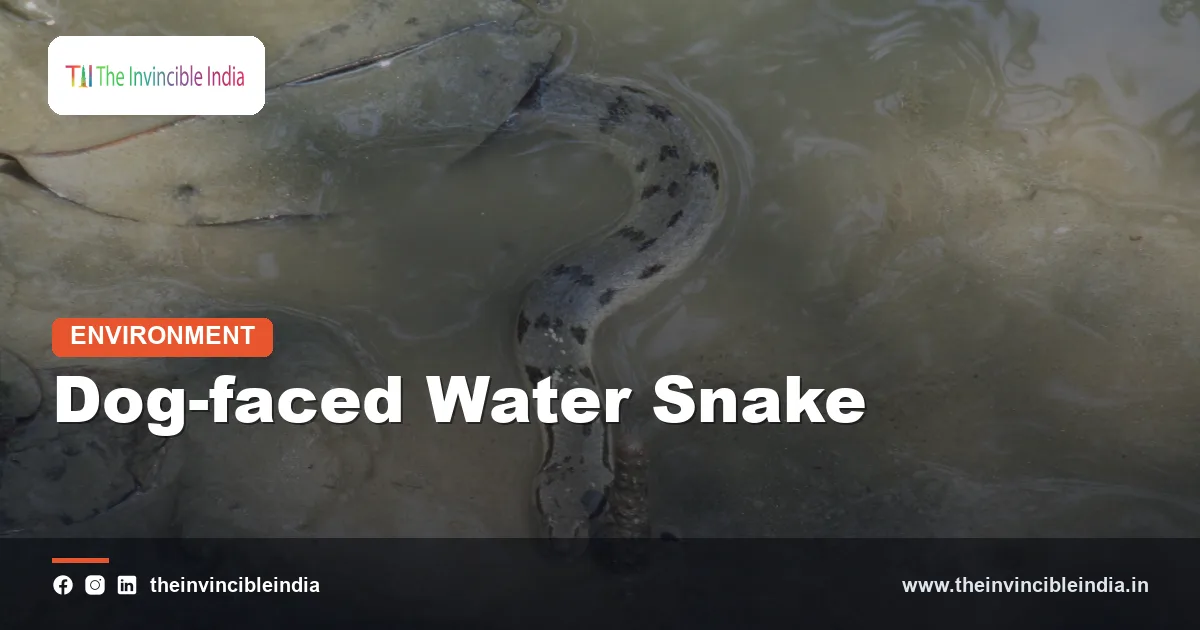
The dog-faced water snake (Cerberus rynchops) is a mildly venomous, rear-fanged, aquatic snake of Indian mangroves, estuaries and tidal mudflats that hunts fish and crabs in brackish water and is harmless to humans in practical terms. The dog-faced water snake gets its name from its broad, flattish head and blunt snout, and it is also known as the bockadam or puff-faced water snake.
It is one of the commonest snakes of India’s coastal wetlands, from the Sundarbans in the east to the creeks and estuaries of the west coast. This article explains what the dog-faced water snake is, where it lives, how it hunts, whether it is dangerous, and why it matters for coastal ecosystems.
| Quick Facts | Details |
|---|---|
| Scientific name and family | Cerberus rynchops, family Homalopsidae (the Indo-Australian water snakes) |
| Size | Usually about 60 to 100 cm; females grow larger than males |
| Habitat in India | Mangroves, estuaries, creeks, tidal mudflats and coastal lagoons on the east and west coasts and the Andaman and Nicobar Islands |
| Diet | Fish, especially mudskippers and gobies, as well as crabs and shrimps |
| Reproduction | Live-bearing (viviparous); the female gives birth to a litter of young snakes in water or on the mud |
| Activity | Mainly nocturnal and active at low tide on the mud |
| Ecological role | Mid-level predator in mangrove and estuarine food webs |
| Notable features | Dog-like face, upward-pointing valved nostrils, keeled scales and rear fangs with weak venom |
Key Takeaways
- The dog-faced water snake (Cerberus rynchops) is a rear-fanged water snake of the family Homalopsidae that lives in coastal brackish waters in India.
- The dog-faced water snake feeds mainly on fish and crabs and often hunts at night around mangrove roots and mudflats.
- The dog-faced water snake is mildly venomous but is not regarded as dangerous to humans, and bites are rare.
- The dog-faced water snake gives birth to live young rather than laying eggs.
- The dog-faced water snake has nostrils on the top of its snout with valves that close underwater.
- The dog-faced water snake depends on healthy mangroves and tidal creeks, which makes it a useful indicator of coastal wetland health.
What is the dog-faced water snake?
The dog-faced water snake is a medium-sized, semi-aquatic snake whose scientific name is Cerberus rynchops and which belongs to the family Homalopsidae. The genus name Cerberus is borrowed from the many-headed dog of Greek legend and refers to the snake’s dog-like face.
Homalopsids are a family of rear-fanged water snakes found from the Indian subcontinent through South-East Asia to northern Australia. They were once placed in a larger family, Colubridae, but they are now generally treated as a separate family because of their shared anatomy and their adaptations to a life in water.
The dog-faced water snake is grey, brown or olive above, often with dark blotches or crossbars, and paler cream or yellowish below. Its head is broad and a bit flattened, with small eyes and a blunt, rounded snout. The body is stout, and the scales have a ridge or keel, giving the skin a rough feel.
Why is it called the dog-faced water snake?
It is called the dog-faced water snake because its blunt snout, broad head and slightly puffed cheeks resemble the face of a small dog when seen from the side. The same features give it the alternative name of puff-faced water snake.
The common name does not mean that the snake barks or has any relation to dogs. It describes only the shape of the face. In the older literature the snake is also called the bockadam, a name that appears in some Indian regional and colonial sources, and a number of local names exist in coastal languages.
Where does the dog-faced water snake live in India?
The dog-faced water snake lives along the coasts of India, in mangroves, estuaries, tidal creeks, mudflats, brackish lagoons and sometimes in lower stretches of rivers close to the sea. It is recorded from both the east and west coasts and from the Andaman and Nicobar Islands.
Its range extends beyond India, across Pakistan, Sri Lanka, Bangladesh, Myanmar, Thailand, the Malay Archipelago and into northern Australia. Within India it is especially associated with the Sundarbans, the coasts of Odisha, Andhra Pradesh, Tamil Nadu, Kerala, Karnataka, Goa, Maharashtra and Gujarat, where mangroves and estuaries remain.
The snake tolerates a range of salinity, from nearly fresh water to brackish estuaries. Typical sites include:
- Mangrove forests with a tangle of roots and muddy banks.
- Tidal creeks and backwaters.
- Estuaries where rivers meet the sea.
- Fishponds, aquaculture ponds and salt pans near the coast.
- Mudflats that are exposed at low tide.
What does the dog-faced water snake eat?
The dog-faced water snake eats mainly fish and crustaceans, with a strong preference for small fish such as mudskippers and gobies, as well as crabs and shrimps. It hunts in shallow water and on the mud, and it swallows its prey whole.
The snake is an ambush hunter that waits close to a burrow, a root or a pool and strikes when a fish passes. It also searches along the bottom, probing mud and burrows with its snout. At low tide it may follow stranded fish in pools on the mudflat. Most feeding happens at night or in the evening.
As a predator, the snake helps to control populations of small fish and crabs in the mangrove food web. It is also itself prey for larger animals, including herons and other wading birds, monitor lizards, fishing cats and large fish.
Is the dog-faced water snake venomous?
Yes, the dog-faced water snake is mildly venomous, but its venom is weak and it is not considered dangerous to humans. The snake is rear-fanged, meaning that its small venom-delivering teeth are placed at the back of the upper jaw and are not well positioned for biting large animals.
The venom is used to subdue small prey such as fish and crabs. A bite on a person is rare, and when it happens there may be little more than minor local pain, redness or swelling. Because the snake is aquatic and its fangs are small, it seldom injects venom in any quantity. It does not belong to the dangerous “big four” snakes of India, which are the cobra, common krait, Russell’s viper and saw-scaled viper.
Even so, no wild snake should be handled. Anyone bitten by an unknown snake should stay calm, keep the limb still, avoid cutting or sucking the wound, and go to a hospital quickly, as identifying the snake can be difficult.
How does the dog-faced water snake live in water?
The dog-faced water snake lives in water thanks to several physical adaptations, including upward-facing nostrils with valves, a slightly flattened body and a tolerance for salty water. These features let it breathe, swim and hunt in tidal habitats.
Valved nostrils
The nostrils are set on the top of the snout, so the snake can breathe while most of its head stays underwater. Small flaps close the nostrils when the snake dives, keeping water out.
Lungs and diving
The snake breathes air through its lungs and must surface regularly, but it can stay submerged for long periods while waiting or searching for food. A large lung that runs along much of the body helps it store air.
Swimming and moving on mud
Its body is muscular and it swims by side-to-side undulation. It can also crawl across mud and between mangrove roots, which is useful for a snake that moves between water and mudflat with the tide.
Salt tolerance
Estuarine water varies in salinity. The dog-faced water snake can tolerate brackish water, and its skin helps limit the loss of water and gain of salt, although it still needs access to fresher water to drink.
How does the dog-faced water snake reproduce?
The dog-faced water snake is viviparous, meaning that the female gives birth to live young instead of laying eggs. The young develop inside the mother’s body and are born fully formed, ready to swim and feed.
A litter may contain several to more than a dozen young snakes, with larger females producing larger litters. The newborn snakes are small, a few tens of centimetres long, and they begin to hunt small fish and shrimps almost immediately. The mother gives no care after birth. Breeding timing varies with region and season, and in many places births take place around the rains, when food in the estuary is plentiful.
The snake reaches maturity within a few years. Males tend to be smaller and slimmer than females, which is a pattern in many snakes.
How can you tell the dog-faced water snake from other water snakes?
You can tell the dog-faced water snake from other water snakes by its location in brackish or tidal water, its broad flat head with a blunt snout, its upward-facing nostrils, and its rough, keeled scales. It is usually found near mangroves and mudflats rather than in freshwater ponds.
| Snake | Typical habitat | Distinguishing features |
|---|---|---|
| Dog-faced water snake (Cerberus rynchops) | Mangroves, estuaries, tidal mudflats | Broad, flat head with blunt snout; nostrils on top; keeled scales; mildly venomous |
| Checkered keelback (Fowlea piscator) | Freshwater ponds, rice fields, streams | Checkered pattern on the back; dark stripes behind the eye; non-venomous |
| Olive keelback (Atretium schistosum) | Freshwater ponds, tanks and paddy fields | Olive-brown colour; slimmer build; mostly harmless |
| Sea snakes (various) | Open sea and coastal waters | Flattened, paddle-like tail; strongly venomous; rarely found on land |
The flat, paddle-like tail of true sea snakes is a useful marker, because the dog-faced water snake has a rounded tail that looks like that of a normal snake. Identification in the field should always be left to trained observers.
Why does the dog-faced water snake matter?
The dog-faced water snake matters because it is a mid-level predator in mangrove and estuarine ecosystems and an indicator of their health. A population of dog-faced water snakes suggests that the water still supports fish, crabs and cover along the shore.
Mangrove forests protect coasts from storm surges, serve as nurseries for fish and prawns, and store large amounts of carbon. The loss of mangroves to aquaculture, port development, pollution and reclamation also removes the habitat of species like this snake. Pollution of creeks and heavy fishing can reduce its food supply, and some snakes are killed by fishermen who mistake them for dangerous species or by entanglement in nets.
Globally the species is generally regarded as being of low conservation concern because of its wide range, but local populations depend on the condition of the habitat. Protecting mangroves and tidal wetlands is the most effective way to protect the dog-faced water snake and the many other animals that share the habitat.
How big does the dog-faced water snake grow and how does it behave?
The dog-faced water snake usually grows to about 60 to 100 cm, with the largest females somewhat longer, and it behaves as a shy, mostly nocturnal animal that retreats into water or burrows when disturbed. During the day it often rests in crab burrows, under mangrove roots or in the mud, where it is hard to see.
At night and at low tide it becomes more active, moving over the mud and through shallow pools in search of fish. If it is picked up or cornered, it may flatten its head, strike or release a foul-smelling fluid, but it does not chase people. Many sightings occur when fishermen pull in nets or when visitors walk on boardwalks through mangroves at dusk.
The snake can also be seen basking on mudbanks or low branches in the early morning. Its dull colour, which blends with mud and shadow, is a useful camouflage against birds of prey and wading birds.
What should you do if you meet a dog-faced water snake?
If you meet a dog-faced water snake, the best response is to keep a safe distance, avoid handling it and let it move away on its own. The snake has no interest in people and will not attack unless it is trapped or grabbed.
- Do not try to pick up or catch the snake, since a frightened snake may bite.
- Wear closed footwear when walking on muddy creek banks and mangrove edges.
- Use a torch at night in mangrove areas, so that you can see where you step.
- If a bite occurs, wash the area with clean water, keep the limb still and seek medical help.
- Report unusual numbers of dead snakes or fish to local forest or fisheries officials, as it may indicate pollution.
Bottom Line
The dog-faced water snake is a common but little-noticed resident of India’s tidal wetlands, a rear-fanged hunter whose venom suits fish and crabs rather than people. Seeing it as a harmless part of a healthy mangrove, rather than a danger, helps both people and the coastal habitat it depends on.
Frequently Asked Questions
What is the dog-faced water snake?
The dog-faced water snake (Cerberus rynchops) is a mildly venomous, rear-fanged water snake of the family Homalopsidae. It lives in mangroves, estuaries and tidal mudflats and feeds on fish and crabs. It is named for its blunt, dog-like face.
Is the dog-faced water snake dangerous to humans?
No, the dog-faced water snake is not considered dangerous to humans. Its venom is weak and its fangs are small and set at the back of the mouth. Bites are rare, and when they occur the effects are usually minor.
Where is the dog-faced water snake found in India?
The dog-faced water snake is found along the Indian coast, in the Sundarbans, other east and west coast mangroves and the Andaman and Nicobar Islands. It lives in brackish water, such as estuaries, creeks and mudflats.
What does the dog-faced water snake eat?
The dog-faced water snake eats mainly fish, especially mudskippers and gobies, together with crabs and shrimps. It hunts mostly at night, ambushing prey in shallow water or on exposed mud at low tide.
Does the dog-faced water snake lay eggs?
No, the dog-faced water snake does not lay eggs. It is viviparous, which means that the female gives birth to live young. A litter can include several to more than a dozen young snakes.
Why is it called the dog-faced water snake?
It is called the dog-faced water snake because its broad head, blunt snout and puffed cheeks look somewhat like the face of a dog. The genus name Cerberus comes from the mythical hound of Greek legend. It is also called the bockadam or the puff-faced water snake.
{“@context”:”https://schema.org”,”@graph”:[{“@type”:”FAQPage”,”mainEntity”:[{“@type”:”Question”,”name”:”What is the dog-faced water snake?”,”acceptedAnswer”:{“@type”:”Answer”,”text”:”The dog-faced water snake (Cerberus rynchops) is a mildly venomous, rear-fanged water snake of the family Homalopsidae. It lives in mangroves, estuaries and tidal mudflats and feeds on fish and crabs. It is named for its blunt, dog-like face.”}},{“@type”:”Question”,”name”:”Is the dog-faced water snake dangerous to humans?”,”acceptedAnswer”:{“@type”:”Answer”,”text”:”No, the dog-faced water snake is not considered dangerous to humans. Its venom is weak and its fangs are small and set at the back of the mouth. Bites are rare, and when they occur the effects are usually minor.”}},{“@type”:”Question”,”name”:”Where is the dog-faced water snake found in India?”,”acceptedAnswer”:{“@type”:”Answer”,”text”:”The dog-faced water snake is found along the Indian coast, in the Sundarbans, other east and west coast mangroves and the Andaman and Nicobar Islands. It lives in brackish water, such as estuaries, creeks and mudflats.”}},{“@type”:”Question”,”name”:”What does the dog-faced water snake eat?”,”acceptedAnswer”:{“@type”:”Answer”,”text”:”The dog-faced water snake eats mainly fish, especially mudskippers and gobies, together with crabs and shrimps. It hunts mostly at night, ambushing prey in shallow water or on exposed mud at low tide.”}},{“@type”:”Question”,”name”:”Does the dog-faced water snake lay eggs?”,”acceptedAnswer”:{“@type”:”Answer”,”text”:”No, the dog-faced water snake does not lay eggs. It is viviparous, which means that the female gives birth to live young. A litter can include several to more than a dozen young snakes.”}},{“@type”:”Question”,”name”:”Why is it called the dog-faced water snake?”,”acceptedAnswer”:{“@type”:”Answer”,”text”:”It is called the dog-faced water snake because its broad head, blunt snout and puffed cheeks look somewhat like the face of a dog. The genus name Cerberus comes from the mythical hound of Greek legend. It is also called the bockadam or the puff-faced water snake.”}}]}]}


