

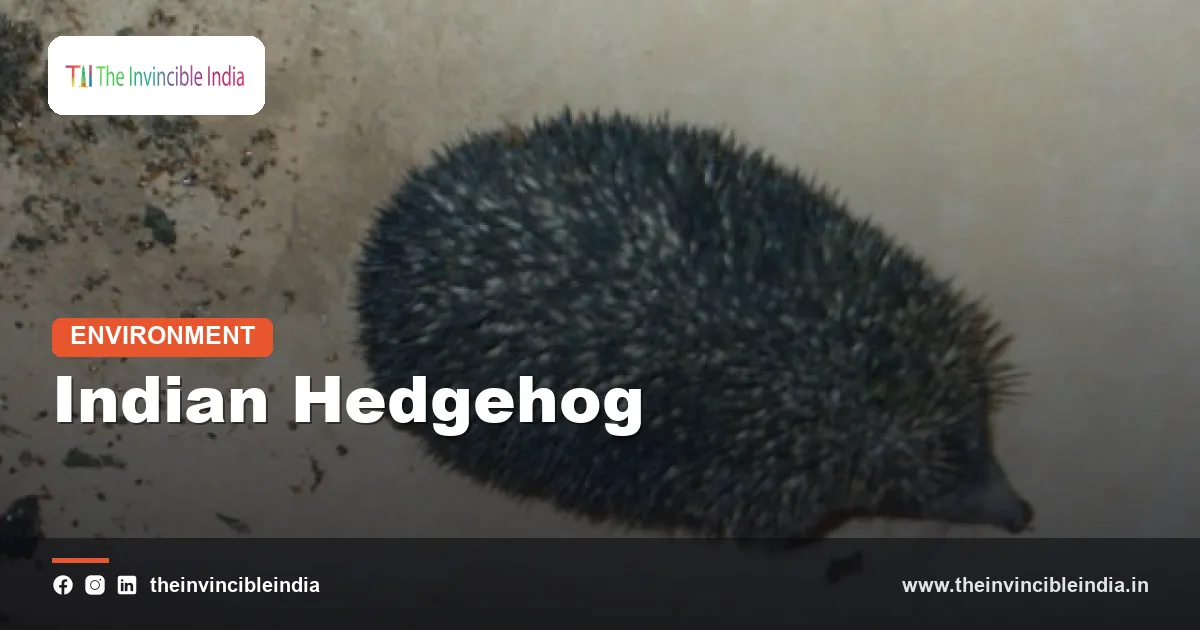
The Indian hedgehog (Paraechinus micropus) is a small, spiny, nocturnal mammal of dry northern and western India that eats mainly insects and other small animals and rolls into a tight ball of spines when threatened. It belongs to the family Erinaceidae and is one of several hedgehog species found in the Indian subcontinent, most commonly in the arid plains, scrub and semi-desert of Rajasthan, Gujarat, Punjab, Haryana and neighbouring regions.
This explainer covers the Indian hedgehog’s appearance, range, diet, burrows, breeding and defences, and how it differs from other Indian hedgehogs such as the long-eared hedgehog and the Madras hedgehog. It also explains why wild hedgehogs should never be kept as pets, and what the animal’s legal status is in India.
Quick Facts: Indian Hedgehog
| Scientific name | Paraechinus micropus |
|---|---|
| Family | Erinaceidae (hedgehogs and gymnures) |
| Size | Head and body roughly 14 to 23 cm; weight roughly 250 to 450 g; tail very short |
| Appearance | Banded brown and white spines on the back; dark face and a bare parting of skin on the crown |
| Range and habitat | North-western India (including Rajasthan, Gujarat, Punjab, Haryana, Delhi) and Pakistan; dry scrub, semi-desert, farmland and grassy plains |
| Diet | Insectivore and opportunist: beetles, ants, termites, scorpions, small reptiles, eggs, occasional fruit |
| Activity | Nocturnal and solitary; shelters in burrows by day |
| Breeding | Usually a few young per litter (commonly two to four) after a gestation of roughly five weeks |
| Conservation status | Least Concern (IUCN); protected under India’s Wildlife (Protection) Act, 1972 |
Key Takeaways
- The Indian hedgehog is a small, nocturnal, insect-eating mammal covered with sharp spines that weighs only a few hundred grams.
- The Indian hedgehog lives mainly in the dry plains, scrub and semi-desert of north-western India, including Rajasthan and Gujarat.
- The Indian hedgehog defends itself by rolling into a ball so that its spines point outwards, using strong muscles along its back.
- The spines of the Indian hedgehog are modified hairs made of keratin, the same protein found in human hair and nails; they are not barbed and cannot be shot at enemies.
- The Indian hedgehog helps farmers by eating beetles, termites, grasshoppers and other crop and household insects.
- Hedgehogs are protected wild animals in India, so capturing them, selling them or keeping them as pets is illegal.
What is the Indian hedgehog?
The Indian hedgehog is a small insectivorous mammal in the family Erinaceidae, known to science as Paraechinus micropus, and it is found in the dry regions of India and Pakistan. Its body is covered above with stiff spines, while the face, legs and underside carry soft fur.
The name “hedgehog” comes from the animal’s habit of foraging in hedges and thickets and from the pig-like grunts it makes while hunting. The Indian version has little in common with the European hedgehog of gardens, though it shares the same basic body plan. It belongs to a group called the Erinaceomorpha, which also includes the gymnures or moonrats of Southeast Asia.
Despite looking like porcupines, hedgehogs are unrelated to them. Porcupines are rodents with much longer, detachable quills, while hedgehogs are small insectivores whose spines are short, fixed in the skin and used mainly for defence.
What does the Indian hedgehog look like?
The Indian hedgehog has a rounded, compact body covered in short spines on its back, a pointed snout, small eyes, short ears and a tiny tail hidden among the spines. It generally weighs between about 250 and 450 grams and measures roughly 14 to 23 centimetres in length.
Spines
The spines are banded, alternating dark brown and white or cream, which gives the back a speckled look. A narrow, spine-free parting runs across the crown of the head, a feature that helps separate this species from some relatives. There are several thousand spines on an adult, and each is a stiff, hollow, keratin hair that is replaced gradually as the animal ages.
Face and underside
The face is usually dark brown or blackish, forming a mask-like pattern, and the snout is slender. The belly, chest and limbs are covered with soft fur that is brownish or whitish. The short legs end in small, clawed feet that are well suited to digging and scratching.
Senses
The Indian hedgehog has poor eyesight but excellent hearing and a very good sense of smell. It finds most of its food by sniffing at the ground, listening for the rustle of beetles and probing soil and leaf litter with its snout.
Where does the Indian hedgehog live?
The Indian hedgehog lives mainly in the dry, open country of north-western India and Pakistan, including semi-desert, scrubland, grassy plains, field margins and thorny thickets. In India it is recorded from Rajasthan, Gujarat, Punjab, Haryana and Delhi and from adjoining parts of Uttar Pradesh and Madhya Pradesh.
The animal prefers places with loose soil for burrowing, scattered shrubs for cover and plenty of insects. Typical habitats include the Thar Desert’s fringes, rocky and sandy scrub, and semi-arid farmland where irrigated and dry fields lie side by side. It avoids dense forests, waterlogged ground and the wettest parts of the country.
Many dry-region towns and villages also host hedgehogs on their outskirts. They are seen occasionally in gardens, orchards and along roadsides after dusk, though they are far less visible than squirrels or mongooses because of their nocturnal habits.
What does the Indian hedgehog eat?
The Indian hedgehog eats mainly insects and other small invertebrates, and also takes small vertebrates, eggs and a little plant material. Its diet reflects what is available in dry habitats, where food can be sparse for much of the year.
Main foods
- Beetles and their larvae, which form a large share of the diet
- Ants, termites, crickets, grasshoppers and caterpillars
- Scorpions, spiders, centipedes and snails
- Lizards, small snakes, frogs and young rodents
- Bird and reptile eggs found on the ground
- Occasional fruit and seeds
Handling venomous prey
Hedgehogs are known for eating scorpions and, in some species, small venomous snakes. Their fast, repeated bites and thick spines protect them from many stings and strikes, and hedgehogs appear to have some physiological tolerance to certain toxins. Tolerance is not complete immunity, and an animal can still be injured or killed.
Water and fat
The animal obtains much of its water from its prey and drinks from puddles or irrigation channels when it can. Like many desert mammals it stores fat in good seasons, and this reserve helps it survive spells when insects become scarce.
How does the Indian hedgehog defend itself?
The Indian hedgehog defends itself mainly by rolling into a tight ball so that its spines cover its head, belly and limbs, leaving predators with a prickly mouthful. A large, ring-shaped muscle running around the sides of the body acts like a drawstring and pulls the spiny skin over the animal.
When surprised, the animal first tends to freeze, raise its spines, and push its head down towards its chest, sometimes hissing, huffing or jumping slightly. If the threat persists, it curls up fully. The spines are fixed in the skin and do not detach on contact, though they can prick painfully.
The Indian hedgehog and some relatives also practise “anointing” or self-anointing. After licking or chewing a strong-smelling substance, the animal produces frothy saliva and spreads it over its spines with its tongue. The purpose is still debated, but proposed explanations include camouflage, defence against predators and a way of managing parasites.
Its natural enemies include foxes, jackals, desert cats, owls, eagles and large snakes. Some predators, such as owls and certain foxes, are able to unroll or get past the defence, and young animals are especially vulnerable. Road traffic is a significant human-linked danger.
Where and when does the Indian hedgehog sleep?
The Indian hedgehog sleeps during the day in a burrow, a crevice or a nest under dense vegetation, and it emerges after dusk to forage. It often digs its own tunnels in loose soil or enlarges holes made by other animals.
Daytime shelter is important in the dry zone because it protects the animal from the heat. Some individuals use several burrows within their territory, moving between them from night to night. The nest chamber is typically lined with dry grass or leaves.
In extreme heat or in cold winters, the Indian hedgehog can enter a state of torpor, in which its body temperature and metabolism drop and it conserves energy. Hibernation in cold weather and aestivation in extreme dry heat are both recorded among hedgehog species, and the exact pattern varies with climate and food supply. In the warmer plains, many individuals remain active for most of the year but reduce their activity during harsh spells.
How does the Indian hedgehog breed?
The Indian hedgehog breeds mainly in the warmer or wetter part of the year in most of its range, and a female typically gives birth to a litter of a few young after a gestation of roughly five weeks. Litters of two to four are common, although smaller and larger litters occur.
The young are born blind and nearly naked, with soft, short spines under the skin that emerge within hours or days. Mothers raise their young alone in a nest chamber within a burrow. The eyes open after roughly two to three weeks, and the youngsters begin to leave the nest and eat solid food by about a month of age.
Hedgehog mothers can be easily disturbed, and a mother that senses danger near the nest sometimes moves her young or abandons them. For this reason, well-meaning people who find a nest should observe from a distance and not touch the animals.
How is the Indian hedgehog different from other Indian hedgehogs?
The Indian hedgehog (Paraechinus micropus) differs from India’s other hedgehogs mainly in its range, size and head pattern: it is a dry north-western species with a dark face and a spine-free parting, while the Madras hedgehog is a southern species with a bare belly and the long-eared hedgehog has noticeably larger ears.
| Species | Scientific name | Main distinguishing features | Typical India range |
|---|---|---|---|
| Indian hedgehog | Paraechinus micropus | Dark face, banded spines, bare parting on the crown | North-western and western dry plains |
| Madras hedgehog (bare-bellied hedgehog) | Paraechinus nudiventris | Naked or sparsely haired belly, paler body | Parts of southern India |
| Long-eared hedgehog | Hemiechinus auritus | Longer ears that project beyond the spines | Arid north-west, such as Rajasthan and Kutch |
The three can look similar in the field, and ranges may overlap in a few places. Experts rely on ear length, belly fur, skull and tooth features, and location to separate the species. Photographs with a clear view of the face and belly help identification.
Why does the Indian hedgehog matter to people and ecosystems?
The Indian hedgehog matters because it controls insect numbers, serves as prey for larger animals and indicates the health of dry-zone habitats. A single animal can eat large numbers of beetles, termites and grasshoppers every night, some of which damage crops, stored grain or gardens.
In India’s semi-arid landscapes, small mammals such as hedgehogs link insects to larger predators. They help turn a wide variety of invertebrate prey into food for owls, foxes and other carnivores. Their burrows may also provide shelter for lizards, insects and other small animals after the owner has left.
Hedgehogs do not harm crops, livestock or people in any meaningful way. They can carry fleas, ticks and some diseases, as most wild mammals do, so hands should be washed after any accidental contact.
Is the Indian hedgehog protected in India?
Yes, hedgehogs are protected wild animals in India under the Wildlife (Protection) Act, 1972, and capturing, selling, keeping or killing them without legal authority is an offence. The IUCN lists the Indian hedgehog as Least Concern because it has a wide range and is relatively common in suitable habitat.
The animal still faces some pressures. These include road deaths, loss of scrub and grassland to intensive farming and construction, poisoning by pesticides that kill its insect prey, predation by feral dogs, and illegal capture. Hedgehogs have been caught for the exotic pet trade and for use in some traditional practices and superstitions, and enforcement agencies have seized animals on occasion.
Wild hedgehogs are poor pets. They are nocturnal, solitary, easily stressed and often carry parasites, and wild-caught animals frequently die in captivity. Some captive-bred hedgehogs sold abroad belong to different, African species and are not the same animal.
What to do if a hedgehog is found
- Keep dogs away and avoid handling the animal with bare hands.
- Do not feed milk or bread, since hedgehogs digest dairy poorly.
- If the animal is injured or in the open by day, call the local forest department or a wildlife rescue group.
- Avoid pesticides and glue traps in gardens and farms, since they harm hedgehogs and other wildlife.
Bottom Line
The Indian hedgehog is a small, spiny, night-active insect eater of India’s dry north-west that shelters in burrows and defends itself by rolling into a ball. It is useful, harmless, protected by law and best left in the wild.
Frequently Asked Questions
What is the Indian hedgehog?
The Indian hedgehog is a small, spiny, nocturnal mammal (Paraechinus micropus) of the family Erinaceidae that lives in dry parts of north-western India and Pakistan. It weighs a few hundred grams and eats mainly insects. It rolls into a ball when threatened.
Do hedgehogs live in India?
Yes, hedgehogs live in India. Several species occur, including the Indian hedgehog in the dry north-west, the long-eared hedgehog in the arid north-west, and the Madras hedgehog in parts of the south. Most are nocturnal and rarely seen.
What does an Indian hedgehog eat?
An Indian hedgehog eats mainly insects such as beetles, ants, termites and grasshoppers. It also eats scorpions, spiders, small lizards, eggs and occasional fruit. Its diet helps keep insect numbers in check.
Can an Indian hedgehog shoot its spines?
No, an Indian hedgehog cannot shoot its spines. The spines are stiff, keratin hairs fixed in the skin, and they stay attached unless the animal sheds them naturally. The animal defends itself by raising them and curling into a ball.
Is it legal to keep an Indian hedgehog as a pet?
No, it is illegal to keep a wild Indian hedgehog as a pet. Hedgehogs are protected under the Wildlife (Protection) Act, 1972, which prohibits capturing, trading or keeping them without permission. Wild animals also suffer badly in captivity.
Is the Indian hedgehog the same as a porcupine?
No, the Indian hedgehog is not a porcupine. A hedgehog is a small insect-eating mammal with short, fixed spines, whereas a porcupine is a much larger rodent with long, loose quills. The two groups are not closely related.
{“@context”:”https://schema.org”,”@graph”:[{“@type”:”FAQPage”,”mainEntity”:[{“@type”:”Question”,”name”:”What is the Indian hedgehog?”,”acceptedAnswer”:{“@type”:”Answer”,”text”:”The Indian hedgehog is a small, spiny, nocturnal mammal (Paraechinus micropus) of the family Erinaceidae that lives in dry parts of north-western India and Pakistan. It weighs a few hundred grams and eats mainly insects. It rolls into a ball when threatened.”}},{“@type”:”Question”,”name”:”Do hedgehogs live in India?”,”acceptedAnswer”:{“@type”:”Answer”,”text”:”Yes, hedgehogs live in India. Several species occur, including the Indian hedgehog in the dry north-west, the long-eared hedgehog in the arid north-west, and the Madras hedgehog in parts of the south. Most are nocturnal and rarely seen.”}},{“@type”:”Question”,”name”:”What does an Indian hedgehog eat?”,”acceptedAnswer”:{“@type”:”Answer”,”text”:”An Indian hedgehog eats mainly insects such as beetles, ants, termites and grasshoppers. It also eats scorpions, spiders, small lizards, eggs and occasional fruit. Its diet helps keep insect numbers in check.”}},{“@type”:”Question”,”name”:”Can an Indian hedgehog shoot its spines?”,”acceptedAnswer”:{“@type”:”Answer”,”text”:”No, an Indian hedgehog cannot shoot its spines. The spines are stiff, keratin hairs fixed in the skin, and they stay attached unless the animal sheds them naturally. The animal defends itself by raising them and curling into a ball.”}},{“@type”:”Question”,”name”:”Is it legal to keep an Indian hedgehog as a pet?”,”acceptedAnswer”:{“@type”:”Answer”,”text”:”No, it is illegal to keep a wild Indian hedgehog as a pet. Hedgehogs are protected under the Wildlife (Protection) Act, 1972, which prohibits capturing, trading or keeping them without permission. Wild animals also suffer badly in captivity.”}},{“@type”:”Question”,”name”:”Is the Indian hedgehog the same as a porcupine?”,”acceptedAnswer”:{“@type”:”Answer”,”text”:”No, the Indian hedgehog is not a porcupine. A hedgehog is a small insect-eating mammal with short, fixed spines, whereas a porcupine is a much larger rodent with long, loose quills. The two groups are not closely related.”}}]}]}


