

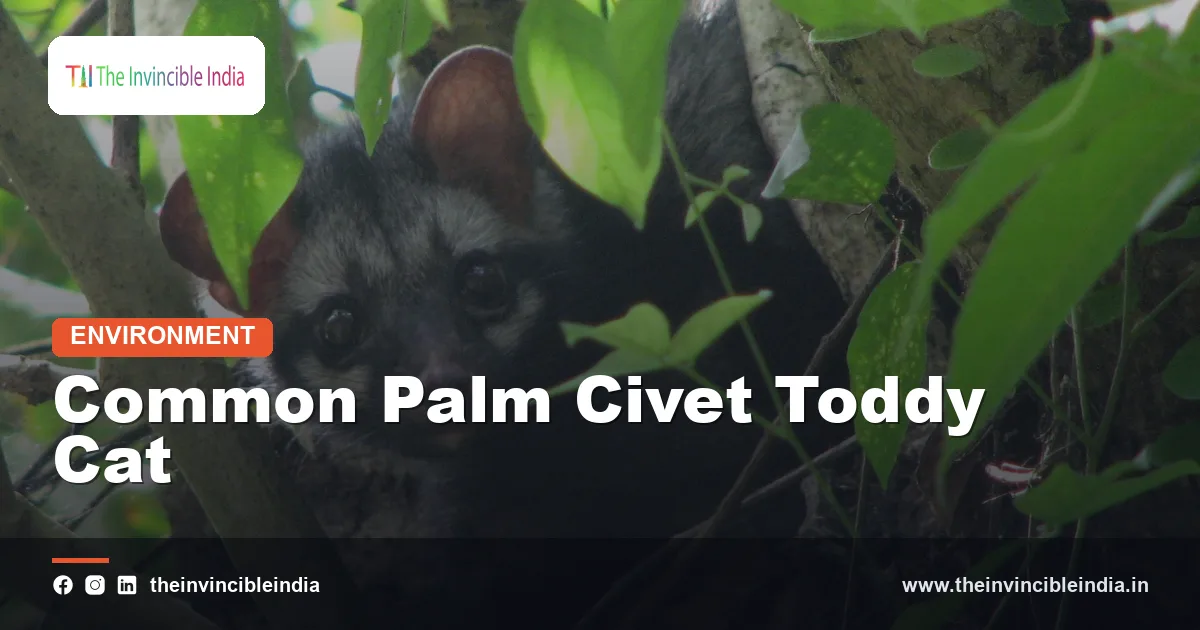
The common palm civet (Paradoxurus hermaphroditus), also called the toddy cat, is a nocturnal, cat-sized, tree-climbing mammal of the civet family that lives in forests, plantations, gardens and even towns across India and eats mainly fruit, small animals and sweet palm sap. It is among the most adaptable wild carnivorans in South and Southeast Asia, and many Indians have heard it moving across a tiled roof at night without ever seeing it.
This explainer describes the common palm civet’s appearance, range, diet, breeding and behaviour, its role as a seed disperser, and the confusion with look-alike species. It pays special attention to one common mix-up: the common palm civet is a different animal from the brown palm civet, a separate species found only in the Western Ghats.
Quick Facts: Common Palm Civet
| Scientific name | Paradoxurus hermaphroditus |
|---|---|
| Other names | Toddy cat, Asian palm civet, musang (Malay) |
| Family | Viverridae (civets, genets and relatives) |
| Size | Head and body roughly 43 to 71 cm, tail roughly 40 to 66 cm; weight roughly 2 to 5 kg |
| Range and habitat | Widespread across India and South and Southeast Asia; forests, plantations, gardens, farmland edges and human settlements |
| Diet | Omnivore: fruit, berries, palm sap, insects, small birds, rodents, reptiles and eggs |
| Activity | Nocturnal and arboreal; usually solitary |
| Breeding | Litters of about two to five young after a gestation of roughly two months |
| Conservation status | Least Concern (IUCN); protected under India’s Wildlife (Protection) Act, 1972 |
Key Takeaways
- The common palm civet is a nocturnal, tree-climbing member of the civet family that weighs roughly two to five kilograms and has a long tail and a dark facial mask.
- The common palm civet is called the toddy cat because it climbs palms at night to lick the sweet fermenting sap collected by toddy tappers.
- The common palm civet (Paradoxurus hermaphroditus) is a different species from the brown palm civet (Paradoxurus jerdoni), which lives only in the rainforests of the Western Ghats.
- The common palm civet eats large amounts of fruit and disperses the seeds in its droppings, which helps forests regenerate.
- Despite its common name, the common palm civet is not a cat; it belongs to the family Viverridae and is a distant relative of mongooses and genets.
- The common palm civet is rated Least Concern by the IUCN, but it is protected in India and its capture for the trade in civet-processed coffee is a welfare concern.
What is the common palm civet?
The common palm civet is a medium-sized, omnivorous carnivoran in the family Viverridae, with a long body, short legs, a long tail and a grizzled grey-brown coat marked with black spots and stripes. Its scientific name is Paradoxurus hermaphroditus, and in English it is also known as the Asian palm civet and, in India, the toddy cat.
Civets are a group of small to medium carnivorans found in Africa and Asia. They resemble cats in size and agility, but they are more closely related to mongooses, genets and the binturong. Their skulls and teeth are shaped for an omnivorous diet, and many species supplement meat with plenty of fruit.
The common palm civet is one of the most widespread species of the family. It is generally treated as a single species in Indian field guides, although genetic studies have suggested that populations in different parts of Asia may represent more than one species. Researchers are still reviewing the classification, so exact naming of regional populations may change in future.
What does the common palm civet look like?
The common palm civet has a stocky, low-slung body with a pointed muzzle, a long unbanded tail, and a coat that ranges from grey to brownish-black with rows of dark spots along the flanks and back. Adults weigh around two to five kilograms, and males and females look much alike.
Face and fur
The face carries a dark mask with pale patches above and below the eyes and a pale area on the nose, which gives the animal an alert, slightly raccoon-like look. The legs, feet and tail tip are usually dark, and the fur is coarse. The tail is long and uniformly coloured, without the rings seen on genets.
Climbing equipment
The feet have five toes with sharp, semi-retractile claws and naked, padded soles. The wrist and ankle joints are flexible, and the animal can descend tree trunks head-first. It uses the tail for balance when it walks along branches and along wires, rafters and parapet walls.
Scent and smell
Palm civets have scent glands near the genitals which release an oily, musky secretion that is used for marking territory. People often describe the odour as musky and sweetish, and a frightened animal can release a stronger, sharper smell.
Why is the common palm civet called the toddy cat?
The common palm civet is called the toddy cat because it climbs palm trees at night to drink the sweet sap that tappers collect in pots, and because its cat-like size and manner suggest a small feline. Toddy is a mildly alcoholic drink made by fermenting sap from palms such as the coconut, palmyra and date palm.
Tappers in parts of southern and eastern India have long noticed that civets visit the collecting pots hung high on the trunks and lap up the sap. The fresh sap is rich in sugar, and the animals appear to enjoy it. Some accounts claim that the animals become intoxicated after drinking fermented sap, but this is difficult to prove and the sap is eaten mainly for sugar.
The name “toddy cat” is purely a common name. The animal is not a cat, and calling it a “palm civet” more accurately reflects both its family and its habit of living in and around palm and fruit trees.
Where does the common palm civet live in India?
The common palm civet lives across most of India, from forests and plantations in the south and the Western Ghats to the Himalayan foothills, the north-east and many wooded parts of the plains. It is especially tolerant of human-modified habitats and often shelters in the roofs, attics and trees of houses.
The animal needs trees. It rests during the day in tree hollows, in dense foliage, in the crowns of palms, in rock crevices, or in roof spaces and abandoned buildings. In cities with mature trees it can live in gardens, campuses, old bungalows and the edges of parks, and it often uses electric wires and tree branches as aerial walkways.
Outside India, the common palm civet is found in Nepal, Bhutan, Sri Lanka, Bangladesh, Myanmar, and much of mainland and island Southeast Asia. Because it adapts to farmland, plantations and mixed habitats, it is more resilient than many forest-dependent mammals. It generally avoids treeless open land and heavy, constant disturbance.
Is the common palm civet the same as the brown palm civet?
No, the common palm civet is a different species from the brown palm civet. The brown palm civet (Paradoxurus jerdoni), also called Jerdon’s palm civet, lives only in the evergreen forests of the Western Ghats, while the common palm civet is widespread across India and much of Asia.
The two are easy to confuse because both are palm civets of similar build. The brown palm civet is, however, plain dark brown without the spotted pattern on the body, and it is more strongly tied to dense, undisturbed rainforest and high-canopy habitat. The common palm civet tolerates plantations and towns.
| Feature | Common palm civet | Brown palm civet |
|---|---|---|
| Scientific name | Paradoxurus hermaphroditus | Paradoxurus jerdoni |
| Distribution | Widespread across India and Asia | Endemic to the Western Ghats |
| Coat | Grey-brown to blackish with spots or stripes | Uniform dark brown, spots absent or very faint |
| Habitat | Forests, plantations, gardens, towns | Evergreen and moist forest, mostly undisturbed |
| Tolerance of humans | High | Low |
| Typical sighting | Roofs, trees and garden edges at night | Rainforest canopy and plantation fringes in the hills |
Several other civets also live in India, including the small Indian civet, the large Indian civet, the masked palm civet of the north-east, the binturong, and the critically endangered Malabar civet. Each has its own build, markings and habitat, so identification usually relies on size, face pattern and tail features.
What does the common palm civet eat?
The common palm civet eats a mixed diet in which fruit dominates, supplemented by palm sap, insects, small vertebrates and eggs. It is an opportunist, and its meals change with the season and with whatever trees are fruiting nearby.
Typical foods
- Fruits such as figs, bananas, mangoes, papayas, berries and wild forest fruits
- Sweet sap from coconut, palmyra, date and other palms
- Insects such as beetles, grasshoppers and termites
- Small mammals, particularly rats and mice
- Lizards, frogs, small birds and eggs
- Occasional carrion and scraps near human settlements
A friend of the orchard and a nuisance of the roof
Because it likes ripe fruit, the common palm civet sometimes raids orchards and gardens, and it may leave droppings and urine in attics, which can be a nuisance. On the other hand, it consumes rodents and insects. This mixed record means that human attitudes vary from place to place.
Civet coffee
In parts of Asia, coffee beans eaten and excreted by palm civets are collected, cleaned and sold as an expensive specialty product. The best-known trade is in Indonesia, and small producers in India’s coffee-growing hills have also experimented with civet-processed coffee. Animal welfare groups warn that the commercial version often involves caged civets fed only coffee cherries, which is cruel and unhealthy for them.
How does the common palm civet behave?
The common palm civet is nocturnal, solitary and largely arboreal, spending the day asleep in a hollow, a roof space or dense foliage and emerging after dusk to forage. It moves quietly and quickly along branches, wires and walls, often following the same routes every night.
Individuals keep home ranges which they mark with scent. Males and females generally meet for breeding rather than living together. The animal communicates through scent marks, hisses, growls, spitting, and a sharp, cat-like calling sound when excited or threatened.
When alarmed, the animal freezes, flees up a tree, or defends itself with bites and a pungent spray. Its natural predators include leopards, large snakes such as pythons, large owls and, for young animals, feral dogs and other carnivores. In human-dominated areas, road traffic, dogs and hunting are the main dangers.
Palm civets are generally wary of people. They seldom attack humans, but like any wild mammal they may bite if cornered or handled, and they can carry parasites and diseases. Wildlife officials advise leaving them alone and calling a rescue service if one is trapped indoors.
How does the common palm civet breed?
The common palm civet breeds mainly in the warmer part of the year in many regions, and a female typically gives birth to about two to five young after a gestation of roughly two months. Timing varies across its wide range, and in tropical areas breeding can occur in more than one season.
The female prepares a nest in a tree hollow, a rock crevice, a thick tangle of vines, or a quiet corner of a roof. The newborns are small, covered with fine hair, and blind. They develop slowly, open their eyes within about a week or two, and begin to take solid food after several weeks.
The mother raises the young alone. Juveniles stay near the den for some months and then disperse. In captivity, palm civets can live a decade or more, and wild animals probably live for fewer years because of predators, accidents and disease.
Why does the common palm civet matter to forests?
The common palm civet matters to forests because it eats many kinds of fruit and spreads the seeds in its droppings, which helps plants colonise new ground. Seed dispersal by medium-sized mammals is a key service in tropical ecosystems, especially for trees whose seeds are too large for birds to move far.
Seeds that pass through a civet’s gut often germinate well, and they are deposited away from the parent tree and in a nutrient-rich package of dung. Studies in Asian forests have documented palm civets dispersing seeds of figs, berries and other fleshy fruits. By travelling at night over long routes, the animal links fruiting trees across fragmented landscapes.
The animal also keeps populations of rodents and large insects in check. In plantations and village gardens, this pest control is useful, though it is rarely noticed. For these reasons, ecologists regard the common palm civet as a quiet but valuable member of Indian ecosystems.
Is the common palm civet protected in India?
Yes, the common palm civet is protected in India under the Wildlife (Protection) Act, 1972, which forbids hunting, capturing, keeping or trading wild civets without permission. The IUCN rates the species as Least Concern globally because of its wide range and adaptability.
The main pressures on palm civets are habitat loss, road accidents, persecution around houses and orchards, and capture for the pet trade, bushmeat and the civet-coffee industry. In some parts of Asia, markets selling live wild animals have been linked to the spread of disease: civets sold in such markets, mainly masked palm civets, were implicated as carriers of the virus in the 2002-2003 SARS outbreak. This history is one reason why scientists and health agencies discourage the trade in wild animals.
Practical guidance for householders is simple. Do not trap or keep palm civets, seal attic entry points once the animal has left, and contact the forest department or a licensed wildlife rescue organisation in case of injury. Keeping garden fruit trees pruned and the compost covered reduces conflict.
Bottom Line
The common palm civet is a nocturnal, fruit-loving mammal that has adapted well to Indian orchards, plantations and rooftops. It is not a cat, it is not the same as the Western Ghats brown palm civet, and it plays a quiet role as a seed disperser and pest eater.
Frequently Asked Questions
What is a common palm civet?
A common palm civet is a nocturnal, tree-climbing mammal of the family Viverridae with a long tail, a spotted grey-brown coat and a dark facial mask. It lives across India and much of Asia, and eats fruit, palm sap, insects and small animals. It is also called the toddy cat.
Why is the common palm civet called the toddy cat?
The common palm civet is called the toddy cat because it climbs palms at night and drinks the sweet sap that tappers collect in pots. This sap is later fermented into toddy. The animal is not a true cat, though its size and agility make it look catlike.
Is the common palm civet the same as the brown palm civet?
No, they are different species. The common palm civet (Paradoxurus hermaphroditus) is widespread across India and Asia, while the brown palm civet (Paradoxurus jerdoni) is found only in the Western Ghats. The brown palm civet is plain dark brown and prefers dense forest.
Is the common palm civet dangerous to humans?
No, the common palm civet is not normally dangerous to humans. It is shy and avoids people, but like any wild animal it can bite if cornered or handled and may carry parasites or diseases. Anyone bitten should wash the wound thoroughly and seek medical advice.
What does a common palm civet eat?
A common palm civet eats mostly fruit, such as figs, bananas and berries, along with sweet palm sap. It also eats insects, rodents, lizards, small birds and eggs. This varied diet lets it live in forests, plantations and towns.
Is the common palm civet protected in India?
Yes, the common palm civet is protected in India under the Wildlife (Protection) Act, 1972. Hunting, capturing, keeping and trading wild civets are offences. The IUCN lists the species as Least Concern globally, but local threats include habitat loss, road accidents and illegal capture.
{“@context”:”https://schema.org”,”@graph”:[{“@type”:”FAQPage”,”mainEntity”:[{“@type”:”Question”,”name”:”What is a common palm civet?”,”acceptedAnswer”:{“@type”:”Answer”,”text”:”A common palm civet is a nocturnal, tree-climbing mammal of the family Viverridae with a long tail, a spotted grey-brown coat and a dark facial mask. It lives across India and much of Asia, and eats fruit, palm sap, insects and small animals. It is also called the toddy cat.”}},{“@type”:”Question”,”name”:”Why is the common palm civet called the toddy cat?”,”acceptedAnswer”:{“@type”:”Answer”,”text”:”The common palm civet is called the toddy cat because it climbs palms at night and drinks the sweet sap that tappers collect in pots. This sap is later fermented into toddy. The animal is not a true cat, though its size and agility make it look catlike.”}},{“@type”:”Question”,”name”:”Is the common palm civet the same as the brown palm civet?”,”acceptedAnswer”:{“@type”:”Answer”,”text”:”No, they are different species. The common palm civet (Paradoxurus hermaphroditus) is widespread across India and Asia, while the brown palm civet (Paradoxurus jerdoni) is found only in the Western Ghats. The brown palm civet is plain dark brown and prefers dense forest.”}},{“@type”:”Question”,”name”:”Is the common palm civet dangerous to humans?”,”acceptedAnswer”:{“@type”:”Answer”,”text”:”No, the common palm civet is not normally dangerous to humans. It is shy and avoids people, but like any wild animal it can bite if cornered or handled and may carry parasites or diseases. Anyone bitten should wash the wound thoroughly and seek medical advice.”}},{“@type”:”Question”,”name”:”What does a common palm civet eat?”,”acceptedAnswer”:{“@type”:”Answer”,”text”:”A common palm civet eats mostly fruit, such as figs, bananas and berries, along with sweet palm sap. It also eats insects, rodents, lizards, small birds and eggs. This varied diet lets it live in forests, plantations and towns.”}},{“@type”:”Question”,”name”:”Is the common palm civet protected in India?”,”acceptedAnswer”:{“@type”:”Answer”,”text”:”Yes, the common palm civet is protected in India under the Wildlife (Protection) Act, 1972. Hunting, capturing, keeping and trading wild civets are offences. The IUCN lists the species as Least Concern globally, but local threats include habitat loss, road accidents and illegal capture.”}}]}]}


