

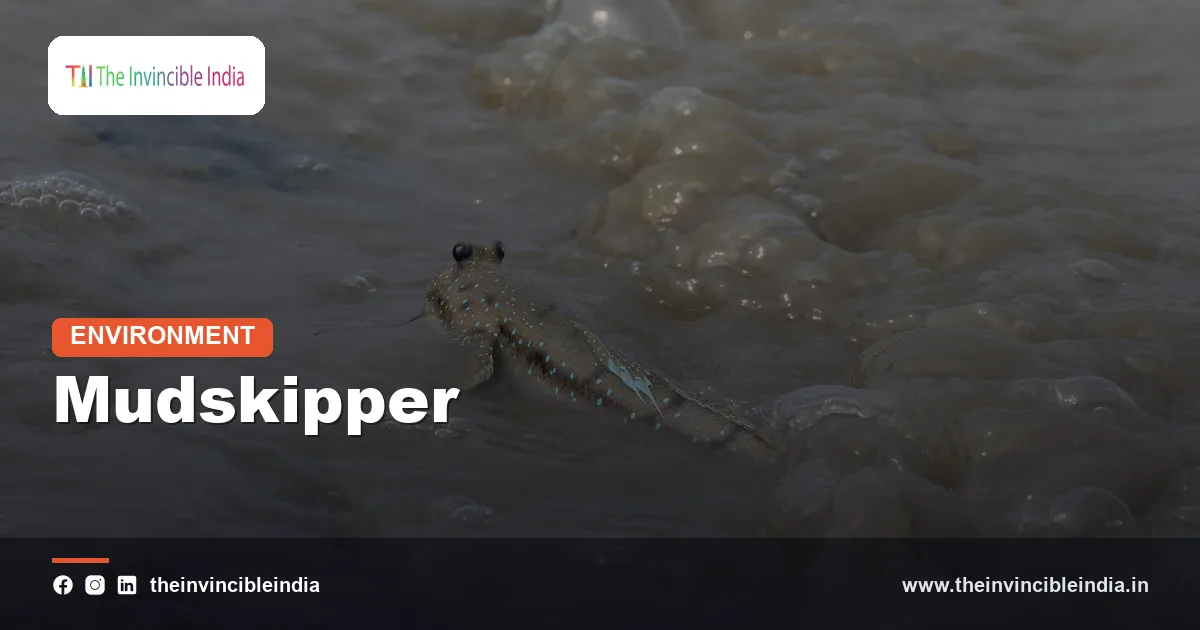
The mudskipper is a small amphibious fish of tidal mudflats and mangroves that can leave the water, breathe air through its moist skin and mouth lining, and skip, crawl and “walk” across mud using its strong pectoral fins. It lives on the muddy shores of the Indian coast, from the Sundarbans in the east to Gujarat in the west, and it is one of the most unusual fishes a visitor to an Indian estuary can see.
The mudskipper spends much of its life out of water, popping in and out of burrows and waving its fins to signal to rivals and mates. This article explains what the mudskipper is, how it breathes and moves on land, what it eats, how it breeds, and why it matters to coastal ecosystems in India.
| Feature | Detail |
|---|---|
| Common name | Mudskipper (also called mud-hopper or walking goby) |
| Scientific groups | Genera Periophthalmus, Boleophthalmus, Scartelaos and Periophthalmodon; subfamily Oxudercinae |
| Family | Oxudercidae (formerly placed in the goby family, Gobiidae) |
| Size | Mostly about 8 to 20 cm in length, depending on the species |
| India range and habitat | Mudflats, mangroves, estuaries and tidal creeks along the east and west coasts and the Sundarbans |
| Diet | Small crustaceans, insects and worms in some species; algae and diatoms from the mud surface in others |
| Breeding | Pairs spawn in mud burrows; males perform leaping and fin-display courtship; eggs are laid in an air-filled chamber |
| Respiration | Gills plus air breathing through skin and the lining of the mouth and gill chambers |
| Importance | Indicator of healthy mudflats and mangroves; prey for birds; local food in some regions |
Key Takeaways
- The mudskipper is an amphibious fish of the family Oxudercidae that lives on tidal mudflats and in mangroves and can stay out of water for long periods.
- A mudskipper breathes air by absorbing oxygen through its moist skin and the lining of its mouth and gill chambers, and it keeps water in enlarged gill chambers to stay wet.
- Mudskippers move over mud by using their muscular pectoral fins like crutches, and they can leap by flicking the tail.
- Mudskippers dig deep burrows in the mud, which they use for shelter at high tide, for escape from predators and for laying eggs.
- Male mudskippers court females by jumping, raising the dorsal fin and defending small territories on the mud.
- Mudskippers stir and aerate coastal mud, feed many birds and other predators, and are an indicator of healthy mangrove and mudflat habitat.
What is a mudskipper?
A mudskipper is a fish adapted to live partly on land, and it belongs to a group of gobies that spend much of their time out of the water on tidal mud. Scientists place the mudskippers in the family Oxudercidae, and the group includes genera such as Periophthalmus, Boleophthalmus, Scartelaos and Periophthalmodon.
The body is elongated and often brownish or grey, sometimes with blue or pale spots. The head is broad, and the eyes sit high on top, like periscopes, so the fish can see above the mud while the rest of its head is low. The pelvic fins are joined in a sucker-like disc, as in other gobies, and the pectoral fins are strong and arm-like.
The eyes of a mudskipper can be pulled back into pouches filled with fluid, which keeps them wet and protected. The mouth is wide, and in some species the teeth are large and sharp, while in others they are small and flattened for scraping algae.
Where are mudskippers found in India?
Mudskippers are found along the Indian coast on soft intertidal mudflats, in the creeks of mangrove forests and in estuaries, from the Sundarbans of West Bengal to Odisha, Andhra Pradesh, Tamil Nadu, Kerala, Karnataka, Goa, Maharashtra and Gujarat. They also occur in the mangroves of the Andaman and Nicobar Islands.
Several species occur in Indian waters, and they tend to occupy different zones of the shore. Some, such as the blue-spotted mudskipper (Scartelaos histophorus) and Boleophthalmus species, live on open mudflats that are exposed at low tide. Others, such as Periophthalmus novemradiatus, prefer the drier mud near mangrove roots and the upper shore.
- The Sundarbans mangroves of West Bengal hold dense populations on the tidal creek banks.
- The mudflats of Gujarat, including the Gulf of Kutch and Gulf of Khambhat, support large numbers of Boleophthalmus species.
- The Mumbai region and the Konkan creeks hold mudskippers in their remaining mangroves.
- The backwater and estuarine mudflats of the south-west coast host several species.
Mudskippers need soft mud, warm temperatures and tidal water, so they are found only on sheltered coasts. They do not live on sandy open beaches or rocky shores.
How does a mudskipper breathe out of water?
A mudskipper breathes out of water by taking in oxygen from the air through its moist skin and the lining of its mouth and throat, and by holding a bubble of water in its enlarged gill chambers. The fish also keeps its gills wet, and it must stay damp at all times to keep this system working.
The skin of the mudskipper is thin and richly supplied with blood vessels, so oxygen can pass directly through it, as in an amphibian. The fish closes its gill covers tightly to stop the gills from drying out and collapsing. When the skin begins to dry, the mudskipper returns to a pool or rolls in the mud to wet itself again.
The mudskipper cannot survive in dry conditions for long. It depends on wet mud, tide pools and burrows, and in hot weather it spends more time in the water or in shaded burrows.
Can a mudskipper live in water too?
Yes, a mudskipper can swim and breathe with its gills like any other fish, and it does so at high tide or when it needs to cool down. However, it prefers to stay at the surface and often returns to land. Mudskippers kept in an aquarium without a mud or rock bank to climb onto generally fail to thrive.
How does a mudskipper move on land?
A mudskipper moves on land by using its muscular pectoral fins like crutches, planting them on the mud and swinging the body forward, and by flicking its tail to leap. The movement is often called skipping, which gives the fish its name.
The pectoral fins have a joint-like elbow structure with strong muscles, and the fish can lift its body off the ground and move at a steady pace. When alarmed, the mudskipper bends its body and snaps the tail against the mud, launching itself forward in a quick jump of several body lengths.
The fish can also climb on mangrove roots and stones, helped by the sucker-like pelvic fins that cling to surfaces. This lets some species rest above the water level and bask in the sun.
| Movement | How it works | Use |
|---|---|---|
| Crutching | Pectoral fins plant on the mud and push the body forward | Normal movement on mudflats |
| Tail-flip jump | Body bends and tail snaps against the ground | Fast escape from predators |
| Climbing | Pelvic fin sucker and pectoral fins grip roots and rocks | Resting and basking above water |
| Swimming | Normal fish-like movement of tail and fins | Moving through water at high tide |
What does a mudskipper eat?
A mudskipper eats small animals or algae from the mud, depending on the species, and it feeds mainly at low tide when the mud is exposed. Species of Periophthalmus are mostly carnivores that catch small crabs, insects, worms and other invertebrates, while Boleophthalmus species are mainly algae-eaters that scrape diatoms and other algae from the mud surface.
The meat-eating species hunt with sharp eyesight, spotting small prey on the mud and pouncing on it. They may also catch flies and other insects near the water’s edge. The plant-eating species wave their heads from side to side and scrape up a thin layer of mud, then sift the food from it.
Because of this feeding, mudskippers help recycle nutrients in the mud, and their feeding on algae keeps the surface from forming thick mats. They are a link between tiny organisms on the mud and larger predators such as herons, kingfishers and crabs.
Why do mudskippers dig burrows?
Mudskippers dig burrows in the mud to shelter at high tide, to escape from predators, to avoid heat and to lay eggs. The burrow is a Y-shaped or U-shaped tunnel that can reach more than a metre in depth in some species, and it holds water even when the tide is out.
The burrow is a key part of the mudskipper’s life. Inside it, the fish finds a moist, cool shelter, and it can also gulp a bubble of air to store in the burrow chamber. In some species the mud around the burrow entrance is shaped into a small mound or chimney.
Burrowing also affects the mud itself. By digging, mudskippers bring air into the soil, mix the layers and help drain the mud, which supports the growth of mangrove roots and other organisms. Ecologists describe such animals as ecosystem engineers because they alter their physical surroundings.
How do mudskippers breed?
Mudskippers breed in burrows dug by the male, and the pair spawns in an egg chamber that holds a pocket of air. The male defends a territory on the mud, attracts a female by leaping and displaying, and then guards the eggs until they hatch.
The courtship display is dramatic. The male raises his large dorsal fin like a sail, bends his body, and springs into the air, repeating the jump to show off to females. He also chases rival males away from his patch.
The female lays sticky eggs on the roof of the chamber in the burrow, and the male fertilises them and keeps watch. The air pocket in the chamber supplies oxygen to the eggs. After the eggs hatch, the larvae are carried out with the tidal water, and they develop in the estuary before settling down as young fish on the mud.
- Males dig and defend the burrow.
- Courtship is a display of jumping and fin-raising.
- The egg chamber in the burrow holds a pocket of air.
- Larvae drift in the water before returning to the mudflats.
Why do mudskippers matter for the coast?
Mudskippers matter because they are abundant, link the mud to the food chain, shape the soil and act as an indicator of healthy mudflats and mangroves. A thriving population shows that the tidal mud is clean, soft and well connected to the sea.
They are an important food for herons, egrets, kingfishers, snakes, crabs and larger fishes. They are also food for people in some coastal areas, though this use is limited in India compared with some other parts of Asia.
Because mudskippers are sensitive to pollution and to changes in the mud, scientists study them to measure the effect of oil, heavy metals and sewage on coastal habitats. They also draw the interest of evolutionary biologists, since they show how fishes may have first adapted to life on land.
Are mudskippers threatened?
Most mudskipper species are not globally threatened, but their habitats are under pressure from mangrove clearance, land reclamation, pollution and development along the Indian coast. The fish itself is hardy, yet it depends on a narrow strip of tidal mud that is easy to destroy.
Threats include the conversion of mudflats to ports, aquaculture ponds, salt pans and housing, the dumping of waste, and oil and industrial pollution. Sea-level rise and storms also pose long-term risks to the intertidal zone.
Protecting mangroves and tidal flats, regulating coastal construction, and keeping creeks free of pollution support mudskipper populations. Indian laws on coastal regulation zones and the protection of mangroves, as well as sanctuaries such as the Sundarbans, give some of the habitat legal safeguards.
Bottom Line
The mudskipper is a hardy, quirky fish that lives between land and sea on Indian tidal mud. It breathes air, walks on its fins and digs burrows, and its presence signals a living mudflat. Protecting mangroves and estuaries is the best way to protect it.
Frequently Asked Questions
What is a mudskipper?
A mudskipper is an amphibious fish that lives on tidal mudflats and in mangroves and can spend long periods out of water. It breathes through its moist skin and mouth lining and moves by skipping and crawling on its pectoral fins. Several species live along the Indian coast.
Can a mudskipper live out of water?
Yes, a mudskipper can live out of water for long periods as long as its skin stays moist. It absorbs oxygen through its skin and the lining of its mouth and keeps water in its gill chambers. It must return to water or wet mud regularly to avoid drying out.
How does a mudskipper walk?
A mudskipper walks by planting its muscular pectoral fins on the mud like crutches and swinging its body forward. It can also leap by snapping its tail against the ground. Its pelvic fins form a sucker that helps it cling to roots and stones.
What does a mudskipper eat?
A mudskipper eats small crabs, insects and worms, or algae scraped from the mud, depending on the species. Periophthalmus species are mostly carnivores, while Boleophthalmus species mainly eat algae and diatoms. They feed mainly at low tide when the mud is exposed.
Where can you see mudskippers in India?
You can see mudskippers on tidal mudflats and mangrove creeks of the Indian coast, including the Sundarbans, the Odisha coast, the Gulf of Kutch and the Konkan creeks. The best time is at low tide on a warm day, when the fish are out on the mud. They are shy and dive into burrows if approached closely.
Why do mudskippers dig burrows?
Mudskippers dig burrows to shelter at high tide, to escape predators and heat, and to lay their eggs. The burrow holds water and an air pocket even when the tide is out. The male digs and guards the burrow during breeding.
{“@context”:”https://schema.org”,”@graph”:[{“@type”:”FAQPage”,”mainEntity”:[{“@type”:”Question”,”name”:”What is a mudskipper?”,”acceptedAnswer”:{“@type”:”Answer”,”text”:”A mudskipper is an amphibious fish that lives on tidal mudflats and in mangroves and can spend long periods out of water. It breathes through its moist skin and mouth lining and moves by skipping and crawling on its pectoral fins. Several species live along the Indian coast.”}},{“@type”:”Question”,”name”:”Can a mudskipper live out of water?”,”acceptedAnswer”:{“@type”:”Answer”,”text”:”Yes, a mudskipper can live out of water for long periods as long as its skin stays moist. It absorbs oxygen through its skin and the lining of its mouth and keeps water in its gill chambers. It must return to water or wet mud regularly to avoid drying out.”}},{“@type”:”Question”,”name”:”How does a mudskipper walk?”,”acceptedAnswer”:{“@type”:”Answer”,”text”:”A mudskipper walks by planting its muscular pectoral fins on the mud like crutches and swinging its body forward. It can also leap by snapping its tail against the ground. Its pelvic fins form a sucker that helps it cling to roots and stones.”}},{“@type”:”Question”,”name”:”What does a mudskipper eat?”,”acceptedAnswer”:{“@type”:”Answer”,”text”:”A mudskipper eats small crabs, insects and worms, or algae scraped from the mud, depending on the species. Periophthalmus species are mostly carnivores, while Boleophthalmus species mainly eat algae and diatoms. They feed mainly at low tide when the mud is exposed.”}},{“@type”:”Question”,”name”:”Where can you see mudskippers in India?”,”acceptedAnswer”:{“@type”:”Answer”,”text”:”You can see mudskippers on tidal mudflats and mangrove creeks of the Indian coast, including the Sundarbans, the Odisha coast, the Gulf of Kutch and the Konkan creeks. The best time is at low tide on a warm day, when the fish are out on the mud. They are shy and dive into burrows if approached closely.”}},{“@type”:”Question”,”name”:”Why do mudskippers dig burrows?”,”acceptedAnswer”:{“@type”:”Answer”,”text”:”Mudskippers dig burrows to shelter at high tide, to escape predators and heat, and to lay their eggs. The burrow holds water and an air pocket even when the tide is out. The male digs and guards the burrow during breeding.”}}]}]}


