

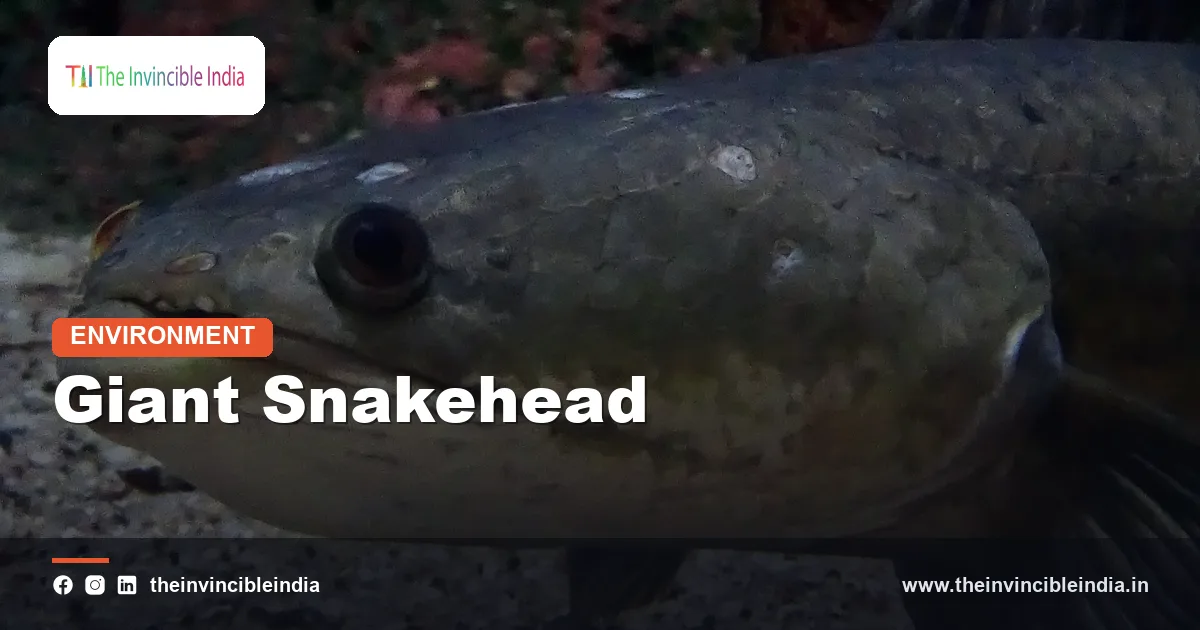
The giant snakehead (Channa marulius) is a large, air-breathing, predatory freshwater fish of South Asia, known in Indian trade as a murrel, that lives in rivers, lakes, reservoirs and weedy wetlands and is famous for the fierce way both parents guard their young. It is one of the biggest members of the snakehead family and is valued as a food fish and as a sport fish.
The giant snakehead gets its name from its long, cylindrical body and its flattened, scaly head, which resemble those of a snake. This article explains what the fish is, how it breathes air, what it eats, how it breeds and defends its young, and where it stands in Indian fisheries and conservation.
| Feature | Detail |
|---|---|
| Common names | Giant snakehead, bullseye snakehead, great snakehead; murrel in the fish trade; regional names such as sol, saul and gajal |
| Scientific name | Channa marulius |
| Family | Channidae (the snakeheads) |
| Size | Grows to well over a metre in length and can weigh many kilograms |
| India range and habitat | Rivers, canals, lakes, reservoirs and weedy wetlands across much of peninsular, northern and eastern India |
| Diet | Carnivorous: fish, frogs, crustaceans, snakes, insects and other small animals |
| Breeding | Builds a nest in vegetation; eggs float; both parents guard eggs and fry |
| Respiration | Breathes air with an accessory organ above the gills, in addition to gills |
| Economic importance | Food fish, sport fish and subject of limited aquaculture; Least Concern globally |
Key Takeaways
- The giant snakehead (Channa marulius) is a large predatory freshwater fish of the family Channidae that occurs across the Indian subcontinent and parts of Southeast Asia.
- A giant snakehead can breathe atmospheric air using a special chamber above its gills, so it survives in stagnant, oxygen-poor water where many other fish would die.
- The giant snakehead is an ambush predator that eats fish, frogs, crustaceans and other small animals, and it sits near the top of the food chain in the waters where it lives.
- Both parents of the giant snakehead guard the nest and the school of young fish, and they will attack intruders that come close.
- Young giant snakeheads are orange-red with dark stripes and a large eye-like spot at the base of the dorsal fin, while adults turn darker and more mottled.
- The giant snakehead is assessed as Least Concern worldwide, but local declines occur in India because of overfishing, pollution and loss of wetlands.
What is the giant snakehead?
The giant snakehead is the largest-growing of the common Indian snakeheads, a group of air-breathing predatory fishes in the family Channidae. Its scientific name is Channa marulius, and in older books it was sometimes called Ophiocephalus marulius.
The body is long, thick and nearly cylindrical, with a long dorsal fin and anal fin that run along most of the back and belly. The head is broad and flat with a large mouth full of sharp teeth, and the scales on the head resemble the plates of a snake. The overall colour is a dark olive or brown with lighter bands and spots on the sides.
The fish is often confused with other snakeheads, and Indian traders group several of them under the name murrel. The giant snakehead is distinguished by its size, the large number of rays in its dorsal fin and the eye-like spot on the young.
Where is the giant snakehead found?
The giant snakehead is found across the Indian subcontinent, including India, Pakistan, Nepal, Bangladesh and Sri Lanka, and extends into Myanmar and parts of Southeast Asia. In India it lives in the large rivers and their tributaries, and it also occurs in reservoirs, lakes, canals and weedy ponds.
It prefers calm or slow-flowing water with plenty of aquatic plants, submerged logs and rocks that provide cover for ambush. Clear, deep pools in rivers are also used, especially in the peninsular rivers and the foothill streams.
The fish has been introduced outside its native range. A population has become established in the state of Florida in the United States, where it is regarded as an invasive predator, and this has made the species a topic of study in invasion biology.
How does the giant snakehead breathe air?
The giant snakehead breathes air using a suprabranchial chamber, an air-filled cavity above the gills lined with a thin, richly supplied tissue that absorbs oxygen directly from the air. The fish rises to the surface and gulps air at intervals, and the oxygen passes through the chamber lining into the blood.
This ability makes the giant snakehead extremely hardy. It can live in warm, stagnant, muddy ponds and in drying pools where oxygen is very low. Snakeheads are in fact obligate air-breathers as adults, and they may drown if they are denied access to the surface for long.
The adaptation also helps the fish survive when water bodies shrink in the dry season. Snakeheads can stay alive in damp mud and may travel short distances over wet ground, which helps them reach new pools. The giant snakehead is less adept at overland movement than some smaller snakehead species.
What does the giant snakehead eat?
The giant snakehead is a carnivore that feeds mainly on other fish, and it also takes frogs, tadpoles, crustaceans, insects and occasionally small snakes, birds and rodents that come to the water. It hunts by ambush, waiting motionless among plants and rushing out to seize prey in a sudden strike.
The wide mouth and bands of sharp teeth hold struggling prey firmly. Young fish feed first on zooplankton, then on insect larvae, and later on small fish and crustaceans as they grow.
As a top predator, the giant snakehead helps control populations of smaller fish and amphibians in the waters where it lives. In fish ponds, however, it is regarded as a nuisance because it preys on stocked fish, and farmers try to keep it out of nursery ponds.
How does the giant snakehead breed and guard its young?
The giant snakehead breeds by building a nest in shallow water among plants, and the male and female stay together to guard the eggs and the fry. Breeding takes place mainly in the warmer months, often before and during the monsoon.
The pair clears a circular patch of vegetation, then spawns repeatedly in the cleared area. The eggs contain an oil droplet that makes them float, so they rise to the surface of the nest, where they are protected from the muddy bottom.
After hatching, the tiny fry stay together in a dense, dark school that moves close to the surface. The parents swim beside and around the school, and they drive away fish, frogs and other animals that approach. The brood is guarded for several weeks, until the young are big enough to disperse.
Why is the guarding behaviour important?
The guarding raises the survival of the young. In water full of predators, an unguarded school of fry would be eaten quickly. In this species both parents take part, which is unusual among freshwater fish, and the care continues after the eggs have hatched.
- The pair builds a circular nest in vegetation.
- Floating eggs rise to the surface of the nest.
- Both parents guard the eggs and then the swimming fry.
- The fry stay in a tight school, often visible as a moving dark patch.
How does the young giant snakehead differ from the adult?
The young giant snakehead looks very different from the adult, because juveniles are bright orange or reddish with dark lateral stripes, while adults are dark and mottled. The change occurs as the fish grows and moves from the brood school into more independent life.
Juveniles also carry a prominent eye-like spot, called an ocellus, near the base of the dorsal fin. The spot fades as the fish matures, though it may remain faintly visible in some individuals. The bright colour of the young makes the school easy to see, and it is likely a signal to the guarding parents.
The large size of the adult is a point of interest to anglers. Big fish are strong fighters that can break light tackle, and they are the reason that the giant snakehead has a following among sport fishers in India.
How is the giant snakehead different from other Indian snakeheads?
The giant snakehead is the largest of the common Indian snakeheads and differs from the others in size, markings and habitat. Several species share Indian waters, and traders often group them together as murrels.
| Species | Common name | Typical features |
|---|---|---|
| Channa marulius | Giant snakehead | Largest; eye-like spot on young; rivers, lakes and reservoirs |
| Channa striata | Striped snakehead | Medium to large; dark body with faint bands; ponds, tanks and paddy fields |
| Channa punctata | Spotted snakehead | Small; spotted body; widely found in ponds and ditches |
| Channa gachua | Dwarf snakehead | Small; found in streams and hill waters |
| Channa diplogramma | Malabar snakehead | Medium-sized, with a banded pattern; restricted to streams and rivers of the Western Ghats region |
The striped snakehead is the species most often raised in ponds, while the spotted snakehead is common and cheap in markets. The giant snakehead is mostly a wild-caught fish, although experiments in its culture have been carried out.
Is the giant snakehead good to eat?
Yes, the giant snakehead is eaten in many parts of India and is valued for firm, white flesh that has few small bones. The fish is cut into thick steaks and cooked in curries, fried, or grilled.
Murrels as a group are well-regarded in several regional cuisines, including those of Kerala, Karnataka, Tamil Nadu, Andhra Pradesh, Odisha and Bengal. In some communities, snakehead flesh is traditionally given to people who are recovering from illness or surgery. This is a folk belief, and nutrition science supports only the general point that the fish is a good source of protein.
Because the fish can live out of water for a while in damp conditions, it is often sold alive in markets, which is preferred by buyers who want fresh fish. Live sale also keeps the fish fresh without ice.
Can the giant snakehead be farmed or used for sport?
The giant snakehead can be farmed on a small scale, but its predatory habit and slow supply of seed limit commercial culture. Farmers must give it live prey or formulated feed, and they must keep it away from other fish in the same pond.
The species has a following among anglers, who fish for it with live bait, lures and flies from the banks of reservoirs and rivers. Sport fishers value its power, its sudden strikes and its aggressive character, and many practise catch-and-release to protect local stocks.
Its tolerance of poor water and its high market price have encouraged research on hatchery breeding and nursery rearing. The work aims to supply seed for both aquaculture and for restocking of depleted wetlands.
Is the giant snakehead a threatened species?
The giant snakehead is assessed by the International Union for Conservation of Nature (IUCN) as Least Concern across its range, but local populations in India have declined. The species is widespread, adaptable and able to breathe air, so its overall risk is low.
The main threats are overfishing, the use of poison and destructive nets, pollution, the filling of wetlands and the construction of dams that fragment rivers. The fish is particularly vulnerable during the breeding season, when the pair stays in a visible nest and can be netted easily.
Protecting wetlands and breeding sites, limiting fishing during the nesting months and leaving the guarding parents undisturbed help maintain populations. The giant snakehead is also an indicator of healthy, vegetated wetlands, because it needs cover and clean shallow areas for breeding.
Bottom Line
The giant snakehead is a powerful, air-breathing predator and a devoted parent, one of the most distinctive fishes of Indian rivers and wetlands. It remains widespread, but it needs vegetated, connected waters and some protection during nesting if local populations are to hold up.
Frequently Asked Questions
What is a giant snakehead?
A giant snakehead is a large, air-breathing predatory freshwater fish, Channa marulius, in the snakehead family Channidae. It lives in rivers, lakes and reservoirs of the Indian subcontinent and Southeast Asia. It is known in the fish trade as a murrel and is eaten in many regions.
How does the giant snakehead breathe air?
The giant snakehead breathes air through an air-filled chamber above its gills that absorbs oxygen from gulps of air taken at the surface. This lets it survive in stagnant, oxygen-poor water. Adults need access to the surface and can drown if they are kept from it.
What does the giant snakehead eat?
The giant snakehead eats mainly fish, along with frogs, crustaceans, insects and sometimes small snakes or birds. It hunts by ambush, striking suddenly from among plants. Young fish begin with zooplankton and small insects.
How big does the giant snakehead grow?
The giant snakehead grows to well over a metre in length and can weigh many kilograms, making it the largest of the common Indian snakeheads. Size varies with food supply and water. Very large fish are now uncommon where fishing pressure is high.
Do giant snakeheads protect their young?
Yes, both parents of the giant snakehead guard the nest and then the school of young fish. They drive away fish, frogs and other animals that come near. The care lasts for several weeks after hatching.
Is the giant snakehead dangerous to humans?
The giant snakehead is not dangerous to humans in general, but its sharp teeth can inflict a bite on anyone who handles it carelessly. Guarding parents may rush at objects near the nest, including a hand or a net. Fish handlers use a firm grip behind the head and keep their fingers away from the mouth.
{“@context”:”https://schema.org”,”@graph”:[{“@type”:”FAQPage”,”mainEntity”:[{“@type”:”Question”,”name”:”What is a giant snakehead?”,”acceptedAnswer”:{“@type”:”Answer”,”text”:”A giant snakehead is a large, air-breathing predatory freshwater fish, Channa marulius, in the snakehead family Channidae. It lives in rivers, lakes and reservoirs of the Indian subcontinent and Southeast Asia. It is known in the fish trade as a murrel and is eaten in many regions.”}},{“@type”:”Question”,”name”:”How does the giant snakehead breathe air?”,”acceptedAnswer”:{“@type”:”Answer”,”text”:”The giant snakehead breathes air through an air-filled chamber above its gills that absorbs oxygen from gulps of air taken at the surface. This lets it survive in stagnant, oxygen-poor water. Adults need access to the surface and can drown if they are kept from it.”}},{“@type”:”Question”,”name”:”What does the giant snakehead eat?”,”acceptedAnswer”:{“@type”:”Answer”,”text”:”The giant snakehead eats mainly fish, along with frogs, crustaceans, insects and sometimes small snakes or birds. It hunts by ambush, striking suddenly from among plants. Young fish begin with zooplankton and small insects.”}},{“@type”:”Question”,”name”:”How big does the giant snakehead grow?”,”acceptedAnswer”:{“@type”:”Answer”,”text”:”The giant snakehead grows to well over a metre in length and can weigh many kilograms, making it the largest of the common Indian snakeheads. Size varies with food supply and water. Very large fish are now uncommon where fishing pressure is high.”}},{“@type”:”Question”,”name”:”Do giant snakeheads protect their young?”,”acceptedAnswer”:{“@type”:”Answer”,”text”:”Yes, both parents of the giant snakehead guard the nest and then the school of young fish. They drive away fish, frogs and other animals that come near. The care lasts for several weeks after hatching.”}},{“@type”:”Question”,”name”:”Is the giant snakehead dangerous to humans?”,”acceptedAnswer”:{“@type”:”Answer”,”text”:”The giant snakehead is not dangerous to humans in general, but its sharp teeth can inflict a bite on anyone who handles it carelessly. Guarding parents may rush at objects near the nest, including a hand or a net. Fish handlers use a firm grip behind the head and keep their fingers away from the mouth.”}}]}]}


