

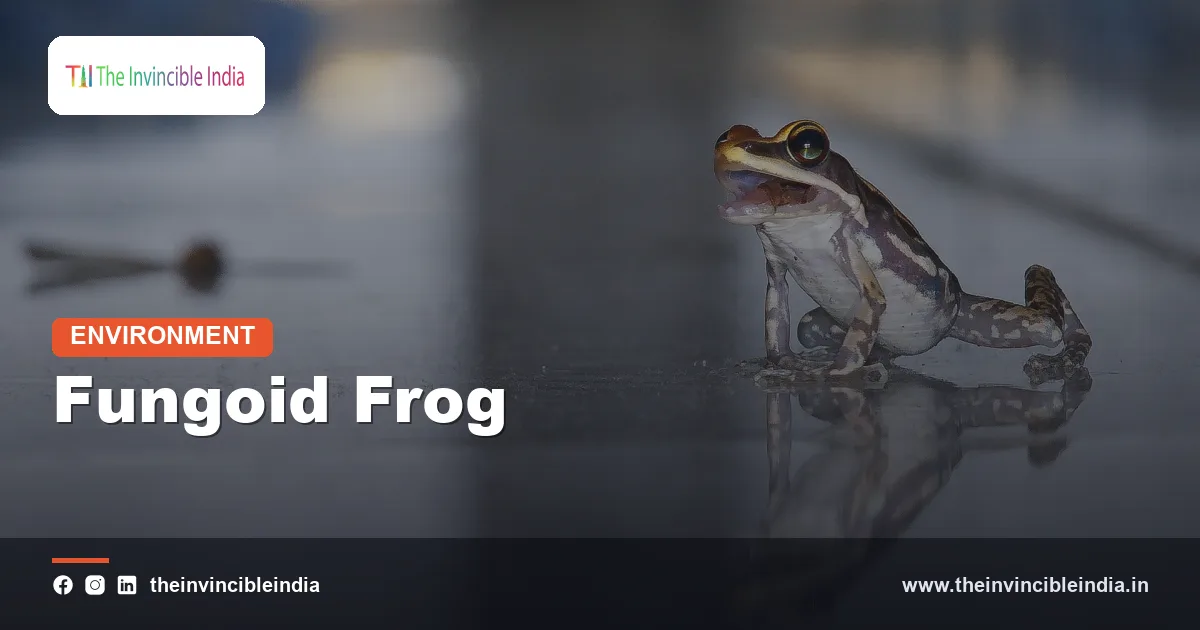
The fungoid frog (Hydrophylax malabaricus) is a medium-sized true frog of the Western Ghats and peninsular India, named for the dark, fungus-like blotches that mark its brownish back, and it is most easily seen and heard around ponds and streams during the monsoon. The fungoid frog belongs to the family Ranidae, the true frogs, and it is a common, adaptable amphibian of forest streams, plantations, paddy fields and village ponds.
Many people in southern and western India hear the fungoid frog long before they ever see it. Its calls rise from flooded fields and woodland pools on rainy nights, and its life closely follows the rhythm of the monsoon. Understanding the fungoid frog shows how much amphibians depend on seasonal rain, clean water and leaf litter.
Quick Facts About the Fungoid Frog
| Common name | Fungoid frog (the species name malabaricus refers to the Malabar region) |
|---|---|
| Scientific name | Hydrophylax malabaricus (formerly placed in the genus Hylarana or Rana) |
| Family | Ranidae (true frogs) |
| Size | Medium-sized; adults generally measure about 5 to 8 cm from snout to vent, with females larger than males |
| India range and habitat | Western Ghats and adjoining parts of peninsular India; forest streams, ponds, marshes, paddy fields, plantations and gardens |
| Diet | Insects, spiders and other small invertebrates |
| Breeding | Monsoon breeder; males call near water, eggs are laid in still or slow water and develop into free-swimming tadpoles |
| Conservation status | Least Concern on the IUCN Red List; widespread in suitable habitat |
Key Takeaways
- The fungoid frog, Hydrophylax malabaricus, is a medium-sized true frog that is common in the Western Ghats and in the wetter parts of peninsular India.
- The fungoid frog is named after the dark, patchy markings on its back, which look somewhat like fungus or lichen growing on bark.
- Fungoid frogs breed during the monsoon, when males call from the edges of ponds and streams to attract females.
- The fungoid frog feeds on insects, spiders and other small invertebrates, and it helps to keep insect numbers in check around farms and villages.
- The fungoid frog has a life cycle that includes eggs, aquatic tadpoles, froglets and adults, like most frogs.
- The fungoid frog is currently of Least Concern, but its freshwater habitats are vulnerable to pollution and drainage.
What Is the Fungoid Frog?
The fungoid frog is a species of true frog in the family Ranidae, scientifically called Hydrophylax malabaricus, and it is one of the common frogs of southern and western India. The word fungoid means resembling a fungus, and the frog earned the name from the mottled, uneven dark patches on its skin.
The species has been moved between genera over the years. Older field guides may list it as Rana malabarica, and later it was commonly placed in Hylarana before being assigned to Hydrophylax. Such changes in names do not alter the animal itself, but they can confuse anyone comparing old and new sources.
In India, the Western Ghats are recognised as one of the world’s major amphibian diversity hotspots, with many species found nowhere else. The fungoid frog is not restricted to such a tiny range, but it is a characteristic member of the amphibian community of the region.
What Does a Fungoid Frog Look Like?
A fungoid frog is a slender, long-legged frog with a pointed snout, brownish to greyish-olive upper surface and dark irregular spots that resemble fungus. The underside is pale, often whitish, and the hind limbs show dark crossbars that help the frog blend into leaf litter and mud.
Key identifying features include:
- A triangular head with a pointed snout and prominent, horizontally oval eyes
- Thin ridges, called dorsolateral folds, running along each side of the back
- Dark, patchy spots on a pale brown or olive back
- Strong hind legs with webbed toes for powerful jumps and swimming
- A distinctly visible eardrum (tympanum) behind each eye
Colour varies with age, habitat and breeding condition. Breeding males may look slightly different from females and typically have vocal sacs that are used in calling. Females are generally larger in body size than males.
Where Does the Fungoid Frog Live in India?
The fungoid frog lives mainly in the Western Ghats and adjoining parts of peninsular India, including the coastal plains and foothills of states such as Kerala, Karnataka, Goa, Maharashtra and Tamil Nadu. It occupies habitats that are wet during the monsoon and that offer cover on the ground.
Typical places to find the species are:
- Forest streams and the pools beside them
- Ponds, tanks and temporary rain pools
- Paddy fields and irrigation channels
- Plantations of coffee, tea, arecanut, rubber and cardamom
- Gardens and damp areas near villages
Because the fungoid frog tolerates some disturbance, it can persist in farmland where more specialised frogs have vanished. It still depends on unpolluted freshwater, and it is most abundant where there is a mosaic of water, leaf litter and vegetation.
What Does the Fungoid Frog Eat?
The fungoid frog eats insects, spiders and other small invertebrates, which it catches with a quick strike of its sticky tongue. Beetles, crickets, ants, flies and moths are common prey, and the frog usually hunts at night near the water’s edge or among leaf litter.
The frog hunts by sitting still and waiting, or by short hops to approach a target, before flicking out its tongue. Prey is swallowed whole, and the frog uses its eyes to help push food down the throat. Tadpoles, in contrast, feed mainly on algae, plant matter and tiny organic particles in the water.
Frogs sit in the middle of the food chain. They control insect numbers, including some agricultural pests and mosquitoes, and they feed snakes, birds, monitor lizards, fish, mongooses and other predators. Fewer frogs generally means fewer food sources for these animals.
How Does the Fungoid Frog Breed?
The fungoid frog breeds mainly during the monsoon, when males gather at ponds, pools and slow streams and call loudly to attract females. After mating, the female lays eggs in water, and these develop into tadpoles that later change into small frogs.
The life cycle follows a standard amphibian pattern:
- Calling: males use their vocal sacs to produce repeated calls at night, usually after rain.
- Amplexus: the male clasps the female from behind while she lays eggs in shallow water.
- Eggs: laid in clusters or masses in still or slow-moving water.
- Tadpoles: free-swimming larvae that feed, grow limbs and gradually lose the tail.
- Froglets: tiny, fully formed frogs leave the water and disperse into land habitat.
The time taken for each stage depends on temperature and rainfall. Because ponds can dry up, tadpoles that develop quickly have an advantage in seasonal pools.
Why Do Fungoid Frogs Appear With the Monsoon?
Fungoid frogs appear with the monsoon because rain fills ponds and streams, raises humidity and creates the damp conditions that frogs need for breeding and for keeping their skin moist. Amphibians absorb water and oxygen partly through the skin, so they stay close to wet places.
Before the rains, many frogs spend dry weeks hidden in burrows, under logs and stones, or in moist crevices to avoid drying out. When the first heavy showers arrive, large numbers emerge at once and the night air fills with calls. This burst of activity is called explosive or seasonal breeding in many species.
For people in rural India, frog calls have long been a natural sign of the monsoon. A sudden silence in a pond that once echoed with frogs can be a warning that something has gone wrong with the water.
How Is the Fungoid Frog Different From Other Indian Frogs?
The fungoid frog differs from other Indian frogs mainly in its patchy, fungus-like back pattern, slim build and strong jumping ability, in contrast to burrowing or tree-dwelling species. The comparison below places it alongside a few frogs that people often see in the same areas.
| Frog | Scientific name | Key difference |
|---|---|---|
| Fungoid frog | Hydrophylax malabaricus | Slim, long-legged true frog with patchy fungus-like markings |
| Indian bullfrog | Hoplobatrachus tigerinus | Much larger and heavier, with a bulky build and strong jaws |
| Skipper frog | Euphlyctis cyanophlyctis | Smaller, floats at the water surface and skips across it |
| Indian balloon frog | Uperodon globulosus | Plump, short-limbed burrowing frog that puffs up |
| Common Indian toad | Duttaphrynus melanostictus | Dry, warty skin and short legs, belongs to the true toads |
The family Ranidae includes many of the frogs people recognise easily, with smooth skin, powerful legs and strong swimming ability. True toads, burrowing microhylids and tree frogs belong to other families.
Is the Fungoid Frog Poisonous or Harmful?
No, the fungoid frog is not harmful to people, and it does not bite or sting. Like many amphibians, its skin produces mucus and can carry mild defensive compounds, so it is best to avoid handling frogs, and any person who touches one should wash their hands afterwards.
Frogs are very sensitive to chemicals on human hands, such as soap, sunscreen and insect repellent, and handling can harm the animal. Observation from a distance, with a torch and a camera, is the best way to watch frogs. Frogs should never be picked up for display, food or amusement.
Is the Fungoid Frog Endangered?
The fungoid frog is not endangered: it is assessed as Least Concern on the IUCN Red List because it is fairly widespread and adaptable. Even so, amphibians worldwide have declined faster than most other animal groups, and local populations can disappear when ponds and streams are lost or polluted.
The main pressures on frogs like the fungoid frog are:
- Drainage and filling of ponds, marshes and paddy wetlands
- Pesticides and fertilisers that wash into water
- Road traffic during rainy-night migrations to breeding sites
- Loss of forest cover and leaf litter in the Western Ghats
- Disease, including the fungal infection chytridiomycosis, which affects amphibians in many regions
- Collection for food or dissection in some places
Protecting wetlands, keeping village ponds clean and reducing chemical use are practical steps that help all frogs.
People can spot and help fungoid frogs by visiting ponds, streams and paddy edges on a rainy evening, listening for calls and using a torch to scan the banks gently. The best time is usually the first weeks of heavy monsoon rain. Responsible frog-watching follows a few simple habits:
- Walk slowly and avoid trampling banks and vegetation.
- Use a dim torch rather than a very bright light, which can startle frogs.
- Do not collect frogs or tadpoles from the wild.
- Keep pesticides and detergents away from ponds and drains.
- Photograph frogs and share records through citizen-science platforms to help researchers.
How Do Fungoid Frogs Communicate and Avoid Predators?
Fungoid frogs communicate mainly through calls produced by males, and they avoid predators by staying still, relying on camouflage and leaping into water at the first sign of danger. Calling is the most noticeable part of their behaviour, and it peaks on warm, wet nights.
The call of the male is used to advertise his presence and position to females and to other males. Each frog species has its own call pattern, which is why biologists often identify frogs by sound rather than by sight. Choruses form when many males call together, and the noise can be heard from a considerable distance.
Defence relies on several simple strategies:
- Camouflage: the brownish, blotched back blends with leaf litter, mud and bark.
- Freezing: a frog sitting motionless is difficult for a predator to notice.
- Escape: powerful hind legs allow long leaps, and the frog often dives underwater and hides on the bottom.
- Timing: activity at night reduces exposure to daytime hunters such as birds.
Even so, many eggs and tadpoles are eaten by fish, insects, dragonfly larvae and birds. Only a small fraction of tadpoles survive to become adult frogs, which is why females lay many eggs.
What Is the Role of the Fungoid Frog in the Ecosystem?
The fungoid frog connects water and land by moving energy between the two: its tadpoles feed on algae and organic matter in water, while the adults eat insects on land and are themselves eaten by many predators. This two-stage life makes frogs an important link in the food web.
Frogs are often called indicator species because their thin, permeable skin makes them sensitive to pollution, changes in temperature and loss of moisture. A pond with healthy frog populations is generally a pond with reasonably clean water, adequate vegetation and a good supply of insects. When frog numbers fall sharply, scientists treat it as an early warning about wider environmental problems.
Bottom Line
The fungoid frog is a common, slender true frog of the Western Ghats and peninsular India, easily recognised by its fungus-like back pattern and its monsoon calls. Though currently of Least Concern, it relies on clean, seasonal water, and its presence is a useful sign that a pond or stream is healthy.
Frequently Asked Questions
What is a fungoid frog?
A fungoid frog is a medium-sized true frog, Hydrophylax malabaricus, found in the Western Ghats and parts of peninsular India. It is named for the dark, fungus-like patches on its back. It belongs to the family Ranidae.
Where is the fungoid frog found in India?
The fungoid frog is found mainly in the Western Ghats and adjoining parts of peninsular India. It lives in forest streams, ponds, paddy fields, plantations and gardens. It is most active during the monsoon.
What does the fungoid frog eat?
The fungoid frog eats insects, spiders and other small invertebrates. It hunts at night near water or among leaf litter and catches prey with its sticky tongue. Its tadpoles feed on algae and tiny plant matter.
When does the fungoid frog breed?
The fungoid frog breeds mainly during the monsoon. Males call from the edges of ponds and streams, and females lay eggs in the water. The eggs hatch into tadpoles that later turn into froglets.
Is the fungoid frog poisonous?
No, the fungoid frog is not dangerous to humans. Its skin can carry mild defensive substances like many amphibians, so wash your hands after any contact. It is better to watch frogs without handling them.
Is the fungoid frog endangered?
No, the fungoid frog is listed as Least Concern on the IUCN Red List. It is widespread and adapts to farmland and gardens. Even so, it needs unpolluted ponds and streams to survive in the long term.
{“@context”:”https://schema.org”,”@graph”:[{“@type”:”FAQPage”,”mainEntity”:[{“@type”:”Question”,”name”:”What is a fungoid frog?”,”acceptedAnswer”:{“@type”:”Answer”,”text”:”A fungoid frog is a medium-sized true frog, Hydrophylax malabaricus, found in the Western Ghats and parts of peninsular India. It is named for the dark, fungus-like patches on its back. It belongs to the family Ranidae.”}},{“@type”:”Question”,”name”:”Where is the fungoid frog found in India?”,”acceptedAnswer”:{“@type”:”Answer”,”text”:”The fungoid frog is found mainly in the Western Ghats and adjoining parts of peninsular India. It lives in forest streams, ponds, paddy fields, plantations and gardens. It is most active during the monsoon.”}},{“@type”:”Question”,”name”:”What does the fungoid frog eat?”,”acceptedAnswer”:{“@type”:”Answer”,”text”:”The fungoid frog eats insects, spiders and other small invertebrates. It hunts at night near water or among leaf litter and catches prey with its sticky tongue. Its tadpoles feed on algae and tiny plant matter.”}},{“@type”:”Question”,”name”:”When does the fungoid frog breed?”,”acceptedAnswer”:{“@type”:”Answer”,”text”:”The fungoid frog breeds mainly during the monsoon. Males call from the edges of ponds and streams, and females lay eggs in the water. The eggs hatch into tadpoles that later turn into froglets.”}},{“@type”:”Question”,”name”:”Is the fungoid frog poisonous?”,”acceptedAnswer”:{“@type”:”Answer”,”text”:”No, the fungoid frog is not dangerous to humans. Its skin can carry mild defensive substances like many amphibians, so wash your hands after any contact. It is better to watch frogs without handling them.”}},{“@type”:”Question”,”name”:”Is the fungoid frog endangered?”,”acceptedAnswer”:{“@type”:”Answer”,”text”:”No, the fungoid frog is listed as Least Concern on the IUCN Red List. It is widespread and adapts to farmland and gardens. Even so, it needs unpolluted ponds and streams to survive in the long term.”}}]}]}


