

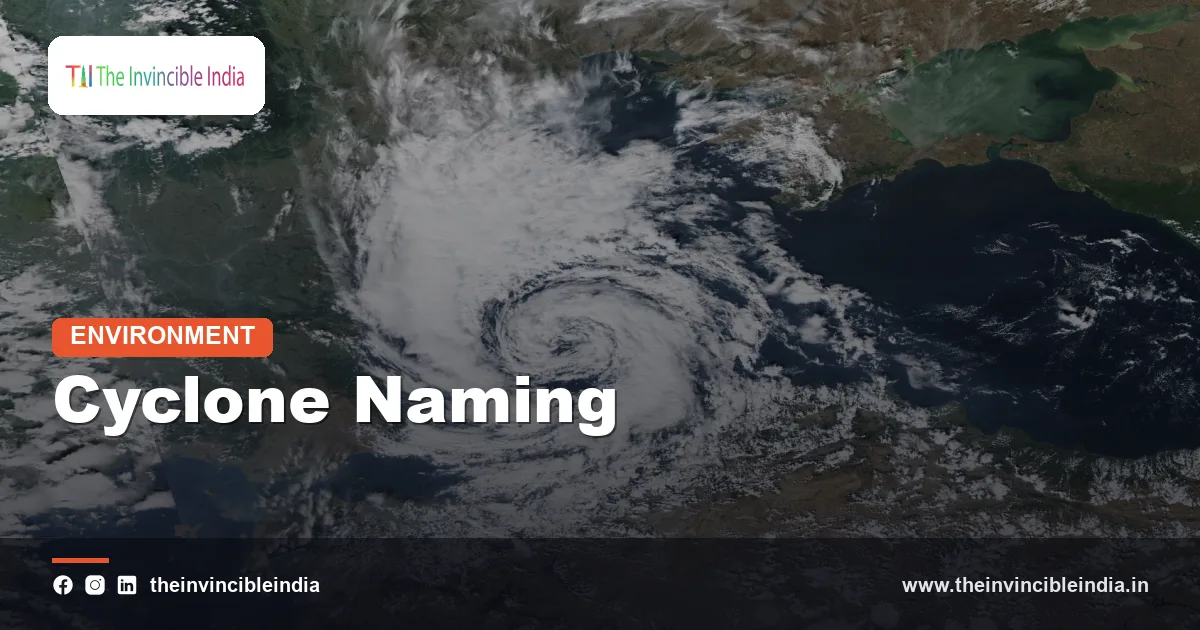
In the North Indian Ocean, cyclone naming is the agreed system by which India and twelve neighbouring countries give each tropical storm a short, distinctive name from a rotating list, so that forecasters, officials, the media and the public can discuss a single storm clearly. The India Meteorological Department (IMD) assigns the name once a system reaches cyclonic storm strength, and that name then stays with the storm until it dies out.
The names that Indians now associate with disaster, such as Amphan, Tauktae and Biparjoy, are not chosen by Indian meteorologists alone. They come from a table drawn up by thirteen countries ringing the Bay of Bengal and the Arabian Sea, each of which contributes names in its own language. Understanding cyclone naming explains why a storm off Odisha can carry a Thai word, why India supplies names like Gati and Tej, and why a name, once used, is never used again.
Quick Facts
| Region covered | The Bay of Bengal and the Arabian Sea (the North Indian Ocean basin) |
|---|---|
| Naming authority | IMD, which runs the Regional Specialised Meteorological Centre (RSMC) for tropical cyclones in New Delhi |
| Governing body | The WMO/ESCAP Panel on Tropical Cyclones, which has 13 member countries |
| Member countries | Bangladesh, India, Iran, Maldives, Myanmar, Oman, Pakistan, Qatar, Saudi Arabia, Sri Lanka, Thailand, United Arab Emirates and Yemen |
| Naming began | 2004, after the member countries agreed on a list in 2000 |
| Trigger for a name | Sustained winds of about 34 knots, roughly 62 kilometres per hour, which is the cyclonic storm stage |
| Current list | A list of 169 names, 13 from each country, released in 2020 after the first list ran out |
| Name length | Short and easy to pronounce, with a maximum of eight letters |
| Reuse | A name is never used a second time |
| Examples | Fani, Amphan, Tauktae, Yaas, Biparjoy, Michaung, Remal, Dana |
Key Takeaways
- Cyclone naming in the North Indian Ocean began only in 2004, decades after names were adopted in the Atlantic and Pacific, because the region’s many languages and cultures made agreement slow.
- The names come from the thirteen member countries of the WMO/ESCAP Panel on Tropical Cyclones, with each country contributing names in its own language.
- The IMD, through its New Delhi centre, is the only body authorised to name storms in the basin, and it does so when a system reaches cyclonic storm strength of about 62 kilometres per hour.
- Names must be neutral, short, easy to say, not offensive to any group and not tied to a person, and a name used once is never repeated.
- A fresh list of 169 names replaced the first list after it was exhausted with Cyclone Amphan in 2020, and the countries use their names in alphabetical order of country.
- The purpose is public safety: a single, clear name cuts confusion when several storms are active and makes warnings easier to remember and share.
Why are cyclones given names?
Cyclones are given names because a short, memorable name is far easier to communicate, track and remember than a technical label, and it reduces confusion when more than one storm is active at once. Before names, forecasters used a code such as a number and a letter, for example 02B for the second Bay of Bengal system of a year, which is accurate but forgettable.
The advantages are practical. A name can be broadcast quickly on radio, television and mobile alerts. It is easy to use in warnings that must reach fishers, farmers and villagers who may not read technical bulletins. It prevents mix-ups when two cyclones are active at the same time, one in the Bay of Bengal and one in the Arabian Sea. It also gives researchers, insurers and relief agencies an unambiguous label when they look back at past events.
Studies of public response in several countries suggest that people pay more attention to a named storm than to an unnamed disturbance, which helps awareness campaigns. A name does not change the storm in any way. It is simply a tag, applied consistently from the moment the system is strong enough to deserve one until it fades.
How did cyclone naming start in the North Indian Ocean?
Cyclone naming started in the North Indian Ocean when the member countries of the WMO/ESCAP Panel on Tropical Cyclones agreed on a naming scheme in 2000, and the first named storm under it appeared in 2004. The basin was one of the last in the world to adopt names.
Elsewhere, names were in use much earlier. Storms in the Atlantic have carried names since the early 1950s, and other basins followed over the next decades. In the North Indian Ocean, the delay arose partly from the region’s diversity. The coast is shared by countries with different languages, religions and political situations, and any name risked being offensive or inappropriate to some community. Officials were wary of names that might trigger sensitivity, so the discussion took years.
The WMO/ESCAP Panel on Tropical Cyclones was created in 1972 as a regional body to improve warnings, and it began with eight members: Bangladesh, India, Maldives, Myanmar, Oman, Pakistan, Sri Lanka and Thailand. After the 2000 agreement, each of the eight supplied names, and the first cyclone to be named under the system was Onil, in 2004. For many years afterwards the list ran in a fixed sequence, moving across the eight countries.
Who names cyclones in the North Indian Ocean?
In the North Indian Ocean, the India Meteorological Department names cyclones, acting as the Regional Specialised Meteorological Centre (RSMC) in New Delhi that the World Meteorological Organization designated for tropical cyclones in the basin. The names themselves come from the member countries, but only the RSMC assigns the next name in the sequence to a storm.
This division of labour is deliberate. The member countries propose names that fit the agreed rules. The panel approves them and publishes the table. When the IMD’s analysis shows a system has strengthened to cyclonic storm intensity, the centre simply takes the next name from the list and announces it in its bulletins. Other national weather services around the basin then use the same name, so that a storm has one identity from Oman to Myanmar.
The IMD also monitors the tropical cyclones of the region and issues forecasts, warnings and track predictions, including cyclone advisories that are shared with the other countries of the panel. The naming is therefore one part of a larger regional warning system rather than a stand-alone task.
Which countries are on the panel and how have the lists grown?
Thirteen countries are on the panel today: Bangladesh, India, Iran, Maldives, Myanmar, Oman, Pakistan, Qatar, Saudi Arabia, Sri Lanka, Thailand, the United Arab Emirates and Yemen. The panel started with eight members and expanded in 2018, when Iran, Qatar, Saudi Arabia, the United Arab Emirates and Yemen joined.
The first list, agreed in 2000, had 64 names, eight from each of the original eight countries. It was used in order over sixteen years, with Cyclone Amphan in May 2020 being the last name on the table. The panel had by then drawn up a replacement. In April 2020, the IMD released a new list of 169 names, 13 from each of the 13 members, which was designed to last for many years at the usual rate of about five to six named storms a year in the basin.
Names are used in a fixed order. The sequence runs alphabetically by country, from Bangladesh to Yemen, and then starts again with the next set of names from Bangladesh. Because storms do not form on a regular schedule, a country may see several of its names used in one year and none in another.
What are the rules for choosing a cyclone name?
The rules for choosing a cyclone name are that it should be short, easy to pronounce, culturally neutral and unlikely to offend any group, and that it must not be reused. These criteria were set out by the panel so that names can be accepted by all member countries.
The main guidelines are as follows:
- The name must be neutral to politics, religious belief, culture and gender, and must not hurt the sentiments of any group of people in the region.
- The name should not be the name of a living or historical person, or tied to a specific individual.
- It should be short and simple, with no more than eight letters, and be easy to pronounce in the languages of the region.
- It should not be rude, cruel or likely to cause distress, particularly to those affected by a storm.
- The name should not be one already used in this or another basin, to avoid confusion.
- Once a name has been used for a cyclone, it is not used again for another storm, so each name is permanent in the record.
The no-reuse rule differs from the practice in the Atlantic, where names are recycled on a six-year cycle and only the names of the most destructive storms are retired. In the North Indian Ocean, the lists are long enough that recycling is not needed.
At what point does a storm get a name?
A storm gets a name when it intensifies into a cyclonic storm, which means that its maximum sustained surface winds reach about 34 knots, roughly 62 kilometres per hour. Weaker systems, such as depressions and deep depressions, are identified by numbers and are not named.
The IMD classifies systems in the basin by the strength of their sustained winds. A low-pressure area gives way to a depression, with winds of about 17 to 27 knots, and then a deep depression, with 28 to 33 knots. At 34 to 47 knots the system is a cyclonic storm and receives its name. The stronger categories keep the same name. They are the severe cyclonic storm at 48 to 63 knots, the very severe cyclonic storm at 64 to 89 knots, the extremely severe cyclonic storm at 90 to 119 knots and the super cyclonic storm at 120 knots or more.
Not every depression reaches the threshold. Many weak systems form over the Bay of Bengal in the monsoon season and never strengthen to a named storm, which is why the monsoon depressions that bring heavy rain to central India do not carry names. Names are given to systems that threaten coasts with high winds and storm surges, rather than to the monsoon’s rain-bearing lows.
What do some well-known Indian cyclone names mean?
Well-known cyclone names in the North Indian Ocean usually draw on a word from the contributing country’s language, often a simple word for nature, wind, speed or a local plant, animal or place. Some of the recent storms that affected India show how varied the sources are.
- Fani (2019) was a name supplied by Bangladesh, the Bengali word for the hood of a snake, and the storm struck Odisha.
- Amphan (2020) was supplied by Thailand and means sky. It was the last name on the first list and caused severe damage in West Bengal and Bangladesh.
- Nisarga (2020), supplied by Bangladesh, means nature, and it was the first name on the new list of 169.
- Tauktae (2021) came from Myanmar and refers to a type of gecko, and the storm moved up India’s west coast to Gujarat.
- Yaas (2021), from Oman, is a word for jasmine, and the storm hit Odisha and West Bengal.
- Biparjoy (2023), from Bangladesh, means disaster or calamity in Bengali, and it made landfall near the Gujarat-Pakistan border after a long life over the Arabian Sea.
- Michaung (2023), from Myanmar, brought heavy rain to Chennai and the Andhra coast.
India itself has contributed names such as Vayu, Gati and Tej, along with others on the list, while other countries have supplied names like Asani from Sri Lanka and Mandous from the United Arab Emirates. A name rarely tells the story of the storm it labels, and for some communities the name later becomes a reminder of loss.
How do the names rotate by country?
The names rotate by country in alphabetical order, so each cyclone takes the next unused name from the table, which cycles from Bangladesh through India and Iran and onward to Yemen before returning to Bangladesh. The system is mechanical, which keeps it neutral and avoids any debate over who picks the name of a particular storm.
The sample below shows how the sequence works for recent years. It is simplified and covers only part of the table.
| Order | Country supplying the name | Example name | Storm and year |
|---|---|---|---|
| 1 | Bangladesh | Nisarga | Nisarga, 2020 |
| 2 | India | Gati | Gati, 2020 |
| 3 | Iran | Nivar | Nivar, 2020 |
| 4 | Maldives | Burevi | Burevi, 2020 |
| 5 | Myanmar | Tauktae | Tauktae, 2021 |
| 6 | Oman | Yaas | Yaas, 2021 |
| 7 | Pakistan | Gulab | Gulab, 2021 |
| 8 | Qatar | Shaheen | Shaheen, 2021 |
The pattern then continues through Saudi Arabia, Sri Lanka, Thailand, the United Arab Emirates and Yemen, after which the second round begins with another Bangladeshi name. In a later round, names such as Biparjoy and Michaung appeared in the same order.
Is the name of a cyclone ever changed or retired?
The name of a cyclone in the North Indian Ocean is not changed during the life of the storm and is not retired in the Atlantic sense, because a name is simply never used again once it has been given. This means that there is no formal list of retired names for the basin, and the used names form a permanent record.
A storm keeps its name even if it moves from the Bay of Bengal into the Arabian Sea after crossing land, or if it weakens and then re-intensifies. If a cyclone from the western Pacific crosses the Malay peninsula and enters the Bay of Bengal as a depression, it can be given a fresh North Indian Ocean name if it later reaches cyclonic storm strength. The name from the previous basin is not carried over.
This policy keeps the system simple but does mean that the list must be long. At the current rate, the table of 169 names is expected to serve for several decades, although the panel can revise or extend it if needed.
Why do names sometimes seem unusual or hard to pronounce?
Names sometimes seem unusual or hard to pronounce because they are drawn from thirteen different languages, including Bengali, Burmese, Thai, Arabic, Persian, Dhivehi, Sinhala and Hindi. A name chosen by one country may feel unfamiliar to people in another, even though it is a simple everyday word at home.
The panel’s rules about length and simplicity are meant to reduce this problem, but they cannot remove it entirely. Weather agencies add short guides to pronunciation where needed, and the IMD uses a standard English transliteration for all bulletins. Because the list is public, it is easy to see what the next names will be, although the exact name to be used depends on how many storms form.
Critics have sometimes asked whether a more local or descriptive system would work better in a country with many languages. Supporters of the current method answer that the shared list is a symbol of regional cooperation and that, in practice, people adopt a storm’s name quickly once it appears in news bulletins.
Bottom Line
Cyclone naming turns a technical weather system into a clear, shared warning. By agreeing on a rotating list of 169 neutral names and giving the IMD the job of assigning them, thirteen countries have made it easier to communicate danger across the Bay of Bengal and the Arabian Sea. Last updated: 2 November 2026.
Frequently Asked Questions
Who names cyclones in India?
The India Meteorological Department names cyclones in the North Indian Ocean through its Regional Specialised Meteorological Centre in New Delhi. It takes the next name from a list proposed by 13 member countries of the WMO/ESCAP Panel on Tropical Cyclones. The name is given when a system reaches cyclonic storm strength.
How many countries take part in naming North Indian Ocean cyclones?
Thirteen countries take part: Bangladesh, India, Iran, Maldives, Myanmar, Oman, Pakistan, Qatar, Saudi Arabia, Sri Lanka, Thailand, the United Arab Emirates and Yemen. The panel started with eight members and added five in 2018. Each country supplies names in its own language.
At what wind speed does a storm get a name?
A storm gets a name when its sustained surface winds reach about 34 knots, or roughly 62 kilometres per hour. This is the cyclonic storm stage. Weaker depressions and deep depressions are not named and are known only by numbers.
Why do Indian cyclones have Thai or Bangladeshi names?
Cyclones have names from other countries because the naming list is a shared one. Each of the 13 member countries supplies a set of names, and they are used in alphabetical order of country. For example, Amphan came from Thailand, Tauktae from Myanmar and Biparjoy from Bangladesh.
Are cyclone names reused?
No, a name used for a cyclone in the North Indian Ocean is never used again. This differs from the Atlantic, where lists are recycled and only the names of the worst storms are retired. The list of 169 names is long enough to avoid reuse for many years.
When did cyclone naming start in the North Indian Ocean?
Naming was agreed by the panel members in 2000 and started in 2004. The first list of 64 names was used until Cyclone Amphan in 2020. A new list of 169 names, released in April 2020, replaced it.
{“@context”:”https://schema.org”,”@graph”:[{“@type”:”FAQPage”,”mainEntity”:[{“@type”:”Question”,”name”:”Who names cyclones in India?”,”acceptedAnswer”:{“@type”:”Answer”,”text”:”The India Meteorological Department names cyclones in the North Indian Ocean through its Regional Specialised Meteorological Centre in New Delhi. It takes the next name from a list proposed by 13 member countries of the WMO/ESCAP Panel on Tropical Cyclones. The name is given when a system reaches cyclonic storm strength.”}},{“@type”:”Question”,”name”:”How many countries take part in naming North Indian Ocean cyclones?”,”acceptedAnswer”:{“@type”:”Answer”,”text”:”Thirteen countries take part: Bangladesh, India, Iran, Maldives, Myanmar, Oman, Pakistan, Qatar, Saudi Arabia, Sri Lanka, Thailand, the United Arab Emirates and Yemen. The panel started with eight members and added five in 2018. Each country supplies names in its own language.”}},{“@type”:”Question”,”name”:”At what wind speed does a storm get a name?”,”acceptedAnswer”:{“@type”:”Answer”,”text”:”A storm gets a name when its sustained surface winds reach about 34 knots, or roughly 62 kilometres per hour. This is the cyclonic storm stage. Weaker depressions and deep depressions are not named and are known only by numbers.”}},{“@type”:”Question”,”name”:”Why do Indian cyclones have Thai or Bangladeshi names?”,”acceptedAnswer”:{“@type”:”Answer”,”text”:”Cyclones have names from other countries because the naming list is a shared one. Each of the 13 member countries supplies a set of names, and they are used in alphabetical order of country. For example, Amphan came from Thailand, Tauktae from Myanmar and Biparjoy from Bangladesh.”}},{“@type”:”Question”,”name”:”Are cyclone names reused?”,”acceptedAnswer”:{“@type”:”Answer”,”text”:”No, a name used for a cyclone in the North Indian Ocean is never used again. This differs from the Atlantic, where lists are recycled and only the names of the worst storms are retired. The list of 169 names is long enough to avoid reuse for many years.”}},{“@type”:”Question”,”name”:”When did cyclone naming start in the North Indian Ocean?”,”acceptedAnswer”:{“@type”:”Answer”,”text”:”Naming was agreed by the panel members in 2000 and started in 2004. The first list of 64 names was used until Cyclone Amphan in 2020. A new list of 169 names, released in April 2020, replaced it.”}}]}]}


