

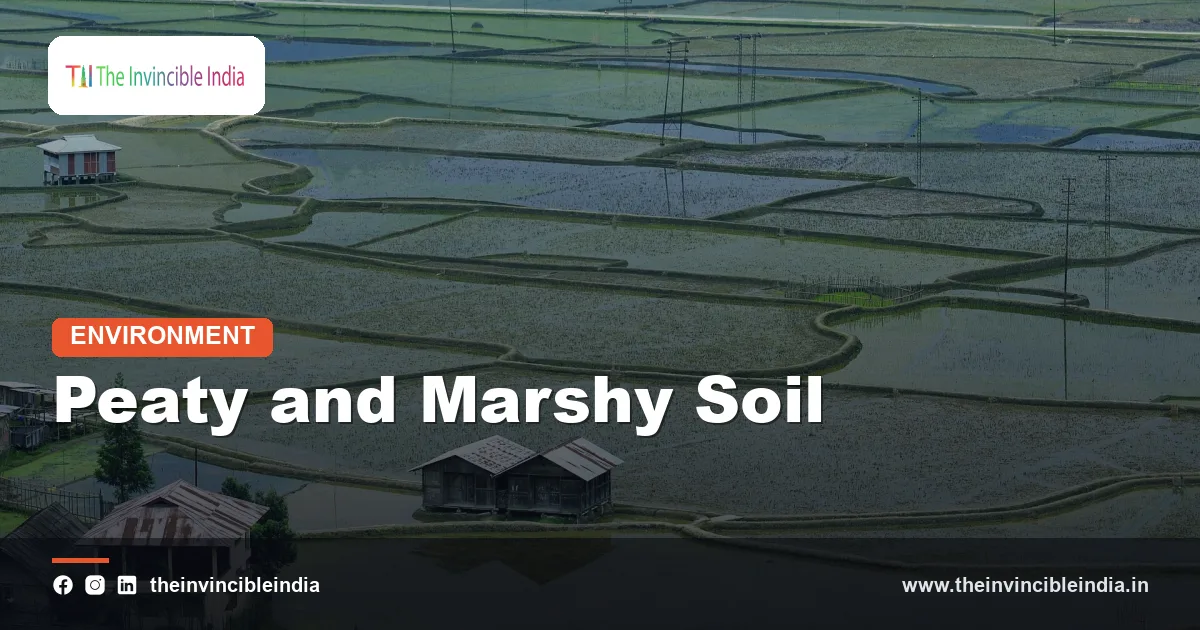
Peaty soil is the dark, spongy, waterlogged soil made largely of partly decayed plant matter that builds up in India’s marshes, backwaters and low coastal belts. Because it forms where water stands for most of the year and air is scarce, dead vegetation rots only slowly and piles up as peat instead of turning into ordinary humus. The most famous Indian example is the black, acidic kari soil of Kerala’s Kuttanad region, where rice is grown below sea level behind earthen dykes.
This guide explains how peaty and marshy soils form, where they occur in India, what makes them acidic and difficult to farm, how Kuttanad’s farmers have managed them and why draining or reclaiming them carries real environmental costs. It was last reviewed on 3 November 2026, and figures are described in general terms because peatland surveys in India remain patchy.
Quick Facts
| Feature | Dark, organic-rich soil formed in waterlogged, oxygen-poor conditions |
|---|---|
| Main materials | Partly decomposed roots, reeds, grasses and other marsh vegetation |
| Colour and feel | Black or deep brown, heavy, spongy and often with a sulphurous smell |
| Reaction | Strongly acidic, often with salts and toxic iron or sulphur compounds |
| Key Indian regions | Kuttanad and nearby Kerala lowlands, the Sundarbans, coastal Odisha, parts of Tamil Nadu’s coast and Almora hills in Uttarakhand |
| Famous local name | Kari soil in Kerala |
| Typical use | Paddy, coconut on raised bunds, fish and duck farming |
| Main concerns | Acidity, flooding, subsidence on drainage, loss of stored carbon |
Key Takeaways
- Peaty soil forms where waterlogging cuts off oxygen, so dead plants decompose slowly and accumulate as dark, organic-rich material instead of breaking down.
- In India, peaty and marshy soils are found mainly in Kerala’s Kuttanad, the deltaic and coastal strips of Odisha and West Bengal, some Tamil Nadu coastal pockets and a few hill basins such as Almora in Uttarakhand.
- These soils are typically strongly acidic and can contain harmful iron and sulphate compounds, which restrict the choice of crops and need careful water management.
- Kerala’s kari lands and Kuttanad show how farmers can cultivate below sea level using dykes, pumps and seasonal drainage, a system recognised internationally as an agricultural heritage landscape.
- Draining peat exposes it to air, so the soil shrinks, becomes more acidic and releases stored carbon, which is why wholesale reclamation is risky.
- Protecting wetlands and managing water levels often does more for these soils and the people who farm them than draining them for other uses.
What exactly are peaty and marshy soils?
Peaty and marshy soils are organic-rich, waterlogged soils that develop in marshes, swamps and low-lying coastal land where plant remains accumulate faster than they decay. The two names overlap but are not identical. Peat is the thick, brownish-black mass of partly rotted vegetation itself, while marshy soil is a wider term for the wet, often muddy soil of marshland that may contain a mix of organic material and fine mineral silt and clay.
Soil surveys in India group these soils into a single category of peaty and marshy soils, usually described as dark, heavy and rich in organic matter. Textbook accounts often cite organic content as high as around a third to a half of the soil by weight in the most peaty layers, though real values vary widely from place to place and layer to layer.
These are not the fertile loams that people usually imagine when they think of farmland. High organic content does not automatically mean high fertility, because the acidity, waterlogging and chemical imbalances in these soils limit what roots can use. They are better understood as wetland soils that can be farmed with special techniques than as ordinary agricultural soils.
How does peaty soil form?
Peaty soil forms when waterlogged ground starves decomposers of oxygen, so that fallen plant matter breaks down very slowly and builds up in layers over hundreds or thousands of years. In a well-drained soil, bacteria and fungi in the presence of air quickly consume dead leaves and roots. In a marsh or swamp, standing water fills the spaces between soil particles, air is excluded and decay slows to a crawl.
A humid climate and a steady supply of vegetation speed the process. Reeds, sedges, grasses and other marsh plants grow in abundance each season, die back and sink into the wet ground. Over time the accumulating material compacts into peat, which can become metres deep in the right conditions. Cool conditions help in temperate regions, but in the tropics, as in Kerala, heavy rainfall and permanently wet low ground do the job.
Coastal peaty soils have an extra history. In Kerala’s lowlands, the dark kari soils are widely described as the remains of ancient vegetation, including forest, buried when changes in sea level and the building of river deposits drowned the land. Dark layers of buried wood and organic matter lie under the surface in parts of Kuttanad, which fits the picture of a once-wooded coastal plain slowly submerged and covered with sediment.
Where are peaty and marshy soils found in India?
Peaty and marshy soils in India are found chiefly in Kerala’s coastal lowlands, in the deltaic and coastal belts of Odisha and West Bengal including the Sundarbans, in pockets of the Tamil Nadu coast and in a few hill basins such as the Almora region of Uttarakhand. They occupy a small share of the country’s land compared with alluvial, black or red soils, but they matter far more than their area suggests because they sit in wetlands that support fisheries, birds and flood buffering.
In Kerala, the districts around Vembanad Lake, notably Alappuzha, Kottayam and parts of Pathanamthitta and Ernakulam, hold the best-known examples. The Kuttanad rice bowl and neighbouring wetlands rely on these soils. Along the east coast, the low tidal plains of the Mahanadi, Subarnarekha and Ganga deltas contain marshy soils mixed with saline clay, and in the Sundarbans the mangrove-covered mud is a muddy, salty, organic-rich soil that blends marsh and mangrove conditions.
Small patches also occur in the Himalayan foothills and hill basins where drainage is poor, and some high-altitude wetlands develop peat-like deposits. Because systematic national surveys of peat are limited, estimates of the total area and thickness of peatland in India are uncertain, and researchers have called for better mapping.
What is kari soil and why is it special to Kerala?
Kari soil is the black, heavy, strongly acidic and organic-rich peaty soil of Kerala’s low-lying Kuttanad and nearby areas, and it is special because it supports one of the world’s few systems of rice cultivation below sea level. The Malayalam word kari means black or charcoal, and the soil is exactly that: a dark, sticky, clay-rich material mixed with decaying vegetation and, in many places, buried wood.
Kari soil is notable for its chemistry as well as its colour. It is highly acidic, partly because of sulphur compounds that form when iron sulphide minerals in the waterlogged soil are exposed to air and oxidise to sulphuric acid. Such soils are often called acid sulphate soils. They also tend to carry high levels of soluble salts and, when acidified, high concentrations of iron and aluminium that can harm rice roots.
In Kuttanad, the acid problem becomes worst at certain times of the year. During the dry months, sea water pushes into the backwaters and the soil dries and oxidises, so acidity rises. When the monsoon floods arrive, they flush acid out of the soil but also wash it into the lake and canals, sometimes causing fish kills. Farmers and agricultural scientists have to time the planting, flooding and flushing of fields with great care.
How is rice grown below sea level in Kuttanad?
Rice is grown below sea level in Kuttanad by enclosing low-lying fields within earthen dykes, pumping out water to prepare the land for planting, and growing the crop in the dry season before the monsoon floods return. The reclaimed paddy fields, known locally as kayal lands or polders, were created by farmers over the nineteenth and early twentieth centuries, who built bunds in shallow parts of Vembanad Lake and pumped out water to expose the fertile bed.
The result is a landscape unlike any other in India. Paddy fields lie below the level of the surrounding canals and lake, houses and coconut palms stand on narrow raised strips of land, and boats serve as everyday transport. Rice is grown in the dry season, and during the monsoon the fields are often left flooded and used for fishing. Ducks, fish and prawns add to farm incomes, making the system a combination of agriculture and aquaculture.
The importance of this landscape has been widely recognised. The Food and Agriculture Organization of the United Nations designated Kuttanad’s below-sea-level farming system as a Globally Important Agricultural Heritage System, and the Vembanad-Kol wetland that surrounds it is a Ramsar site of international importance. To control saltwater entry, the Thanneermukkom bund was built across Vembanad Lake and the Thottappally spillway was built to carry floodwater to the sea. These structures have helped rice farming, but studies have also linked them to changes in water quality, fisheries and the flushing of the backwaters, a trade-off that remains debated.
Why are peaty soils acidic and hard to farm?
Peaty soils are acidic and hard to farm because waterlogging, organic acids and sulphur chemistry combine to produce a sour, oxygen-poor environment where roots struggle and nutrients become unavailable. In a waterlogged soil, roots cannot get enough oxygen, and the plants that tolerate it, such as rice, have special tissues that carry air down to the roots.
Acidity affects what the soil can hold. At low pH, essential nutrients such as phosphorus can be locked into forms plants cannot take up, while elements such as iron, aluminium and manganese become soluble enough to be toxic. Salt can add further stress, especially in coastal soils flooded by tides. High organic matter holds water and keeps the soil soft, but it also means the land is spongy, prone to sinking under weight and difficult for heavy machinery.
These soils are also physically unstable. Peat shrinks when drained, and the ground level falls, a process called subsidence. In places where drainage has been practised for decades, farmers find that fields lie ever lower relative to water levels, making them more flood-prone and harder to drain. Fertiliser and liming programmes, together with careful water control, are standard recommendations of agricultural research stations working on kari soils.
How do peaty soils compare with other Indian soils?
Peaty soils differ from India’s other major soil groups in being organic rather than mineral, permanently wet rather than well drained, and acidic rather than neutral or alkaline. The table below sets out how they compare with three better-known soil types.
| Soil type | Main material | Water condition | Reaction | Typical use |
|---|---|---|---|---|
| Peaty and marshy | Decayed plant matter with clay | Waterlogged much of the year | Strongly acidic | Paddy, fish, coconut on bunds |
| Alluvial | River silt, sand and clay | Moist but usually well drained | Near neutral | Wheat, rice, sugarcane |
| Black (regur) | Weathered basalt, clay-rich | Holds moisture, cracks when dry | Neutral to alkaline | Cotton, soybean, pulses |
| Laterite | Iron- and aluminium-rich leached material | Drains freely | Acidic | Cashew, tea, rubber |
The comparison shows why peaty soil is treated as a specialist case. It is not suited to the general run of field crops, but it is vital for wetland rice systems and for the ecological functions of marshes, which no other soil can replace.
What problems arise when peaty land is reclaimed or drained?
Reclaiming or draining peaty land causes the soil to shrink, turn more acidic, lose its stored carbon and become more flood-prone, which can undo the benefits that the drainage was meant to bring. When water is removed, air enters the peat, microbes begin to break down the organic matter and the soil volume falls, with the land surface sinking over time.
Drainage can also trigger acid sulphate problems. When sulphide-rich soils that were permanently wet are exposed to air, they produce sulphuric acid, which can leach into canals and kill fish and crops. This is a recognised hazard in Kerala’s low-lying farmland and in other coastal acid sulphate regions around the world.
Peatlands hold a large store of carbon, and draining them releases carbon dioxide to the atmosphere, besides destroying habitat for wetland birds, fish and plants. Dried peat can also catch fire in some climates. In a country of rising sea levels and heavy monsoon floods, filling or draining wetlands also removes natural sponges that soak up flood water. This is why conservation specialists argue for keeping water in the land and farming with it rather than against it.
How are peaty and marshy soils managed and protected?
Peaty and marshy soils are managed by controlling water levels, flushing acid through well-timed flooding and drainage, adding lime, choosing tolerant crops and conserving the wetlands around them. In Kuttanad, agricultural research stations have developed rice varieties tolerant to acidity and salt, and farmers rotate rice with fish and prawn culture, which fits the seasonal flooding cycle.
In coastal Pokkali fields near Kochi, a related system alternates salt-tolerant paddy with prawn farming, using the natural rise and fall of tides and organic inputs from the crop residues. Such traditional, low-input systems are valued because they work with the wet soil rather than draining it. In the Sundarbans and other deltaic areas, mangrove protection and embankment repair help hold the marshy soil against tides and storms.
Policy has increasingly recognised wetlands as valuable in their own right. India has designated many wetlands as Ramsar sites, and wetland rules restrict conversion of protected areas. For peaty soils specifically, the main needs are better surveys, monitoring of acidity and subsidence, and support for farmers in adopting water-sensitive methods, so that livelihoods and wetland health can be sustained together.
Bottom Line
Peaty and marshy soils are rare in India but remarkable: dark, waterlogged, acidic and rich in organic matter, they underpin Kerala’s below-sea-level rice farming and the ecological health of coastal wetlands. They are difficult to farm and easy to damage, because draining them causes sinking, acid release and carbon loss. Working with the water, rather than against it, is the lesson that Kuttanad’s farmers and scientists keep returning to.
Frequently Asked Questions
What is peaty soil in simple words?
Peaty soil is dark, spongy soil made mostly of partly rotted plant matter that has piled up in waterlogged ground. It is usually acidic and found in marshes and low coastal lands.
Where is peaty soil found in India?
It is found mainly in Kerala’s Kuttanad region, the Sundarbans and other coastal belts of West Bengal and Odisha, pockets of the Tamil Nadu coast, and parts of the Almora hills in Uttarakhand.
What is kari soil?
Kari soil is the black, heavy, acidic and organic-rich peaty soil of Kerala’s Kuttanad lowlands. It supports rice farming below sea level but needs careful water and acidity management.
Why is peaty soil acidic?
Decaying plants release organic acids, and in coastal peat, sulphide minerals oxidise to sulphuric acid when exposed to air. Waterlogging also keeps basic salts from neutralising the acidity.
Which crops grow in peaty and marshy soil?
Rice is the main crop, supported by coconut on raised bunds, and fish, prawn and duck farming. Salt- and acid-tolerant paddy varieties are used where conditions are harsh.
Why is draining peatland harmful?
Drainage lets air into the peat, so the soil shrinks, becomes more acidic and releases stored carbon dioxide. It can also harm fisheries and increase flooding by removing a natural water sponge.
{“@context”:”https://schema.org”,”@graph”:[{“@type”:”FAQPage”,”mainEntity”:[{“@type”:”Question”,”name”:”What is peaty soil in simple words?”,”acceptedAnswer”:{“@type”:”Answer”,”text”:”Peaty soil is dark, spongy soil made mostly of partly rotted plant matter that has piled up in waterlogged ground. It is usually acidic and found in marshes and low coastal lands.”}},{“@type”:”Question”,”name”:”Where is peaty soil found in India?”,”acceptedAnswer”:{“@type”:”Answer”,”text”:”It is found mainly in Kerala’s Kuttanad region, the Sundarbans and other coastal belts of West Bengal and Odisha, pockets of the Tamil Nadu coast, and parts of the Almora hills in Uttarakhand.”}},{“@type”:”Question”,”name”:”What is kari soil?”,”acceptedAnswer”:{“@type”:”Answer”,”text”:”Kari soil is the black, heavy, acidic and organic-rich peaty soil of Kerala’s Kuttanad lowlands. It supports rice farming below sea level but needs careful water and acidity management.”}},{“@type”:”Question”,”name”:”Why is peaty soil acidic?”,”acceptedAnswer”:{“@type”:”Answer”,”text”:”Decaying plants release organic acids, and in coastal peat, sulphide minerals oxidise to sulphuric acid when exposed to air. Waterlogging also keeps basic salts from neutralising the acidity.”}},{“@type”:”Question”,”name”:”Which crops grow in peaty and marshy soil?”,”acceptedAnswer”:{“@type”:”Answer”,”text”:”Rice is the main crop, supported by coconut on raised bunds, and fish, prawn and duck farming. Salt- and acid-tolerant paddy varieties are used where conditions are harsh.”}},{“@type”:”Question”,”name”:”Why is draining peatland harmful?”,”acceptedAnswer”:{“@type”:”Answer”,”text”:”Drainage lets air into the peat, so the soil shrinks, becomes more acidic and releases stored carbon dioxide. It can also harm fisheries and increase flooding by removing a natural water sponge.”}}]}]}


