

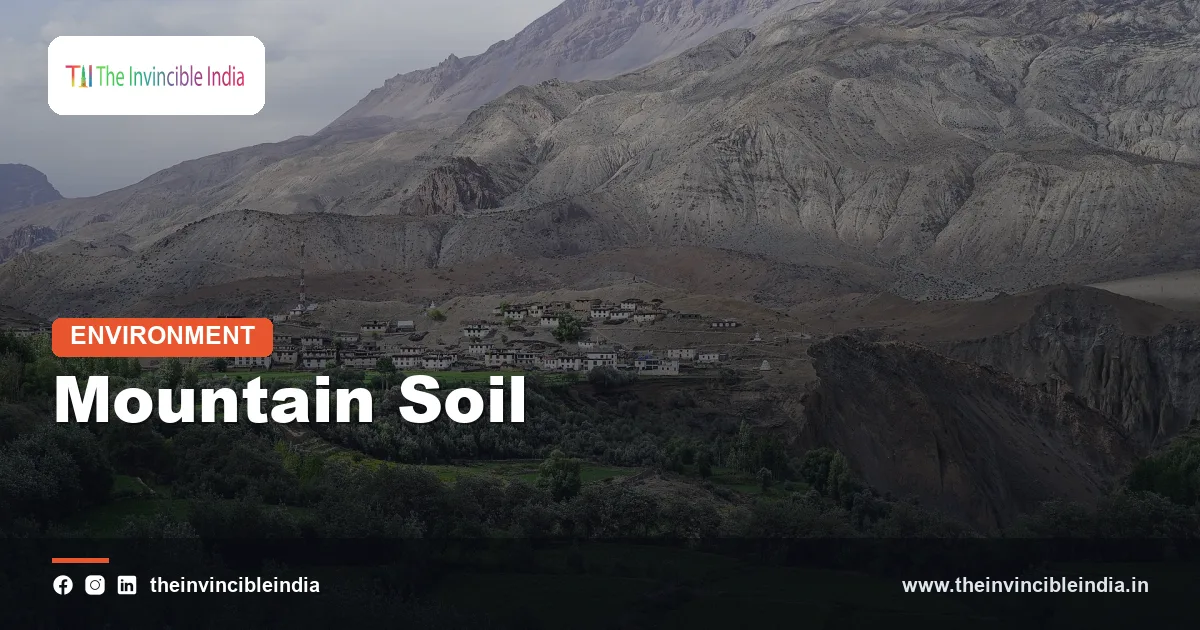
Mountain soil is the thin, stony and often humus-rich soil that forms on the steep slopes of India’s hills and mountains, from the Himalaya in the north to the Western Ghats in the south. It is a young, immature soil, shaped far more by gravity, cold and heavy rain than by the long, settled weathering that builds the deep soils of the plains. Where forest cover is intact it holds a dark layer of leaf litter and decayed matter, and where that cover is stripped it can wash away within a few monsoons.
This guide explains how mountain soil forms, why it is usually acidic, which crops thrive on it, why it erodes so easily and how hill communities have learned to protect it. It was last reviewed on 3 November 2026, and the figures are kept deliberately qualitative because soil conditions change sharply from one slope to the next.
Quick Facts
| Feature | Thin, immature, stony soil on steep hill and mountain slopes |
|---|---|
| Main regions | Himalaya, the Northeast hills, Western Ghats, Eastern Ghats, Nilgiris and other peninsular hill ranges |
| Typical depth | Shallow, often with rock fragments and bedrock close to the surface |
| Organic matter | Rich under forest because cold, wet conditions slow decay |
| Reaction | Generally acidic, especially under conifer and evergreen forest |
| Texture | Variable, from sandy and gravelly to silty loam, changing with altitude and rock type |
| Characteristic crops | Tea, coffee, apples, cardamom, pepper, potatoes, orchard fruits and hill millets |
| Main threats | Erosion, landslides, deforestation, road building and shifting cultivation |
Key Takeaways
- Mountain soil is a thin, stony and young soil that forms on steep slopes where erosion removes material almost as fast as weathering makes it.
- Under hill forest the surface layer is rich in humus because cold temperatures and wet conditions slow the breakdown of fallen leaves, even though the soil beneath is shallow.
- Most Indian mountain soils are acidic, a trait that suits tea, coffee, cardamom and potatoes but often needs lime or careful nutrient management for other crops.
- The Himalaya and the Western Ghats both have mountain soils, but the Himalayan ones are colder and younger while the Ghats’ soils are warmer and often grade into leached laterite.
- Steep slopes, heavy monsoon rain and forest clearing make mountain soil one of the most erosion-prone soils in the country, feeding landslides and silting rivers.
- Terracing, cover crops, agroforestry and keeping tree roots on slopes are the proven ways of holding mountain soil in place while still farming it.
What exactly is mountain soil and how does it differ from plains soil?
Mountain soil is a shallow, coarse and weakly developed soil found on hill and mountain slopes, and it differs from plains soil mainly in depth, age and stability. The great alluvial soils of the Ganga and Brahmaputra basins are deep layers of silt laid down patiently by rivers over thousands of years. Mountain soil, by contrast, sits on a slope where there is no flat ground for material to settle, so it is always on the move, thinning on the steep parts and thickening at the foot of a slope or in a hollow.
Soil scientists often describe such soils as immature because they have not had time to develop the clear horizons, the layered structure of topsoil, subsoil and weathered rock, that deep soils show. In the Indian classification used by agricultural researchers, many hill soils fall among the young soil orders in which only a faint profile has formed. The soil is full of rock fragments, from fine gravel to loose stones, and the rock beneath often shows through at the surface.
Another difference is variability. On a plains farm the same soil can run for kilometres. On a mountain, the soil can change from stony and sandy on a ridge to dark and moist in a ravine within a few hundred metres. A farmer on a hill often has to treat each terrace as its own small field with its own water, depth and fertility.
How does mountain soil form on steep slopes?
Mountain soil forms when rock is broken down by cold, water, roots and temperature swings and then partly held in place by vegetation before gravity pulls it downhill. The first step is weathering. In the high Himalaya, water seeps into cracks in the rock, freezes at night and expands, splitting the rock in a process known as frost shattering. At lower and warmer altitudes, such as the Western Ghats, heavy rain and warm temperatures work through chemical weathering, slowly rotting the rock into clay and sand.
The loosened material does not stay put. On a steep slope, rain splash, running water, creeping soil and landslides carry it downhill. The soil that remains in place is therefore a balance between how fast weathering creates new material and how fast erosion removes it. Where forest or grass covers the slope, roots bind the soil and fallen leaves protect the surface from raindrops, so the balance tips towards soil building. Where the ground is bare, it tips towards loss.
The parent rock matters as well. The Himalaya is built largely of folded sedimentary and metamorphic rocks such as quartzite, slate, schist and limestone, together with the granites of the high ranges, and each weathers into a different soil. The Western Ghats are made mostly of Deccan basalt in their northern stretch and ancient crystalline rocks in the south, which give different clay content and different nutrient levels. Climate, slope direction and altitude then layer their own effects on top.
Where is mountain soil found in India?
Mountain soil is found across the Himalayan arc from Jammu and Kashmir and Ladakh through Himachal Pradesh, Uttarakhand, Sikkim and Arunachal Pradesh, and along the hill ranges of the Northeast, the Western Ghats, the Eastern Ghats and the isolated hills of central and peninsular India. Altogether, hill and mountain terrain makes up a large share of the country’s land, and the soils on it support millions of people who depend on hill agriculture, forests and grazing.
In the Himalaya, soils change with altitude in a pattern that resembles a climbing ladder of climates. At the foothills and lower valleys the soil is warmer and deeper, supporting broad-leaved forest and terraced farms. In the mid-hills, brown forest soils develop under oak and rhododendron, and under conifers such as pine, fir and spruce the soil becomes more strongly acidic and pale, a pattern linked to the process called podzolisation. Higher still, in the alpine zone, soils are skeletal, meaning little more than a skin of gravelly matter over rock, and in the highest parts they lie beneath snow for much of the year.
A notable local exception is the Kashmir Valley, where old lake deposits known as karewas form flat-topped terraces of fine sediment that are valuable for saffron, almonds and orchards. In the Western Ghats, the hill soils run from dark humus-rich forest soils on high, wet crests to red and lateritic soils on lower slopes, and the plantation belts of the Nilgiris, Kodagu, Wayanad and Idukki lie on these.
Why is mountain soil acidic and rich in humus under forest?
Mountain soil under forest tends to be acidic and humus-rich because cool, wet conditions slow the decay of leaf litter while rain washes basic nutrients such as calcium and magnesium out of the upper layers. Humus is the dark, stable remains of decomposed plant and animal matter. In warm lowland soils, microbes break fallen leaves down so quickly that little builds up. On a cool, moist hillside, decomposition is slower, and a thick layer of partly decayed matter accumulates at the surface.
The organic acids released as that litter decays add to the acidity, and conifer needles and the leaves of some evergreen trees are particularly acidic and slow to rot. Heavy rainfall then leaches, or washes downwards, the bases that would otherwise neutralise the acid. The result is a soil whose upper layers are rich in organic matter and low in pH, with a dark, loose, spongy feel when the forest is undisturbed.
This humus layer is the soil’s most valuable asset. It soaks up rain like a sponge, releases water slowly to streams, feeds roots and keeps the stony mineral soil beneath from crumbling away. Strip the forest and the humus disappears quickly because heat and exposure speed up decay and rain carries the dark surface layer downhill. What remains is a pale, stony, infertile soil that can take decades or longer to recover.
What crops grow best on mountain soil?
The crops that grow best on mountain soil are those that tolerate acidity, need good drainage and do well in cool, wet climates, chiefly tea, coffee, apples, other temperate fruits, spices such as cardamom and pepper, and potatoes. Because the soil is stony and well drained, waterlogging, which kills many roots, is rarely a problem on the slope itself, and the cool climate suits crops that struggle in the plains heat.
Tea is the classic example. The tea gardens of Darjeeling, Assam’s hill margins, the Nilgiris and Kangra are planted on acidic hill soils, because tea prefers a low soil pH and abundant rainfall, and the well-drained slope keeps its roots from sitting in water. Coffee thrives on the shaded hill soils of Karnataka’s Kodagu and Chikmagalur and of the Nilgiris and Wayanad, often grown beneath a canopy of native trees. Cardamom is grown in the damp, shaded forest soils of the Cardamom Hills in Kerala and Tamil Nadu, and pepper climbs trees across the Western Ghats foothills.
In the Himalaya, apples are grown on the slopes of Himachal Pradesh, Jammu and Kashmir and Uttarakhand, where cold winters give the chilling the trees need and the loose, well-drained soil suits their roots. Potatoes, peas, beans, buckwheat, amaranth, barley, finger millet and other hardy crops are grown on terraced fields, and many Northeast hill communities have grown rice, millets and vegetables for generations through a mix of terraces and shifting cultivation known as jhum.
Why is mountain soil so prone to erosion?
Mountain soil is prone to erosion because it is thin, loosely held and sits on slopes where gravity and heavy monsoon rain combine to carry it downhill. Even a modest slope speeds up running water, and the steep gradients of the Himalaya and Ghats give rain enormous power to cut into bare ground. When a downpour hits an unprotected surface, raindrops dislodge soil particles, and the runoff carries them away in sheets, rills and then deeper gullies.
Three conditions make the problem worse. The first is intense, concentrated rainfall, which is typical of the monsoon over the hills and which scientists expect to become more erratic in a warming climate. The second is the removal of vegetation, whether by logging, fires, overgrazing or clearing for farms and roads. The third is human construction, in particular the cutting of roads and tunnels, which exposes raw slopes, interrupts natural drainage and dumps debris downhill.
Erosion on the hills is not only a local loss. The soil washed out of the mountains ends up in streams, reservoirs and rivers, where it adds to silt that shortens the life of dams, raises riverbeds and worsens floods downstream. When saturated slopes give way, the result is a landslide, a recurring tragedy during the monsoon in Himachal Pradesh, Uttarakhand, Sikkim, Kerala and the Northeast.
How does terracing protect mountain soil?
Terracing protects mountain soil by turning a steep slope into a series of level steps that slow runoff, trap soil and let rain soak in rather than rush downhill. Each step is held by a retaining wall, often of stacked stone or packed earth, with a flat or slightly inward-tilted surface for crops. Water that would otherwise gather speed down the slope instead pools gently on each terrace and sinks into the ground.
Terraced hillsides are among the most recognisable cultural landscapes of India. Stone-walled terraces cover the Himalayan villages of Uttarakhand and Himachal Pradesh, rice terraces step down the hills of Nagaland, Arunachal Pradesh and Manipur, and terraced plantations line the Nilgiris and the Kodagu slopes. In many places the terraces were built and repaired by communities over centuries, and their drainage channels, stone steps and field boundaries form a carefully designed system.
Terraces work only when maintained. When families migrate out of the hills and fields are abandoned, retaining walls collapse, drains clog and the stored soil can slump suddenly. Researchers working on Himalayan land use have noted that abandoned terraces can raise landslide risk in some settings, which is one reason that supporting hill farmers has direct environmental value.
How do Himalayan and Western Ghats mountain soils compare?
Himalayan mountain soils are generally younger, colder and more strongly shaped by frost and glaciation, while Western Ghats mountain soils are warmer, wetter and more deeply weathered, often grading into laterite. The two ranges are very different in age and climate, so their soils differ even though both are called mountain soil. The table below sets out the main contrasts.
| Feature | Himalaya | Western Ghats |
|---|---|---|
| Mountain age | Geologically young and still rising | Much older, long eroded |
| Dominant weathering | Physical, including frost shattering | Chemical, driven by heat and heavy rain |
| Parent rock | Sedimentary, metamorphic and granitic rocks | Basalt in the north, crystalline rock in the south |
| Soil character | Shallow, stony, brown forest and podzolic soils, skeletal at height | Humus-rich forest soils on crests, red and lateritic soils lower down |
| Main cash crops | Apples, stone fruits, saffron, potatoes, tea in foothills | Tea, coffee, cardamom, pepper, rubber on lower slopes |
| Typical hazard | Landslides, glacial and flash floods, frost | Landslides and soil loss during intense monsoon rain |
These are broad patterns rather than strict rules. Local rock, slope, vegetation and land use can produce a very different soil only a short distance away, which is why soil surveys and local knowledge remain essential before planning a crop or a construction project.
What threats does mountain soil face today?
The main threats to mountain soil today are deforestation, unplanned construction, overgrazing, shortened shifting-cultivation cycles and a changing climate that delivers heavier bursts of rain. Each removes the plant cover that holds the soil, or loads a fragile slope with more water, weight or disturbance than it can bear.
Road building is a particular concern in the Himalaya, where the need for connectivity, pilgrimage routes, hydropower and tourism has driven widespread cutting of slopes. Poorly designed roads and spoil dumping have been linked by many studies and expert committees to increased landslides. In the Northeast, the traditional jhum cycle once left fields fallow for long periods so that forest could regrow, but population pressure has shortened these cycles in many areas, leaving less time for the soil to recover.
Tourism adds pressure through hotels and buildings on unstable ground, and monoculture plantations can leave soil less protected than natural forest. Climate change brings added risk, as shifting rainfall, melting glaciers and thawing ground make slopes less predictable. None of these threats is inevitable, but together they explain why scientists and disaster agencies stress soil and slope protection as a basic form of hazard management in the hills.
How can mountain soil be managed sustainably?
Mountain soil can be managed sustainably by keeping slopes covered with deep-rooted vegetation, maintaining terraces and drains, building roads with proper drainage and retaining structures, and growing crops suited to the site. The common thread is to avoid leaving soil bare and to slow water down before it gathers erosive force.
Practical measures include planting native trees and grasses on degraded slopes, contour farming across rather than down the slope, and mixing trees with crops in agroforestry systems, such as shade coffee and cardamom beneath forest cover. Check dams and vegetated drains stabilise gullies, and mulching with leaf litter or crop residue protects the surface while adding organic matter. Applying lime in measured amounts can correct acidity for crops that need it, though over-liming can cause its own problems, so soil testing is the sensible first step.
Community institutions often succeed where top-down schemes struggle. Village forest councils, such as the van panchayats of Uttarakhand, and community forest management in the Northeast and elsewhere have shown that local control over forests and grazing can stabilise slopes. Watershed development programmes that treat a whole catchment from ridge to valley, and payments or support that make hill farming viable, help ensure that the people who look after the soil can afford to stay.
Bottom Line
Mountain soil is thin, young, stony and often acidic, yet under healthy forest it is rich in humus and supports some of India’s most valuable crops, from Darjeeling tea to Himalayan apples and Western Ghats spices. Its fragility is the central fact: with steep slopes and intense rain, it is lost far faster than it forms. Protecting forest cover, terraces and slope drainage is therefore the most reliable way to protect both the hills and the rivers and communities below them.
Frequently Asked Questions
What is mountain soil in simple words?
Mountain soil is the thin, stony, young soil found on hill and mountain slopes. It is often rich in humus under forest, usually acidic, and easily washed away when vegetation is removed.
Which crops are grown in mountain soil in India?
Tea, coffee, apples, other temperate fruits, cardamom, pepper, potatoes and hill millets are the main crops. They suit its good drainage, acidity and cool, wet climate.
Is mountain soil fertile?
It can be fertile in the surface layer where forest litter has built up humus, but the soil is shallow and loses fertility quickly once cleared. Its productivity depends on keeping organic matter and preventing erosion.
Why is mountain soil acidic?
Cool, wet conditions slow the decay of leaf litter, which releases organic acids, and heavy rain washes away basic nutrients such as calcium and magnesium. Together these lower the soil’s pH.
How does mountain soil differ from alluvial soil?
Alluvial soil is deep, fine and river-deposited on flat plains, while mountain soil is shallow, coarse and stony and forms on slopes. Alluvial soil is generally more uniformly fertile and easier to farm.
How can mountain soil erosion be prevented?
Erosion is reduced by terracing, contour farming, planting trees and grasses, mulching, and building roads with proper drainage. Keeping tree roots and ground cover on slopes is the single most effective measure.
{“@context”:”https://schema.org”,”@graph”:[{“@type”:”FAQPage”,”mainEntity”:[{“@type”:”Question”,”name”:”What is mountain soil in simple words?”,”acceptedAnswer”:{“@type”:”Answer”,”text”:”Mountain soil is the thin, stony, young soil found on hill and mountain slopes. It is often rich in humus under forest, usually acidic, and easily washed away when vegetation is removed.”}},{“@type”:”Question”,”name”:”Which crops are grown in mountain soil in India?”,”acceptedAnswer”:{“@type”:”Answer”,”text”:”Tea, coffee, apples, other temperate fruits, cardamom, pepper, potatoes and hill millets are the main crops. They suit its good drainage, acidity and cool, wet climate.”}},{“@type”:”Question”,”name”:”Is mountain soil fertile?”,”acceptedAnswer”:{“@type”:”Answer”,”text”:”It can be fertile in the surface layer where forest litter has built up humus, but the soil is shallow and loses fertility quickly once cleared. Its productivity depends on keeping organic matter and preventing erosion.”}},{“@type”:”Question”,”name”:”Why is mountain soil acidic?”,”acceptedAnswer”:{“@type”:”Answer”,”text”:”Cool, wet conditions slow the decay of leaf litter, which releases organic acids, and heavy rain washes away basic nutrients such as calcium and magnesium. Together these lower the soil’s pH.”}},{“@type”:”Question”,”name”:”How does mountain soil differ from alluvial soil?”,”acceptedAnswer”:{“@type”:”Answer”,”text”:”Alluvial soil is deep, fine and river-deposited on flat plains, while mountain soil is shallow, coarse and stony and forms on slopes. Alluvial soil is generally more uniformly fertile and easier to farm.”}},{“@type”:”Question”,”name”:”How can mountain soil erosion be prevented?”,”acceptedAnswer”:{“@type”:”Answer”,”text”:”Erosion is reduced by terracing, contour farming, planting trees and grasses, mulching, and building roads with proper drainage. Keeping tree roots and ground cover on slopes is the single most effective measure.”}}]}]}


