

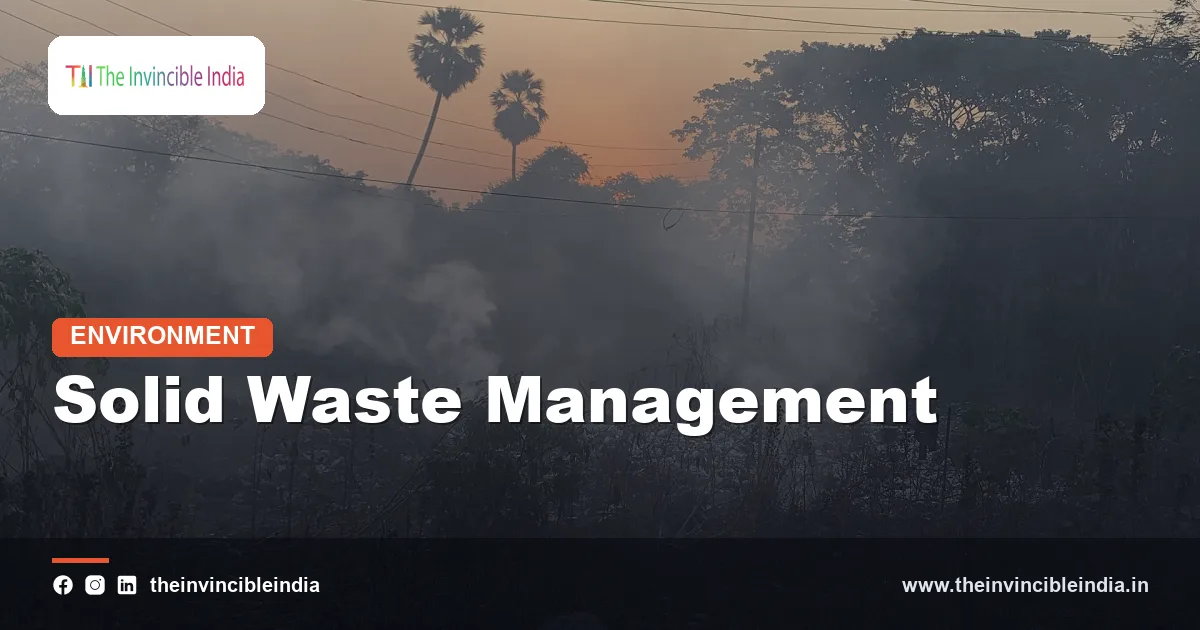
In India, solid waste management is the system of collecting, segregating, transporting, processing and safely disposing of the garbage that households, markets, hotels, offices and construction sites generate every day, governed mainly by the Solid Waste Management Rules, 2016. Indian towns and cities produce well over a lakh of tonnes of municipal solid waste daily, and how well that mountain is handled decides whether a city has clean streets and healthy neighbourhoods or smouldering dumps. Last reviewed: 3 November 2026.
The challenge is both enormous and fixable. Urban India is growing fast, consumption is shifting toward packaged goods, and municipal bodies often lack money, land and trained staff. Yet cities such as Indore, Ambikapur and Alappuzha show that source segregation, composting and community buy-in can transform a waste system within a few years. This explainer covers how much waste India makes, what it contains, how the rules work, where the big dumps are, and what is actually working.
| Feature | Quick fact |
|---|---|
| What it covers | Municipal solid waste: household, market, commercial and street waste, plus construction debris and some hazardous household items |
| Scale | Roughly 1.5 lakh tonnes of municipal waste a day nationally, according to Central Pollution Control Board assessments |
| Composition | Typically about half wet or organic waste, with the rest dry recyclables, inert matter and sanitary or hazardous items |
| Governing law | Solid Waste Management Rules, 2016, under the Environment (Protection) Act, 1986 |
| Core principle | Segregation at source into wet, dry and domestic hazardous streams |
| Lead programme | Swachh Bharat Mission (Urban), launched in 2014 and renewed as Swachh Bharat Mission-Urban 2.0 |
| Who runs it | Urban local bodies such as municipal corporations, with private operators and informal waste pickers |
| Notorious dumpsites | Ghazipur, Bhalswa and Okhla in Delhi, Deonar in Mumbai and many others |
Key Takeaways
- India generates roughly 1.5 lakh tonnes of municipal solid waste every day, and recent official assessments suggest only about half of it is treated, with much of the rest dumped or landfilled.
- The Solid Waste Management Rules, 2016 require households to separate waste at source into wet, dry and domestic hazardous categories, and make local bodies responsible for collection and processing.
- Roughly half of Indian municipal waste is wet organic matter, which makes composting and biogas more practical than incineration for most cities.
- Giant dumpsites such as Ghazipur and Deonar cause fires, toxic leachate, methane emissions and health risks for nearby communities.
- Informal waste pickers recover a large share of India’s recyclables at almost no public cost, and good systems bring them into the formal chain.
- Cities like Indore show that strict segregation, door-to-door collection and decentralised processing can change results within a few years.
How much solid waste does India produce?
India produces roughly 1.5 lakh tonnes of municipal solid waste a day, which comes to more than 50 million tonnes a year, according to figures compiled by the Central Pollution Control Board. Per-person generation is modest compared with rich countries, often in the range of a few hundred grams a day in cities, but the sheer number of urban residents makes the total huge.
These figures are estimates, and they differ by year and source because many municipalities weigh waste poorly or not at all. Larger cities generate more per person than small towns, and waste volumes rise with income, packaged food and online shopping. Projections suggest that urban waste could more than double over the next couple of decades if current trends continue.
The picture also depends on definitions. Municipal solid waste is separate from industrial hazardous waste, biomedical waste, e-waste and plastic waste, each of which has its own rules. In practice, however, many of these streams end up mixed in the same bins and dumps, which complicates handling.
What does Indian garbage actually contain?
Indian municipal garbage contains mostly organic kitchen and market waste, along with paper, plastic, glass, metal, textiles, rubber and a large share of inert dust, ash and construction debris. Wet organic waste usually forms about half of the total, and in some cities a good deal more, because of vegetable markets, hotels and home cooking.
This is very different from the garbage of wealthy countries, which holds more packaging and paper. Indian waste is damp, heavy and of low calorific value. That has big consequences: it rots quickly, attracts flies and rats, and generates foul leachate if left uncovered. It also burns poorly in incinerators unless it is dried or blended with fuel.
Dry waste, such as plastic, paper, cardboard, metal and glass, has resale value, and a vast informal sector sorts it out. Domestic hazardous waste, such as used batteries, expired medicines, paint cans, tube lights, mosquito repellents and sanitary products, forms a small portion but is the most dangerous when it ends up in the wet stream or open dumps.
What do the Solid Waste Management Rules, 2016 require?
The Solid Waste Management Rules, 2016 require every waste generator to segregate waste at source, hand it over to authorised collectors, and pay user fees, while making local bodies responsible for collection, processing and disposal. They replaced the older Municipal Solid Wastes Rules of 2000 and widened the scope beyond municipal limits to include urban agglomerations, census towns, airports, railway stations and special economic zones.
Key provisions include:
- Segregation of waste into three streams: wet or biodegradable, dry, and domestic hazardous waste including sanitary items.
- Door-to-door collection by local bodies and a ban on littering, burning waste, or dumping it in drains and water bodies.
- Bulk waste generators, such as large hotels, institutions and housing societies, to process wet waste on their own premises where feasible.
- Landfills to receive only inert, non-recyclable waste and processing rejects, not raw mixed garbage.
- User fees and spot fines to be fixed by local bodies, applying the polluter-pays principle.
- Responsibilities for state governments, the Central Pollution Control Board and pollution control boards to monitor and enforce.
The rules have been revisited in recent years, and updated versions have been proposed and issued, so readers should check the currently notified text. In practice, the weak point has never been the law but its enforcement and financing at the municipal level.
How is waste collected and segregated in Indian cities?
Waste in Indian cities is collected mostly through door-to-door pick-up by municipal workers or contractors using handcarts, tricycles or tipper vehicles, followed by transport to transfer stations and processing or disposal sites. In well-run cities, households keep separate bins, typically green for wet waste and blue for dry waste, and collection vehicles have separate compartments.
Where segregation fails, mixed waste goes to the dump, which is the root of most later problems. Mixed garbage is contaminated, hard to recycle and costly to process. Cities that insist on segregation from the start save money downstream, because the wet fraction can be composted and the dry fraction sold.
The informal sector plays a major role. Waste pickers, itinerant buyers and small scrap dealers, numbering in the lakhs, recover paper, plastic, metal and glass long before it reaches a landfill. Studies suggest they save municipalities a great deal of money. Integrating them through identity cards, material recovery centres and collection contracts improves incomes and recovery rates, and several city programmes and cooperatives now do exactly that.
Why do Indian cities have mountains of garbage?
Indian cities have mountains of garbage because for decades most waste was dumped unsegregated in open sites, which kept filling while new capacity and processing plants lagged behind. Ghazipur in east Delhi, which has operated since the 1980s, is often compared in height to the Qutub Minar, and Delhi’s Bhalswa and Okhla landfills are similar towers of old waste.
Deonar in Mumbai, among the oldest and largest dumping grounds in the country, has seen major fires, and its smoke has repeatedly blanketed surrounding neighbourhoods. Other cities, from Bengaluru and Pune to Kolkata and Chennai, have faced their own dump crises, with local protests whenever a new site is proposed.
The reasons are structural. Cities have little spare land, so new sites are pushed to the outskirts, where residents resist. Processing plants have been slow to come up, transport costs are high, and mixed waste is unsuited to composting. The result is a backlog of so-called legacy waste, which the government now wants cleared through bioremediation and biomining.
What harm do dumpsites and open burning cause?
Dumpsites and open burning cause air pollution, groundwater contamination, greenhouse gas emissions and disease, and they harm the health of people living or working nearby. Rotting organic waste releases methane, a potent greenhouse gas, and landfill fires emit smoke laden with particulate matter, dioxins and other toxic compounds.
Rainwater percolating through a dump creates leachate, a dark liquid carrying organic matter, ammonia, heavy metals and pathogens, which can seep into groundwater and nearby streams. Unlined dumps are a particular worry. Methane trapped inside piles can also ignite spontaneously during hot summers, producing fires that burn for days.
The burden falls most heavily on poor neighbourhoods around dumps and on waste pickers who work without protective gear. Studies on communities near large dumps report higher rates of respiratory complaints, skin disease and infections, though exact links are hard to isolate. Clogged drains full of plastic also worsen urban flooding in the monsoon.
How does composting and biomethanation fit in?
Composting and biomethanation fit in as the main ways to treat the wet half of Indian garbage, turning food and market waste into manure or biogas rather than leaving it to rot in a landfill. Because wet waste is so large a share, treating it near the source is the biggest single lever for reducing the waste that reaches dumpsites.
Options range from household compost bins and community pits to large windrow plants and biomethanation units. Decentralised models, run at the ward or housing-society level, avoid long transport and reduce odour complaints. Biogas plants digest the waste without oxygen and produce methane-rich gas that can be used for cooking, electricity or, after purification, compressed biogas for vehicles.
Indore, repeatedly ranked India’s cleanest city in the national Swachh Survekshan survey, runs a large bio-CNG plant fed by segregated wet waste, and sells compost and gas. For this to work, the input must be clean. Plants that receive mixed garbage struggle with plastic contamination and produce poor-quality compost that farmers will not buy.
Is waste-to-energy the answer?
Waste-to-energy is only a partial answer for India, because the country’s damp, low-calorific waste burns poorly and plants have a mixed record on cost, emissions and reliability. Incinerators work best on dry, high-energy waste, so wet mixed garbage must either be dried, pre-treated or turned into refuse-derived fuel.
Several waste-to-energy plants operate in Delhi and a few other cities, and refuse-derived fuel is increasingly burned in cement kilns as a substitute for coal. Residents near some plants, such as the Okhla facility in Delhi, have raised concerns about emissions and ash. Experts generally argue that waste-to-energy should only receive non-recyclable, dry residue after segregation and recycling, not the full mixed stream.
The table below compares the main treatment routes for Indian municipal waste.
| Method | Best suited to | Main benefit | Main limit |
|---|---|---|---|
| Composting | Clean wet organic waste | Produces manure and cuts landfill volume | Needs segregation and a market for compost |
| Biomethanation | Wet waste in bulk, such as markets and canteens | Yields biogas or bio-CNG plus slurry | Needs consistent clean feed and capital |
| Recycling | Paper, plastic, metal, glass | Saves raw material and gives incomes | Depends on clean, sorted material |
| Refuse-derived fuel | Dry combustible fraction | Substitutes coal in cement and power plants | Needs pre-processing and emission control |
| Waste-to-energy incineration | High-calorific dry residue | Reduces volume and generates power | Costly; poor fit for wet mixed waste |
| Sanitary landfill | Inert residue and processing rejects | Safe final disposal if engineered | Needs land, liners and gas management |
What is Swachh Bharat doing about waste?
Swachh Bharat Mission (Urban), launched in October 2014, is the national programme that funds sanitation, door-to-door collection, waste processing and public awareness in towns and cities, and its second phase aims at garbage-free cities and clearing old dumps. Its early focus was on toilets and open-defecation-free status, with solid waste the next frontier.
Under the second phase, launched in 2021, the mission supports source segregation, scientific processing, reduction of single-use plastic and remediation of legacy dumpsites through bioremediation, where old waste is mined, sorted and the fine fraction used as soil cover or the combustible part sent for fuel. The annual Swachh Survekshan rankings create competition among cities and push mayors to improve.
The results are visible but uneven. Door-to-door collection now reaches most wards in many cities, and segregation levels are improving in the best performers. Yet progress on processing and on clearing legacy waste has been slower than on collection, and many small towns remain behind. Complementary rules also exist for plastic packaging, e-waste, construction and demolition waste and biomedical waste, including extended producer responsibility for plastic packaging.
What works: lessons from Indore, Ambikapur and Alappuzha?
The clearest lessons from Indore, Ambikapur and Alappuzha are that strict segregation, reliable door-to-door collection and decentralised processing work better than relying on distant landfills. Indore combined mandatory segregation, special collection vehicles, fines for violators and public campaigns, which helped it top national rankings for several years in a row.
Ambikapur in Chhattisgarh built a model around women’s self-help groups running waste collection and processing sheds, including a well-known garbage cafe scheme where plastic waste can be exchanged for meals. Alappuzha in Kerala, after a waste crisis, pushed household and neighbourhood composting and biogas units to cut transport and reliance on a central dump.
Common ingredients emerge from these cases: political will, public participation, steady user fees, trained workers with safety gear, and treating waste pickers as partners. The failures are equally consistent. Cities that spend heavily on trucks and megaplants, but ignore segregation, usually end up with the same dump problem as before.
Bottom Line
Solid waste management in India is a problem of systems more than technology. The country already has a strong legal framework, a national mission and proven local models. What it needs is consistent segregation at source, dependable collection, processing capacity close to where waste is generated, clearing of legacy dumps and fair treatment of the informal workers who keep so much material in circulation. Where those pieces come together, cities become cleaner and cheaper to run.
Frequently Asked Questions
How much waste does India generate every day?
India generates roughly 1.5 lakh tonnes of municipal solid waste per day, according to Central Pollution Control Board estimates. Only about half of it is reported as treated, with the rest landfilled or dumped.
What are the Solid Waste Management Rules, 2016?
They are national rules under the Environment (Protection) Act that require waste to be segregated at source into wet, dry and domestic hazardous streams and make local bodies responsible for collection, processing and disposal. They also introduce user fees, spot fines and limits on landfilling raw garbage.
Why are landfills like Ghazipur and Deonar a problem?
Such sites hold huge piles of mixed waste that release methane, produce toxic leachate and sometimes catch fire, polluting air and groundwater. Nearby communities face respiratory and other health risks.
What is source segregation?
Source segregation means separating waste at home or the workplace into wet, dry and hazardous categories before it is collected. It makes composting and recycling possible and prevents contamination of usable material.
Is waste-to-energy suitable for India?
It is useful only for dry, high-calorific residue, because most Indian waste is wet and burns poorly. Experts suggest segregation, composting and recycling should come first, with incineration limited to what cannot be reused.
What can citizens do to help?
Citizens can separate wet and dry waste at home, compost kitchen scraps, hand over dry recyclables and hazardous items separately, avoid single-use plastic and pay user fees where charged. Supporting local waste workers and following the rules makes the whole system function better.
{“@context”:”https://schema.org”,”@graph”:[{“@type”:”FAQPage”,”mainEntity”:[{“@type”:”Question”,”name”:”How much waste does India generate every day?”,”acceptedAnswer”:{“@type”:”Answer”,”text”:”India generates roughly 1.5 lakh tonnes of municipal solid waste per day, according to Central Pollution Control Board estimates. Only about half of it is reported as treated, with the rest landfilled or dumped.”}},{“@type”:”Question”,”name”:”What are the Solid Waste Management Rules, 2016?”,”acceptedAnswer”:{“@type”:”Answer”,”text”:”They are national rules under the Environment (Protection) Act that require waste to be segregated at source into wet, dry and domestic hazardous streams and make local bodies responsible for collection, processing and disposal. They also introduce user fees, spot fines and limits on landfilling raw garbage.”}},{“@type”:”Question”,”name”:”Why are landfills like Ghazipur and Deonar a problem?”,”acceptedAnswer”:{“@type”:”Answer”,”text”:”Such sites hold huge piles of mixed waste that release methane, produce toxic leachate and sometimes catch fire, polluting air and groundwater. Nearby communities face respiratory and other health risks.”}},{“@type”:”Question”,”name”:”What is source segregation?”,”acceptedAnswer”:{“@type”:”Answer”,”text”:”Source segregation means separating waste at home or the workplace into wet, dry and hazardous categories before it is collected. It makes composting and recycling possible and prevents contamination of usable material.”}},{“@type”:”Question”,”name”:”Is waste-to-energy suitable for India?”,”acceptedAnswer”:{“@type”:”Answer”,”text”:”It is useful only for dry, high-calorific residue, because most Indian waste is wet and burns poorly. Experts suggest segregation, composting and recycling should come first, with incineration limited to what cannot be reused.”}},{“@type”:”Question”,”name”:”What can citizens do to help?”,”acceptedAnswer”:{“@type”:”Answer”,”text”:”Citizens can separate wet and dry waste at home, compost kitchen scraps, hand over dry recyclables and hazardous items separately, avoid single-use plastic and pay user fees where charged. Supporting local waste workers and following the rules makes the whole system function better.”}}]}]}


