

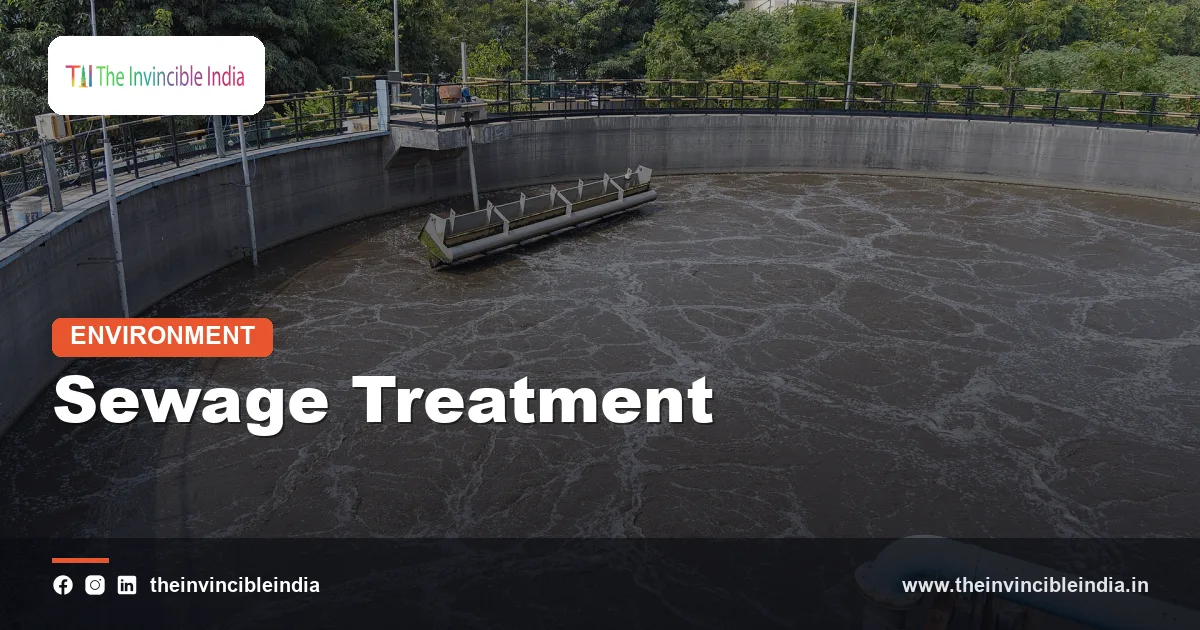
In India, sewage treatment is the process of cleaning the used water that flows out of homes, offices and businesses, removing solids, organic matter and germs, before it is released into rivers, lakes or the sea or reused for gardens, industry and farming. It is one of the weakest links in the country’s water story, because a large share of urban sewage still reaches drains and rivers without adequate treatment. Last reviewed: 3 November 2026.
Every Indian city sits on the banks of a river, lake or coast that doubles as its drain. When treatment plants are missing, undersized or switched off to save electricity, the result is foul water, fish kills, disease and a rising bill for drinking-water supply downstream. This guide explains what sewage is, how a treatment plant works, how big the gap in capacity is, what it does to rivers such as the Yamuna and Ganga, and which cheaper, decentralised and nature-based options are catching on.
| Feature | Quick fact |
|---|---|
| What it is | Cleaning of domestic and mixed urban wastewater before disposal or reuse |
| Main stages | Preliminary, primary, secondary and tertiary treatment, followed by disinfection |
| Scale of the problem | Urban India generates roughly 70,000 million litres of sewage a day, according to Central Pollution Control Board assessments |
| Treatment gap | Installed treatment capacity covers less than half of this, and actual treatment is lower still |
| Key measure of pollution | Biochemical oxygen demand (BOD), the oxygen microbes use to break down organic matter |
| Main schemes | Namami Gange, AMRUT and AMRUT 2.0, and state-level river action plans |
| Regulators | Central and State Pollution Control Boards, the National Green Tribunal and urban local bodies |
| Alternatives | Decentralised plants, constructed wetlands, waste stabilisation ponds and faecal sludge treatment |
Key Takeaways
- Urban India generates roughly 70,000 million litres of sewage a day, and official assessments show installed treatment capacity covers less than half of it, with actual treatment lower.
- Sewage treatment works in stages: screening and grit removal, settling of solids, biological breakdown of organic matter by microbes, and finally disinfection or polishing.
- Untreated sewage raises river pollution, measured as high biochemical oxygen demand and faecal coliform counts, and the Central Pollution Control Board has identified hundreds of polluted river stretches.
- Many plants that exist run below capacity or fail discharge standards because of poor operation, power costs, weak sewer networks and a lack of connections.
- Sewage is not only a waste: treated water can serve industry, construction, gardens and cooling, and sludge can become manure or biogas.
- Decentralised plants, constructed wetlands and faecal sludge management offer cheaper options for smaller towns and peri-urban areas where long sewer lines are not practical.
What is sewage and why does it need treatment?
Sewage is the wastewater from toilets, kitchens, bathrooms and laundry, often mixed with water from small businesses, and it needs treatment because it carries disease-causing germs, organic matter and nutrients that damage water bodies. In the language of engineers, domestic sewage is more than 99 per cent water, but the remaining fraction is a dangerous cocktail.
The biggest threats are pathogens such as bacteria, viruses and parasite eggs that cause cholera, typhoid, hepatitis and diarrhoea, and the organic matter that robs rivers of oxygen. When sewage enters a stream, microbes feed on the organic matter and use up dissolved oxygen. Fish and other aquatic life suffocate, and the water turns black and foul. Nutrients like nitrogen and phosphorus trigger algal blooms in lakes, and detergents, oils, microplastics and traces of medicines add to the load.
Sewage is also a resource. It contains water that can be reused, nutrients that can fertilise land and organic matter that can generate biogas. Treatment therefore protects public health, rivers and drinking-water sources, and it opens the door to recycling.
How does a sewage treatment plant work?
A sewage treatment plant, or STP, works by passing wastewater through a series of physical, biological and sometimes chemical steps that progressively remove solids, organic matter and germs. The standard sequence has four levels, summarised in the table below.
| Stage | What happens | What it removes |
|---|---|---|
| Preliminary | Screens catch rags, plastic and debris; grit chambers settle sand and gravel | Large solids and grit that would damage pumps |
| Primary | Water rests in settling tanks so heavy solids sink as sludge and grease floats | Suspended solids and part of the organic load |
| Secondary | Microbes digest dissolved organic matter in aerated tanks, filters or reactors | Most remaining organic matter, measured as BOD |
| Tertiary and disinfection | Filtration, nutrient removal and chlorination, ultraviolet light or ozone | Remaining germs, nutrients and fine particles |
Primary treatment alone removes a limited share of the organic pollution, so secondary treatment is the heart of most plants. India uses several secondary technologies: the activated sludge process, in which air is bubbled through a mix of sewage and microbes; trickling filters; upflow anaerobic sludge blanket reactors; sequencing batch reactors; and moving bed biofilm reactors. Choice depends on land, power, cost and the standards to be met.
The sludge left behind is thickened, digested and dried. Anaerobic digestion yields biogas, and the stabilised solids can be used as soil conditioner if free of heavy metals. Good sludge handling is often neglected, yet a plant is only as good as its sludge management.
How much sewage does India produce, and how much is treated?
Urban India produces roughly 70,000 million litres of sewage a day, but the sewage treatment capacity installed covers only a little under half, and the amount actually treated is lower still. Central Pollution Control Board assessments in recent years have reported a gap of this kind, with treatment capacity in the range of 40 per cent of generation and actual treatment closer to about a quarter to 30 per cent.
The numbers vary between surveys, but the pattern is consistent: capacity has grown, yet generation has grown too, and many plants run below design capacity or not at all. Rural sewage is largely unmeasured, as most villages rely on septic tanks, soak pits or open drains. The gap is widest in smaller towns, where entire cities may have no functioning plant.
Capacity on paper is also misleading. A plant may exist, but if the sewer network feeding it is incomplete, broken or choked, the plant receives a fraction of its design flow while raw sewage runs through storm drains to the river. Engineers call this the difference between treatment capacity and treatment actually delivered.
Why do so many treatment plants underperform?
Many treatment plants underperform because of weak sewer networks, high running costs, poor operation and maintenance, shortage of trained staff and inadequate monitoring. Building a plant is a one-time capital project that attracts funding, while running it well demands steady money for electricity, chemicals, repairs and skilled operators.
Common problems include:
- Incomplete sewerage: households and drains are not connected, so sewage never reaches the plant.
- Power costs: aeration is energy-hungry, and some plants are throttled or switched off to save electricity.
- Poor design for local flows: plants are sized on population forecasts that did not materialise, or built before the sewer lines were laid.
- Weak enforcement: treated water often fails the discharge standards on biochemical oxygen demand or faecal coliform, with few penalties.
- Stormwater mixing: in monsoon, combined flows overwhelm plants and carry untreated sewage into rivers.
Pollution control boards and the National Green Tribunal have repeatedly criticised non-compliant plants. Contracting models such as hybrid annuity, used under Namami Gange, tie part of the payment to long-term performance, which is meant to address the weak operation problem.
What does untreated sewage do to Indian rivers?
Untreated sewage turns stretches of Indian rivers into open drains by loading them with organic matter, nutrients and germs, driving oxygen levels down and faecal coliform counts far above safe limits. The Central Pollution Control Board has identified more than 300 polluted river stretches on hundreds of rivers, and sewage from towns and cities is the single biggest cause.
The Yamuna through Delhi is the best-known case. The river is relatively clean as it enters the city, but a short stretch through the capital, a small fraction of its total length, receives a majority of its pollution load, mostly from drains. Downstream, the water is often low in oxygen and dangerously contaminated. Similar patterns occur on the Ganga near its large cities, and on the Musi, Mithi, Vaigai, Cooum, Sabarmati and many smaller rivers.
Downstream communities pay the price. Towns that draw drinking water from the same river must spend more on treatment, fishers lose catches, farmers irrigate with contaminated water and the risk of waterborne disease climbs. Lakes suffer especially, because they flush slowly, so nutrients from sewage cause algal blooms and foam, as seen in Bengaluru’s Bellandur and Varthur lakes.
What health risks does untreated sewage pose?
Untreated sewage poses serious health risks because it spreads waterborne diseases such as cholera, typhoid, dysentery, hepatitis A and E, and childhood diarrhoea, which remains a leading cause of illness and malnutrition among young children. Contaminated water can reach people through drinking-water pipes that leak, handpumps and wells sited near drains, vegetables irrigated with drain water and fish caught in polluted stretches.
The danger is greatest in dense low-income settlements, where open drains run past homes and children play near them. Monsoon floods make it worse by pushing sewage into streets and wells. Studies of sewage have also shown that it carries signals of infections such as polio, and public health teams in several countries now monitor wastewater to track disease outbreaks early. Antibiotic-resistant bacteria and traces of drugs also pass into rivers when sewage is released untreated, creating a long-term risk that is only beginning to be measured in India.
What laws and programmes govern sewage treatment?
Sewage treatment in India is governed by the Water (Prevention and Control of Pollution) Act, 1974, the Environment (Protection) Act, 1986, discharge standards issued by the environment ministry and pollution control boards, and directions from the National Green Tribunal. Under these laws, municipal bodies must treat sewage to prescribed norms before discharge.
National standards for sewage treatment plants were notified in 2017 and cover parameters such as BOD, suspended solids and faecal coliform. The National Green Tribunal has since directed tighter limits in certain situations, including for newer plants and in sensitive stretches. Pollution control boards monitor and can issue closure notices, though enforcement against municipal bodies is limited by politics and funding.
Funding comes from programmes such as the National Mission for Clean Ganga, known as Namami Gange, which has financed sewage infrastructure along the Ganga and its tributaries, the Atal Mission for Rejuvenation and Urban Transformation (AMRUT) and its second phase, and state schemes and loans from multilateral agencies. A national policy on faecal sludge and septage management, issued in 2017, recognises that many cities will depend on onsite systems for years.
Can treated sewage be reused?
Yes, treated sewage can be reused for industry, construction, gardening, cooling, toilet flushing and agriculture, and India has begun to encourage this through policy and local projects. With freshwater under strain in many cities, treated wastewater is increasingly seen as an extra source rather than a waste stream.
Some thermal power stations and refineries already use treated municipal sewage for cooling and process needs, and several cities supply it to parks, construction sites and industrial estates. A national framework on safe reuse of treated water, released in the early 2020s, encourages states to set reuse targets and quality norms. Households and housing societies in cities like Bengaluru and Chennai are required in many cases to run their own STPs and reuse the water.
The challenges are quality, price and trust. Buyers need reliable water that meets specified standards, and farmers must be protected from heavy metals and pathogens. Where sewage mixes with industrial effluent, reuse for food crops is risky. Pricing treated water competitively with groundwater and tanker water remains a hurdle.
What are decentralised and nature-based treatment options?
Decentralised and nature-based treatment options are smaller systems that clean wastewater close to where it is produced, using ponds, wetlands, soil filters and compact biological units rather than a single huge plant and kilometres of sewer pipes. They suit small towns, villages, institutions and new colonies where laying long sewers is costly.
Examples include decentralised wastewater treatment systems (often called DEWATS), constructed wetlands in which reed beds and gravel filters clean water, waste stabilisation ponds that rely on sunlight and algae, and phytoremediation designs developed by Indian research institutes. Housing complexes use small package plants and recycle the water on site.
The East Kolkata Wetlands, a Ramsar-listed site, are a celebrated natural example. For decades the city’s sewage has flowed into shallow fish ponds and farms, where sunlight and microbes cleanse it and produce fish and vegetables. Faecal sludge treatment plants, which handle contents emptied from septic tanks, are another growing option, helped by Odisha, Tamil Nadu and other states that have promoted septage management. These systems are cheaper to build and run, but need land, careful design and local management.
How can India close the sewage gap?
India can close the sewage gap by connecting households to sewers, building and properly operating plants, mixing centralised and decentralised systems, enforcing standards and treating wastewater as a resource. Capacity alone does not clean rivers; the sewage must actually reach the plants and meet the limits.
Priorities that experts commonly stress include completing sewer networks and house connections before or along with plants, intercepting and diverting drains that carry raw sewage to rivers, and funding operations as seriously as construction. Real-time monitoring of plant outlets, public disclosure of results and penalties for non-compliance would improve accountability.
For smaller places, decentralised treatment and faecal sludge management can deliver faster, cheaper gains. Citizens can help too: avoiding dumping of oil, plastic, chemicals and medicines into drains, maintaining septic tanks, and supporting reuse of treated water. Progress is slow, but cities that treat sewage as a resource, such as those selling treated water to industry, show a way forward.
Bottom Line
Sewage treatment is the unglamorous infrastructure that decides whether Indian rivers stay alive. The country has built substantial capacity, yet generation outpaces it, networks are incomplete and many plants fail to meet standards. The solution lies in finishing the pipes, running plants properly, adopting decentralised and nature-based systems where suitable, and reusing treated water. Clean rivers are not only a matter of building plants but of making sure sewage reaches them and that they work every day.
Frequently Asked Questions
What are the stages of sewage treatment?
Sewage treatment generally has preliminary, primary, secondary and tertiary stages. Screens and grit chambers remove large solids, settling tanks remove suspended solids, microbes digest dissolved organic matter in the secondary stage, and tertiary treatment with disinfection removes remaining germs and nutrients.
How much of India’s sewage is treated?
Central Pollution Control Board assessments suggest urban India generates roughly 70,000 million litres of sewage a day, with installed treatment capacity covering a little under half and actual treatment lower. Exact figures change from survey to survey.
Why are Indian rivers polluted by sewage?
Many towns discharge untreated or poorly treated sewage through drains into rivers because treatment plants are missing, undersized or underused, and because sewer networks are incomplete. The resulting load of organic matter and germs depletes oxygen and contaminates the water.
What is BOD in sewage treatment?
BOD, or biochemical oxygen demand, measures how much oxygen microbes need to break down organic matter in water. A high BOD means heavy organic pollution and low oxygen for fish, so it is a key test for sewage and river quality.
Can treated sewage water be reused?
Yes. Properly treated sewage can be used for industry, cooling, construction, gardens and some farming, and India has a national framework encouraging safe reuse. Quality control and pricing are the main challenges.
What is decentralised wastewater treatment?
It means treating sewage near its source using small systems such as constructed wetlands, ponds or compact plants instead of sending it through long sewers to a large plant. It is useful for villages, small towns and housing complexes.
{“@context”:”https://schema.org”,”@graph”:[{“@type”:”FAQPage”,”mainEntity”:[{“@type”:”Question”,”name”:”What are the stages of sewage treatment?”,”acceptedAnswer”:{“@type”:”Answer”,”text”:”Sewage treatment generally has preliminary, primary, secondary and tertiary stages. Screens and grit chambers remove large solids, settling tanks remove suspended solids, microbes digest dissolved organic matter in the secondary stage, and tertiary treatment with disinfection removes remaining germs and nutrients.”}},{“@type”:”Question”,”name”:”How much of India’s sewage is treated?”,”acceptedAnswer”:{“@type”:”Answer”,”text”:”Central Pollution Control Board assessments suggest urban India generates roughly 70,000 million litres of sewage a day, with installed treatment capacity covering a little under half and actual treatment lower. Exact figures change from survey to survey.”}},{“@type”:”Question”,”name”:”Why are Indian rivers polluted by sewage?”,”acceptedAnswer”:{“@type”:”Answer”,”text”:”Many towns discharge untreated or poorly treated sewage through drains into rivers because treatment plants are missing, undersized or underused, and because sewer networks are incomplete. The resulting load of organic matter and germs depletes oxygen and contaminates the water.”}},{“@type”:”Question”,”name”:”What is BOD in sewage treatment?”,”acceptedAnswer”:{“@type”:”Answer”,”text”:”BOD, or biochemical oxygen demand, measures how much oxygen microbes need to break down organic matter in water. A high BOD means heavy organic pollution and low oxygen for fish, so it is a key test for sewage and river quality.”}},{“@type”:”Question”,”name”:”Can treated sewage water be reused?”,”acceptedAnswer”:{“@type”:”Answer”,”text”:”Yes. Properly treated sewage can be used for industry, cooling, construction, gardens and some farming, and India has a national framework encouraging safe reuse. Quality control and pricing are the main challenges.”}},{“@type”:”Question”,”name”:”What is decentralised wastewater treatment?”,”acceptedAnswer”:{“@type”:”Answer”,”text”:”It means treating sewage near its source using small systems such as constructed wetlands, ponds or compact plants instead of sending it through long sewers to a large plant. It is useful for villages, small towns and housing complexes.”}}]}]}


