

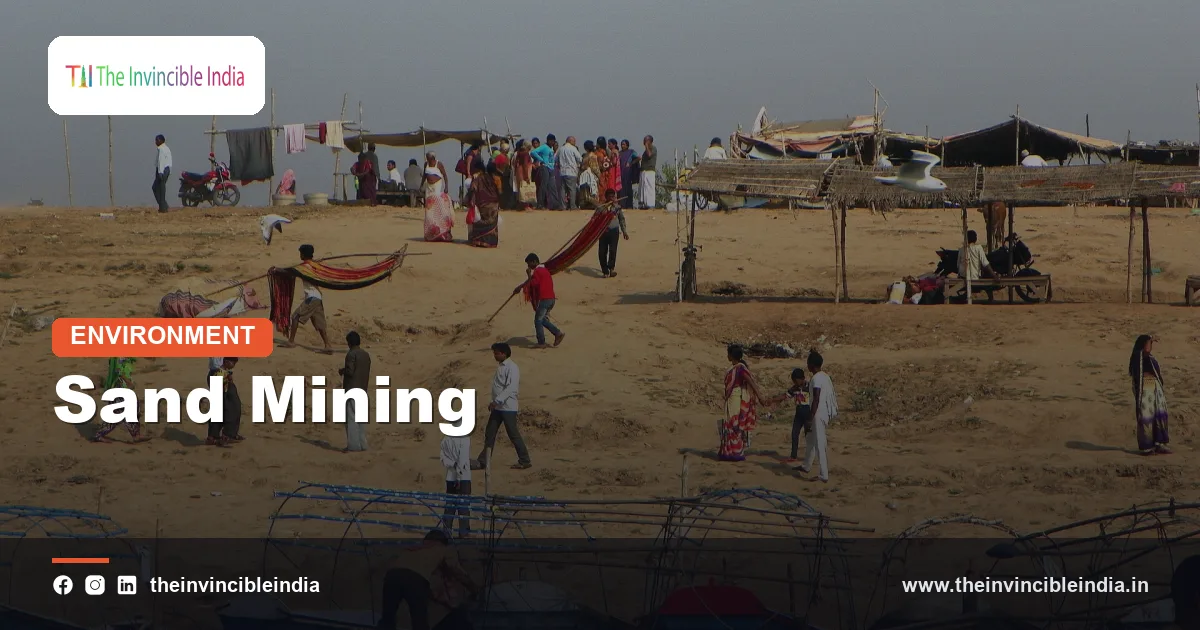
Sand mining is the extraction of sand and gravel from riverbeds, floodplains, beaches and coastal dunes, mostly to feed the construction industry, and in India it has grown into one of the largest and least-governed extractive trades in the country. Every road, flyover, apartment block and rural house needs sand for concrete, mortar and plaster, and the cheapest source has long been the nearest river. The result is a booming business in which legal quarries and illegal operators dig side by side, often with the same machines and the same trucks. Last updated: 3 November 2026.
This explainer sets out what sand mining is, why India needs so much sand, how the law treats it, what it does to rivers, aquifers, bridges and wildlife, who the so-called sand mafia are, how courts and the National Green Tribunal have responded, and what a more sustainable sand economy could look like. Figures are rounded and described as tendencies, because reliable national data on sand extraction remain thin.
| Topic | Sand mining in India |
|---|---|
| What is extracted | River sand, gravel, coastal and beach sand, and sand from dunes and floodplains |
| Main use | Construction: concrete, mortar, plaster, road bases and land filling |
| Legal status | Sand is a “minor mineral” regulated mainly by state governments under the Mines and Minerals (Development and Regulation) Act, 1957 and state rules |
| Key national guidance | Sustainable Sand Mining Management Guidelines (2016) and Enforcement and Monitoring Guidelines for Sand Mining (2020) |
| Biggest ecological harm | Deepened riverbeds, falling water tables, bank collapse and lost habitat |
| Main enforcement problem | Illegal extraction by organised groups, often at night and in the monsoon ban period |
| Main alternatives | Manufactured sand (M-sand), recycled construction and demolition waste, and fly ash |
Key Takeaways
- Sand is the second most heavily used natural resource in the world after water, and India’s construction boom makes it one of the largest sand consumers.
- Most sand mining in India is regulated by states as a minor mineral, so rules, royalties and enforcement vary widely from one state to another.
- Digging too much sand from a river lowers the riverbed, drains nearby groundwater, undermines bridges and destroys habitat for fish, gharials and nesting birds.
- Illegal sand mining is widespread and has been linked to violence against officials, journalists and villagers who tried to stop it.
- Courts and the National Green Tribunal have repeatedly ordered bans, environmental clearances, monsoon-season closures and scientific replenishment studies.
- Manufactured sand, recycled demolition waste and fly ash can ease pressure on rivers, but only if governments also measure demand and enforce limits.
What Is Sand Mining and Why Does India Need So Much Sand?
Sand mining is the removal of sand from natural deposits, and India needs enormous quantities because concrete and mortar are roughly two-thirds to three-quarters aggregate by weight, with sand as a key part. Growing cities, rural housing schemes, highways, railways, metro lines and airports have all pushed demand upward over the past few decades. Government housing programmes, which promise millions of new homes, add to the load.
Not just any sand will do. Desert sand, shaped by wind into smooth, rounded grains, binds poorly in concrete, so builders prefer the sharp, angular grains found in rivers. Sea sand contains salt that corrodes the steel inside reinforced concrete unless it is washed thoroughly. River sand, which is clean, graded and easy to reach, therefore became the default material, and the rivers have paid for that preference.
A United Nations Environment Programme report in 2019 described sand as the most-extracted solid material on Earth after water and warned that extraction was outpacing natural replenishment in many places. India does not have a single reliable national figure for how much sand is dug each year, because much of the mining is unrecorded. Most estimates are therefore indicative rather than exact, and they all point in one direction: demand is large and rising.
How Is Sand Mining Regulated in India?
Sand mining in India is regulated mainly by state governments, because sand is classed as a minor mineral under the Mines and Minerals (Development and Regulation) Act, 1957. The Act lets states frame their own rules for leasing, royalties, transport permits and penalties. States usually auction or allot sand blocks, often through district-level committees, and collect royalty on every cubic metre moved.
The central government steps in through environmental law and guidance. The Ministry of Environment, Forest and Climate Change issued the Sustainable Sand Mining Management Guidelines in 2016, followed by the Enforcement and Monitoring Guidelines for Sand Mining in 2020. These documents ask states to prepare district survey reports that assess where sand is available, how fast rivers replenish it and which stretches should stay off-limits. They also call for transport tracking, mining plans, and limits on depth and on the use of heavy machinery in the riverbed.
The Supreme Court shaped the framework in a 2012 judgment in the Deepak Kumar case, which held that even small mining leases need prior environmental clearance. That ruling pulled many small sand leases into the environmental clearance process and prompted the district survey approach now used across the country. The weak point has never been the paperwork on paper; it has been the ability of district administrations to monitor hundreds of kilometres of river.
What Damage Does Sand Mining Do to Rivers?
Excessive sand mining deepens and destabilises riverbeds, because a river normally carries as much sand downstream as it receives from upstream, and mining removes sand faster than it can arrive. When the bed drops, the channel becomes narrower and deeper, the banks steepen and collapse, and the river’s natural flow pattern changes.
Healthy riverbeds hold more than sand. The gravel and sand layers are habitat for insects, snails, fish eggs and the plants that anchor the banks. Dredging and pit digging strip that layer away, stir up silt and cloud the water, and leave a bed of hard clay or bare rock in which fewer creatures can live. Fish that spawn on gravel bars lose their breeding grounds.
Mining also changes how a river carries sediment to the sea. Sand extracted in the middle reaches means less sediment arrives in the delta and along the coast. Over time, starved coastlines and deltas can retreat faster, and low-lying farmland near river mouths becomes more vulnerable to salt intrusion and storm surge. Scientists describe this effect as sediment starvation, and it compounds the sediment already trapped behind dams.
How Does Sand Mining Affect Groundwater and Bridges?
Sand mining lowers the water table near the river, because the riverbed sand acts like a sponge that stores water and feeds it slowly into surrounding aquifers. When that sponge is removed and the bed is cut deeper, groundwater drains toward the river faster, wells nearby can dry up, and villages that depended on shallow wells may have to dig deeper or switch to piped supply.
Bridges and embankments are also at risk. The foundations of a bridge are designed for a particular bed level. If sand mining lowers the bed near the piers, the foundations can be exposed, scouring accelerates, and a structure that once stood safely may become unstable in a flood. Engineers and courts have repeatedly warned about mining close to bridges, barrages and water-intake wells, and the national guidelines ask for a safe buffer around them. Several bridge failures and foundation scares in different states have been blamed, at least in part, on bed lowering from mining, although each collapse usually has several causes and investigations differ.
Pumping stations that draw drinking water from rivers can be left high and dry when the bed drops below their intakes. Embankments and riverside fields lose support when banks cave in, and the land lost to bank erosion is often private farmland that cannot be reclaimed. These costs are paid by farmers and local residents while the profits go to the sand trade.
What Does Sand Mining Do to Wildlife?
Sand mining harms wildlife by destroying the sandbars, channels and banks that many river species use for breeding and feeding. The gharial, a critically endangered fish-eating crocodilian, nests on exposed sandy banks in rivers such as the Chambal, and mining, boats and trucks disturb or destroy those nesting sites. Turtles that lay eggs on sandbars, including several freshwater species, face the same problem, as do riverine birds such as the Indian skimmer and sand-nesting lapwings.
River dolphins, fish and invertebrates suffer from noise, turbidity and changed flow. Heavy machinery and constant truck movement along riverbanks bring dust, noise and spills of fuel and oil. In coastal areas, mining of beach sand and dunes can remove the natural barrier that protects villages from waves and nesting beaches for sea turtles. In some places, wildlife sanctuaries along rivers have been the scene of illegal extraction, which has repeatedly drawn court intervention.
Who Are the Sand Mafia and Why Is Illegal Sand Mining So Common?
The sand mafia is the popular name for organised groups that mine, transport and sell sand illegally, and illegal mining is common because the profits are high, the material is easy to dig and moving it leaves little paper trail. A single truckload of sand sells for far more in a city than it costs to load at the river, and enforcement is hard when hundreds of vehicles can move at night along rural roads.
Reports from many states describe the same pattern: unlicensed pits, extraction beyond the leased area or depth, fake or reused transport permits, mining during the monsoon ban and bribery of local officials. Some groups have political protection, which makes honest enforcement dangerous. Over the years there have been reports of attacks on police, revenue officials, journalists and activists who tried to stop illegal trucks, and some deaths. A widely publicised suspension of a young Uttar Pradesh civil servant in 2013, after she acted against illegal mining, brought national attention to how risky enforcement can be.
The lack of data feeds the problem. When a state does not know how much sand its rivers hold or how much is being dug, it cannot say whether a given volume is sustainable or illegal. Experts argue that transparent online auctions, GPS-tracked trucks, satellite and drone monitoring and public disclosure of leases would shrink the space in which illegal mining thrives.
What Have Courts and the National Green Tribunal Ordered?
Courts and the National Green Tribunal have repeatedly ordered states to stop illegal sand mining, require environmental clearance and base extraction on scientific studies. The Supreme Court’s 2012 Deepak Kumar judgment required clearance for small leases, and the Tribunal has since heard hundreds of cases from nearly every state. It has banned mining in specific rivers and stretches, ordered strict closure of all riverbed mining during the monsoon, directed states to prepare district survey reports and replenishment studies, and imposed penalties on offenders.
Several High Courts have taken similar action. The Madras High Court, for example, has issued strong directions to Tamil Nadu on illegal quarrying and on the protection of rivers, and courts in other states have restricted mining near bridges, sanctuaries and drinking-water intakes. The monsoon closure rule, usually running from about June to September, exists because rivers are in spate, fish are breeding and banks are weakest during those months.
Court orders have limits. They can order a ban but cannot patrol a riverbed every night. Contractors sometimes challenge bans citing shortage of construction material, and states worry about price spikes. The pattern in many places is a cycle of crackdown, relief and relapse, which suggests that orders work best when paired with real monitoring and affordable alternatives.
What Are the Main Types of Sand Mining and Their Impacts?
The main types of sand mining are in-stream mining, floodplain and terrace mining, and coastal or beach mining, and each leaves a different mark. The table below compares them in simple terms.
| Type | Where it happens | Typical methods | Main impacts |
|---|---|---|---|
| In-stream mining | Active riverbed and channel | Dredgers, pumps, excavators and manual digging | Bed lowering, bank collapse, lost fish habitat, damage to bridges |
| Floodplain and terrace mining | Dry riverbanks, bars and old channels | Excavators, pits and trucks | Farmland loss, pits that fill with water, falling groundwater levels |
| Coastal and beach mining | Beaches, dunes and tidal creeks | Manual and mechanised digging, sand-pumping | Coastal erosion, loss of turtle nesting beaches, salt intrusion |
| Marine and estuarine dredging | Estuaries and shallow seabeds | Suction dredgers | Disturbed seabed life, changed currents, sediment shifts |
Can Sand Mining Be Done Sustainably?
Sand mining can be made more sustainable if extraction stays below the rate at which a river naturally replenishes its sand, but that requires measurement, restraint and honest enforcement. The 2016 and 2020 national guidelines already set the outline: carry out a replenishment study for each river stretch, decide a safe annual quantity, limit mining depth to a few metres, keep a distance from bridges, banks and intake wells, avoid sanctuaries, and close all mining in the monsoon.
Practical safeguards include mining only at designated blocks with marked boundaries, rotating blocks so that stretches can recover, banning heavy machinery in active water channels, and using weighbridges and tracked transport permits. Some experts also argue for focusing extraction on sand deposited by dams and reservoirs, where trapped sediment is a nuisance rather than a loss, and on carefully planned desilting, though poorly managed desilting can become a cover for plain mining.
Sustainability is as much about demand as supply. India will build for decades, so supply from rivers alone will not keep up. Government procurement rules that favour recycled or manufactured materials, building designs that use less concrete and better reuse of demolition debris can all reduce the pressure on rivers.
What Are the Alternatives to River Sand?
The main alternatives to river sand are manufactured sand, recycled construction and demolition waste, fly ash and quarry dust, each of which can replace some of the river sand in construction. Manufactured sand, or M-sand, is made by crushing hard rock such as granite or basalt into sand-sized grains. It is widely used in southern India, where several states have promoted it, and quality is acceptable when the crushing and washing are well controlled.
Recycled aggregate from demolished buildings can replace part of the sand and gravel in non-structural uses and some structural ones, and several Indian cities have set up processing plants for construction and demolition waste. Fly ash, the fine residue from coal power plants, is already blended into cement and bricks and can substitute for some of the sand in blocks and fill. Each option has a footprint of its own: quarrying for M-sand is also a mining activity that needs regulation, and recycling plants need steady waste flow and quality checks. Imports have also been tried, with some southern ports receiving imported sand in recent years, but this is costly and has not become a mainstream solution.
No single alternative will replace river sand overnight. A realistic path combines all of them, together with price signals that reflect the true cost of river damage, so that legal river sand is not artificially cheap and illegal sand is not artificially profitable.
What Can Citizens and Governments Do About Sand Mining?
Governments can publish district survey reports and lease maps, track every truck with GPS, use satellite and drone imagery to detect new pits and protect enforcement officers, while citizens can report illegal activity and demand disclosure. Local communities are often the first to notice a pit appearing, a night convoy of trucks or a collapsing bank, and their evidence has supported many tribunal cases.
Builders and buyers also matter. Specifying certified M-sand or recycled material in contracts, asking contractors where their sand comes from and favouring projects that use less river sand all shift demand. For policymakers, the central challenge is to treat sand as a strategic resource rather than a throwaway minor mineral: map it, price it, cap its extraction and invest in alternatives before more rivers lose their beds.
Bottom Line
Sand mining feeds India’s construction boom, but done carelessly it lowers riverbeds, drains aquifers, threatens bridges and wipes out habitat for some of the country’s rarest river wildlife. The legal framework exists, and the courts have backed it. What is missing is dependable data, strong monitoring and a serious shift toward manufactured sand, recycled material and lower-sand building. Rivers can supply some sand sustainably, but not all that India’s cities and villages want to build.
Frequently Asked Questions
Is sand mining legal in India?
Yes, sand mining is legal when it is done under a valid lease or permit issued by the state, with the required environmental clearance, within the approved area, depth and season. It becomes illegal when it happens without a permit, beyond the permitted limits or during the monsoon ban.
Why is sand mining banned during the monsoon?
Mining is closed during the monsoon, usually from about June to September, because rivers are in flood, fish and other species are breeding, banks are weakest and mining at that time does the most damage. The closure also lets the river bring in fresh sediment.
How does sand mining cause bridges to collapse?
Sand mining near a bridge lowers the riverbed and exposes the foundations of the piers, so that floodwater can scour them and weaken the structure. Bridge failures usually have several causes, but unsafe mining nearby is a recognised risk that national guidelines try to control with buffer distances.
Can desert sand be used instead of river sand?
Desert sand is generally unsuitable for concrete because wind-blown grains are smooth and rounded and too fine, so they bind poorly. Builders prefer sharp-edged river sand or well-crushed manufactured sand.
What is M-sand and is it a good substitute?
M-sand, or manufactured sand, is made by crushing hard rock into sand-sized grains. It can be a good substitute when properly washed and graded, and it eases pressure on rivers, though the quarries that supply it also need regulation.
What is the National Green Tribunal’s role in sand mining?
The National Green Tribunal hears complaints about illegal and unsustainable sand mining and can ban mining in particular rivers, require environmental clearances and replenishment studies, and order penalties and restoration. Its orders have shaped monsoon closures and district-level planning across many states.
{“@context”:”https://schema.org”,”@graph”:[{“@type”:”FAQPage”,”mainEntity”:[{“@type”:”Question”,”name”:”Is sand mining legal in India?”,”acceptedAnswer”:{“@type”:”Answer”,”text”:”Yes, sand mining is legal when it is done under a valid lease or permit issued by the state, with the required environmental clearance, within the approved area, depth and season. It becomes illegal when it happens without a permit, beyond the permitted limits or during the monsoon ban.”}},{“@type”:”Question”,”name”:”Why is sand mining banned during the monsoon?”,”acceptedAnswer”:{“@type”:”Answer”,”text”:”Mining is closed during the monsoon, usually from about June to September, because rivers are in flood, fish and other species are breeding, banks are weakest and mining at that time does the most damage. The closure also lets the river bring in fresh sediment.”}},{“@type”:”Question”,”name”:”How does sand mining cause bridges to collapse?”,”acceptedAnswer”:{“@type”:”Answer”,”text”:”Sand mining near a bridge lowers the riverbed and exposes the foundations of the piers, so that floodwater can scour them and weaken the structure. Bridge failures usually have several causes, but unsafe mining nearby is a recognised risk that national guidelines try to control with buffer distances.”}},{“@type”:”Question”,”name”:”Can desert sand be used instead of river sand?”,”acceptedAnswer”:{“@type”:”Answer”,”text”:”Desert sand is generally unsuitable for concrete because wind-blown grains are smooth and rounded and too fine, so they bind poorly. Builders prefer sharp-edged river sand or well-crushed manufactured sand.”}},{“@type”:”Question”,”name”:”What is M-sand and is it a good substitute?”,”acceptedAnswer”:{“@type”:”Answer”,”text”:”M-sand, or manufactured sand, is made by crushing hard rock into sand-sized grains. It can be a good substitute when properly washed and graded, and it eases pressure on rivers, though the quarries that supply it also need regulation.”}},{“@type”:”Question”,”name”:”What is the National Green Tribunal’s role in sand mining?”,”acceptedAnswer”:{“@type”:”Answer”,”text”:”The National Green Tribunal hears complaints about illegal and unsustainable sand mining and can ban mining in particular rivers, require environmental clearances and replenishment studies, and order penalties and restoration. Its orders have shaped monsoon closures and district-level planning across many states.”}}]}]}


