

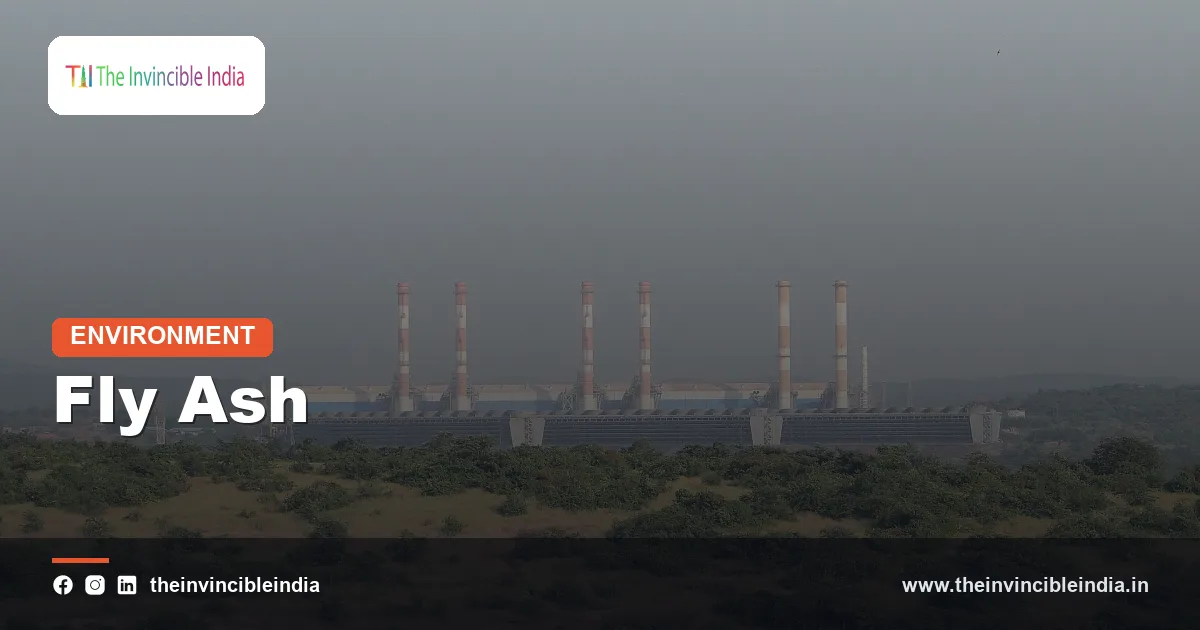
In India, fly ash is the fine, powdery grey residue carried up the chimney when pulverised coal burns in thermal power plants, and it is captured by filters before it escapes into the air. Because Indian coal is unusually rich in incombustible mineral matter, the country’s coal-fired stations produce well over 200 million tonnes of ash every year, making fly ash one of the largest industrial wastes in the country and, increasingly, one of its most useful raw materials. Last reviewed: 3 November 2026.
For decades the ash was simply flushed into large ponds near the plants, where it spread dust over villages, clogged rivers and sometimes burst through broken embankments. Since the late 1990s, a series of environment ministry notifications has pushed power stations and builders to reuse it in cement, bricks, roads and mine filling. The shift has been dramatic, but old ponds remain, and the health and water risks have not disappeared. This explainer covers what fly ash is, why India makes so much of it, the harm it can do, the rules that govern it and how it is being put to work.
| Feature | Quick fact |
|---|---|
| What it is | Fine particulate residue from burning pulverised coal, collected from flue gases |
| Companion product | Bottom ash, the coarser residue that falls to the base of the furnace |
| Typical size | Particles often finer than cement, in the range of a few to tens of microns |
| Main ingredients | Silica, alumina, iron oxide and lime, plus traces of heavy metals |
| Indian coal ash content | Commonly 30 to 45 per cent, far higher than many imported coals |
| Annual ash output | More than 200 million tonnes from coal-based power stations |
| Main uses | Cement and concrete, bricks and blocks, road embankments, mine void filling |
| Governing framework | Environment ministry fly ash notifications under the Environment (Protection) Act, 1986, amended several times since 1999 |
Key Takeaways
- Fly ash is the fine powder left when coal burns in power plants, and India produces more than 200 million tonnes of coal ash a year because its domestic coal is high in ash.
- Stored in wet ash ponds, fly ash can pollute air, soil and groundwater, and dyke failures have caused deadly ash spills in past years.
- Fly ash is a pozzolan, meaning it reacts with lime to form cement-like compounds, so it can replace part of the cement in concrete and make bricks, blocks and road fill.
- Environment ministry notifications since 1999 require power plants to manage ash and require builders and road agencies near plants to use fly ash-based products.
- Official data report that most current ash output is now utilised, but legacy ponds still hold very large stocks that need safe closure or reuse.
- Safe reuse depends on quality testing, dust control and protection for workers, because ash can contain fine silica and trace metals.
What is fly ash made of?
Fly ash is made mostly of tiny glassy spheres of silica, alumina and iron oxide, with some calcium and small amounts of carbon, sulphur and trace elements, all left over from the mineral matter in coal. When coal is ground to powder and burned at very high temperatures in a boiler, the organic part burns off as gas and the mineral part melts, then cools quickly into fine glassy particles that float in the flue gas.
Most Indian fly ash is low in calcium and is classed as a siliceous or Class F type, while ash from lignite and some coals is higher in calcium and can set on its own. The particles are spherical and very fine, which helps concrete flow better. Some particles are hollow microscopic spheres called cenospheres, which float on water and have niche industrial uses.
Fly ash also contains trace amounts of arsenic, lead, chromium, mercury, boron and other elements that were present in the coal. The levels vary by coal source. This chemistry explains both its value, because silica and alumina give cementing power, and its hazard, because metals can leach into water.
Why does India produce so much fly ash?
India produces so much fly ash because coal still generates most of its electricity and Indian domestic coal is high in ash, often 30 to 45 per cent by weight, compared with perhaps 10 to 15 per cent in many imported coals. Burning one tonne of such coal can leave a third or more of that weight behind as ash.
Coal-based plants account for roughly 70 per cent of the country’s electricity generation, and the thermal fleet has grown steadily. Large clusters of plants in Chhattisgarh, Odisha, Jharkhand, Madhya Pradesh, Uttar Pradesh, Maharashtra and Gujarat each produce millions of tonnes of ash annually. Singrauli, on the Madhya Pradesh and Uttar Pradesh border, is a well-known hub where many stations, mines and ash ponds crowd a small region.
About four-fifths of the ash from a pulverised coal plant is fly ash collected from the flue gas, and the rest is bottom ash. Modern electrostatic precipitators capture the vast majority of particles before the stack, which is good for air quality but means a big stream of solid waste to be handled.
How is fly ash collected and disposed of?
Fly ash is collected from flue gas by electrostatic precipitators or bag filters and then disposed of either as a wet slurry piped to ash ponds or as a dry powder stored in silos and trucked away. Electrostatic precipitators charge the particles and pull them onto plates, capturing well over 99 per cent of the ash in well-run units.
The older and still common method is wet disposal, in which ash is mixed with large quantities of water and pumped as slurry to a pond, called an ash pond or ash dyke, enclosed by embankments. This is cheap but uses vast amounts of water and land, and ponds can leak or overflow. Dry handling, in which ash is collected and stored dry, uses little water, reduces the chance of leaching and makes the ash easier to sell for cement and construction.
The difference between the two disposal routes is important, as the table below shows.
| Aspect | Wet ash pond disposal | Dry ash handling |
|---|---|---|
| How it works | Ash is mixed with water and pumped to a pond | Ash is collected dry in silos and loaded onto trucks or rail |
| Water use | Very high | Low |
| Land need | Large areas for ponds | Smaller storage area |
| Risk | Leaching, dyke failure, dust from dried ponds | Dust during handling if not covered |
| Reuse potential | Lower; ash becomes wet and mixed | High; suitable for cement and concrete |
Why is fly ash a pollution problem?
Fly ash is a pollution problem because the fine dust can be inhaled, the leachate from ponds can contaminate soil and water, and dyke failures can bury land and choke rivers. Where ash ponds dry out in hot or windy weather, the surface turns into a source of blowing dust that settles on houses, crops and roads.
The finest particles contribute to airborne particulate pollution, and fine ash contains crystalline silica, which can damage lungs over long exposure. Communities living close to ash ponds and handling sites have reported respiratory illness, skin problems and other complaints, although linking specific diseases to ash alone is difficult and studies are mixed.
Water is another concern. Rainwater and pond water can carry dissolved metals and salts into groundwater, wells and nearby rivers. Ash pond overflow can discolour streams and smother aquatic life. Past dyke breaches at power plants in Madhya Pradesh and elsewhere have buried farmland, damaged villages and, in some reported cases, caused deaths and injuries, which forced regulators to demand stronger dyke safety and monitoring.
There is also a land cost. Ponds take thousands of acres across the country, often in fertile or forested areas, and once full they leave a long-term closure problem. Safe capping, revegetation and groundwater monitoring are needed long after a plant stops adding ash.
What do India’s fly ash rules require?
India’s fly ash rules require thermal power stations to manage and utilise their ash and require certain construction and road projects to use fly ash-based products, enforced through notifications from the environment ministry first issued in 1999. These have been revised repeatedly to extend the radius, tighten timelines and widen the uses covered.
The original notification asked builders and road agencies within a set distance of a coal or lignite power station to use fly ash bricks and products, and required plants to supply ash free of cost within a short radius. Later amendments increased the distance to several hundred kilometres, added mandatory use in road embankments and fillings, encouraged dry ash collection and set targets for reaching full utilisation. Recent notifications also deal with the use of ash in filling abandoned mines and with reclaiming old ponds, and they provide for transport cost sharing between plants and users.
Plants must report ash generation and use to pollution control boards and the Central Electricity Authority, which publishes utilisation figures. Enforcement is uneven in practice, but official data show that utilisation has climbed from a low base in the 1990s to a high share of annual ash output in recent years, though there is a lingering stock in older ponds.
How is fly ash used in cement and concrete?
Fly ash is used in cement and concrete as a pozzolan, a material that reacts with the lime released when cement hardens to form extra binding compounds, allowing it to replace a portion of the cement. It is the largest single use of ash in India, mainly through Portland pozzolana cement and ready-mix concrete.
Indian standards allow a substantial share of fly ash, commonly around 15 to 35 per cent, in blended cement, and concrete mixes can include more. The benefits are real: the spherical particles improve workability, the slow reaction reduces heat and cracking in massive pours, and long-term strength and durability can improve, especially against chemical attack. Because cement production is a large source of carbon dioxide, substituting fly ash lowers the carbon footprint of each cubic metre of concrete.
Quality matters. Ash must be dry, fine and low in unburnt carbon to perform well, and it should be tested before use. Cement and ready-mix plants tend to prefer dry ash straight from the silos of nearby power stations, which is why dry collection supports reuse.
What are the other uses of fly ash?
Other major uses of fly ash include bricks and blocks, road and embankment fill, mine void filling, low-lying area reclamation and, in smaller amounts, soil conditioning and speciality products. Each takes a different grade of ash and brings a different set of benefits.
- Bricks and blocks: fly ash bricks, fly ash-lime-gypsum bricks and autoclaved aerated concrete blocks replace clay bricks, saving topsoil and cutting kiln emissions.
- Roads and embankments: ash is a lightweight, easily compacted fill, and highway agencies have used large quantities in embankments and in the base layers of roads and flyovers.
- Mine filling: ash mixed with other material is used to backfill abandoned open-cast and underground coal mines, which stabilises land and absorbs large volumes.
- Reclamation: low-lying land and quarries can be filled and then covered with soil, though groundwater must be protected.
- Agriculture and soil: carefully dosed ash can improve some soils, but results depend on soil type and ash chemistry, and heavy use is not advised.
- Emerging uses: research continues on extracting useful elements, producing geopolymer binders and making ceramics from ash.
Brickmaking has special significance. Traditional clay brick kilns eat up fertile topsoil and burn coal and wood, adding smoke and carbon. Replacing them with fly ash products helps to protect farmland, which is one reason the notifications stress bricks and blocks.
Is fly ash safe to reuse?
Fly ash is generally safe to reuse when it is tested, correctly handled and locked into products such as concrete or bricks, but loose ash used carelessly can still release dust and metals. In bound forms, the fine particles are fixed within the material and leaching is minimal under normal conditions.
The main safety issues arise during handling, transport and fill work, where uncovered trucks and dry dust can expose workers and nearby residents. Covered transport, water sprinkling, enclosed silos and protective masks greatly reduce risks. For fill applications, designers consider groundwater depth, the type of ash and capping to avoid contamination of wells. Standards on radioactivity are also relevant, since coal ash holds low levels of natural radionuclides, though they are usually well within safe limits for building use.
Researchers and regulators continue to refine guidance, particularly on using ash from older ponds, which may be wetter and more variable in quality than fresh dry ash. Independent monitoring of leachate and workers’ health around sites would increase public trust.
What is the future of fly ash in India?
The future of fly ash in India is likely to depend on cleaning up legacy ponds, expanding dry collection, tightening safety, and finding higher-value uses even as coal-based generation eventually levels off. Utilisation of fresh ash is already high on paper, but millions of tonnes lie in old ponds that must be excavated, reused or safely capped.
Demand from housing, roads and cement should stay strong because India is building rapidly. At the same time, other industries are creating competing materials, such as steel slag and ground granulated blast furnace slag, and cement makers want consistent quality. Better logistics, including rail and covered transport and storage hubs close to demand, can help match supply with users hundreds of kilometres away.
As the energy transition progresses, new ash will eventually fall, but the stock will remain for decades, so remediation of ponds will continue to be necessary. Stronger monitoring by pollution control boards, open data on utilisation and attention to nearby communities will determine whether a waste becomes a resource without leaving health or water damage behind.
Bottom Line
Fly ash shows both sides of India’s coal economy: a vast pollution burden created by high-ash fuel and a rich supply of industrial raw material. Properly collected dry and put into cement, bricks and roads, it saves topsoil, lowers cement emissions and reduces the need for ponds. Poorly stored in wet ponds, it threatens air, water and lives. The progress since 1999 is real, and the next step is to clear old stocks, enforce safety and keep the reuse rules honest.
Frequently Asked Questions
What is fly ash?
Fly ash is the fine powder left after pulverised coal is burned in a power plant, carried in the flue gas and captured by filters. It consists mainly of silica, alumina and iron oxide.
How much fly ash does India produce?
Coal-based power stations in India produce well over 200 million tonnes of ash a year, including fly ash and bottom ash. The quantity is high because Indian coal contains a large share of ash.
Is fly ash harmful to health?
Breathing fine fly ash dust can irritate the lungs, and ash ponds can leach metals into soil and water. Used and handled properly, especially when bound into concrete or bricks, the risks are much lower.
What is fly ash used for?
It is used mainly in cement and concrete, fly ash bricks and blocks, road and embankment fill and the backfilling of mines. Smaller uses include soil improvement and research into advanced materials.
What are India’s rules on fly ash utilisation?
Environment ministry notifications, first issued in 1999 and amended since, require power plants to manage and supply ash and require nearby construction and road projects to use fly ash-based products. They also push dry ash collection and set utilisation goals.
What is the difference between fly ash and bottom ash?
Fly ash is the fine powder carried up with flue gas, while bottom ash is the coarser material that settles at the bottom of the furnace. Fly ash is usually the larger share and the main one used in cement.
{“@context”:”https://schema.org”,”@graph”:[{“@type”:”FAQPage”,”mainEntity”:[{“@type”:”Question”,”name”:”What is fly ash?”,”acceptedAnswer”:{“@type”:”Answer”,”text”:”Fly ash is the fine powder left after pulverised coal is burned in a power plant, carried in the flue gas and captured by filters. It consists mainly of silica, alumina and iron oxide.”}},{“@type”:”Question”,”name”:”How much fly ash does India produce?”,”acceptedAnswer”:{“@type”:”Answer”,”text”:”Coal-based power stations in India produce well over 200 million tonnes of ash a year, including fly ash and bottom ash. The quantity is high because Indian coal contains a large share of ash.”}},{“@type”:”Question”,”name”:”Is fly ash harmful to health?”,”acceptedAnswer”:{“@type”:”Answer”,”text”:”Breathing fine fly ash dust can irritate the lungs, and ash ponds can leach metals into soil and water. Used and handled properly, especially when bound into concrete or bricks, the risks are much lower.”}},{“@type”:”Question”,”name”:”What is fly ash used for?”,”acceptedAnswer”:{“@type”:”Answer”,”text”:”It is used mainly in cement and concrete, fly ash bricks and blocks, road and embankment fill and the backfilling of mines. Smaller uses include soil improvement and research into advanced materials.”}},{“@type”:”Question”,”name”:”What are India’s rules on fly ash utilisation?”,”acceptedAnswer”:{“@type”:”Answer”,”text”:”Environment ministry notifications, first issued in 1999 and amended since, require power plants to manage and supply ash and require nearby construction and road projects to use fly ash-based products. They also push dry ash collection and set utilisation goals.”}},{“@type”:”Question”,”name”:”What is the difference between fly ash and bottom ash?”,”acceptedAnswer”:{“@type”:”Answer”,”text”:”Fly ash is the fine powder carried up with flue gas, while bottom ash is the coarser material that settles at the bottom of the furnace. Fly ash is usually the larger share and the main one used in cement.”}}]}]}


