

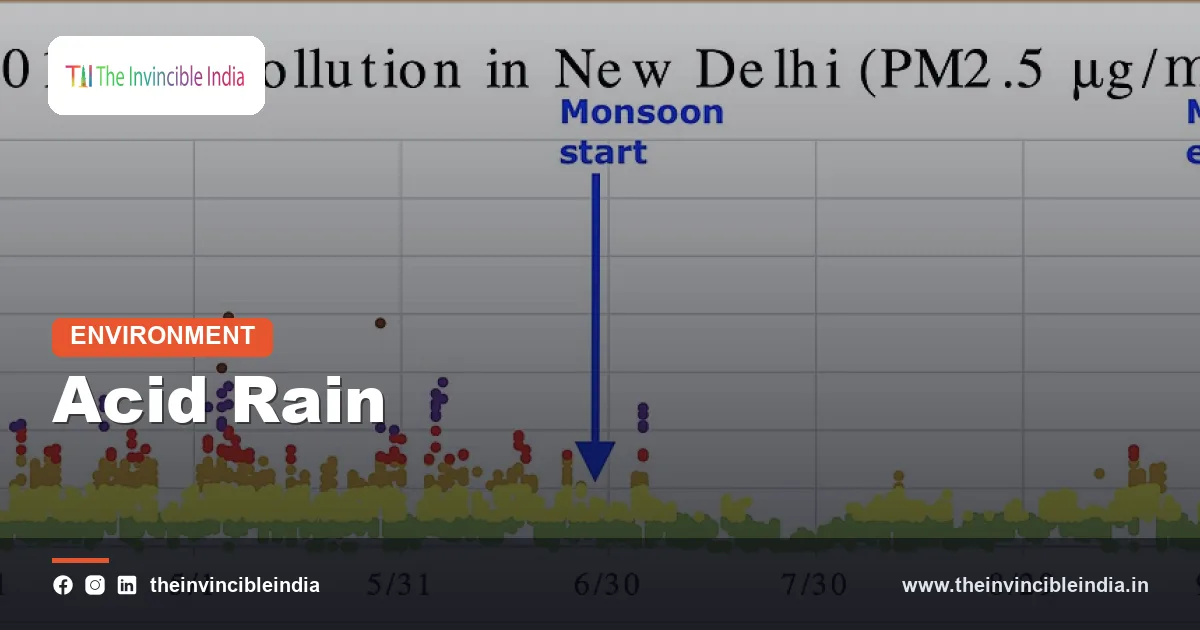
Acid rain is rain, snow, fog or dust that has turned unusually acidic because sulphur dioxide and nitrogen oxides released by burning fuels react in the atmosphere to form sulphuric and nitric acids. In India it is a real but patchy problem: far less visible than the country’s particulate smog, yet tied to the same coal-fired power plants, smelters, refineries and vehicles, and strongest near industrial clusters rather than evenly across the land.
This explainer covers how acid rain forms, why India’s measurements show a mixed picture rather than a uniform crisis, what it does to soils, water, crops and monuments such as the Taj Mahal, and what the Taj Trapezium Zone measures and newer emission rules have done about it. Last updated: 3 November 2026. Numbers are kept qualitative, because rainwater acidity varies sharply by place and season and monitoring across India is thin.
| Topic | Acid rain and acid deposition in India |
|---|---|
| Main pollutants | Sulphur dioxide (SO2) and nitrogen oxides (NOx) |
| Chief sources | Coal-fired power plants, smelters, refineries, brick kilns, diesel and petrol vehicles, industrial boilers |
| Normal rain acidity | Clean rain is slightly acidic, around pH 5.6; acid rain is generally considered to be below that value |
| India’s pattern | Patchy and localised; alkaline dust often neutralises acids across much of the north and west |
| Most affected materials | Marble, limestone and sandstone monuments, metals, and poorly buffered soils and lakes |
| Famous case | Taj Mahal and the Taj Trapezium Zone, protected by a Supreme Court-backed pollution control regime |
| Key control measures | Cleaner fuel, flue gas desulphurisation, stricter vehicle norms, shifting industries from coal to gas |
Key Takeaways
- Acid rain forms when sulphur dioxide and nitrogen oxides from burning coal, oil and petrol turn into acids in the air and fall as rain, snow, fog or dry particles.
- India burns a great deal of coal and is among the world’s largest sulphur dioxide emitters, but its rain is not uniformly acidic because alkaline dust neutralises much of the acidity.
- Acidic deposition is most likely near industrial belts and in regions with poorly buffered soils, rather than across the whole country.
- Marble and limestone monuments are especially vulnerable, which is why the Taj Mahal became the centre of India’s best-known air pollution case.
- Current evidence suggests that dust, soot and particulate pollution do more day-to-day damage to the Taj than acid rain alone.
- Cleaner fuels, desulphurisation equipment on power plants and tighter vehicle norms are the main ways to reduce acid-forming pollutants.
What exactly is acid rain?
Acid rain is precipitation with a higher acidity than normal rainwater, caused by the atmospheric conversion of sulphur dioxide and nitrogen oxides into sulphuric acid and nitric acid. Even perfectly clean rain is mildly acidic, because carbon dioxide dissolves in raindrops and forms weak carbonic acid, which gives a pH of about 5.6. Rain is generally called acid rain when its pH drops clearly below that level.
The term is slightly misleading, because the same acids can reach the ground without any rain at all. Scientists therefore speak of acid deposition, which includes wet forms such as rain, snow, mist and fog, and dry forms such as acidic gases and fine particles that settle on leaves, buildings and soil. Dry deposition is often important near the sources of pollution, which is one reason why places downwind of big plants can be affected even in a dry spell.
How does acid rain form?
Acid rain forms when burning fuels releases sulphur dioxide and nitrogen oxides, which then react with oxygen, water vapour and sunlight-driven oxidants high above the ground to create acids. Sulphur occurs naturally as an impurity in coal and in crude oil, so burning those fuels, or roasting metal ores in smelters, sends sulphur dioxide up the chimney. Nitrogen oxides are made when any fuel burns at high temperature, because nitrogen and oxygen in the air combine in the heat, which is why vehicles and power plants are major sources.
Once in the air, the gases can travel hundreds of kilometres before they turn into acids and come down, which means the area that suffers may be far from the chimney. Weather decides much of the outcome. Dry spells let pollutants build up, and the first showers after a long dry period can briefly wash out a concentrated dose. In India, the summer monsoon flushes the air with large volumes of rain that dilute acidity, but the seasonal reversal of winds can also carry pollutants between regions and across borders.
Is acid rain a big problem in India?
Acid rain is a real but localised problem in India rather than a country-wide crisis, and measurements show wide variation from place to place. India has few long-running rainwater chemistry stations, mostly operated by the India Meteorological Department and research institutions, and their records show mostly near-neutral or even alkaline rain over large parts of the Indo-Gangetic plain and the arid west. The reason is that India’s air carries a great deal of alkaline dust, rich in calcium carbonate, which reacts with acids and neutralises them before they reach the ground. Ammonia from farming and livestock also helps neutralise acidity.
That does not mean the problem is absent. Acidic rain has been recorded at some stations, particularly in parts of the north-east, some coastal and hill sites, and near industrial clusters, and local studies around refineries, power plants and smelters have reported lower pH values. Researchers also caution that neutralisation hides the burden rather than removing it: the sulphur and nitrogen still land on soils and water as salts, and some scientists worry that stronger pollution controls on dust could, ironically, reduce neutralisation and expose acidity that is currently masked. The honest conclusion is that India is a patchwork, with a few hotspots and a lot of uncertainty.
Which Indian sources emit the most acid-forming pollutants?
Coal-fired power plants are the largest Indian source of sulphur dioxide, followed by industry, refineries, smelters and, for nitrogen oxides, road transport. Coal supplies a large share of the country’s electricity, and Indian coal tends to be low in sulphur compared with some foreign coals but is high in ash. Even so, because the volumes burned are enormous, satellite-based studies have ranked India among the world’s biggest emitters of sulphur dioxide in recent years, with big clusters visible over coal belts such as Singrauli, Korba, the Talcher-Angul region and the Mundra and Chandrapur areas.
Other contributors matter locally. Oil refineries and fertiliser plants add sulphur compounds. Metal smelters release large amounts when they process sulphide ores. Brick kilns and small industries burn coal with little pollution control. Vehicles and diesel generators produce a good share of nitrogen oxides in cities. The table below shows how the main sources compare in role.
| Source | Main acid-forming gas | Why it matters |
|---|---|---|
| Coal power plants | Sulphur dioxide, nitrogen oxides | Largest single source of SO2; plants cluster in coal belts |
| Metal smelters | Sulphur dioxide | Release sulphur locked in ores; pollution is intense near the plant |
| Refineries | Sulphur dioxide, nitrogen oxides | Process crude oil; relevant to the Mathura refinery debate near the Taj |
| Vehicles | Nitrogen oxides | Diesel engines are a major urban source |
| Brick kilns and small industry | Sulphur dioxide, particulates | Often burn coal or poor fuel without controls |
| Agriculture | Ammonia | Does not cause acidity but can neutralise it, altering the balance |
What does acid rain do to soil, water and forests?
Acid rain damages soils, lakes and forests mainly by leaching away nutrients and releasing toxic metals, though the harm depends heavily on how well the local environment can buffer acidity. Soils rich in lime, which are widespread across the north-western plains and the black cotton soil belts, neutralise acids and show little effect. Weakly buffered soils, such as many red and laterite soils of the south and parts of the north-east, are more vulnerable, because acid deposition strips calcium and magnesium and can free aluminium, which harms roots.
In water, acidification can stress fish and aquatic insects, and in forests it can weaken trees so that they become more sensitive to drought, pests and cold. Evidence from India is limited. Unlike parts of Europe and North America, where lakes lost their fish and conifers died back, India has not documented a comparable ecosystem collapse linked to acid rain. Some local studies on tea, rice and forest sites suggest subtle effects, but they are often confounded by other pollutants such as ground-level ozone, which can also cut crop yields. Scientists generally describe this as a risk that needs more monitoring rather than a proven widespread impact.
Does acid rain affect crops and human health?
Acid rain itself has only a limited direct effect on human health and crops, but the pollutants that cause it, sulphur dioxide, nitrogen oxides and the fine particles they form, are well-established health hazards. Breathing sulphur dioxide irritates the airways and can trigger asthma attacks, and the sulphate and nitrate particles created from these gases are an important part of the fine particulate matter that harms lungs and hearts in Indian cities. In other words, cutting the pollutants that make acid rain also cuts a share of the deadly smog.
For crops, the picture is mixed. A little deposited sulphur and nitrogen can act as a fertiliser, which is one reason sulphur-deficient soils in parts of India have not shown obvious harm. Heavy local deposition near plants and smelters, however, can scorch leaves, and acidic fog or mist may damage foliage directly. Farmers in industrial belts sometimes report poorer yields and corroded roofing, but proving that acid rain alone is responsible is difficult because other pollutants such as ground-level ozone and dust act at the same time. Drinking water from rainwater tanks can also become more acidic and leach metals from pipes, which is worth testing near heavy industry.
How does acid rain affect the Taj Mahal and other monuments?
Acid rain attacks the Taj Mahal and other monuments because marble and limestone are made of calcium carbonate, which dissolves and crumbles when it meets acid. Sulphur dioxide can also react directly with stone surfaces, forming a crust of gypsum that traps dirt and flakes away, sometimes called stone sickness or marble cancer. Sandstone buildings, such as many Mughal and temple structures, suffer from salt crystallisation that widens cracks, and metal fittings and iron clamps corrode more quickly in polluted, moist air.
The Taj Mahal’s marble has been turning yellowish and brownish in patches, and for decades acid rain was blamed. More recent studies of the monument’s surface suggest that particulate matter, soot, dust and organic carbon deposits are an important cause of the discolouring, along with acid gases, rather than rainfall acidity alone. This is a useful correction to a popular story. Acid rain contributes to decay, but the visible staining owes much to the broader air pollution of the Agra region, which is why the conservation response has involved dust and fuel controls as well as emission limits. Periodic mud-pack cleaning with fuller’s earth, a traditional method, is used to lift the stains.
What was the Taj Trapezium Zone and did it work?
The Taj Trapezium Zone is a protected area of roughly ten thousand square kilometres around Agra, Mathura, Firozabad, Hathras and Etah, created by a Supreme Court-backed regime to limit air pollution near the Taj Mahal. It came out of a public interest case brought by the environmental lawyer M.C. Mehta in the 1980s, with a major judgment in 1996 that ordered polluting industries in the zone to switch from coal and coke to natural gas or move out, and restricted the setting up of new polluting units.
The measures also included action on the Mathura refinery, which had been a long-standing worry because of its sulphur dioxide output, along with scrutiny of foundries, glassworks in Firozabad, brick kilns and traffic near the monument. Authorities restricted heavy vehicles close to the Taj, promoted cleaner fuels, and planted green belts. Results have been mixed but generally positive for sulphur dioxide levels around the monument, and air pollution control authorities and the court continued to monitor the zone for years. Dust, vehicle emissions, waste burning and crop residue smoke remain stubborn problems, which shows that a regional approach helps but does not fully solve the issue.
What is India doing to cut sulphur and nitrogen emissions?
India is cutting acid-forming emissions mainly through cleaner transport fuel, stricter standards for power plants and a push to shift industries to gas and electricity. A major step was the jump to Bharat Stage VI vehicle and fuel norms in 2020, which cut the sulphur content of petrol and diesel to a tiny fraction of earlier levels and sharply reduced vehicle pollution. Refineries upgraded to produce the cleaner fuel, which also reduced their own emissions in the process.
For coal power, emission standards notified in 2015 required plants to control sulphur dioxide, typically by installing flue gas desulphurisation units, along with tighter limits on nitrogen oxides and particulates. Implementation has been slow, with compliance deadlines extended repeatedly and, more recently, relaxed for many plants on the grounds of cost and the lower sulphur content of Indian coal. Critics argue that this leaves a large pollution source under-controlled, while supporters point out that limited ambient sulphur dioxide readings in many places suggest that the benefits are uneven. Renewable energy growth, the retirement of old units and improved efficiency also help reduce emissions over time.
How can you tell if rain is acidic?
You can tell whether rain is acidic only by measuring its pH, because acid rain usually looks, smells and feels like ordinary rain. The standard method is to collect rain in a clean container, taking care not to contaminate it with roof dust, and test it with a calibrated pH meter or good-quality indicator strips. Laboratories analyse rainwater for sulphate, nitrate, ammonium, calcium and other ions to find out what is making it acidic or neutralising it.
Because single samples vary enormously, scientists rely on long-term collections at fixed stations across seasons. India’s patchy network is one reason knowledge of the problem remains incomplete. Schools, universities and citizen groups can help by monitoring rainfall chemistry in their neighbourhood, particularly near power plants, refineries and industrial estates, and by recording whether leaves, monuments and metal roofing show unusual damage. Indirect clues include rapid corrosion of metal roofs, pitting of marble steps and a whitish crust on stone, but these can also be caused by other forms of pollution and weathering.
Bottom Line
Acid rain in India is a localised and under-measured pollution problem rather than a nationwide emergency, softened by alkaline dust but driven by the same coal and fuel burning that harms health and monuments. Cutting sulphur and nitrogen emissions at source remains the most direct fix.
Frequently Asked Questions
What is acid rain?
Acid rain is rainfall, or other precipitation, made more acidic than normal by sulphur dioxide and nitrogen oxides that turn into sulphuric and nitric acids in the air. Normal clean rain has a pH of about 5.6, and acid rain is generally lower than that.
Does India have acid rain?
Yes, but it is patchy. Many parts of India receive near-neutral or alkaline rain because dust neutralises acids, while acidic rain has been reported at some stations and near industrial clusters.
Does acid rain damage the Taj Mahal?
Acid gases and acidic deposition can harm the Taj Mahal’s marble, but studies suggest that dust, soot and particulate deposits are a major cause of its yellowing. Conservation therefore focuses on cleaning the air generally and not only on cutting acid rain.
What is the Taj Trapezium Zone?
It is a protected area of about ten thousand square kilometres around the Taj Mahal where industries and fuels are regulated to reduce air pollution. A 1996 Supreme Court order pushed industries there to use natural gas instead of coal or to relocate.
What causes acid rain in India?
The main causes are sulphur dioxide from coal power plants, smelters and refineries, and nitrogen oxides from vehicles and combustion. These gases react in the atmosphere to form acids that later return to the ground.
How can acid rain be reduced?
It can be reduced by cutting sulphur and nitrogen emissions through cleaner fuels, desulphurisation equipment on power plants and stricter vehicle norms. Shifting from coal to renewable energy and gas also helps.
{“@context”:”https://schema.org”,”@graph”:[{“@type”:”FAQPage”,”mainEntity”:[{“@type”:”Question”,”name”:”What is acid rain?”,”acceptedAnswer”:{“@type”:”Answer”,”text”:”Acid rain is rainfall, or other precipitation, made more acidic than normal by sulphur dioxide and nitrogen oxides that turn into sulphuric and nitric acids in the air. Normal clean rain has a pH of about 5.6, and acid rain is generally lower than that.”}},{“@type”:”Question”,”name”:”Does India have acid rain?”,”acceptedAnswer”:{“@type”:”Answer”,”text”:”Yes, but it is patchy. Many parts of India receive near-neutral or alkaline rain because dust neutralises acids, while acidic rain has been reported at some stations and near industrial clusters.”}},{“@type”:”Question”,”name”:”Does acid rain damage the Taj Mahal?”,”acceptedAnswer”:{“@type”:”Answer”,”text”:”Acid gases and acidic deposition can harm the Taj Mahal’s marble, but studies suggest that dust, soot and particulate deposits are a major cause of its yellowing. Conservation therefore focuses on cleaning the air generally and not only on cutting acid rain.”}},{“@type”:”Question”,”name”:”What is the Taj Trapezium Zone?”,”acceptedAnswer”:{“@type”:”Answer”,”text”:”It is a protected area of about ten thousand square kilometres around the Taj Mahal where industries and fuels are regulated to reduce air pollution. A 1996 Supreme Court order pushed industries there to use natural gas instead of coal or to relocate.”}},{“@type”:”Question”,”name”:”What causes acid rain in India?”,”acceptedAnswer”:{“@type”:”Answer”,”text”:”The main causes are sulphur dioxide from coal power plants, smelters and refineries, and nitrogen oxides from vehicles and combustion. These gases react in the atmosphere to form acids that later return to the ground.”}},{“@type”:”Question”,”name”:”How can acid rain be reduced?”,”acceptedAnswer”:{“@type”:”Answer”,”text”:”It can be reduced by cutting sulphur and nitrogen emissions through cleaner fuels, desulphurisation equipment on power plants and stricter vehicle norms. Shifting from coal to renewable energy and gas also helps.”}}]}]}


