

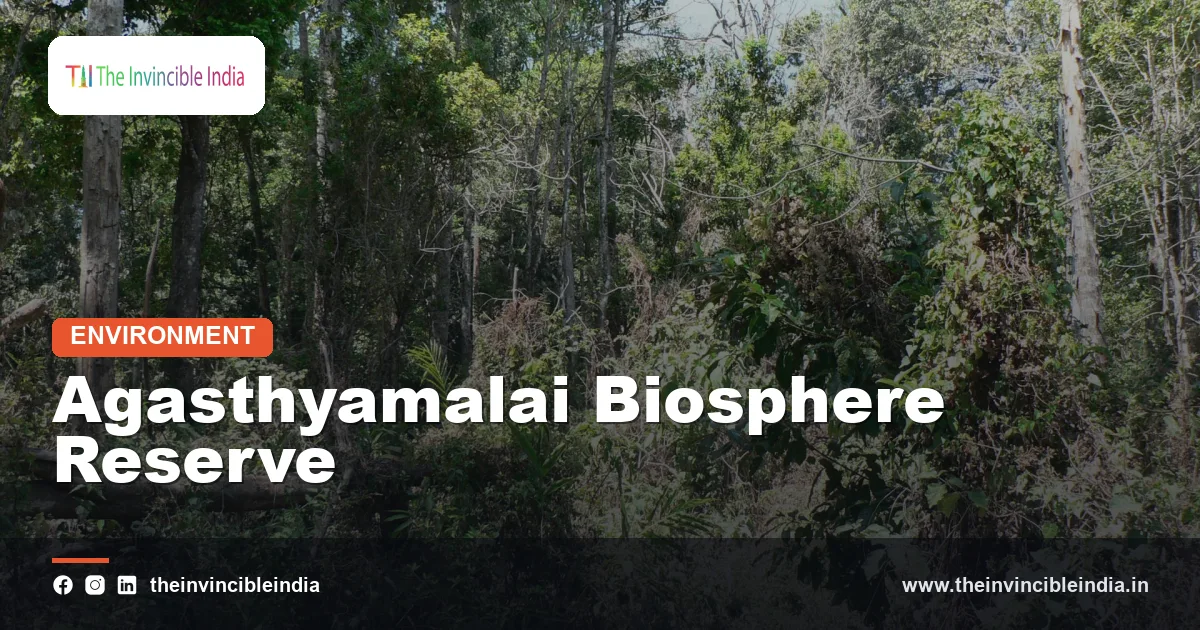
The Agasthyamalai Biosphere Reserve is a protected landscape in the southern Western Ghats, spanning Kerala and Tamil Nadu, that was admitted to the UNESCO World Network of Biosphere Reserves in 2016 as one of the richest centres of plant diversity and endemism in peninsular India. Dominated by the peak of Agastyarkoodam, it holds rainforest, grassland and river headwaters that feed streams on both sides of the mountains, and it is closely tied to the traditional knowledge of the Kani tribal community.
This explainer covers the reserve from an ecological and conservation viewpoint: where it lies, why its rainfall and terrain support so much life, what plants and animals it protects, the story of the arogyapacha plant and the Kani people, how its rivers matter downstream, and the threats it faces. It was last reviewed on 2 November 2026.
| Attribute | Detail |
|---|---|
| Location | Southern Western Ghats, across southern Kerala and southern Tamil Nadu |
| Established | Declared as a biosphere reserve in 2001 |
| UNESCO recognition | Added to the UNESCO World Network of Biosphere Reserves in 2016 |
| Area | About 3,500 sq km |
| Highest point | Agastyarkoodam, about 1,868 metres |
| Protected areas inside | Neyyar, Peppara and Shendurney sanctuaries in Kerala; Kalakad Mundanthurai Tiger Reserve and Kanyakumari sanctuary in Tamil Nadu |
| Habitats | Tropical wet evergreen forest, semi-evergreen forest, moist deciduous forest, montane grassland and shola |
| Flagship species | Asian elephant, tiger, Nilgiri tahr, lion-tailed macaque, Nilgiri langur |
| Key rivers | Tamiraparani, Neyyar, Karamana and Kallada, among others |
| Local community | Kani (Kanikkar) tribe, known for the plant arogyapacha |
Key Takeaways
- The Agasthyamalai Biosphere Reserve lies in the southern Western Ghats across Kerala and Tamil Nadu and joined the UNESCO biosphere network in 2016.
- It is dominated by Agastyarkoodam, a peak of about 1,868 metres, and holds forests from lowland rainforest to high-altitude grassland.
- The reserve is a hotspot of plant endemism, with many medicinal plants and wild relatives of crops such as pepper, cardamom and banana.
- It shelters elephants, tigers, the Nilgiri tahr and the lion-tailed macaque, together with many endemic amphibians and birds.
- The Kani tribe discovered the energising properties of arogyapacha, leading to a well-known benefit-sharing arrangement with a research institute.
- Its forests feed rivers such as the Tamiraparani, so conserving the hills also protects water supply for people downstream.
Where Is the Agasthyamalai Biosphere Reserve?
The Agasthyamalai Biosphere Reserve lies at the southern end of the Western Ghats, where the mountain chain narrows and ends near Kanyakumari, and it covers about 3,500 square kilometres across the districts of Thiruvananthapuram, Kollam and Pathanamthitta in Kerala and Tirunelveli and Kanyakumari in Tamil Nadu.
Its central feature is the Agasthyamalai range, also called the Pothigai hills, which rises to its highest point at Agastyarkoodam. The mountain is named after the sage Agastya, who in legend lived in the southern hills, and it is regarded as sacred by local communities. The range stretches roughly north to south and forms a barrier to the monsoon winds, receiving heavy rain on its slopes.
Several protected areas make up the core zones. In Kerala these include the Neyyar, Peppara and Shendurney wildlife sanctuaries, and in Tamil Nadu the Kalakad Mundanthurai Tiger Reserve and the Kanyakumari wildlife sanctuary. The reserve also forms part of the larger Western Ghats, a UNESCO World Heritage Site since 2012, whose component areas include forests of the Agasthyamalai hills.
Why Is the Agasthyamalai Region So Rich in Biodiversity?
The region is rich in biodiversity because of its heavy rainfall, steep altitude range, ancient and stable climate and its position at the southern tip of a mountain chain that has acted as an island of forest for millions of years. These factors allowed species to evolve in isolation and persist through climate changes.
The southern Western Ghats receive both the southwest monsoon from June and the northeast monsoon from October, so the region has long wet periods and comparatively short dry spells. Rain-fed forests stay green for most of the year, and mist and cloud on the highest slopes sustain moist habitats. Elevation ranges from near sea level to nearly 1,900 metres, creating many climatic niches within a small area.
Many species in these hills are found nowhere else. The area belongs to the Western Ghats and Sri Lanka biodiversity hotspot, one of the world’s recognised centres of endemic life. Within the Western Ghats, the Agasthyamalai region is regarded as a distinct unit with its own set of species, particularly among plants, amphibians and insects.
Which Forests and Habitats Does the Reserve Protect?
The reserve protects a gradient of forests, from tropical wet evergreen and semi-evergreen forests on the lower and middle slopes to moist deciduous forest on drier flanks and shola-grassland on the highest ridges. This range of habitats packs a great deal of variety into a relatively small area.
The wet evergreen forest is the richest habitat. Tall trees form a closed canopy, with layers of smaller trees, shrubs, ferns, orchids and epiphytes below. On the rain-shadow side, in parts of the Tamil Nadu slopes, the forest changes to semi-evergreen and then to moist deciduous types, and the contrast between the two sides shows how strongly the mountains control local climate.
At higher elevations, shola forests and montane grasslands form a patchwork similar to that of the Nilgiris. These cool habitats hold specialised plants and animals, including high-altitude birds, amphibians and the Nilgiri tahr. Rocky outcrops, streams, waterfalls and swamps add further microhabitats, and many of the smallest species live only in a single stream or hillside.
| Habitat | Typical elevation | Key features |
|---|---|---|
| Tropical wet evergreen forest | Low to about 1,500 m | Dense canopy, high rainfall, many endemic trees and amphibians |
| Semi-evergreen and moist deciduous forest | Lower slopes and drier flanks | Elephant, gaur and deer ranges, seasonal leaf fall |
| Montane shola forest | Above about 1,500 m | Stunted evergreen pockets in sheltered folds |
| Montane grassland | High ridges near the summit | Open slopes, tahr habitat, strong winds and mist |
| River and swamp habitats | Throughout | Headwater streams, waterfalls, fish and frog endemics |
Which Plants Make Agasthyamalai a Botanical Treasure?
Agasthyamalai is a botanical treasure because it holds more than two thousand species of flowering plants, including hundreds of endemic species, many medicinal plants and wild relatives of important crops. Botanists regard it as one of the richest plant areas in peninsular India.
The forests contain wild relatives of cultivated plants such as pepper, cardamom, ginger, turmeric, banana, mango and jackfruit, which hold genes that may help future crops resist disease or drought. Orchids, balsams, ferns, begonias and many shrubs and herbs also grow here, and some species were discovered or described only in recent decades.
The region is also a centre for medicinal plants. Local healers and ayurvedic practitioners have long used hundreds of species from these forests. Because of this value, conservationists worry about overharvesting of wild herbs, and the reserve has long been a focus for research on sustainable use of plants and on seed banks and botanical gardens.
What Animals Live in the Agasthyamalai Biosphere Reserve?
The reserve shelters Asian elephants, tigers, leopards, gaur, sloth bears, Nilgiri tahr, lion-tailed macaques and Nilgiri langurs, along with hundreds of bird species and a remarkable variety of endemic amphibians, reptiles and fishes. Its large forests still support a full range of predators and herbivores.
The Kalakad Mundanthurai Tiger Reserve is the main stronghold for tigers on the Tamil Nadu side, and the forests are a significant part of the elephant range in the southern Western Ghats. The lion-tailed macaque, a rainforest monkey found only in the Western Ghats, lives in the tall evergreen forests, while the Nilgiri tahr occupies the grassy cliffs near the summits. Smaller mammals such as the Nilgiri marten, Malabar civet and flying squirrels live in the canopy.
The Western Ghats are a global hotspot for frogs, and the Agasthyamalai hills contain many species of frogs and toads, some of them restricted to a single hill range, along with endemic fishes in the hill streams and rare reptiles such as certain snakes and lizards. Birds include the Malabar trogon, Nilgiri flycatcher and several endemic species of the southern Ghats. Much of the smaller life, including insects, is still being documented.
Who Are the Kani People and What Is Arogyapacha?
The Kani, also called the Kanikkar, are a tribal community of the Agasthyamalai forests, and arogyapacha is a medicinal plant whose energising properties were first shared by them with scientists, leading to one of India’s best-known benefit-sharing arrangements. The name means roughly the green that gives health.
The Kani have lived in these hills for generations and hold deep knowledge about forest plants, foods and healing. Researchers noticed that Kani people eating the fruits of a forest plant remained energetic during long forest walks. The plant was identified as a species of Trichopus, locally called arogyapacha, and scientists at the Tropical Botanic Garden and Research Institute in Kerala studied it and developed a herbal energy tonic from it.
In the 1990s the institute licensed the formulation to an ayurvedic company, and an arrangement was set up to share part of the licence fee and royalties with the Kani community through a trust. It was widely discussed as an early example of sharing the benefits of traditional knowledge, in line with ideas later set out in the Convention on Biological Diversity. Debates remain about whether the benefits were large or fair enough, but the case is still taught as a landmark in ethnobotany and community rights.
Why Are the Agasthyamalai Hills Important for Rivers and Water?
The hills are important because they are the source region of several rivers, including the Tamiraparani, Neyyar, Karamana and Kallada, which supply drinking water, irrigation and power to millions of people in southern Kerala and Tamil Nadu. Forests on the slopes absorb monsoon rain and release it gradually.
The Tamiraparani, which rises on the eastern slopes in Tamil Nadu, is one of the major perennial rivers of the far south and supports farming and settlements through Tirunelveli district before reaching the sea at the Gulf of Mannar. On the Kerala side, rivers drain towards the Arabian Sea, and the Neyyar and Karamana provide water for the capital region of Thiruvananthapuram.
This link makes conservation a matter of water security. When forests are cleared or burned, rivers can dry up faster after the monsoon and carry more silt in the rains. The reserve therefore delivers an ecosystem service of regulating flows, which downstream cities and farmers depend on, even though it is rarely counted in economic terms.
What Threatens the Agasthyamalai Biosphere Reserve?
The main threats are forest fires, invasive plants, conversion of forest to plantations and settlements, overharvesting of medicinal plants, hydropower and irrigation projects, and human-wildlife conflict. Climate change adds to the pressure on high-altitude species.
Fires in the dry season damage grassland and forest edges, and invasive plants spread easily in disturbed areas and reduce native diversity. Plantations of tea, rubber and cardamom around the edges have broken forest into patches and reduced habitat for large mammals. Reservoirs and dams have flooded some valley forest in the past and altered river flows.
Human-wildlife conflict occurs where elephants and other animals raid crops near the forest boundary, and it can cause losses on both sides. Rising temperatures and changing rainfall could shift or shrink the ranges of high-altitude species such as the Nilgiri tahr, which has nowhere higher to go. Pressure from visitors and pilgrims to the high peaks also requires regulation to protect fragile summit habitat.
How Is the Reserve Managed and Conserved?
The reserve is managed by the forest departments of Kerala and Tamil Nadu, and its core areas are legally protected as wildlife sanctuaries and a tiger reserve under the Wildlife (Protection) Act, 1972. Coordination between the two states is essential because the forest is continuous across the border.
Conservation work includes anti-poaching patrols, fire management, habitat restoration, wildlife monitoring and ecodevelopment programmes with forest communities. In the zoned biosphere reserve model, villages and farmland in the buffer and transition areas are encouraged to adopt sustainable practices, such as agroforestry and regulated collection of non-timber forest produce.
The reserve also benefits from research institutions, botanical gardens and its place within the Western Ghats World Heritage framework, which draws attention and funding to the region. Long-term success depends on maintaining forest continuity, protecting river sources, and respecting the rights and knowledge of the Kani and other forest-dwelling people.
Bottom Line
The Agasthyamalai Biosphere Reserve is a southern Western Ghats stronghold of endemic plants, rainforest wildlife and river sources, recognised by UNESCO in 2016. Its value lies in its richness of unique species, its role in water supply and the living example of the Kani community, and its future depends on protecting forest continuity and sharing benefits fairly with local people.
Frequently Asked Questions
Where is the Agasthyamalai Biosphere Reserve located?
It is located in the southern Western Ghats across southern Kerala and southern Tamil Nadu, covering about 3,500 square kilometres. It includes the Agasthyamalai range, whose highest peak is Agastyarkoodam at about 1,868 metres. Districts include Thiruvananthapuram, Kollam, Pathanamthitta, Tirunelveli and Kanyakumari.
When did the Agasthyamalai Biosphere Reserve become a UNESCO site?
It was declared a biosphere reserve in India in 2001 and was added to the UNESCO World Network of Biosphere Reserves in 2016. It also overlaps with parts of the Western Ghats World Heritage Site, which was inscribed in 2012. The recognition highlights its biodiversity and endemic species.
What is special about Agastyarkoodam?
Agastyarkoodam is the highest peak of the Agasthyamalai range, at about 1,868 metres, and it is the most prominent summit of the reserve. It is named after the sage Agastya and is regarded as sacred. Its upper slopes carry shola forest and grassland that shelter specialised species such as the Nilgiri tahr.
What is arogyapacha?
Arogyapacha is a medicinal plant of the Agasthyamalai forests whose fruits are used by the Kani tribe for energy and stamina. Scientists at a Kerala research institute developed a herbal tonic from it. The case became well known for sharing part of the profits with the Kani community.
Which rivers originate in the Agasthyamalai hills?
Rivers that rise in or near the hills include the Tamiraparani, Neyyar, Karamana and Kallada. They supply drinking water and irrigation to southern Kerala and Tamil Nadu. The Tamiraparani flows east and ends at the Gulf of Mannar, while the Kerala rivers flow west towards the Arabian Sea.
What animals are found in the Agasthyamalai Biosphere Reserve?
The reserve is home to Asian elephants, tigers, leopards, gaur, sloth bears, Nilgiri tahr, lion-tailed macaques and Nilgiri langurs. It also holds many endemic frogs, reptiles, fishes and birds. Much of its smaller wildlife is still being studied and new species are sometimes described.
{“@context”:”https://schema.org”,”@graph”:[{“@type”:”FAQPage”,”mainEntity”:[{“@type”:”Question”,”name”:”Where is the Agasthyamalai Biosphere Reserve located?”,”acceptedAnswer”:{“@type”:”Answer”,”text”:”It is located in the southern Western Ghats across southern Kerala and southern Tamil Nadu, covering about 3,500 square kilometres. It includes the Agasthyamalai range, whose highest peak is Agastyarkoodam at about 1,868 metres. Districts include Thiruvananthapuram, Kollam, Pathanamthitta, Tirunelveli and Kanyakumari.”}},{“@type”:”Question”,”name”:”When did the Agasthyamalai Biosphere Reserve become a UNESCO site?”,”acceptedAnswer”:{“@type”:”Answer”,”text”:”It was declared a biosphere reserve in India in 2001 and was added to the UNESCO World Network of Biosphere Reserves in 2016. It also overlaps with parts of the Western Ghats World Heritage Site, which was inscribed in 2012. The recognition highlights its biodiversity and endemic species.”}},{“@type”:”Question”,”name”:”What is special about Agastyarkoodam?”,”acceptedAnswer”:{“@type”:”Answer”,”text”:”Agastyarkoodam is the highest peak of the Agasthyamalai range, at about 1,868 metres, and it is the most prominent summit of the reserve. It is named after the sage Agastya and is regarded as sacred. Its upper slopes carry shola forest and grassland that shelter specialised species such as the Nilgiri tahr.”}},{“@type”:”Question”,”name”:”What is arogyapacha?”,”acceptedAnswer”:{“@type”:”Answer”,”text”:”Arogyapacha is a medicinal plant of the Agasthyamalai forests whose fruits are used by the Kani tribe for energy and stamina. Scientists at a Kerala research institute developed a herbal tonic from it. The case became well known for sharing part of the profits with the Kani community.”}},{“@type”:”Question”,”name”:”Which rivers originate in the Agasthyamalai hills?”,”acceptedAnswer”:{“@type”:”Answer”,”text”:”Rivers that rise in or near the hills include the Tamiraparani, Neyyar, Karamana and Kallada. They supply drinking water and irrigation to southern Kerala and Tamil Nadu. The Tamiraparani flows east and ends at the Gulf of Mannar, while the Kerala rivers flow west towards the Arabian Sea.”}},{“@type”:”Question”,”name”:”What animals are found in the Agasthyamalai Biosphere Reserve?”,”acceptedAnswer”:{“@type”:”Answer”,”text”:”The reserve is home to Asian elephants, tigers, leopards, gaur, sloth bears, Nilgiri tahr, lion-tailed macaques and Nilgiri langurs. It also holds many endemic frogs, reptiles, fishes and birds. Much of its smaller wildlife is still being studied and new species are sometimes described.”}}]}]}


