

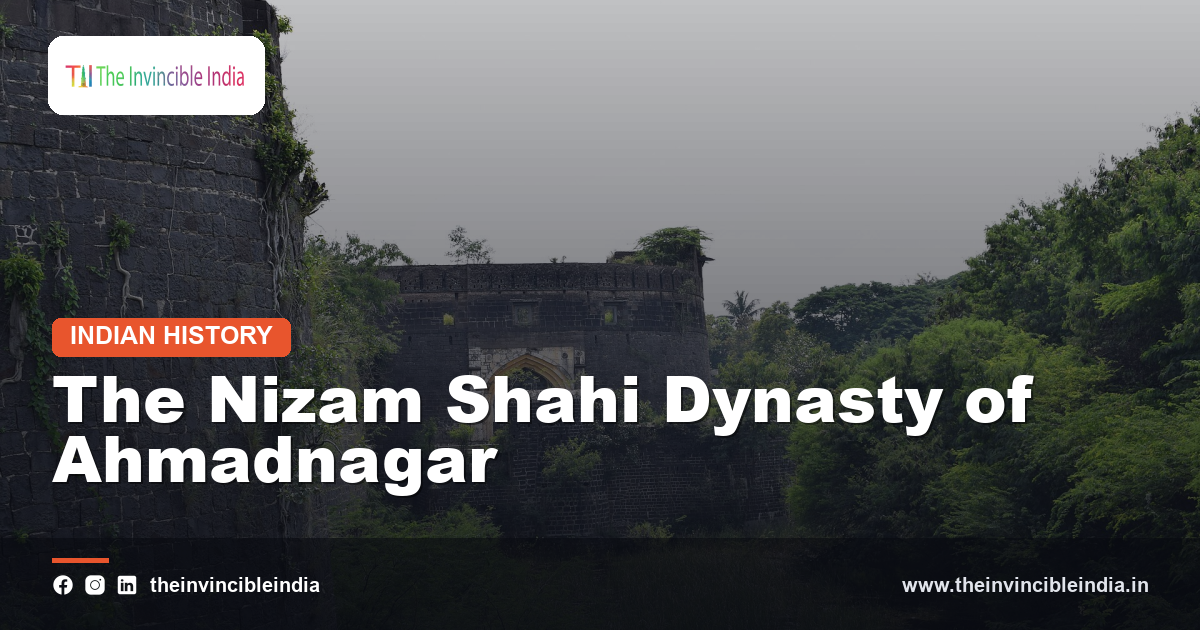
The Nizam Shahi dynasty, also called the Nizam Shahis of Ahmadnagar or the Ahmadnagar Sultanate, was one of the Deccan sultanates that emerged from the breakup of the Bahmani Sultanate. Ruling from the city of Ahmadnagar in present-day Maharashtra, the dynasty governed a broad stretch of the western Deccan for roughly a century and a half. Its history includes the defence of Ahmadnagar by Chand Bibi, the statecraft of the Abyssinian regent Malik Ambar, and the long struggle against the Mughal advance from the north. The Nizam Shahis were also patrons of painting, architecture and learning. Their story belongs beside that of neighbouring kingdoms such as the Vijayanagara Empire and the powers that later shaped the Maratha rise.
Quick answer: The Nizam Shahi dynasty was a Muslim ruling house that governed the Deccan sultanate of Ahmadnagar, in present-day Maharashtra, from the late fifteenth to the early seventeenth century. It broke away from the Bahmani Sultanate under Malik Ahmad Nizam Shah I and is remembered for Chand Bibi’s defence of Ahmadnagar, Malik Ambar’s regency and the Mughal annexation of the state.
Key Takeaways
- The Nizam Shahi dynasty ruled the Ahmadnagar Sultanate, one of five Deccan states that emerged from the Bahmani Sultanate.
- Malik Ahmad Nizam Shah I founded the dynasty in the late fifteenth century and named his capital Ahmadnagar after himself.
- Chand Bibi, a Nizam Shahi princess, led the defence of Ahmadnagar against a Mughal siege in the late sixteenth century.
- Malik Ambar, an Abyssinian-born regent, extended Nizam Shahi resistance in the early seventeenth century and founded Khadki, later Aurangabad.
- Ahmadnagar Fort, a circular stone fortress with a moat, is the best-known monument of the dynasty and later served as a prison under British rule.
- The Mughal Empire absorbed the remaining Nizam Shahi territory in the first half of the seventeenth century.
Quick Facts
| Detail | Information |
|---|---|
| Dynasty | Nizam Shahi (Nizam Shahis of Ahmadnagar) |
| Capital | Ahmadnagar, Maharashtra |
| Origin | Breakaway state of the Bahmani Sultanate |
| Founder | Malik Ahmad Nizam Shah I |
| Notable figures | Chand Bibi, Malik Ambar, Husain Nizam Shah I |
| End of independence | Absorbed by the Mughal Empire in the early seventeenth century |
What was the Nizam Shahi dynasty of Ahmadnagar?
The Nizam Shahi dynasty was a Muslim ruling house that governed the Deccan sultanate of Ahmadnagar from the late fifteenth to the early seventeenth century. It began as a provincial command under the Bahmani Sultanate and became independent as central authority collapsed. Its rulers took the name Nizam Shah, derived from the title of the founder’s father, and they presided over a state that stretched across much of the western Deccan plateau. Ahmadnagar was one of the five successor states of the Bahmanis and played a major part in the politics of the region. The dynasty is remembered for its resistance to outside powers, for able women and ministers, and for artistic patronage, all of which gave a small kingdom a large place in history.
How did Ahmadnagar break away from the Bahmani Sultanate?
Ahmadnagar broke away when a powerful Bahmani official’s son turned his provincial command into an independent state during the late fifteenth century. The Bahmani Sultanate was weakened by factional rivalry among its nobles, and provincial governors increasingly acted on their own. Malik Ahmad, whose father had served as a senior minister, defeated forces sent to restrain him and declared his independence. Accounts of the exact sequence differ, and chroniclers vary in the details of dates and battles, so historians describe the process in general terms as a gradual transfer of power in the closing decades of the fifteenth century. The new state soon proved durable and grew into a major kingdom of the Deccan.
Who was Malik Ahmad Nizam Shah I?
Malik Ahmad Nizam Shah I was the founder of the dynasty and the first ruler of independent Ahmadnagar. He was the son of Nizam-ul-Mulk Bahri, a leading minister in the Bahmani court, and he inherited both rank and ambition from his father. Traditional accounts say that the family had Hindu Brahmin origins before entering Bahmani service, though this is one of the points on which sources are not fully clear. Malik Ahmad consolidated his hold on the region, built up a loyal army and established a new capital. The city that bore his name quickly became the centre of a powerful state. His achievement was to turn a provincial base into a lasting sovereign dynasty.
Where is Ahmadnagar and why was it founded?
Ahmadnagar is located in present-day Maharashtra, on the plateau near the Sina river, and it was founded as the capital of the new sultanate. The site was chosen for its central position on routes linking the western coast with the interior Deccan, and for its defensible terrain. The city grew around a fortified core and was supplied with water through channels and gardens, a feature of many Deccan capitals. Its founder named it after himself, a common practice among medieval rulers. Today Ahmadnagar remains a district town with many surviving monuments, including tombs, mosques and the great fort. The location helped make the city both a political centre and a gateway between north and south.
How did the Nizam Shahi state expand and govern?
The Nizam Shahi state expanded through military campaigns against its neighbours and governed through a mixture of court nobles, regional officers and local landholders. Its early rulers pushed into the western Deccan and coastal regions, fought repeated wars over border territory and forts, and defended their lands against rivals such as Bijapur, Berar and Gujarat. Persian served as the language of the court, while Marathi was widely used in local administration, which brought many Marathi families into the state’s service. Revenue came from land and trade, and the army included cavalry, infantry and artillery. This flexible system allowed the sultanate to hold together a diverse territory and to remain a serious regional power for several generations.
What role did the Nizam Shahis play in the Deccan sultanates?
The Nizam Shahis played the role of one of the five Deccan successor states, competing and cooperating with Bijapur, Golconda, Berar and Bidar. These states fought over borderlands but also shared a Persianate court culture and sometimes joined in alliances. Ahmadnagar’s most famous collective action was the alliance with its neighbours against the Vijayanagara Empire, which culminated in the Battle of Talikota in the mid-sixteenth century. Marriage ties also linked the courts, as seen in the marriage of an Ahmadnagar princess to the ruler of Bijapur. Historians now view the Deccan sultanates as a connected political world rather than isolated rivals, and Ahmadnagar was a central part of that system.
Who was Chand Bibi?
Chand Bibi, also called Chand Sultana, was a royal woman of the Nizam Shahi family who became famous for defending Ahmadnagar against the Mughals. She was a daughter of Husain Nizam Shah I and was married to a ruler of Bijapur, where she acted as a regent for a time. Later she returned to Ahmadnagar and took a leading role in the kingdom’s affairs during a period of succession crisis. Tradition praises her courage, learning and skill as a leader, and she remains one of the best-known women of medieval Indian history. Some details of her life are shaped by later legend, but her leadership in the defence of the city is widely accepted. She stands as a symbol of resistance and statecraft.
How did Chand Bibi defend Ahmadnagar?
Chand Bibi defended Ahmadnagar by organising the fort’s garrison and resisting a Mughal siege in the late sixteenth century. A Mughal army sent by Emperor Akbar and led by his son Murad besieged the city, and Chand Bibi took command of the defence as rival nobles quarrelled. Accounts describe her leading the repair of breached walls and encouraging the defenders. A settlement was eventually reached, which left the city temporarily under Nizam Shahi control. Her later death in the political turmoil that followed is described differently in different sources, and the exact circumstances remain debated. The defence, however, became one of the most celebrated episodes in the story of the Deccan and is widely retold.
Who was Malik Ambar?
Malik Ambar was an Abyssinian-born statesman and military commander who became the leading regent of the Nizam Shahi state in the early seventeenth century. Brought to India as a slave, he rose through ability and service, eventually leading forces in Ahmadnagar and installing a Nizam Shahi prince on the throne under his authority. He organised the kingdom’s defence against Mughal pressure and reformed revenue administration with a system that later writers praised. He is also credited with founding a new city at Khadki, later known as Aurangabad. Malik Ambar’s career shows how talent and merit could open paths of power in the medieval Deccan, and he is remembered as one of the great figures of the period.
How did Malik Ambar resist the Mughals?
Malik Ambar resisted the Mughals by using flexible mobile warfare in the hills and relying on local forces rather than pitched battles. His troops, including Maratha horsemen, harassed Mughal supply lines and avoided direct confrontation on open ground, a style later called ganimi kava in the Maratha tradition. Among those who served under him was Shahaji Bhonsle, the father of the future Maratha leader Shivaji. Ambar also moved the capital to safer locations and strengthened defences. His methods kept the Nizam Shahi state alive long after it might otherwise have fallen. Historians often cite his campaigns as an influence on later Deccan resistance, although the extent of that influence is a matter of scholarly discussion.
What is Ahmadnagar Fort?
Ahmadnagar Fort is a large circular fortress of stone and earth on the plain beside the city, built under the Nizam Shahis and surrounded by a moat. Begun in the sixteenth century, it served as the centre of Nizam Shahi defence and has bastions, gates and thick walls designed to resist artillery. The fort later passed to the Mughals and then to other regional powers, and under British rule it served as a prison. Several political leaders of the independence movement were detained there, and the fort is also known for the writing done by prisoners during that time. Today the fort stands under military use, and it remains the most recognisable monument of Ahmadnagar.
What monuments did the Nizam Shahis leave?
The Nizam Shahis left a group of monuments in and around Ahmadnagar that show the Deccan style of the sixteenth and seventeenth centuries. The Bagh Rauza, associated with the founder, is a tomb in a garden setting, and the Damri Masjid shows the elegance of local mosque design. The Farah Bakhsh Mahal, a pleasure pavilion, reflects the court’s taste for water and garden architecture. The tomb of Salabat Khan, a regent and minister, rises on a hill outside the city as an imposing octagonal structure. Most of these buildings use local stone, plaster and carved decoration. They survive in various states of repair and form a heritage trail for visitors interested in the Deccan sultanates.
How did the Nizam Shahis patronise art and painting?
The Nizam Shahis patronised art by supporting painters, poets and craftsmen, and the court of Ahmadnagar is associated with an early and important school of Deccani painting. A well-known illustrated manuscript from the court of Husain Nizam Shah I is often cited as an example of this early style, and Ahmadnagar painters later produced ragamala series, which depict musical modes as scenes of nature and romance. The style blends Persian elements, local colour and regional figure types. Court poets and scholars also found support, and learned visitors came from Persia and Central Asia. The artistic achievement of Ahmadnagar was out of proportion to its size and politics, and it contributed to the wider Deccani visual tradition.
How did the Nizam Shahi dynasty decline?
The Nizam Shahi dynasty declined through a long mixture of Mughal pressure, factional quarrels and the loss of its strongest leaders. After the Mughals took Ahmadnagar fort around the turn of the seventeenth century, the Nizam Shahi cause continued through a series of claimant princes and regents, with Malik Ambar the most successful. After his death, court rivalries and the pressure of Mughal armies, along with the shifting loyalties of neighbouring sultanates, overwhelmed what was left of the state. In the first half of the seventeenth century the Mughal Empire absorbed the remaining territories. Historians stress that the end came slowly, over several decades, and that the decline reflected both external force and internal weakness.
What was the Nizam Shahi legacy?
The Nizam Shahi legacy lies in its monuments, its resistance to larger powers and its influence on the political culture of the Deccan. Chand Bibi and Malik Ambar are remembered as leaders who defended the state against heavy odds, and their stories have become part of Indian popular memory. The inclusion of local families in the administration helped prepare the ground for the Maratha leaders who emerged from the same region. The dynasty also left a mark on Deccani painting, on architecture and on the cities of Ahmadnagar and Aurangabad. Historians treat the Nizam Shahis as a significant regional state that shaped the course of the Deccan, rather than as a minor episode before Mughal rule.
Why does Ahmadnagar matter in Indian history?
Ahmadnagar matters in Indian history because it was a leading Deccan state at the meeting point of Persianate court culture, Maratha society and the expanding Mughal Empire. The city saw major alliances, sieges and reforms, and its leaders influenced the way later Deccan powers governed and fought. It also shows how a regional kingdom could shape wider events through diplomacy and war. Its connection with the family of Shivaji, through Shahaji Bhonsle’s service, ties it to the later Maratha story. For students of the period, Ahmadnagar offers a window into the politics of the sixteenth and seventeenth centuries and shows that history in the Deccan was shaped by many actors beyond the major empires.
The Nizam Shahi Dynasty Today
The Nizam Shahi dynasty is remembered today through the fort, tombs and palaces of Ahmadnagar, and through stories of Chand Bibi and Malik Ambar that are told in schools, books and popular culture. The Archaeological Survey of India and local bodies care for many of the sites, and visitors can trace the story through the monuments of the city and the hills around it. Historians continue to study the sultanate’s chronicles, paintings and inscriptions, adding detail to a picture that was once overshadowed by larger empires. The city of Ahmadnagar, now a modern district centre, carries the name of its founder and keeps alive the memory of a dynasty that defended and enriched the Deccan.
Sources & Further Reading
- Ministry of Culture, Government of India (indiaculture.gov.in).
- Archaeological Survey of India (asi.nic.in).
Frequently Asked Questions
Who were the Nizam Shahis of Ahmadnagar?
The Nizam Shahis were a Muslim dynasty that ruled the Deccan sultanate of Ahmadnagar from the late fifteenth to the early seventeenth century. They emerged from the breakup of the Bahmani Sultanate and ruled from Ahmadnagar in Maharashtra.
Who founded the Nizam Shahi dynasty?
Malik Ahmad Nizam Shah I founded the Nizam Shahi dynasty. He was the son of a Bahmani minister and declared independence at the end of the fifteenth century, naming his new capital Ahmadnagar after himself.
Who was Chand Bibi?
Chand Bibi was a Nizam Shahi princess who became famous for leading the defence of Ahmadnagar against a Mughal siege in the late sixteenth century. She was a daughter of Husain Nizam Shah I and had earlier acted as regent in Bijapur.
Who was Malik Ambar?
Malik Ambar was an Abyssinian-born regent and military leader who defended the Nizam Shahi state against the Mughals in the early seventeenth century. He is also credited with founding Khadki, later known as Aurangabad.
What is Ahmadnagar Fort known for?
Ahmadnagar Fort is known as a large circular stone fortress with a moat, built under the Nizam Shahis. It later served as a prison during British rule and held several leaders of the independence movement.
How did the Nizam Shahi dynasty end?
The Nizam Shahi dynasty ended when the Mughal Empire absorbed its remaining territory in the first half of the seventeenth century. The decline was gradual and followed the loss of the fort and the death of Malik Ambar.


