

The Ahom kingdom was a powerful state that ruled much of the Brahmaputra valley in present-day Assam for nearly six centuries, from the medieval period into the early modern era. Founded by a group of Tai-speaking migrants who crossed the mountains from present-day Myanmar, the kingdom grew from a small principality into one of the most durable regional powers in Indian history, notable for repeatedly repelling invasions by the Mughal Empire. Over time the Ahom rulers embraced the languages, faith and customs of the Brahmaputra valley, forging a distinctive Assamese identity that still shapes the region’s culture, architecture and collective memory today.
Quick Facts
| Detail | Information |
|---|---|
| Region | Brahmaputra Valley, Assam |
| Founded By | Tai-Ahom migrants |
| Period of Rule | Medieval to early modern era |
| Known For | Resisting Mughal invasions |
| Key Monuments | Rang Ghar, Talatal Ghar |
| Successor | Incorporated into British India |
Origins and the Tai-Ahom Migration
The origins of the Ahom kingdom lie in a migration of Tai-speaking people who moved westward from the hill tracts bordering present-day Myanmar into the Brahmaputra valley in the medieval period. Led by a chieftain who is remembered as the founder of the line, this group brought with them their own language, social organisation and warrior traditions, distinct from the Indo-Aryan and Tibeto-Burman communities already settled in the valley. Rather than displacing the existing population, the newcomers gradually settled among diverse local groups, adapting to the wet-rice agriculture and river-based geography of the region.
Over succeeding generations, intermarriage and cooperation with local chiefs allowed the Tai-Ahom to extend their influence steadily rather than through sudden conquest. This slow, absorptive style of expansion set the pattern for the kingdom’s later growth and distinguished it from many contemporary Indian states, producing a hybrid political culture from its earliest years.
Founding of the Ahom Kingdom
The Ahom kingdom took shape as scattered settlements were consolidated under a single ruling house that established control over the upper Brahmaputra valley. Early rulers focused on organising the agrarian population, securing river routes and negotiating or subduing rival chieftaincies, gradually building the institutions of a settled kingdom rather than a loose migratory band. A hereditary monarchy emerged, supported by a council of nobles and officials who administered justice, revenue and military affairs on the king’s behalf.
As the kingdom matured, its rulers began to model elements of court ceremony and administration on Indian practice while retaining Tai-Ahom customs of succession and governance. This blending of traditions gave the young state both stability and flexibility, and within a few centuries it had grown from a modest riverside settlement into the dominant power of the region.
Expansion Across the Brahmaputra Valley
From its base in the upper reaches of the Brahmaputra valley, the Ahom kingdom expanded steadily downstream, bringing an increasing number of local chiefdoms and communities under its authority. Expansion was pursued through a combination of military pressure, alliance-building and administrative integration, with newly incorporated territories typically retaining local customs while contributing labour and revenue to the central state.
Control of the river system was central to this growth, since the Brahmaputra and its tributaries served as the primary routes for trade, communication and troop movement. By the later medieval period the kingdom’s authority extended across much of what is now Assam, making it one of the longest-lived regional states in the subcontinent, and this gradual, negotiated style of expansion helped it avoid the fragmentation that affected many contemporaries.
The Paik System of Labour and Administration
One of the most distinctive features of Ahom governance was the paik system, under which able-bodied male subjects owed periodic labour or military service to the state instead of paying a conventional land tax. Paiks were organised into units and assigned duties ranging from military service and construction work to agricultural labour on royal lands, with officials keeping records of manpower and obligations.
This system allowed the kingdom to mobilise large numbers of workers for building embankments, roads, temples and defensive structures, and it gave the state a ready pool of trained manpower for warfare. Over time the paik system became deeply embedded in Ahom society, and its legacy is still studied as an example of a labour-based, rather than purely tax-based, pre-modern state economy.
Resistance to Mughal Invasions
The Ahom kingdom is remembered above all for its long and largely successful resistance to repeated attempts by the Mughal Empire to bring Assam under its control. Mughal forces advanced into the Brahmaputra valley on several occasions, drawn by the region’s resources and strategic position, but found the terrain of rivers, marshes and dense forest difficult to hold with conventional armies.
Ahom commanders used their knowledge of the local landscape, mobile riverine tactics and fortified positions to wear down invading forces and reclaim lost ground. These campaigns became a defining chapter in the kingdom’s history and a source of lasting regional pride, cited as one of the few sustained instances of a regional power checking Mughal expansion in the northeast, and the successful defence reinforced the authority of the Ahom monarchy at home.
Military Organisation and Frontier Defence
Ahom military strength rested on a combination of disciplined infantry, riverine naval power and an intimate knowledge of local geography that outside armies struggled to match. War boats and fortified river posts allowed Ahom forces to control movement along the Brahmaputra and its tributaries, the main arteries for any invading army, while earthworks and garrisons protected key approaches to the kingdom’s heartland.
Commanders were expected to combine battlefield leadership with careful logistics, since campaigns in the wet, forested terrain depended heavily on supply lines and local cooperation. This emphasis on adaptable, terrain-aware warfare rather than purely large-scale set-piece battles became a hallmark of Ahom military thinking, allowing a comparatively modest kingdom to hold its own against far larger imperial powers for generations.
Assimilation with Assamese Society
As the Ahom kingdom matured, its ruling elite increasingly adopted the language, customs and religious practices of the wider Assamese population among whom they had settled. Intermarriage with local families, participation in regional festivals and patronage of local institutions gradually blurred the distinction between the original Tai-Ahom migrants and the diverse communities of the valley.
This process of assimilation was not one-directional; local traditions also absorbed elements of Tai-Ahom custom, particularly in court ceremony and craft. By the later centuries of Ahom rule, Assamese had become the dominant tongue of everyday life, even as older rituals and titles were preserved ceremonially, an example of successful cultural integration often cited in Indian regional history.
Religion and the Turn Toward Hinduism
The religious life of the Ahom kingdom evolved considerably over its long history, moving from indigenous Tai beliefs centred on ancestor veneration and nature spirits toward the gradual adoption of Hindu practice among the ruling class and wider population. Brahmin priests were invited to court, temples were endowed, and Ahom kings increasingly performed rituals associated with Hindu kingship, even as older rites continued to be observed in parallel for a considerable period.
The Vaishnavite reform movements that spread through Assam in the medieval period, with their emphasis on devotion and vernacular worship, found significant support under Ahom patronage. The satras, or Vaishnavite monastic centres, that flourished during this period remain important religious and cultural institutions in Assam today.
The Ahom Language and the Buranji Chronicles
Among the most valuable legacies of the Ahom kingdom are its buranjis, historical chronicles maintained by court officials that recorded political events, genealogies, treaties and administrative decisions over successive reigns. Originally composed in the Tai-Ahom language and script, these chronicles were later also written in Assamese, reflecting the broader linguistic shift within the kingdom.
The buranji tradition is notable for its relatively systematic, chronological approach to record-keeping, distinguishing it from many other regional historical traditions and making it an important source for historians studying medieval Assam. Although the original Tai-Ahom language eventually fell out of everyday use, its script and vocabulary survive in ceremonial contexts and remain a cornerstone of historical scholarship on the region.
Sivasagar and the Ahom Capitals
Over the course of its history the Ahom kingdom established several capitals, with Sivasagar, also known historically as Rangpur, emerging as one of its most significant political and religious centres. The area around Sivasagar is dotted with tanks, temples and royal structures built under different Ahom rulers, reflecting sustained investment in monumental architecture at the seat of power.
Large artificial water tanks constructed near the capital served both practical irrigation purposes and ceremonial functions, underlining the importance the Ahom state placed on water management in the flood-prone valley. Today the monuments clustered around Sivasagar are among the most visited historical sites in Assam, continuing to anchor local and regional heritage tourism.
Architecture: Rang Ghar and Talatal Ghar
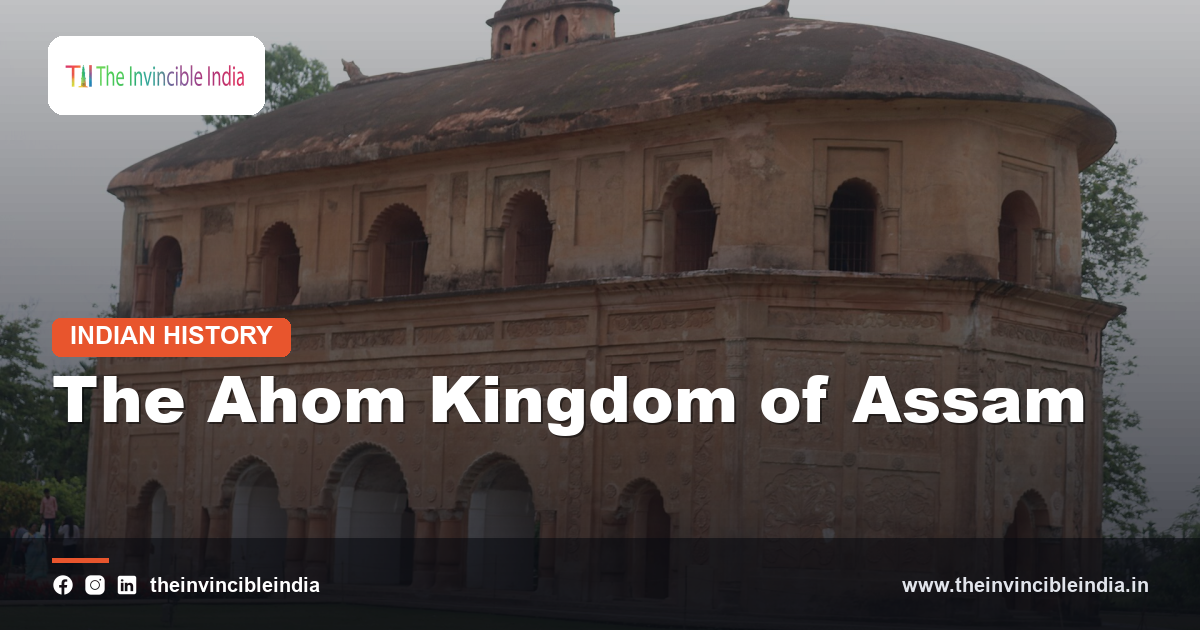
Ahom architecture is best known today through structures such as the Rang Ghar, an oval-shaped pavilion associated with royal entertainment and sporting events, and the Talatal Ghar, a multi-storeyed palace complex that reportedly included underground passages for security and storage. These structures were built using distinctive techniques suited to the region’s climate and materials, allowing some monuments to withstand centuries of monsoon weather.
Ahom builders also constructed numerous temples, tanks and bridges, many combining functional and ceremonial purposes within the same design, blending Southeast Asian building traditions with features common to eastern Indian temple architecture. Many of these monuments have been protected as heritage structures and remain among the most recognisable physical symbols of the kingdom’s legacy.
Art, Craft and Court Culture
Ahom court culture supported a range of artistic and craft traditions, including textile weaving, metalwork and manuscript illustration, many of which continue to influence Assamese art today. Royal patronage extended to music, dance and dramatic performance, with the court serving as a centre for cultural production that drew on both local Assamese traditions and elements introduced by the Tai-Ahom ruling family.
Traditional Assamese silk weaving, in particular, is closely associated with the patronage and social customs of this period and remains an important part of the region’s cultural identity. Festivals and ceremonial occasions at court provided opportunities for artists and performers to showcase their skills, and many of these art forms are still actively practised and celebrated across Assam today.
Trade, Agriculture and the Regional Economy
The economy of the Ahom kingdom rested primarily on wet-rice cultivation in the fertile floodplains of the Brahmaputra valley, supplemented by fishing, forest produce and craft production. The paik labour system played a central role in mobilising manpower for agricultural expansion, irrigation works and the construction of embankments that helped manage the region’s seasonal flooding.
Trade along the river system connected the kingdom with neighbouring hill regions and, at various points, with wider South and Southeast Asian networks, facilitating the exchange of textiles, salt and forest products. Artisan communities producing textiles and metalwork also contributed to a diversified local economy that allowed the kingdom to sustain a long-lived and comparatively well-organised state structure.
Administration and Governance
Ahom governance combined a hereditary monarchy with an elaborate structure of ministers, regional officials and local headmen responsible for administration, revenue collection and justice at different levels of the kingdom. Senior officials, often drawn from noble families, oversaw major departments of state, while local administrators managed village affairs in coordination with the paik system.
This layered structure allowed the kingdom to govern a large and ethnically diverse territory without relying solely on direct royal control, and councils of nobles played an important role during succession disputes or periods of external threat. This administrative framework proved resilient enough to survive numerous succession crises and invasions, and is often cited as an example of an effective, adaptable pre-modern administrative system.
Decline, Internal Strife and Colonial Annexation
The later history of the Ahom kingdom was marked by growing internal strife, including succession disputes, factional rivalries among nobles and a prolonged period of unrest associated with the Moamoria uprising, which severely weakened royal authority. These internal conflicts drained the kingdom’s resources and undermined the administrative and military structures that had sustained it for centuries.
External pressures compounded these difficulties, including invasions from neighbouring Burma that brought further disruption to the valley in the early nineteenth century. The resulting turmoil eventually drew the attention of the expanding British colonial administration, which intervened and ultimately brought Ahom rule to an end as Assam was incorporated into British India, closing one of the longest continuous royal lines in South Asian history.
The Ahom Kingdom Today
The legacy of the Ahom kingdom remains deeply woven into the identity of modern Assam, visible in its language, festivals, architecture and historical consciousness. Monuments clustered around Sivasagar attract visitors and researchers interested in the kingdom’s engineering, religious life and court culture, while the buranji chronicles continue to inform scholarly understanding of medieval Assamese history.
The paik system, satra institutions and traditions of craft and performance nurtured under Ahom patronage remain reference points for discussions of regional identity, and the kingdom’s long resistance to external conquest is frequently invoked as a source of regional pride. As interest in India’s diverse regional histories grows, the Ahom kingdom is increasingly recognised nationally as a distinctive chapter in the subcontinent’s past.
Sources & Further Reading
- Ministry of Culture, Government of India (indiaculture.gov.in).
- Archaeological Survey of India (asi.nic.in).
Frequently Asked Questions
Who founded the Ahom kingdom?
The Ahom kingdom was founded by Tai-speaking migrants who moved into the Brahmaputra valley from the hill regions bordering present-day Myanmar, led by a chieftain remembered as the founder of the ruling line.
How long did the Ahom kingdom rule Assam?
The Ahom kingdom governed large parts of the Brahmaputra valley for roughly six centuries, from the medieval period until it was absorbed into British India in the early nineteenth century.
Why is the Ahom kingdom significant in Indian history?
The kingdom is best known for successfully resisting repeated invasions by the Mughal Empire, making it one of the few regional powers to withstand sustained Mughal expansion for so long.
What is the paik system?
The paik system was an Ahom administrative arrangement in which subjects provided periodic labour or military service to the state instead of paying conventional taxes, supporting construction, agriculture and defence.
What are the most famous Ahom monuments?
The Rang Ghar amphitheatre and the Talatal Ghar palace complex near Sivasagar are among the most celebrated surviving examples of Ahom architecture and royal life.


