

Alluri Sitarama Raju occupies a distinctive place among India’s freedom fighters, remembered as the young leader who gave voice and direction to the grievances of the tribal communities of the Eastern Ghats. Operating in the forested hill tracts of the Godavari Agency in present-day Andhra Pradesh, he organised local tribespeople into a determined resistance against colonial forest regulations that had stripped them of traditional rights over the land they had long depended upon. His campaign, conducted through guerrilla methods suited to the dense terrain he knew intimately, earned him the affectionate title “Manyam Veerudu”, the hero of the jungle. This guide traces his early life, the course of the Rampa Rebellion, and the legacy he left behind.
Quick Facts
| Detail | Information |
|---|---|
| Known as | Manyam Veerudu (Hero of the Jungle) |
| Region | Godavari Agency hill tracts, Andhra region |
| Movement led | Rampa Rebellion against colonial forest policy |
| Community mobilised | Tribal communities of the Eastern Ghats |
| Method | Organised guerrilla resistance in forest terrain |
| Legacy | Revered symbol of tribal resistance to colonial rule |
A Hero of the Eastern Ghats
Alluri Sitarama Raju is remembered as one of the most distinctive figures of India’s freedom struggle, a young man who chose to make common cause with the tribal peoples of the Eastern Ghats rather than pursue the more conventional paths of nationalist politics followed elsewhere in the country. His decision to live among and lead the tribal communities of the Godavari hill tracts set him apart from many of his contemporaries and reflected a deep personal conviction that colonial injustice had to be resisted wherever it was felt most acutely. The affection in which he continues to be held across the Andhra region rests on this close identification with a community whose struggles were often overlooked elsewhere. As a hero of the Eastern Ghats, Alluri Sitarama Raju’s legacy is inseparable from the people he chose to serve.
Early Life and Formative Years
Alluri Sitarama Raju was born into a Telugu family with roots in the coastal Andhra region, and from an early age he displayed a restless, searching temperament that drew him toward the forested interior of the Godavari hill tracts. He is remembered as having spent time as a wandering ascetic in his youth, travelling through forests and hill villages and developing an intimate familiarity with the terrain and the tribal communities who inhabited it. This period of wandering brought him face to face with the everyday hardships of tribal life under colonial administration, including restrictions imposed on traditional forest use. These formative years shaped the deep sympathy for tribal grievances that would later define his revolutionary career.
The Grievances of the Hill Tracts
The tribal communities of the Godavari Agency depended heavily on the forest for their livelihood, practising shifting cultivation and gathering forest produce according to customs followed for generations. Colonial forest regulations introduced restrictions on these traditional practices, requiring permits for activities that tribal families had long carried out freely and imposing forms of forced labour on local communities for public works. These measures caused deep and widespread resentment among the hill people, who found their customary way of life increasingly constrained by rules imposed without their consent. It was this accumulated grievance over forest policy that provided the immediate context for the resistance that Alluri Sitarama Raju would come to lead.
Emergence as a Tribal Leader
Sensing the depth of tribal discontent with colonial forest administration, Alluri Sitarama Raju began to position himself as a spokesman and organiser for the hill communities, gaining their trust through his familiarity with local customs and his evident sympathy for their concerns. He drew on elements of local religious and cultural belief to strengthen his standing among the tribespeople, presenting the coming struggle as a righteous defence of their traditional way of life. This gradual emergence as a trusted tribal leader gave him the standing needed to mobilise a scattered and largely non-political population into an organised movement. His leadership marked a turning point in transforming local grievance into collective resistance.
The Outbreak of the Rampa Rebellion
The resistance movement that Alluri Sitarama Raju led came to be known as the Rampa Rebellion, named for the Rampa hill region where it began in the early 1920s. The uprising took the form of coordinated raids on police outposts and colonial administrative points, actions intended to seize weapons and to demonstrate to the tribal population that organised resistance to colonial authority was possible. These early actions were carried out with careful planning, drawing on Raju’s knowledge of the forest terrain to achieve surprise against better-armed colonial forces. The outbreak of the rebellion marked the beginning of a sustained campaign that would draw the determined attention of the colonial government.
Guerrilla Strategy in the Forest
Central to the effectiveness of the Rampa Rebellion was the guerrilla strategy that Alluri Sitarama Raju employed, one built on intimate knowledge of the dense forest and hill terrain of the Godavari Agency. Rather than confronting colonial forces in open engagement, his fighters relied on mobility, local knowledge and the element of surprise, striking at vulnerable points before withdrawing into terrain that was extremely difficult for outside forces to navigate. This approach allowed a relatively small and poorly equipped band of tribal fighters to sustain resistance against a much better-armed colonial administration for a considerable period. The guerrilla strategy pursued in the forest remains one of the most notable features of Raju’s campaign.
The Colonial Response
The colonial administration responded to the Rampa Rebellion with growing alarm, deploying additional police and military forces to the Godavari Agency in an effort to suppress the uprising and restore its authority over the hill tracts. Special forces experienced in frontier and jungle warfare were brought in to track down Raju and his followers, reflecting the seriousness with which the colonial government viewed the challenge to its authority in the region. The difficulty of operating in unfamiliar forest terrain against a mobile and locally supported adversary posed considerable challenges for these forces. This determined colonial response set the stage for a prolonged and difficult campaign against the rebellion.
Support Among the Tribal Population
A crucial element in the endurance of the Rampa Rebellion was the support that Alluri Sitarama Raju enjoyed among the tribal population of the Godavari hill tracts, who supplied food, shelter and intelligence to the rebel fighters even as colonial pressure intensified. This popular support reflected the genuine grievances that had given rise to the uprising and the trust that Raju had built through his years living among the hill communities. Without this sustained local backing, the guerrilla campaign could not have continued as long as it did against a determined colonial effort at suppression. The depth of tribal support for Raju underscores the genuinely popular character of the rebellion he led.
Symbolic and Religious Dimensions
Alluri Sitarama Raju’s leadership carried a symbolic and religious dimension that resonated strongly with the tribal communities of the region, who came to regard him with a reverence that went beyond ordinary political loyalty. He was seen by many followers as possessing an almost prophetic authority, a perception that strengthened the cohesion of the movement and inspired remarkable loyalty even in the face of great danger. This blending of political resistance with local belief and symbolism was characteristic of several tribal uprisings of the period and gave the Rampa Rebellion a distinctive character of its own. These symbolic and religious dimensions of Raju’s leadership deepened the movement’s hold on the popular imagination.
A Prolonged and Difficult Campaign
The Rampa Rebellion continued for an extended period, with Alluri Sitarama Raju and his followers evading capture through repeated movement across the difficult hill terrain of the Godavari Agency. Colonial forces conducted extensive search operations, gradually tightening the net around the rebel leader while suffering the frustrations common to counter-insurgency campaigns in unfamiliar and hostile terrain. The prolonged nature of the campaign reflected both the resilience of Raju’s forces and the genuine difficulty the colonial administration faced in suppressing a locally rooted insurgency. This extended struggle further enhanced Raju’s stature as a symbol of determined resistance to colonial authority.
Capture and Final Days
Alluri Sitarama Raju’s campaign eventually came to an end when he was captured by colonial forces in the mid-1920s, following a sustained pursuit through the forests of the Godavari Agency. His capture marked the effective conclusion of the Rampa Rebellion, though the memory of his resistance continued to resonate among the tribal population long after the uprising itself had ended. Accounts of his final days emphasise the composure with which he faced his fate, a demeanour consistent with the conviction he had shown throughout his campaign. His capture and the events that followed brought a difficult chapter of tribal resistance to its close.
Death and Martyrdom
Alluri Sitarama Raju’s death at the hands of colonial authorities transformed him from a regional insurgent leader into a lasting martyr of India’s freedom struggle, particularly revered across the Andhra region and among tribal communities of the Eastern Ghats. News of his death spread through the hill tracts and beyond, cementing his reputation as a leader who had given his life in defence of tribal rights and dignity against an unjust colonial order. His martyrdom added a solemn and enduring dimension to the story of the Rampa Rebellion, ensuring that his sacrifice would not be forgotten. This martyrdom remains central to how Alluri Sitarama Raju is remembered today.
Significance for Tribal Rights
The Rampa Rebellion led by Alluri Sitarama Raju holds particular significance in the wider history of tribal rights in India, illustrating how colonial forest and land policies provoked determined resistance from communities whose traditional livelihoods were placed under threat. His campaign drew national attention to the specific grievances of tribal populations, grievances that were often distinct from those animating the broader nationalist movement led from urban centres. This focus on tribal rights and forest access gives the Rampa Rebellion a distinctive place within the larger mosaic of resistance to colonial rule. The significance of Raju’s struggle for tribal rights continues to be recognised in historical accounts of the period.
Place in the Wider Freedom Struggle
Although the Rampa Rebellion unfolded largely apart from the mainstream nationalist movement of its time, Alluri Sitarama Raju’s campaign is widely recognised as an important thread within the broader tapestry of India’s struggle against colonial rule. His story demonstrates that resistance to British authority took many forms across the subcontinent, shaped by the particular circumstances and grievances of different regions and communities. Historians have increasingly emphasised the importance of such regional and tribal uprisings in understanding the full scope of resistance to colonial governance. Raju’s place in the wider freedom struggle reflects this broader recognition of diverse and locally rooted forms of resistance.
Memorials and Commemoration
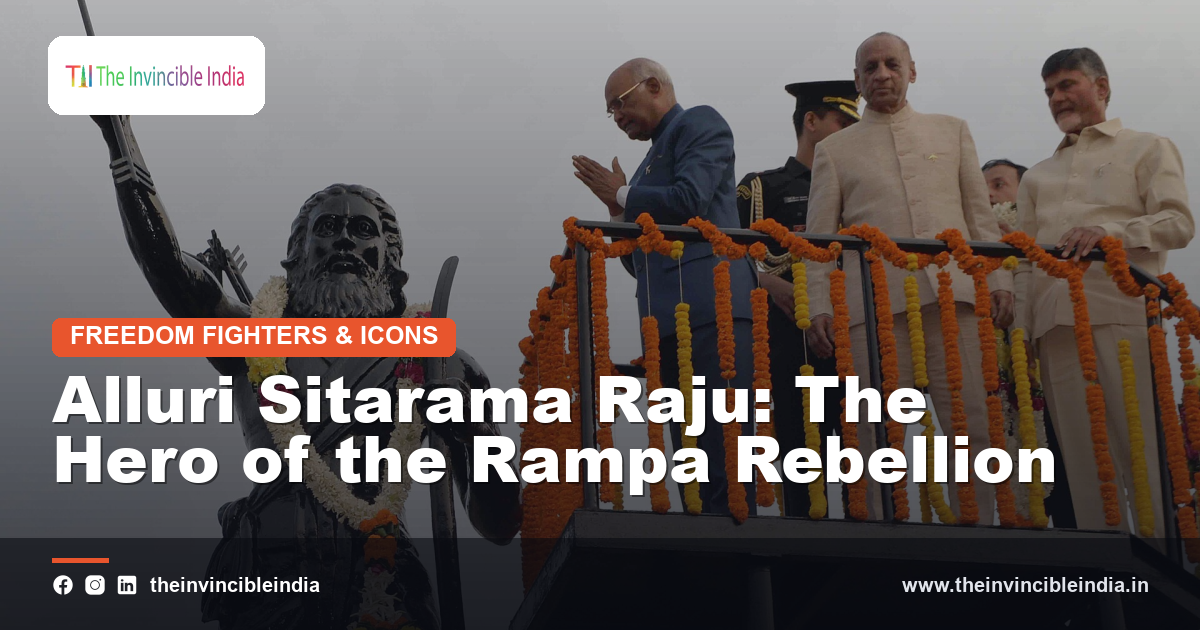
Across Andhra Pradesh, and particularly in the districts that were once part of the Godavari Agency, Alluri Sitarama Raju is honoured through statues, memorials and public commemorations that keep alive the memory of his leadership and sacrifice. Institutions, public spaces and commemorative events bear his name in tribute, reflecting the deep and continuing regard in which he is held across the region. These acts of remembrance ensure that the story of the Rampa Rebellion and its tribal context remains part of the region’s living historical memory. Such memorials and commemorations reflect the enduring place Alluri Sitarama Raju occupies in Andhra’s collective memory.
Cultural Memory and Popular Retelling
The story of Alluri Sitarama Raju has been retold across generations through popular narratives, regional literature and cinema, each retelling reinforcing his status as a folk hero of the Andhra region and a symbol of tribal courage. These popular retellings, while sometimes embellished, have played an important role in keeping his story alive for audiences far removed from the forested hill tracts where the Rampa Rebellion actually unfolded. His enduring appeal reflects the powerful combination of personal conviction, tribal solidarity and tragic sacrifice that defines his story. This continuing cultural memory ensures that Alluri Sitarama Raju remains a familiar and cherished figure in Indian popular imagination.
Alluri Sitarama Raju Today
Today Alluri Sitarama Raju is remembered as one of the most distinctive and revered figures of India’s freedom struggle, honoured for his leadership of the Rampa Rebellion and his lifelong identification with the tribal communities of the Godavari hill tracts. His story continues to be taught, commemorated and retold across the Andhra region, ensuring that the specific struggles of tribal India during the colonial period remain part of the national historical memory. He is remembered particularly as a bridge between mainstream nationalist history and the distinct grievances of tribal communities. As a symbol of tribal resistance and sacrifice, Alluri Sitarama Raju endures as a cherished hero of India’s freedom movement.
Sources & Further Reading
- Ministry of Culture, Government of India, on regional freedom movements (indiaculture.gov.in).
- National Archives of India, records relating to the freedom struggle (nationalarchives.gov.in).
Frequently Asked Questions
Who was Alluri Sitarama Raju?
Alluri Sitarama Raju was a young leader who organised the tribal communities of the Godavari Agency hill tracts into the Rampa Rebellion, an armed uprising against unjust colonial forest policy, earning him the title Manyam Veerudu, hero of the jungle.
What was the Rampa Rebellion?
The Rampa Rebellion was a tribal uprising in the Godavari hill tracts of the Andhra region in the early 1920s, led by Alluri Sitarama Raju against colonial forest regulations that restricted traditional tribal livelihoods.
Why did the tribal communities support Raju?
Tribal communities supported Raju because he shared their grievances against restrictive colonial forest laws and forced labour demands, and because he had built deep trust with them through years spent living among the hill population.
How is Alluri Sitarama Raju remembered today?
Alluri Sitarama Raju is remembered through statues, memorials and cultural retellings across Andhra Pradesh, honoured as a folk hero and a symbol of tribal resistance to colonial injustice.
What makes the Rampa Rebellion significant?
The Rampa Rebellion is significant for highlighting the distinct grievances of tribal communities under colonial rule, particularly around forest access and traditional livelihoods, within the broader history of India’s freedom struggle.


