

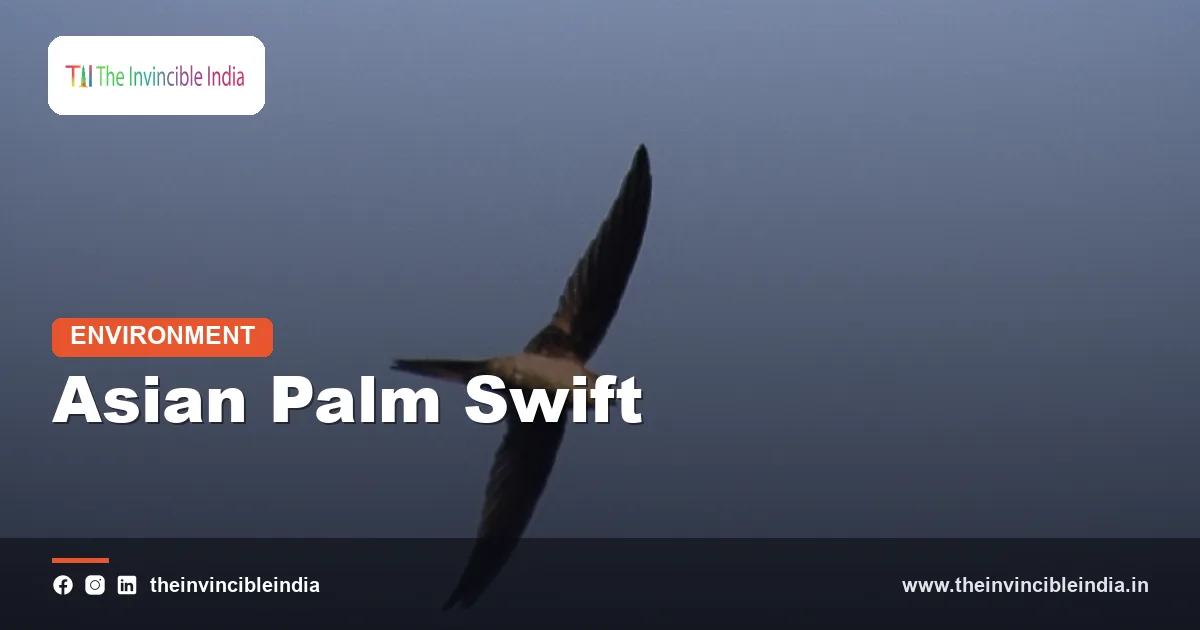
The Asian palm swift is a slender, pale grey-brown swift with a long, deeply forked tail that glues its tiny nest to the underside of hanging palm fronds and hunts flying insects in the air above palm groves, fields and towns across much of India. It is one of the most graceful of India’s swifts, easy to recognise by its thin build and needle-like tail.
The Asian palm swift (Cypsiurus balasiensis) is closely tied to palms such as coconut, palmyra and other fan palms, which give it both a nest site and a roost. Where palms are common, the bird is common too, which makes it a familiar sight along the coast, in plains villages and in southern and eastern India.
Quick Facts
| Attribute | Detail |
|---|---|
| Common name | Asian palm swift; also called the palm swift in India |
| Scientific name | Cypsiurus balasiensis |
| Family | Apodidae (swifts), order Apodiformes |
| Size | About 13 cm long, a slim bird with very long, narrow wings |
| Key features | Pale greyish-brown plumage, slender body, long tail that is deeply forked but usually held closed like a spike |
| Range and habitat | Lowland and foothill India, Sri Lanka and South-East Asia; found around palms, open country and villages |
| Diet | Small flying insects caught in the air |
| Breeding | Nest of feathers and plant down glued with saliva to the underside of a palm frond; eggs are also glued; usually two eggs |
| Conservation status | Least Concern on the IUCN Red List |
Key Takeaways
- The Asian palm swift, Cypsiurus balasiensis, is a slender swift of the family Apodidae that depends heavily on palm trees for nesting and roosting.
- The Asian palm swift glues a very small nest of feathers and plant down to the underside of a hanging palm frond using its own saliva.
- The eggs of the Asian palm swift are also glued to the nest, and the adult clings upright to the frond to incubate them.
- The long, deeply forked tail of the Asian palm swift is usually held closed so that it looks like a single thin spike.
- The Asian palm swift feeds entirely on flying insects, which it catches in the air and never from the ground.
- The IUCN classifies the Asian palm swift as Least Concern, though felling of old palms and heavy pesticide use can affect local colonies.
What is the Asian palm swift?
The Asian palm swift is a small aerial insect-eater of the swift family that lives in tropical and subtropical Asia, including most of lowland India. It is built for speed and endurance, with a streamlined body, scythe-like wings and tiny feet that are used only for clinging, never for walking or hopping.
It belongs to the genus Cypsiurus, which has only a few species. Its nearest relative is the African palm swift, which has a similar life tied to palms. The Asian species is generally regarded as resident through most of its range, though small local movements follow rain and insect supply.
The species name balasiensis is widely understood to refer to Balasore in Odisha, one of the places from which the bird was described in the early nineteenth century. Whatever its exact origin, the name reflects how long the bird has been known in India.
How can you identify an Asian palm swift?
The Asian palm swift can be identified by its slim shape, uniformly pale greyish-brown colour and a very long, thin tail that looks like a single spike when closed. It lacks the white rump seen on house swifts and little swifts, and it looks slighter and lighter than those birds.
What are the key field marks?
- Plain, pale grey-brown upper parts, a little darker on the back and wings.
- Slightly paler throat and underparts, with no obvious markings.
- Long, narrow, curved wings that give the bird a stretched, elegant look.
- A deeply forked tail, which appears as a needle when closed and opens into a V during turns.
- Flight that mixes quick wingbeats with long, buoyant glides.
Can the palm swift be confused with other birds?
The Asian palm swift is occasionally confused with other swifts and with swallows, so the following table summarises the differences.
| Bird | Colour and rump | Tail | Where usually seen |
|---|---|---|---|
| Asian palm swift | Pale grey-brown; no white rump | Very long and deeply forked | Around palms, open country, villages |
| House swift | Sooty black with white rump patch | Short, square or slightly notched | Buildings, cliffs, bridges |
| Little swift | Dark with a broad white rump | Short and square | Towns, old buildings |
| Barn swallow | Glossy blue above, pale below | Forked with long streamers | Wires, fields, wetlands |
| Wire-tailed swallow | Glossy blue above, white below, chestnut cap | Very fine wire-like streamers | Rivers and bridges |
Where does the Asian palm swift live in India?
The Asian palm swift lives mainly in the plains, coastal belts and low foothills of peninsular and eastern India, wherever palms grow in reasonable numbers. It also occurs in Sri Lanka and eastward through South-East Asia as far as Indonesia and the Philippines, which makes it widespread across tropical Asia.
Palmyra palms (Borassus flabellifer) in drier parts of the peninsula and coconut groves along the coasts are especially favoured. The bird is also found over paddy fields, scrub, village tanks, plantations and the edges of towns, as long as there are tall palms nearby for nesting.
It is less common in dense, humid forest interiors and at higher altitudes, where the cover of palms thins. Even so, in the foothills and along river valleys it can reach surprisingly high ground wherever suitable trees and open air coexist.
Because palm trees are often left standing in cultivated areas, the Asian palm swift has done well alongside people. It is an example of a wild bird whose fortunes are linked to a traditional farm tree rather than a forest.
What does the Asian palm swift eat?
The Asian palm swift eats small flying insects such as flies, midges, termites, flying ants, small beetles and bugs, all caught on the wing. It never takes food from the ground or from plants, and it drinks by skimming low over water.
The bird hunts in the open sky over fields and tanks, often in loose, noisy groups. It flies in sweeping loops, closing its wings in a quick dive when it spots a cloud of prey and then rising again. Foraging height depends on weather. In warm conditions insects rise on thermals and the birds hunt high, while on cool or damp days they hunt low over water and crops.
During the monsoon, the sudden emergence of winged termites after rain draws swifts, swallows and bee-eaters together. The palm swift joins these feeding frenzies and can gorge on a brief but large supply of food.
Parents carry insects back to the nest in a ball bound with saliva. The chicks take this bolus from the parent’s throat, and the parents can store a surprising number of insects in one trip.
How does the Asian palm swift build its nest?
The Asian palm swift builds a very small, shallow pad-like nest of feathers, down and plant fibres, glued with saliva to the underside of a palm frond. The nest is so small that it is hardly more than a platform or half-cup, just big enough to hold the eggs and keep them from falling.
The bird collects its materials while flying, plucking feathers and plant fluff from the air. It sticks each piece to the frond with sticky saliva, which hardens as it dries. The nest is placed on a drooping or hanging frond, often one that is slightly angled so that the surface is sheltered from rain and wind.
Palm fronds suit this design because their pleated, folded leaves give a firm surface at a protected angle. Old coconut and palmyra fronds that stay on the tree for a long time are often chosen.
After laying, the parents do not sit on the eggs the way most birds do. They cling to the frond upright and press the eggs against the nest surface, holding on with sharp claws. This unusual posture is one of the best-known traits of palm swifts.
How do the eggs and chicks of the Asian palm swift survive in a swaying frond?
The eggs of the Asian palm swift survive in a swaying frond because the female glues them to the nest with saliva, and the chicks later grip the nest and frond with strong claws. This is a clever adaptation to life on a branch that can whip about in high winds.
The clutch usually consists of two small whitish eggs. Both parents take turns incubating, pressing against the eggs while clinging vertically to the frond. When the chicks hatch, they have strong feet and cling firmly, even when the frond shakes in a storm.
Young palm swifts stay in the nest until they can fly strongly. Because they are fed insects that arrive at irregular times, they can slow their metabolism during bad weather, a trick shared by other swifts.
- Nest: tiny pad of feathers and down on the underside of a palm frond.
- Eggs: usually two, glued to the nest with saliva.
- Incubation: both parents, clinging upright to the frond.
- Chicks: cling firmly with their claws and are fed saliva-bound insect balls.
- Timing: varies with region, often in the drier months and around the early rains.
Why are palm trees important to the Asian palm swift?
Palm trees are important to the Asian palm swift because they provide both nest sites and roosts in the form of tall, exposed fronds. Few other trees offer such safe, leaf-covered perches high above the ground and away from most climbing predators.
Roosting groups often gather in the evening around a palm grove, wheeling and calling before settling to cling to the underside of fronds. Because roosting is communal, a few palms can support large numbers of birds, and the loss of a single old tree can be significant locally.
What happens when palms are cut down?
When palms are felled, the Asian palm swift loses nest sites and roosts, and local colonies may disperse. In regions where palmyra palms are being cleared for development, or old coconut groves are replaced, the bird becomes less common. Where palm groves remain standing, the swifts continue to use them for generations.
What does the Asian palm swift sound like, and how does it fly?
The Asian palm swift gives high, shrill, rapidly repeated notes, often described as a chittering or screaming sound, and it flies with quick, shallow wingbeats broken by long, graceful glides. The sound is usually heard in flight, especially when small groups circle over palms at dawn and dusk.
Observers note that the palm swift looks lighter and more buoyant in the air than heavier swifts. Its long tail acts as a rudder in tight turns, opening and closing in short flicks. The thin build and high wing-loading allow rapid changes in direction, which helps it catch erratic insects.
The bird often hunts along with other aerial feeders, so a patient observer at a tank bund or paddy edge may see palm swifts, swallows and martins sharing the same airspace and chasing the same insects at different heights.
How can you watch the Asian palm swift?
You can watch the Asian palm swift by visiting a palm grove, coconut plantation or tank edge in the early morning or just before sunset and looking up at the sky around the fronds. A wide scan without binoculars finds the birds first, and binoculars then help to confirm the long tail and pale colour.
- Look for hanging fronds that carry a small whitish pad on their underside, which may be a nest.
- Notice the birds returning to the same palm at dusk; this often marks a roost.
- Stay well back from nests and do not shake or cut fronds during the breeding months.
- Photograph the flying birds against a bright sky to show the tail shape.
Sharing sightings on a citizen-science platform helps scientists understand how aerial insectivores respond to changes in farmland, weather and palm cover.
Is the Asian palm swift in danger?
No, the Asian palm swift is not considered globally threatened and is classed as Least Concern, because it has a very wide range and a large population. Its main local risks are loss of old palms, heavy use of insecticides and disturbance of nests during trimming of fronds.
Because palms are often cut or trimmed for roofing, toddy tapping or tidying, nests can be destroyed accidentally. Delaying frond cutting until chicks have fledged is a simple step that protects colonies. Lowering insecticide use around groves also helps, because a swift’s diet depends entirely on the abundance of flying insects.
In India, most native wild birds are covered by the Wildlife (Protection) Act, 1972, which discourages the deliberate harm of birds and their nests.
Bottom Line
The Asian palm swift is a slim, pale swift that lives its life around palm trees, gluing its tiny nest and even its eggs to a hanging frond. It is common, widespread and harmless, and keeping old palms standing and trimming fronds outside the breeding season is the easiest way to look after it.
Frequently Asked Questions
What is the Asian palm swift?
The Asian palm swift is a slender, pale grey-brown swift (Cypsiurus balasiensis) with a long, deeply forked tail. It catches flying insects in the air and nests on the underside of palm fronds. It is widespread in lowland India, Sri Lanka and South-East Asia.
How does the Asian palm swift build its nest?
The Asian palm swift builds a tiny pad of feathers and plant down glued with saliva to the underside of a hanging palm frond. The eggs are also glued to the nest. The adults cling upright to the frond to incubate the eggs and later to feed the chicks.
What does the Asian palm swift eat?
The Asian palm swift eats small flying insects, including flies, midges, termites and flying ants. It catches them in the air while gliding and diving, and it never feeds from the ground. Parents bring food to their chicks in saliva-bound balls.
How is the palm swift different from the house swift?
The Asian palm swift is paler, slimmer and has a long, deeply forked tail, while the house swift is darker with a white rump and a short, nearly square tail. The palm swift nests on palm fronds, whereas the house swift nests on buildings, bridges and cliffs.
Where can I see the Asian palm swift in India?
The Asian palm swift can be seen around palm groves, coconut plantations, palmyra stands, village tanks and open fields in lowland and coastal India. Early morning and the hour before sunset are the best times, when the birds feed and gather to roost.
Is the Asian palm swift endangered?
No, the Asian palm swift is not endangered and is listed as Least Concern by the IUCN. Its range is large and its numbers are healthy overall. Local declines can occur when old palms are felled or when fronds are cut during the nesting season.
{“@context”:”https://schema.org”,”@graph”:[{“@type”:”FAQPage”,”mainEntity”:[{“@type”:”Question”,”name”:”What is the Asian palm swift?”,”acceptedAnswer”:{“@type”:”Answer”,”text”:”The Asian palm swift is a slender, pale grey-brown swift (Cypsiurus balasiensis) with a long, deeply forked tail. It catches flying insects in the air and nests on the underside of palm fronds. It is widespread in lowland India, Sri Lanka and South-East Asia.”}},{“@type”:”Question”,”name”:”How does the Asian palm swift build its nest?”,”acceptedAnswer”:{“@type”:”Answer”,”text”:”The Asian palm swift builds a tiny pad of feathers and plant down glued with saliva to the underside of a hanging palm frond. The eggs are also glued to the nest. The adults cling upright to the frond to incubate the eggs and later to feed the chicks.”}},{“@type”:”Question”,”name”:”What does the Asian palm swift eat?”,”acceptedAnswer”:{“@type”:”Answer”,”text”:”The Asian palm swift eats small flying insects, including flies, midges, termites and flying ants. It catches them in the air while gliding and diving, and it never feeds from the ground. Parents bring food to their chicks in saliva-bound balls.”}},{“@type”:”Question”,”name”:”How is the palm swift different from the house swift?”,”acceptedAnswer”:{“@type”:”Answer”,”text”:”The Asian palm swift is paler, slimmer and has a long, deeply forked tail, while the house swift is darker with a white rump and a short, nearly square tail. The palm swift nests on palm fronds, whereas the house swift nests on buildings, bridges and cliffs.”}},{“@type”:”Question”,”name”:”Where can I see the Asian palm swift in India?”,”acceptedAnswer”:{“@type”:”Answer”,”text”:”The Asian palm swift can be seen around palm groves, coconut plantations, palmyra stands, village tanks and open fields in lowland and coastal India. Early morning and the hour before sunset are the best times, when the birds feed and gather to roost.”}},{“@type”:”Question”,”name”:”Is the Asian palm swift endangered?”,”acceptedAnswer”:{“@type”:”Answer”,”text”:”No, the Asian palm swift is not endangered and is listed as Least Concern by the IUCN. Its range is large and its numbers are healthy overall. Local declines can occur when old palms are felled or when fronds are cut during the nesting season.”}}]}]}


